
 by
by
Symmetry in physics means that a physical law remains unchanged when you apply a specified transformation. Move the experiment, rotate it, repeat it tomorrow, or change an internal phase: if the governing equation keeps the same form, the system has that symmetry.
That definition is more useful than visual balance. It explains why energy, momentum, and angular momentum are conserved. It also tells physicists which theories are possible, which processes are forbidden, and where new physics may be hiding.

What Does Symmetry Mean in Physics?
A symmetry has two parts: a transformation and something that stays invariant. The transformation might shift every position by the same distance, rotate the apparatus, or change a quantum field’s phase. The invariant may be an equation, the action, or an observable prediction.
Suppose you perform a mechanics experiment in Delhi, then repeat the same experiment in New York under equivalent conditions. The coordinates have changed, but Newton’s equations have not. That is spatial-translation symmetry. It expresses a physical claim: empty space has no preferred location.
The same reasoning applies to orientation. A sealed laboratory rotated through an angle should not discover a special direction in otherwise empty space. The components of vectors may change when you rotate the coordinate axes, but the physical prediction does not. This distinction matters. Symmetry is not the claim that every object looks identical after rotation. It is the claim that the relevant law or state is invariant under the transformation being tested.
What Are the Main Types of Symmetry in Physics?
Physicists classify symmetries by what is transformed and by whether the transformation varies continuously. These categories overlap, so the cleanest way to understand them is by example.
| Type | What changes | Example | Why it matters |
|---|---|---|---|
| Spacetime symmetry | Position, orientation, time, or inertial frame | Translation, rotation, Lorentz transformation | Constrains mechanics, relativity, and field theory |
| Internal symmetry | A field or particle label, not its spacetime position | Quantum phase or quark color | Organizes particles, charges, and interactions |
| Continuous symmetry | A parameter changes by any small amount | Rotation through any angle | Falls under Noether’s theorem |
| Discrete symmetry | A separate, non-continuous operation | Parity P, charge conjugation C, time reversal T | Creates selection rules and sharp experimental tests |
| Gauge symmetry | A local description can change point by point | \(U(1)\), \(SU(2)\), \(SU(3)\) | Determines the structure of modern field theories |
Continuous and discrete symmetry should not be mixed together. A rotation through an arbitrarily small angle is continuous. A mirror reflection is discrete: you cannot reach it through a sequence of infinitesimal reflections. Noether’s first theorem directly connects continuous symmetries to conserved currents. Discrete symmetries can still be physically powerful, but they do not generate a Noether charge in the same way.
How Does Noether’s Theorem Connect Symmetry and Conservation Laws?
Noether’s theorem says that every continuous differentiable symmetry of the action has a corresponding conserved quantity or current. Emmy Noether published the result in 1918. It turned conservation laws from separate facts to consequences of deeper invariances.
The theorem needs its conditions. The system must have an action or equivalent variational formulation, and the transformation must be a continuous symmetry of that action, possibly up to a boundary term. Saying “every symmetry creates a conservation law” without those qualifications is too loose.
| Continuous symmetry | Physical meaning | Conserved quantity |
|---|---|---|
| Time translation | The laws do not depend on when the experiment is performed | Energy |
| Spatial translation | The laws do not depend on where the experiment is performed | Linear momentum |
| Spatial rotation | The laws do not select an absolute direction | Angular momentum |
| Global \(U(1)\) phase transformation | A common phase change leaves the physics invariant | Electric charge |
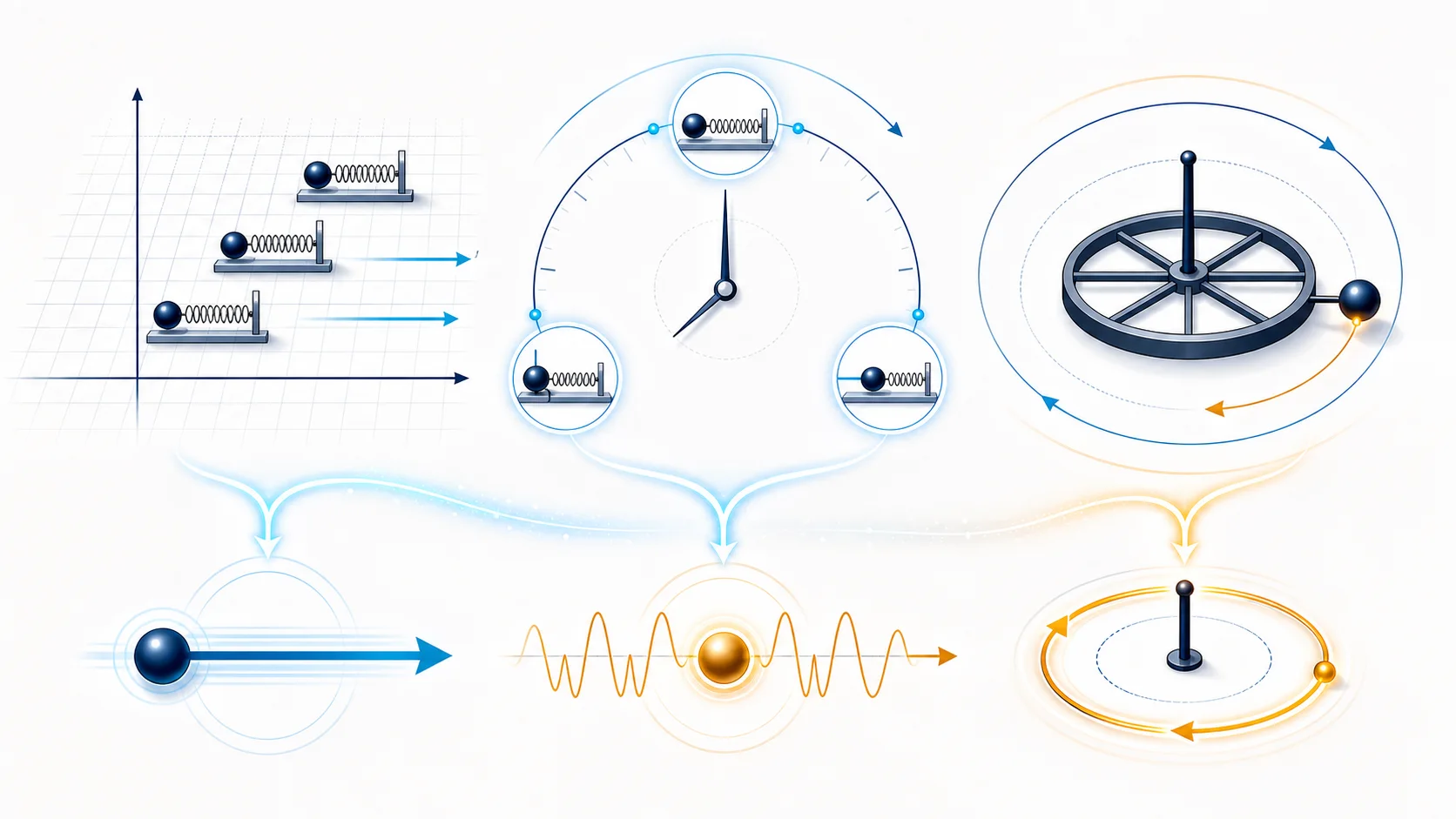
Here is the practical payoff. If your Lagrangian does not depend explicitly on position, momentum is conserved. If it does not depend explicitly on time, energy is conserved. If it is unchanged by rotations, angular momentum is conserved. The theorem lets you identify constants of motion before solving the full equations.
The Mathematics of Noether’s Theorem
For generalized coordinates \(q_i(t)\), write the action as
$$S[q]=\int_{t_1}^{t_2}L(q_i,\dot q_i,t)\,dt.$$
Consider an infinitesimal continuous transformation
$$q_i\rightarrow q_i+\varepsilon X_i(q,t),$$
where \(\varepsilon\) is small. If this changes the Lagrangian only by a total derivative,
$$\delta L=\varepsilon\frac{dF}{dt},$$
then, along solutions of the Euler-Lagrange equations, the quantity
$$Q=\sum_i\frac{\partial L}{\partial\dot q_i}X_i-F$$
is conserved, so \(dQ/dt=0\). For a spatial translation, \(X_i\) points along the translation and \(Q\) becomes linear momentum. A more general version also transforms time. Time-translation invariance then produces the Hamiltonian \(H\), which is the conserved energy when the usual conditions hold.
A Simple Time-Translation Example
Take a particle moving in a time-independent potential:
$$L=\frac{1}{2}m\dot x^2-V(x).$$
There is no explicit \(t\) in this Lagrangian. Shifting the clock from \(t\) to \(t+\varepsilon\) does not change the law, so the corresponding conserved quantity is
$$E=\dot x\frac{\partial L}{\partial\dot x}-L=\frac{1}{2}m\dot x^2+V(x).$$
This is ordinary mechanical energy. The result is familiar, but Noether’s theorem explains why it is conserved: the law has no preferred moment in time.
What Is Gauge Symmetry?
Gauge symmetry is a local freedom in how we describe a physical field. Two mathematical configurations related by a gauge transformation can represent the same physical state. Calling it an ordinary symmetry can be misleading because the local transformation changes the description, not the underlying observable situation.
Electromagnetism provides the simplest example. Multiplying a charged quantum field by a phase that varies from point to point requires introducing a gauge field so that the theory remains consistent. That gauge field is the electromagnetic potential, and its quantum excitation is the photon.
The Standard Model is organized around the gauge group
$$SU(3)_C\times SU(2)_L\times U(1)_Y.$$
- \(SU(3)_C\) describes the strong interaction and quark color.
- \(SU(2)_L\times U(1)_Y\) describes the electroweak theory before symmetry breaking.
- The gauge structure fixes the interaction pattern and the gauge bosons that carry those interactions.
This is why symmetry is not cosmetic language in particle physics. It is part of the construction manual. If you want the broader particle-and-force context, start with my guide to the four fundamental forces.
What Is Spontaneous Symmetry Breaking?
Spontaneous symmetry breaking happens when the laws are symmetric but the system settles into a state that is not. The standard analogy is a pencil balanced on its tip. The setup is rotationally symmetric, but once the pencil falls, it selects one direction.
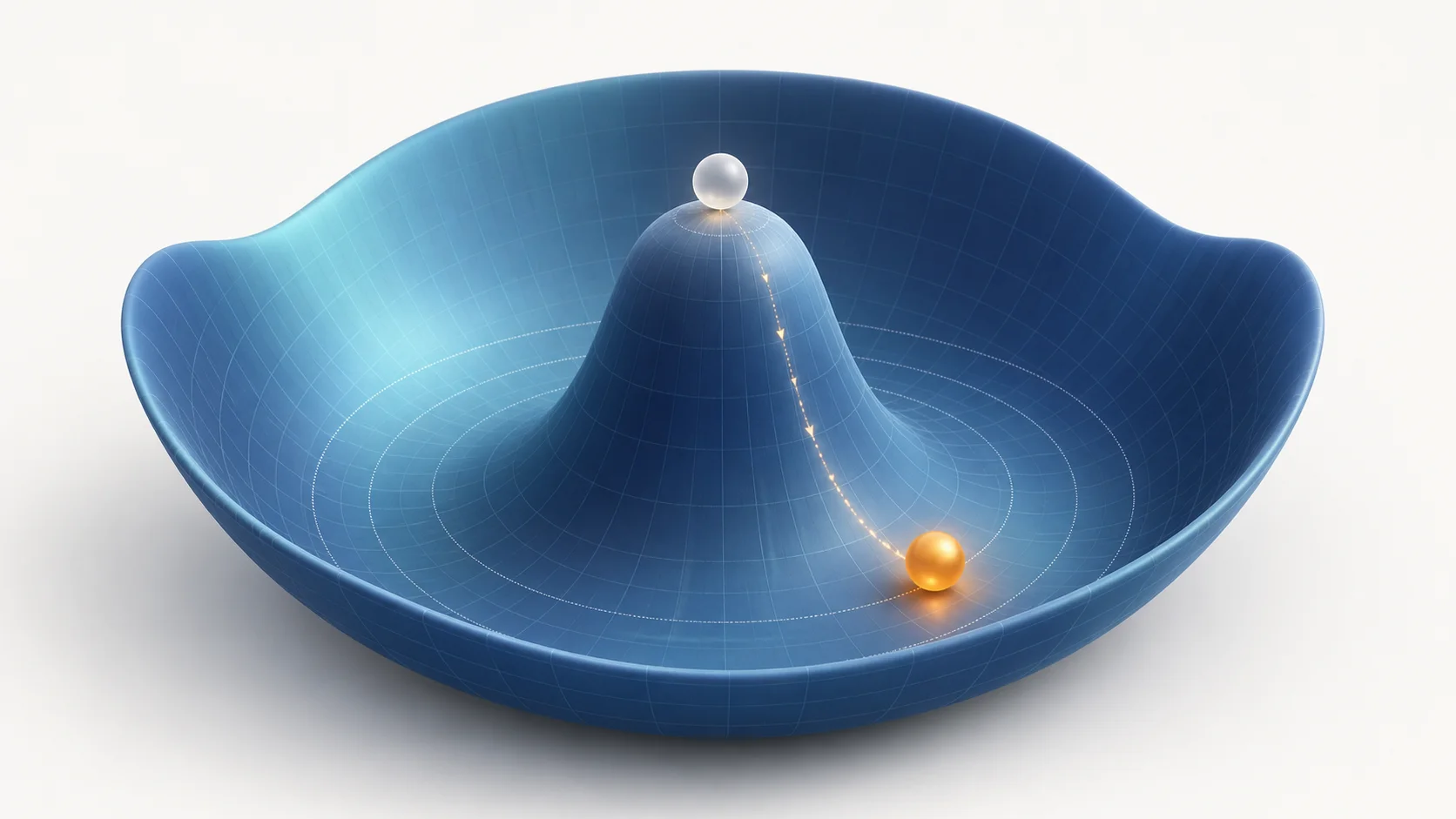
A ferromagnet makes the idea physical. Above the Curie temperature, microscopic magnetic moments point in many directions and the average magnetization is zero. Below the transition, the material can choose a common direction. The equations do not prefer that direction, but the ordered state does. The same statistical logic appears throughout statistical mechanics and ensemble theory.
In the Standard Model, the Higgs field has a nonzero vacuum value. Electroweak symmetry breaks from \(SU(2)_L\times U(1)_Y\) to the electromagnetic \(U(1)_{\mathrm{em}}\). The W and Z bosons become massive while the photon remains massless.
The popular phrase “the Higgs gives everything mass” hides important details:
- W and Z masses arise through the Higgs mechanism.
- Quarks and charged leptons acquire masses through their Yukawa couplings to the Higgs field.
- Most of a proton’s mass comes from quantum chromodynamics, including gluon fields and the energy of confined quarks, not directly from the Higgs field.
Are All Physical Laws Symmetric?
No. Some proposed symmetries are violated, and those failures have taught us as much as the successful symmetries. You must always ask three questions: what is being transformed, which interaction is involved, and whether the symmetry belongs to the law or only to a particular state.
Charge, Parity, and Time Reversal
- Charge conjugation (C) exchanges particles with antiparticles.
- Parity (P) reflects spatial coordinates, producing a mirror-transformed system.
- Time reversal (T) reverses the direction of time in the equations, with momenta and angular momenta transformed appropriately.
The weak interaction violates P and C separately. It also violates the combined CP symmetry in certain particle decays. These discoveries ended the old assumption that nature must treat mirror-reflected processes and matter-antimatter exchanges identically.
CPT is different. The CPT theorem says that a local, Lorentz-invariant quantum field theory with the standard assumptions is invariant under the combined C, P, and T transformation. A confirmed CPT violation would therefore force a serious revision of those foundations.
Explicit vs. Spontaneous Breaking
When an equation contains a term that directly picks out a direction or value, the symmetry is explicitly broken. When the equation is symmetric but the lowest-energy state chooses one option among many equivalent possibilities, the symmetry is spontaneously broken. The distinction determines the observable consequences, including whether massless modes called Nambu-Goldstone bosons appear.
Why Is Symmetry Important in Physics?
Symmetry matters because it removes guesswork. Instead of testing every imaginable equation, physicists require a candidate law to respect the transformations already supported by experiment. That restriction can determine the allowed terms before a calculation begins.
- It identifies conserved quantities. Noether’s theorem turns spacetime and internal symmetries into constants of motion.
- It simplifies difficult problems. Rotational symmetry can reduce a three-dimensional force problem to one radial coordinate.
- It organizes quantum states. Symmetry groups classify particles, degeneracies, and selection rules.
- It guides theory building. Gauge symmetry determines the interaction structure of the Standard Model.
- Its failure reveals new physics. Parity violation, CP violation, and broken electroweak symmetry all opened new parts of physics.
Symmetry also connects topics that can otherwise feel unrelated. The mode-counting behind the Rayleigh-Jeans law, the state spaces used in quantum computing, and angular momentum in mechanics all become easier to reason about once you look for invariance first.
Primary Sources and Further Reading
If you want to push beyond this introduction, these are the sources I would read next:
- The Feynman Lectures on Physics, Volume I, Chapter 52, for the clearest physical tour of symmetry operations.
- John Baez’s explanation of Noether’s theorem, for the mathematical conditions behind the theorem.
- The U.S. Department of Energy’s symmetry overview, for continuous, discrete, and broken symmetry examples.
- CERN’s Higgs boson guide, for the experimental and theoretical context of electroweak symmetry breaking.
Key Takeaways
- Symmetry in physics means invariance under a specified transformation.
- Continuous symmetries of the action produce conserved quantities through Noether’s theorem.
- Time translation, spatial translation, and rotation correspond to conservation of energy, momentum, and angular momentum.
- Gauge symmetry is a local descriptive freedom that fixes the structure of field interactions.
- Discrete symmetries do not produce Noether charges in the same way, and P, C, and CP are not universally conserved.
- Spontaneous symmetry breaking leaves the laws symmetric while the physical state selects one of several equivalent possibilities.
Frequently Asked Questions
What is symmetry in physics?
Symmetry in physics means that a physical law, action, or state remains unchanged under a specified transformation. Examples include shifting an experiment through space, rotating it, moving it forward in time, or changing an internal quantum phase.
What does Noether’s theorem say?
Noether’s theorem says that each continuous differentiable symmetry of the action corresponds to a conserved quantity or current. Time-translation symmetry gives energy conservation, spatial translation gives momentum conservation, and rotational symmetry gives angular-momentum conservation.
What are the main types of symmetry in physics?
The most useful categories are spacetime symmetry, internal symmetry, continuous symmetry, discrete symmetry, and gauge symmetry. These categories overlap. For example, rotation is both a spacetime symmetry and a continuous symmetry.
Does every conservation law come from symmetry?
Noether’s first theorem provides the symmetry-conservation connection for continuous symmetries of systems with an action principle. The slogan is powerful but needs those mathematical conditions. Discrete symmetries do not create Noether charges in the same way.
Is parity always conserved?
No. The weak interaction violates parity, so a mirror-reflected weak process need not occur at the same rate as the original process. Charge conjugation is also violated by weak interactions, and some processes violate the combined CP symmetry.
What is spontaneous symmetry breaking?
Spontaneous symmetry breaking occurs when the governing laws are symmetric but the system settles into an asymmetric state. A ferromagnet choosing one magnetization direction and the Higgs field choosing a nonzero vacuum value are standard examples.
My recommendation is simple: when you meet a new physical law, ask what transformations leave it unchanged before you start manipulating the equation. That habit often exposes the conserved quantity and the easiest route through the problem.
Tell Google you want more of this.
Add Gaurav Tiwari as a preferred sourceOne tap, and this site shows up more often in your own Top Stories, AI Overviews and AI Mode. Remove it any time.
Browse more in Physics.