
 by
by
Poincare and Einstein both made decisive contributions to relativity, but they did not present the same theory in the same way. Henri Poincare developed much of the Lorentz group’s mathematical structure and stated a broad relativity principle. Albert Einstein rebuilt kinematics from two postulates and discarded the ether as unnecessary.
The honest historical answer is layered. Lorentz, Poincare, Einstein, and later Minkowski contributed different pieces. Saying “Einstein did everything” erases real precursors. Saying “Poincare already had Einstein’s theory” erases a major conceptual break.

What Did Poincare and Einstein Contribute?
Poincare had key transformation mathematics, group insight, clock-synchronization ideas, and a clear relativity principle before or alongside Einstein. Einstein’s 1905 paper gave a cleaner operational foundation for space and time, derived the transformations from that foundation, and removed the stationary ether from the theory’s explanatory structure.
The comparison between Poincare and Einstein becomes clearer when mathematical priority is separated from physical interpretation. Both matter, and they answer different historical questions.
| Question | Poincare | Einstein |
|---|---|---|
| Relativity principle | Formulated and named it broadly | Made it one of two starting postulates |
| Lorentz transformations | Recognized group structure and refined mathematical form | Derived them from physical postulates and clock definitions |
| Simultaneity | Analyzed synchronization and local time, often within an ether framework | Defined distant simultaneity operationally and treated it as frame-dependent |
| Ether | Retained or tolerated a Lorentzian ether in his interpretation | Declared it superfluous to electrodynamics |
| Dynamics | Developed invariant action ideas and relativistic electron dynamics | Focused the June 1905 paper on kinematics and electrodynamics |
The Problem Before 1905
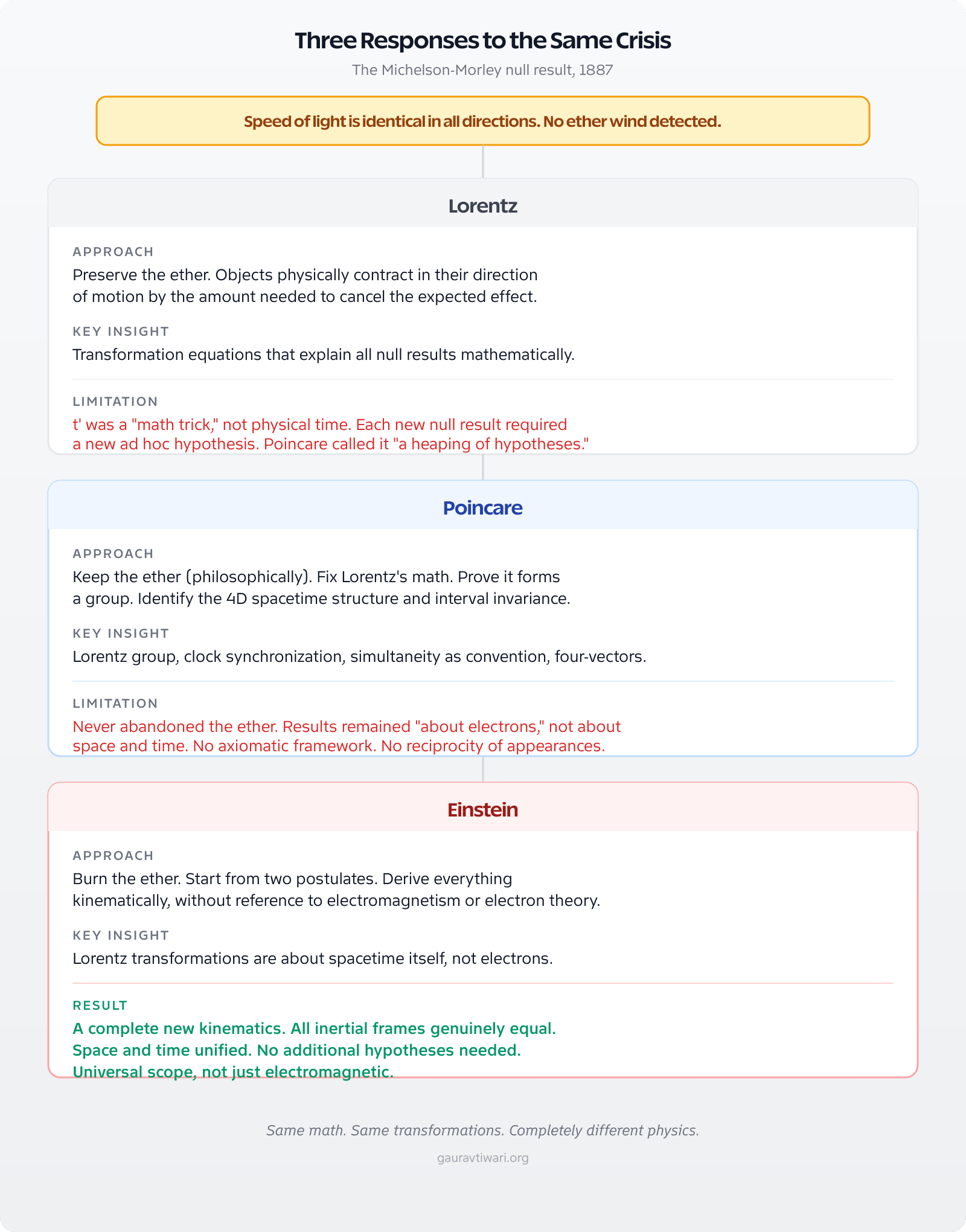
Maxwell’s electrodynamics predicted a fixed speed for electromagnetic waves, while Newtonian mechanics used Galilean transformations between inertial frames. If velocities simply added, different observers should measure different light speeds. Experiments such as Michelson and Morley’s 1887 interferometer result failed to reveal the expected motion through a luminiferous ether.
George FitzGerald and Hendrik Lorentz proposed length contraction. Lorentz developed transformed coordinates, local time, and the equations now carrying his name. The challenge was not merely finding a formula that saved experiments. It was deciding what the transformed space and time meant.
Poincare’s Contributions Before 1905
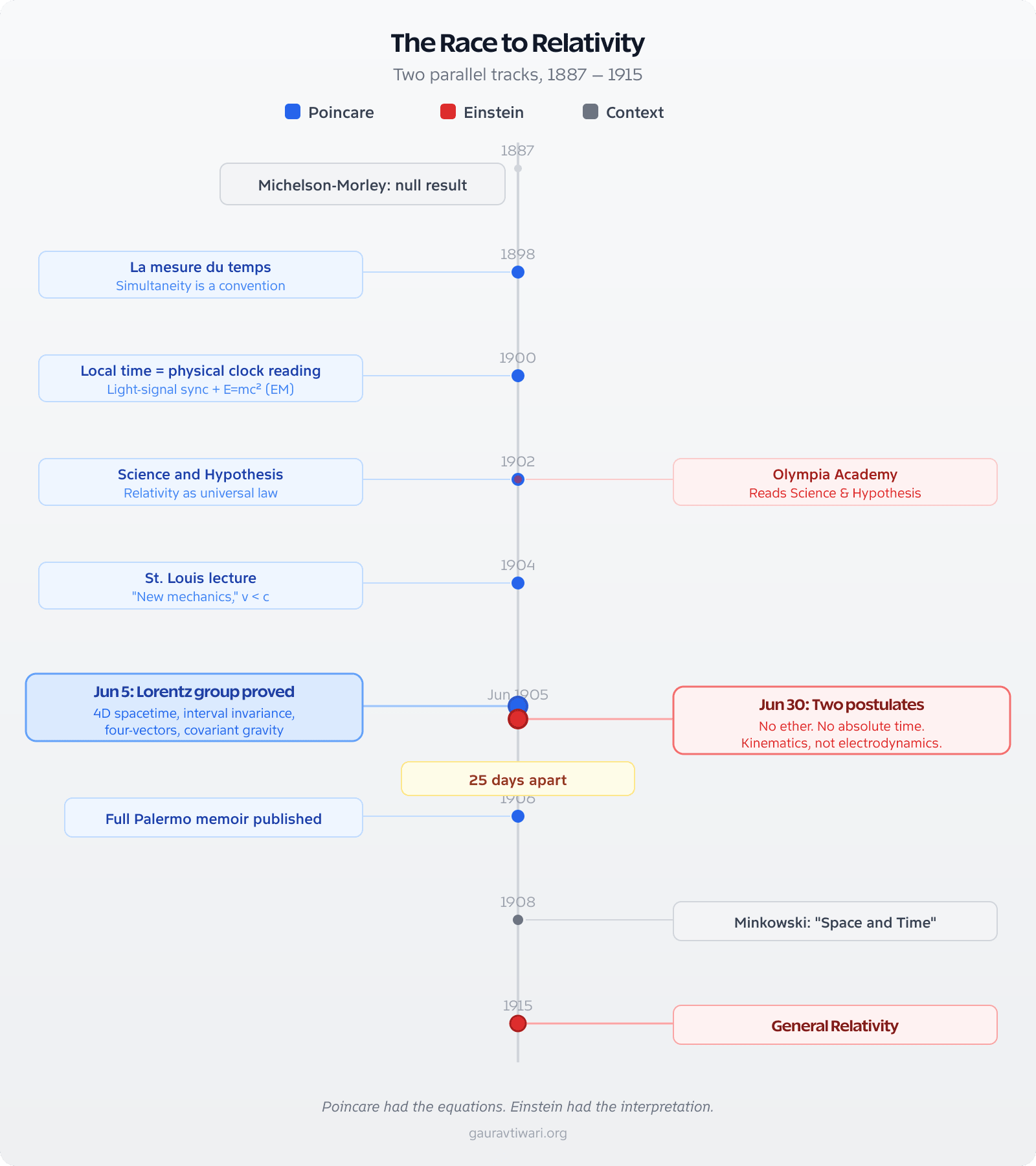
Poincare repeatedly argued that no mechanical or electromagnetic experiment could reveal absolute motion. In 1898 he discussed the measurement of time and the convention involved in synchronizing distant clocks using light signals. In 1900 he gave a physical reading of Lorentz’s local time for moving observers who synchronize clocks by light.
In his 1904 St. Louis lecture, Poincare elevated the relativity principle and listed the pressure it placed on physics. He also worried that repeated auxiliary hypotheses were being added to protect the principle. This was not a casual aside. It was a research program.
The Two 1905 Papers
Poincare sent a short note, “On the Dynamics of the Electron,” to the French Academy on 5 June 1905. Einstein submitted “On the Electrodynamics of Moving Bodies” to Annalen der Physik on 30 June 1905. Poincare then completed a much longer memoir in July, which appeared in print in 1906.
Publication dates alone do not establish who influenced whom. The short Poincare note appeared before Einstein’s submission, but there is no solid documentary evidence that Einstein read it before finishing his paper. The long Poincare memoir was completed after Einstein’s submission but developed a program visible in Poincare’s earlier work.
| Date | Event | Why it matters |
|---|---|---|
| 1887 | Michelson-Morley experiment | No expected ether-wind signal |
| 1895-1904 | Lorentz and Poincare refine transformations, local time, and relativity | Mathematical and conceptual groundwork |
| 5 June 1905 | Poincare communicates short note | Lorentz group and relativistic dynamics |
| 30 June 1905 | Einstein submits special-relativity paper | Postulate-based kinematics without ether |
| July 1905 / 1906 print | Poincare completes long Palermo memoir | Four-dimensional invariants and detailed electron dynamics |
| 1908 | Minkowski presents spacetime formulation | Geometric synthesis of space and time |
What Poincare Achieved
Poincare recognized that the Lorentz transformations form a group, corrected transformation details, introduced an imaginary-time four-dimensional notation, and identified invariant quadratic structure. He sought Lorentz-covariant laws of gravitation and built relativistic dynamics around action principles.
His short 1905 text is available in English as On the Dynamics of the Electron. The mathematical reach is undeniable. Poincare was not merely commenting on Lorentz from the sidelines.
But Poincare often maintained a distinction between true variables associated with the ether and apparent variables measured by moving observers. Historians debate how much weight to place on different passages, but the ether-compatible structure remained more visible in his program than in Einstein’s.
What Einstein Changed
Einstein began with two principles: the laws of physics have the same form in every inertial frame, and light in vacuum has the same speed for every inertial observer, independent of source motion. He defined synchronization with light signals and showed that simultaneity at separated locations is not absolute.
From those commitments he derived time dilation, length contraction, relativity of simultaneity, velocity transformation, and electromagnetic field transformations. The Lorentz transformation was no longer an adjustment describing how motion through an undetectable ether distorted rods and clocks. It became the relation between equally valid inertial frames.
The Einstein Online explanation of the basic ideas of special relativity emphasizes this reconstruction of space and time. The conceptual economy mattered: the theory did not need an experimentally inaccessible preferred rest frame.
For the physics itself, the special relativity study notes explain the postulates, transformations, time dilation, and length contraction without the historical detour.

Why the Difference Is More Than Philosophy
Interpretation changes what counts as a basic quantity. In a Lorentzian ether account, moving clocks may be physically distorted relative to a hidden true time. In Einstein’s account, each inertial frame’s properly synchronized clocks define that frame’s time, and no inertial frame is privileged by the laws.
The two approaches can reproduce many of the same observable predictions. That empirical equivalence is why the historical debate persists. But scientific theories are also structures of concepts, explanations, and permissible questions. Einstein’s formulation made frame-dependent simultaneity foundational rather than a useful appearance masking absolute time.
Where Lorentz Fits
Lorentz supplied essential transformations and electron theory. The name “Lorentz transformation” is deserved. Yet Lorentz continued to treat local time and contraction through an ether-based physical picture for longer than Einstein did.
The clean attribution is not a winner-takes-all ranking. Lorentz developed much of the transformation apparatus. Poincare clarified symmetry, group properties, synchronization, and relativistic dynamics. Einstein made the decisive kinematic reorganization. Minkowski then supplied the geometric spacetime language that became standard.
Minkowski’s Spacetime Synthesis
Hermann Minkowski recast special relativity in four-dimensional spacetime. Events are located by spacetime coordinates, and inertial transformations preserve the interval.
$$s^2=c^2t^2-x^2-y^2-z^2$$
Poincare had already written related four-dimensional invariants using an imaginary time coordinate. Minkowski’s 1908 presentation gave the geometry a clearer physical and mathematical role. It made worldlines, light cones, proper time, and Lorentz transformations parts of one picture.
Did Einstein Plagiarize Poincare?
There is no credible documentary basis for a plagiarism claim. Einstein’s paper did not cite Lorentz or Poincare, which looks strange by modern standards, but sparse citation was not unique to that paper. More importantly, chronological possibility is not evidence of copying.
- Einstein knew Lorentz’s work and the general electrodynamics problem.
- Poincare’s pre-1905 writings were part of the scientific context, but direct use of the June 1905 note is not established.
- Einstein’s derivation, organization, and ether-free interpretation differ substantially from Poincare’s electron-dynamics program.
- Poincare’s independent achievement remains substantial even without turning the story into an accusation.
A Better Way To Assign Credit
Credit should follow contributions, not celebrity. Ask separate questions: Who developed the transformation? Who identified the group? Who formulated the relativity principle? Who operationalized simultaneity? Who removed the ether from the explanation? Who created the spacetime geometry?
| Contribution | Most closely associated figure or figures |
|---|---|
| Transformation theory and local time | Lorentz, with important refinements by Poincare |
| Relativity principle and Lorentz-group insight | Poincare |
| Operational kinematics and relativity of simultaneity | Einstein |
| Mass-energy relation development | Einstein, within a broader prehistory of electromagnetic mass |
| Four-dimensional spacetime geometry | Minkowski, building on Lorentz, Poincare, and Einstein |
This layered account is stronger than both hero worship and counter-hero replacement. The history shows how physics advances: observation, mathematical repair, conceptual criticism, and reformulation can be distributed across several people.
Common Historical Mistakes
- Reading priority from one publication date: ideas have longer development histories, and submission, communication, and print dates differ.
- Treating identical equations as identical theories: interpretation and starting principles can differ.
- Ignoring Lorentz: neither Poincare nor Einstein worked in a vacuum.
- Calling Poincare a footnote: his group, invariance, synchronization, and dynamics work was central.
- Calling Einstein a mere popularizer: his operational reconstruction of space and time was a substantive theoretical change.
- Projecting modern citation rules backward without context: citation practice was different, though historical influences should still be investigated critically.
Related Physics Guides
Use these next if you want to connect this result with the surrounding physics:
Key Takeaways
- Poincare and Einstein reached overlapping mathematical territory in 1905 but framed it differently.
- Poincare developed the relativity principle, Lorentz-group structure, synchronization analysis, invariants, and relativistic dynamics.
- Einstein built special relativity from operational definitions and two postulates, without a preferred ether frame.
- Lorentz supplied crucial transformation theory, and Minkowski supplied the mature spacetime geometry.
- There is no solid evidence that Einstein plagiarized Poincare’s June 1905 work.
Frequently Asked Questions
Did Poincare discover relativity before Einstein?
Poincare developed major mathematical and conceptual parts before and during 1905, including the relativity principle and Lorentz-group insight. Einstein independently gave the decisive ether-free kinematic formulation.
What did Poincare contribute to special relativity?
He advanced clock-synchronization analysis, formulated a broad relativity principle, recognized the Lorentz transformations as a group, used four-dimensional invariants, and developed relativistic electron dynamics.
What was Einstein’s unique contribution?
Einstein made operational clock synchronization and relative simultaneity foundational, derived the theory from two postulates, and removed the stationary ether as an explanatory necessity.
Did Einstein read Poincare’s 1905 paper before writing his own?
There is no solid documentary evidence that Einstein read Poincare’s 5 June note before submitting his own paper on 30 June 1905.
Why is it called the Lorentz transformation?
Lorentz developed the transformation in electron theory, with later corrections and group analysis by Poincare. Einstein derived and reinterpreted it within special relativity.
Did Minkowski invent special relativity?
No. Minkowski recast special relativity as four-dimensional spacetime geometry in 1908, building on Lorentz, Poincare, and Einstein. His formulation became the standard mathematical language.
The fairest verdict on Poincare and Einstein is not that one man owned relativity. It is that Einstein made the conceptual break that organized several powerful earlier results into the theory physicists still use, while Poincare’s independent mathematical and physical contributions remain indispensable.
Tell Google you want more of this.
Add Gaurav Tiwari as a preferred sourceOne tap, and this site shows up more often in your own Top Stories, AI Overviews and AI Mode. Remove it any time.