by
by
Pick any positive integer. If it’s even, halve it. If it’s odd, triple it and add one. Repeat. You’ll always end up at 1.
That’s the Collatz Conjecture. It sounds like something you could prove in an afternoon. Mathematicians have been trying for nearly 90 years. Nobody’s succeeded.
You might also hear it called the 3n+1 problem, Ulam’s conjecture, Kakutani’s problem, Thwaites conjecture, Hasse’s algorithm, or the Syracuse problem. Same puzzle, different names.
The Conjecture
The rules are dead simple:
- Start with any positive integer \( n \).
- If \( n \) is even, divide by 2 to get \( n/2 \).
- If \( n \) is odd, multiply by 3 and add 1 to get \( 3n + 1 \).
- Repeat until you hit 1.
The conjecture claims every positive integer eventually reaches 1. No exceptions.
Quick Examples
Starting with 1: Already there. Done.
Starting with 2 (even): \( 2 \to 1 \). One step.
Starting with 3 (odd): \( 3 \to 10 \to 5 \to 16 \to 8 \to 4 \to 2 \to 1 \). Seven steps.
Starting with 27: This one’s wild. It takes 111 steps and climbs as high as 9,232 before finally dropping to 1.
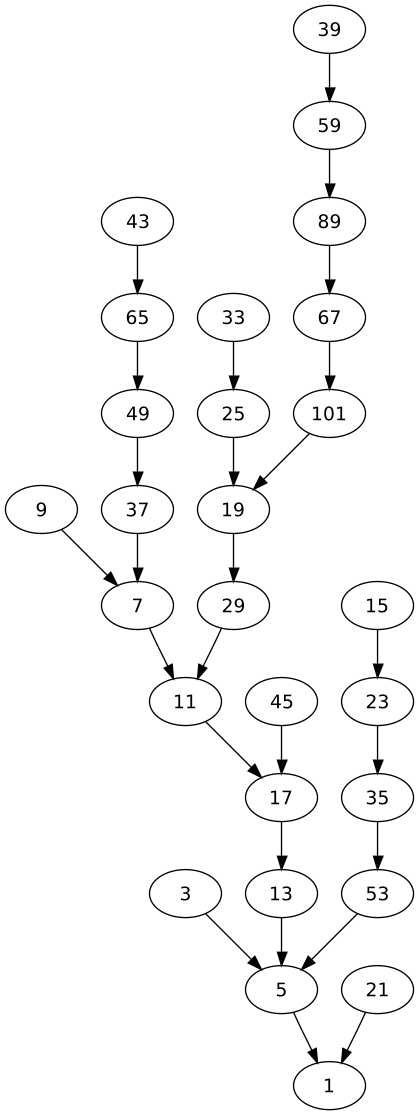
The Formal Definition
Mathematically, we define the Collatz function \( f: \mathbb{Z}^+ \to \mathbb{Z}^+ \) as:
$$f(n) = \begin{cases} n/2 & \text{if } n \equiv 0 \pmod{2} \\ 3n + 1 & \text{if } n \equiv 1 \pmod{2} \end{cases}$$
The conjecture states that for every positive integer \( n \), repeated application of \( f \) eventually yields 1. In other words, the sequence \( n, f(n), f(f(n)), \ldots \) always terminates at 1.
Why It’s So Hard
The problem looks innocent. It’s not.
The 3n+1 step makes odd numbers grow. The n/2 step makes even numbers shrink. But there’s no obvious pattern to how these compete. Sometimes numbers explode upward before crashing down. Sometimes they bounce around for hundreds of steps.
Paul Erdős, one of the greatest mathematicians of the 20th century, said: “Mathematics may not be ready for such problems.”
The conjecture has been verified by computer for all numbers up to approximately \( 2.95 \times 10^{20} \) (Christian Hercher and David Barina’s distributed computing work, 2020). Every single one reaches 1. But verification isn’t proof. There could be a counterexample hiding somewhere larger. This is the same gap between computation and proof that makes prime number formulas so elusive.
The Stopping Time
The stopping time of \( n \) is how many steps it takes to reach 1. Some numbers have surprisingly long stopping times relative to their size.
The number 27 takes 111 steps. The number 9,780,657,630 takes 1,132 steps. There’s no formula to predict stopping time from the starting number.
In September 2019, Terence Tao proved that “almost all” Collatz orbits attain almost bounded values. Published in Forum of Mathematics, Pi (2020), this was the most significant partial result in the conjecture’s history. For any function \( f(n) \) tending to infinity (however slowly), the set of starting values whose orbit minimum exceeds \( f(n) \) has logarithmic density zero. But “almost all” isn’t “all.” The conjecture remains open. Tao himself called it merely a “partial result toward the full conjecture.”
What Could Go Wrong?
If the conjecture is false, there are two possibilities:
First, there might be a number whose sequence goes to infinity. It just keeps growing forever, never coming back down.
Second, there might be a cycle that doesn’t include 1. The sequence could loop forever through a set of numbers without ever reaching 1. The only known cycle is \( 1 \to 4 \to 2 \to 1 \), but others might exist.
Nobody has found either type of counterexample. But nobody has proven they can’t exist.
Is It Useless?
Some mathematicians call the Collatz Conjecture a “dangerous” problem because it’s so easy to state, so tempting to attempt, and so impossible to crack.
The conjecture has no known applications to other areas of mathematics. It doesn’t connect to deep theorems or open doors to new territories. In that sense, it’s isolated. Jeffrey Lagarias compiled an annotated bibliography cataloguing over 500 papers on the conjecture (The Ultimate Challenge: The 3x+1 Problem, AMS, 2010). Five hundred papers on a problem with no applications. That tells you something about its pull.
But here’s the thing. We don’t know why we can’t solve it. The techniques that work on other number theory problems (modular arithmetic, analytic methods, algebraic structures) all fail here. The 3n+1 step scrambles the binary representation of numbers in ways that resist systematic analysis. It connects to dynamical systems (iteration of a piecewise-linear map), ergodic theory (mixing properties modulo powers of 2), and even p-adic analysis. Understanding why standard tools fail might teach us something important.
And there’s always the chance that a solution would require entirely new mathematics. That’s happened before. The Weierstrass function forced mathematicians to rebuild the foundations of analysis. The prime number theorem required complex analysis nobody expected. Sometimes the “useless” problems force breakthroughs.
The Hailstone Analogy

Collatz sequences are sometimes called “hailstone numbers” because they rise and fall like hailstones in a cloud. A hailstone gets pushed up by updrafts, falls a bit, gets pushed up again, and eventually drops to the ground.
The analogy is pretty good. Numbers bounce chaotically before eventually settling at 1 (the ground). But unlike real hailstones, we can’t prove all Collatz sequences eventually land.
The distribution of stopping times is itself interesting. On average, the stopping time of \( n \) grows roughly as \( 6.95 \times \log_2(n) \). But individual numbers deviate wildly from this average. The number 27, which takes 111 steps and climbs to 9,232, is a famous outlier for its size. This unpredictability is part of what makes the conjecture so resistant to systematic problem-solving approaches.
Why Proof Attempts Keep Failing
Every few years somebody announces a proof. The most instructive recent attempt is Chellappa’s sieve argument, which is worth walking through precisely because it fails in a way that shows what any real proof would have to survive.
How Chellappa’s Sieve Argument Works
Chellappa’s idea borrows the crossing-out language of the Sieve of Eratosthenes. The prime sieve crosses out composites. This Collatz sieve tries to cross out integers once their next move appears to connect them to an earlier case.
Step 1: Cross out the even numbers
Take the integers from 1 to a finite bound \(N\). Every even number \(m\) maps to \(m/2<m\), so the proposal crosses out all evens. For example, \(100\to50\), \(98\to49\), and \(50\to25\).
Step 2: Map each remaining odd number
For each odd \(n\), compute \(3n+1\). The result is always even, so it has already been crossed out. The first cases look reassuring:
- \(3\to10\), and 10 is even.
- \(5\to16\), and 16 is even.
- \(7\to22\), and 22 is even.
- \(33\to100\), the last odd start whose image stays within 100.
The proposal then enlarges \(N\) whenever \(3n+1>N\) and repeats. Because every odd image is even, the sieve appears to keep absorbing the remaining starts.
Step 3: Use injectivity to reject loops
The second part argues that \(f(m)=m/2\) is one-to-one on even inputs, so a repeated value in a trajectory should create a contradiction. The intended conclusion is that a nontrivial cycle cannot exist.
Where the Collatz Conjecture Proof Attempt Fails
The Collatz conjecture proof attempt fails because crossed out changes meaning halfway through the sieve. For an even number, it means only that one step goes to a smaller number. For an odd number, it is treated as if the even image has already been proved to reach 1. That stronger claim was never established.
1. An even image is not a completed trajectory
Take the article’s own example: \(7\to22\to11\). The fact that 22 is even tells us the next value is 11. But 11 is larger than 7, and nothing in the crossing-out rule has proved that 11 reaches 1. The sieve has moved the unanswered question, not removed it.
This is why strong induction proves the even case but stalls on the odd case. If every number below \(n\) is known to reach 1 and \(n\) is even, then \(n/2<n\) finishes the step. If \(n>1\) is odd, the first forced odd-plus-even pair increases:
$$\frac{3n+1}{2}-n=\frac{n+1}{2}>0.$$
So the induction hypothesis cannot be used yet.
2. The missing lemma is equivalent to Collatz
The sieve would work if it proved this lemma: every \(n>1\) eventually reaches some value smaller than \(n\). Strong induction would then carry every trajectory down to 1.
But that lemma is not a shortcut. It is equivalent to the Collatz conjecture. If Collatz is true, every start reaches 1, which is smaller than every \(n>1\). If the lemma is true, strong induction proves Collatz. The proposed proof has placed the whole problem inside one unstated step.
3. Injectivity does not rule out cycles
The map \(m\mapsto m/2\) is injective on even inputs, but the full Collatz map is not. For example, \(C(3)=10\) and \(C(20)=10\). More importantly, injective functions can have cycles. One-to-one behavior by itself creates no contradiction when an iterate returns to an earlier value.
A false Collatz conjecture could fail in either of two ways: an orbit could enter a nontrivial cycle, or it could grow without bound. The sieve excludes neither case.
4. Finite checks expose the gap but cannot close it
A reproducible check of starts 1 through 1,000,000 confirms that every one reaches 1. The interesting numbers are the ones that delay descent:
| Record inside 1 to 1,000,000 | Starting value | Measured result |
|---|---|---|
| Longest total stopping time | 837,799 | 524 standard steps to 1 |
| Largest peak | 704,511 | 56,991,483,520 before returning |
| Longest wait to fall below the start | 626,331 | 287 steps, then 597,017 |
The third row matters most. A method that assumes descent will appear to work for hundreds of steps before the descent finally occurs. Computation can find that delay. Only a proof can show the delay is always finite.
Why Average Downward Drift Is Not Enough
Collatz trajectories look as if they should shrink on average, but average behavior cannot settle a universal statement. A density-zero set can still contain infinitely many starts, one nontrivial cycle, or one divergent orbit.
For odd \(n\), mathematicians often use the accelerated Syracuse map
$$S(n)=\frac{3n+1}{2^{\nu_2(3n+1)}}.$$
where \(\nu_2(m)\) counts how many factors of 2 divide \(m\). A probabilistic model treats those powers of 2 roughly like a geometric random variable with mean 2, producing a downward multiplier near \(3/4\) per odd-to-odd step. That heuristic explains why most sampled orbits descend. It does not prove that the parity pattern along every single orbit behaves randomly.
That gap between statistical control and pointwise control is where Tao’s theorem stops too. Tao controls almost all starts under logarithmic density. The conjecture has no exception clause.
What Would Be Enough for a Real Proof?
Nobody knows what the eventual proof will look like. But any valid Collatz conjecture proof must close the quantifier gap and cover every positive integer. Several sufficient routes are easy to state, even if none is easy to prove:
- Prove eventual descent. Show that every \(n>1\) reaches a value below \(n\). Strong induction then gives convergence.
- Exclude both failure modes. Rule out every nontrivial cycle and every unbounded orbit with a structural argument.
- Find a well-founded measure. Construct a quantity that must decrease after a guaranteed finite block of steps, not merely on average.
Jeffrey Lagarias’ overview of the 3x+1 problem is a useful starting point because it separates rigorous theorems from probabilistic predictions. My guide to mathematical logic and the foundations everything else builds on also explains why a million confirming cases and one universal proof are different kinds of knowledge.
How to Stress-Test a Collatz Conjecture Proof Attempt
A useful review starts with the smallest load-bearing lemma, not the largest claim. Write the lemma with its quantifiers, test the first cases where the trajectory rises, and ask whether the conclusion is stronger than the premises.
- Separate computation from deduction. State the finite range tested and the universal statement still missing.
- Track what every label means. If “crossed out” changes from “has a smaller next value” to “is proved to converge,” stop.
- Try 7, 27, and long-descent records. Small examples expose hidden induction assumptions faster than a hundred pages of notation.
- Test both failure modes. A loop argument says nothing about an orbit that grows without bound.
- Ask for review of one lemma. A specialist can evaluate a precise claim more usefully than a manuscript that announces a full proof.
I am not mocking Chellappa’s work. Getting stuck on a hard problem is normal mathematics. The valuable move is to locate the obstruction and make the next claim smaller. If you are building that habit, the four ingredients that actually drive better learning and science-backed techniques to remember what you study are useful for slow proof work. For a lighter look at pattern spotting, Vedic multiplication tricks shows how much structure can hide inside elementary arithmetic.
Frequently Asked Questions
What is the Collatz Conjecture?
The Collatz Conjecture states that if you take any positive integer, halve it if even or triple it and add one if odd, and keep repeating, you’ll eventually reach 1. Despite being tested on numbers up to 2^68, nobody has proven it’s true for all integers.
Who discovered the Collatz Conjecture?
German mathematician Lothar Collatz proposed it in 1937. But several mathematicians worked on similar problems independently, which is why it has so many names: Ulam’s conjecture (Stanisław Ulam), Kakutani’s problem (Shizuo Kakutani), Thwaites conjecture (Bryan Thwaites), and the Syracuse problem.
Has the Collatz Conjecture been proven?
No. Despite nearly 90 years of effort by professional mathematicians, the conjecture remains unproven. In 2019, Terence Tao proved that “almost all” numbers satisfy a weaker form of the conjecture, but the full statement is still open. It’s considered one of the hardest unsolved problems in mathematics.
What is stopping time in the Collatz sequence?
Stopping time is the number of steps needed to reach 1 from a given starting number. For example, 3 has stopping time 7, while 27 has stopping time 111. There’s no known formula to calculate stopping time without actually running the sequence.
Why is the Collatz Conjecture so difficult?
The difficulty comes from the chaotic interaction between the two rules. The 3n+1 step mixes the binary representation of numbers in unpredictable ways. Standard number theory tools (modular arithmetic, analytic methods) don’t gain traction. Paul Erdős said mathematics “may not be ready” for such problems.
What are hailstone numbers?
Hailstone numbers are another name for Collatz sequences. The name comes from how the numbers rise and fall chaotically, like hailstones bouncing in storm clouds before eventually falling to the ground. The sequence “bounces” up and down before settling at 1.
Could there be a number that never reaches 1?
Possibly. If the conjecture is false, either some number’s sequence goes to infinity, or there’s a cycle that doesn’t include 1. No one has found such a counterexample, but no one has proven one can’t exist. The conjecture has been verified computationally up to about 2^68.
Is there a prize for solving the Collatz Conjecture?
Paul Erdős offered $500 for a solution, which was substantial for him. Various institutions and individuals have offered bounties over the years. But the real prize would be the mathematical insight required to crack it, which could open new areas of number theory.
Does the Collatz Conjecture have any practical applications?
Not directly. It doesn’t connect to other mathematical theorems or have known real-world applications. Some consider it an “isolated” problem. But attempting to solve it has led to new techniques in dynamical systems and computational number theory that have broader value.
What did Terence Tao prove about Collatz in 2019?
Tao proved that “almost all” Collatz orbits attain almost bounded values. In technical terms, for any function f(n) going to infinity (however slowly), almost all starting values eventually drop below f(n). This is the strongest result to date, but it doesn’t prove the full conjecture since “almost all” excludes potentially infinitely many exceptions.
Tell Google you want more of this.
Add Gaurav Tiwari as a preferred sourceOne tap, and this site shows up more often in your own Top Stories, AI Overviews and AI Mode. Remove it any time.