by
by
The four fundamental forces are gravity, electromagnetism, the strong interaction, and the weak interaction. Every known everyday force, nuclear process, orbit, chemical bond, and particle decay can be traced to one or more of these interactions.
An interaction’s range, its coupling and the objects carrying the relevant charges determine how it appears. A simple strength ranking needs a stated context.
The familiar strength ranking is useful but easy to abuse. Interaction strengths depend on energy and on what is being compared. Range, charge, mediator mass, confinement, and the number of participating particles often matter more than one memorized ratio.
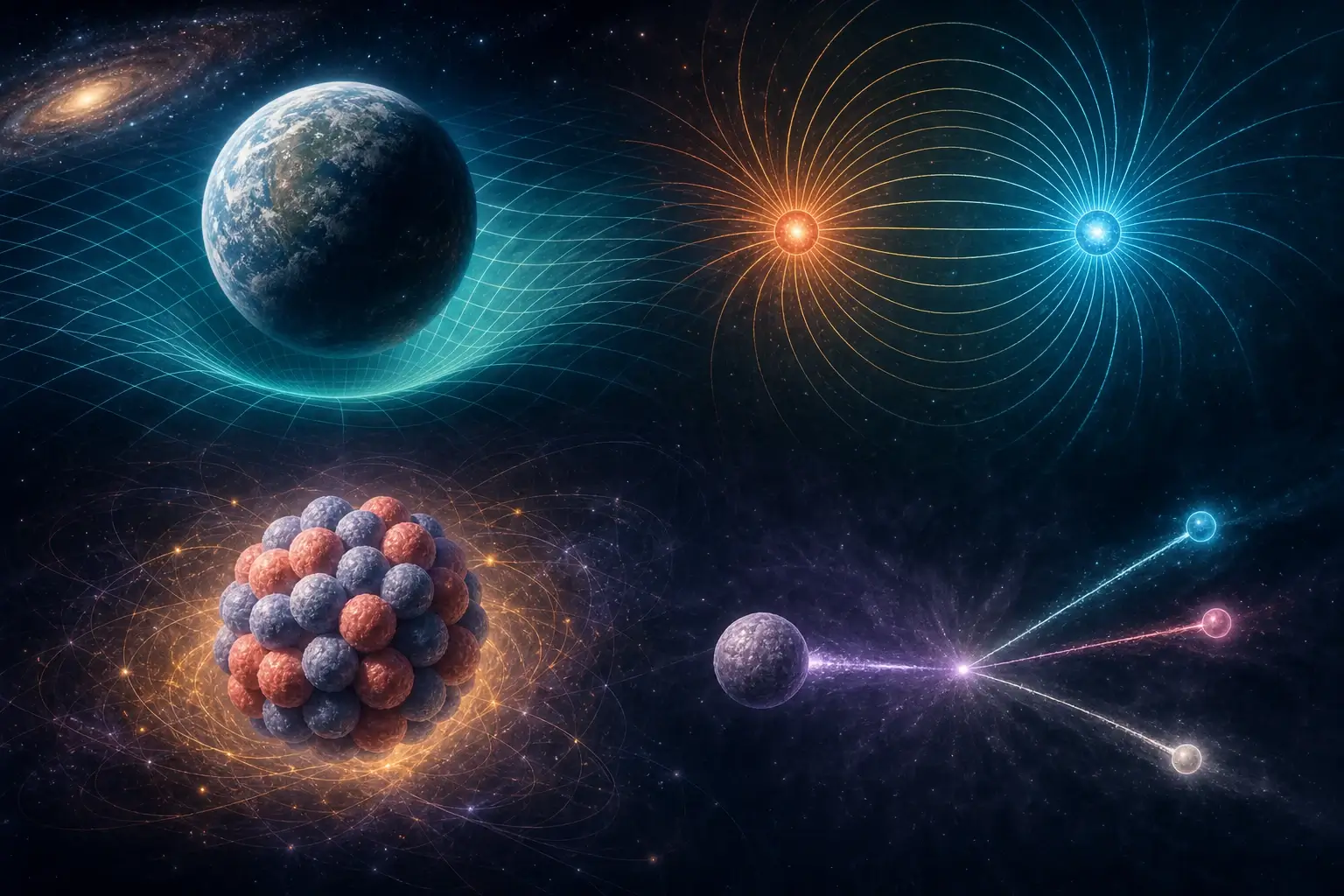
What Are the Four Fundamental Forces?
| Interaction | Acts on | Range | Mediator in quantum theory | Typical role |
|---|---|---|---|---|
| Gravity | Energy and momentum | Infinite | No confirmed quantum carrier | Orbits, stars, galaxies, spacetime |
| Electromagnetism | Electric charge | Infinite | Photon | Atoms, chemistry, light, contact forces |
| Strong interaction | Colour charge | Confining at hadronic scales | Gluons | Binds quarks; residual force binds nuclei |
| Weak interaction | Quarks and leptons | About 10^-18 m | W+, W-, and Z bosons | Beta decay, neutrino reactions, stellar fusion chains |
The CERN Standard Model overview describes electromagnetic, strong, and weak interactions within quantum field theory. Gravity remains outside the Standard Model.
A useful way to study the four fundamental forces is to compare what each interaction responds to, how its influence changes with distance, and which theory describes it.
Gravity
Gravity acts on energy and momentum. In Newtonian physics it is an attractive inverse-square force between masses. In general relativity it is the curvature of spacetime produced by stress-energy, with freely falling bodies following the resulting geometry.
$$F=\frac{Gm_1m_2}{r^2}$$
Gravity is extraordinarily weak between elementary particles, yet it dominates planets, stars, and galaxies. Macroscopic matter has positive mass-energy, gravitational effects add rather than screen easily, and the interaction has infinite range.
- Strength: weakest in particle-scale comparisons.
- Range: infinite, decreasing with distance in familiar isolated systems.
- Charge: mass-energy and momentum rather than electric or colour charge.
- Carrier: a graviton is hypothesized in quantum descriptions, but none has been detected and no complete quantum-gravity theory is established.
General relativity predicts gravitational waves, black holes, lensing, and the expansion dynamics of the universe. It is not merely a corrected version of Newton’s force formula. It changes the description of space and time themselves. The special relativity notes provide the flat-spacetime foundation.
Electromagnetism
Electromagnetism acts on electric charge and includes electric fields, magnetic fields, and electromagnetic radiation. Quantum electrodynamics describes the interaction through photons. At ordinary energies it is vastly stronger than gravity between charged particles.
$$F=\frac{1}{4\pi\varepsilon_0}\frac{|q_1q_2|}{r^2}$$
The inverse-square Coulomb force is the electrostatic limit. Maxwell’s equations add changing fields, magnetism, and light. The photon is massless, which is consistent with the interaction’s infinite range.
Electromagnetism explains atomic structure, chemical bonding, friction, normal forces, material strength, electronics, and nearly every force you feel in contact with matter. Gravity pulls your body downward, but the floor stops you through electromagnetic interactions between atoms.
The Strong Interaction
The strong interaction is described by quantum chromodynamics, or QCD. Quarks carry colour charge, and gluons carry colour themselves. That self-interaction makes QCD unlike the simpler photon field of quantum electrodynamics.
- Colour confinement: isolated quarks and gluons are not observed under ordinary conditions.
- Asymptotic freedom: at very high momentum transfer, quarks interact more weakly.
- Hadron binding: QCD binds quarks into protons, neutrons, mesons, and other hadrons.
- Residual nuclear force: a leftover colour interaction binds protons and neutrons inside nuclei.
Do not equate the strong interaction directly with the proton-neutron nuclear force. The fundamental QCD interaction binds quarks. Nuclear binding is a residual effect between colour-neutral hadrons, often modelled at low energies through meson exchange and effective field theories.
Why Nuclei Do Not Fly Apart
Protons repel electrically, but at femtometre separations the residual strong attraction can bind protons and neutrons. The balance depends on neutron-to-proton ratio, nuclear shell structure, pairing, and size. For very heavy nuclei, electrostatic repulsion contributes to instability and fission.
The Weak Interaction
The weak interaction changes particle flavour and is responsible for beta decay, many neutrino reactions, and key steps in stellar fusion. Its carriers, the W and Z bosons, are massive, so the interaction is extremely short-ranged.
In beta-minus decay, a down quark changes into an up quark, turning a neutron into a proton while producing an electron and an electron antineutrino. At the quark level, the transition involves a virtual W boson.
$$n\rightarrow p+e^-+\bar{\nu}_e$$
The weak interaction violates parity symmetry and also violates charge-parity symmetry in some processes. It couples to left-handed fermions and right-handed antifermions in the Standard Model, a sharp departure from mirror-symmetric intuition.
How the Forces Compare
A one-line relative-strength table usually assumes two protons at a specified low-energy scale. That is a convention, not an eternal ordering independent of context. Couplings run with energy, the strong force is confining, and gravity depends on mass-energy.
| Property | Gravity | Electromagnetic | Strong | Weak |
|---|---|---|---|---|
| Can attract? | Yes | Yes | Effectively, depending on charges/configuration | Not usefully classified this way |
| Can repel? | Not for ordinary positive mass | Yes | Effective behaviour depends on colour state and distance | Not usefully classified this way |
| Infinite range? | Yes | Yes | No free long-range colour field | No |
| Affects neutrinos? | Yes | Only if neutrino has relevant tiny electromagnetic property | No | Yes |
| Inside atoms? | Negligible | Dominant for electron binding | Confined to hadrons/nuclei | Causes rare transitions |
Electroweak Unification
At ordinary energies, electromagnetism and the weak interaction look radically different. In the Standard Model they arise from one electroweak gauge theory. The Higgs field’s nonzero vacuum value breaks the symmetry, leaving the photon massless while the W and Z bosons become massive.
Electroweak unification is experimentally successful. It does not mean electromagnetism and the weak force have identical low-energy effects. It means their fields and couplings are parts of one higher-symmetry description before symmetry breaking.
What Has Not Been Unified
The strong interaction joins the electroweak theory inside the Standard Model’s product gauge structure, but the three gauge interactions are not confirmed as one grand unified force. Proposed grand unified theories make testable ideas such as proton decay, but no accepted evidence selects one.
Gravity is the larger conceptual gap. General relativity treats spacetime dynamically; the Standard Model treats quantum fields on spacetime. Candidate approaches include string theory, loop quantum gravity, asymptotic safety, and other frameworks, but none has decisive experimental confirmation.
Why Four Forces Produce So Much Variety
The diversity comes from scale and organization. Electromagnetism builds atoms and molecules. Residual strong interactions build nuclei. The weak interaction changes particle identities and enables fusion pathways. Gravity gathers neutral bulk matter into planets and stars. Complex structures combine several layers rather than introducing a fifth ordinary force.
Dark matter and dark energy show that our cosmic inventory is incomplete, but they are not established fifth forces. Experiments continue to search for new long-range interactions, violations of known symmetries, and particles beyond the Standard Model.
Common Misconceptions
- “Strongest” means most important everywhere: gravity dominates astronomy despite being weakest per particle.
- The strong force only holds nuclei together: QCD first binds quarks; nuclear attraction is residual.
- The weak force is weak because it has low-energy carriers: its W and Z carriers are heavy, which makes the low-energy interaction short-ranged.
- Photons are ordinary little balls passed between charges: virtual exchange in quantum field calculations is not a classical projectile picture.
- Gravity is part of the Standard Model: it is not.
- Every unexplained observation is a new force: a fifth force requires reproducible evidence and a consistent interaction model.
Related Physics Guides
Use these next if you want to connect this result with the surrounding physics:
Key Takeaways
- The four fundamental forces are gravity, electromagnetism, the strong interaction, and the weak interaction.
- The four fundamental forces differ in charge, range, mediator structure, and the energy scale at which they become important.
- The Standard Model describes electromagnetic, strong, and weak interactions, but not gravity.
- Photons, gluons, and W/Z bosons are the established gauge bosons; a graviton remains hypothetical.
- Force range depends strongly on mediator mass, field structure, and confinement.
- Electromagnetism and the weak interaction are unified electroweakly; a complete unification including gravity remains open.
Fundamental and Everyday Forces
A book rests on a table because contact interactions provide an upward support force that balances its gravitational force. At the microscopic level, electromagnetic interactions and quantum properties of matter underlie the contact response. The support force is not a separate fifth fundamental interaction.
The strong interaction binds quarks inside hadrons, while a residual strong interaction helps bind protons and neutrons in nuclei. Keeping those related descriptions separate helps explain why a short-range nuclear force can coexist with confinement of quarks. Quoted relative-strength tables are rough scale-dependent comparisons, not universal constants.
The points to check in this example are:
- Gravity responds to mass-energy.
- Electromagnetism acts on electric charge and its currents.
- The strong and weak interactions have roles that everyday contact-force descriptions do not capture.
Check Your Understanding
Try the questions before reading the answers.
Question 1. Which interaction underlies ordinary electrostatic attraction?
Answer. Electromagnetism.
Question 2. Is friction a fifth fundamental force?
Answer. No. It is an effective macroscopic force arising from interactions of matter.
Practice Questions
Work each question before reading its solution. The set runs from direct recall and substitution to the applied questions that exams actually use to separate grades. The downloadable PDF includes these questions and their solutions.
Question 1. Name the 4 fundamental forces with their relative strengths and effective ranges.
Solution. Strong nuclear (strength 1, range \(\sim 10^{-15}\) m), electromagnetic (\(\sim 10^{-2}\), infinite range), weak nuclear (\(\sim 10^{-6}\) at nuclear distances, range \(\sim 10^{-18}\) m), gravity (\(\sim 10^{-38}\), infinite range). Two long-range forces run the visible world; two short-range forces run the nucleus.
Question 2. If gravity is 36 orders of magnitude weaker than electromagnetism, why does it dominate planets and galaxies?
Solution. Electric charge comes in 2 signs that cancel: bulk matter is neutral to fantastic precision, so its electromagnetic pull nets to nothing. Mass has 1 sign only; every added atom adds attraction. Gravity wins by monopoly, not muscle. On one atom, electromagnetism wins without contest.
Question 3. Which force holds the nucleus together, and against what?
Solution. The strong force (its residual, nucleon-nucleon form) binds protons and neutrons against the electromagnetic repulsion of the positively charged protons, which at femtometer separations is enormous. The competition is real: it sets a maximum practical nuclear size and is why very heavy nuclei fission.
Question 4. What does the weak force actually do, given that it neither binds nor visibly pushes?
Solution. It transforms particles: a down quark becomes an up quark in beta decay, turning a neutron into a proton while emitting an electron and antineutrino. It is the only force that changes quark flavor, so every radioactive beta decay, and the Sun’s proton-proton fusion first step, runs through it. No weak force, no sunlight.
Question 5. Match each force to its carrier boson and connect carrier mass to range.
Solution. EM: photon, massless, infinite range. Strong: gluons, massless but confined to \(\sim 10^{-15}\) m. Weak: W and Z bosons, 80 to 91 times a proton’s mass, range \(\sim 10^{-18}\) m. A heavy carrier can exist only briefly by the uncertainty principle, so it cannot travel far: mass caps range.
Question 6. Why does the strong force not fade with distance like the others, and what does that imply?
Solution. The gluon field between quarks forms a flux tube whose energy grows linearly with separation, like stretching a rubber band. Pull hard enough and the stored energy materializes a new quark-antiquark pair instead of freeing a quark: confinement. Isolated quarks are therefore unobservable in principle, not just in practice.
Question 7. Which forces act on a neutrino, and what does that predict about its behavior?
Solution. Only the weak force (and negligibly, gravity): no charge, no color. With interactions so feeble, a neutrino typically crosses light-years of lead before scattering; \(10^{13}\) of them pass through your hand each second from the Sun without a trace. Detectors compensate with kiloton targets and patience.
Question 8. Every everyday force, friction, tension, normal force, muscle push, reduces to which fundamental force, and how?
Solution. Electromagnetism. Contact is electron clouds repelling at angstrom range; friction is electromagnetic adhesion and surface roughness; tension is stretched electromagnetic bonds; muscles run on electrochemistry. Apart from weight, essentially every force you have ever felt is electromagnetic.
Question 9. Electromagnetism and the weak force are already unified. What does that mean, and at what scale?
Solution. Above energies around 100 GeV (temperatures of \(10^{15}\) K, the universe’s first \(10^{-11}\) s), they merge into one electroweak interaction with a shared field structure; the Higgs mechanism breaks the symmetry at lower energy, leaving a massless photon and heavy W/Z. Glashow, Salam, and Weinberg earned the 1979 Nobel for the theory; the W and Z were found at CERN in 1983.
Question 10. Why is quantum gravity the outstanding problem, and where would its effects matter?
Solution. The other 3 forces are quantum field theories; gravity is general relativity, a smooth-geometry theory that resists quantization: naive attempts produce unremovable infinities. The conflict only bites where both extreme mass and tiny distance meet, black-hole interiors, the Big Bang’s first instant, so experiments offer little guidance. String theory and loop quantum gravity are candidate resolutions, unconfirmed.
Frequently Asked Questions
What are the four fundamental forces?
They are gravity, electromagnetism, the strong interaction, and the weak interaction. All known ordinary physical interactions can be described through these four.
Which of the four fundamental forces is strongest?
At nuclear scales the strong interaction is strongest in common low-energy comparisons. The ranking depends on energy and the particles involved, so one fixed ratio should not be treated as universal.
Which fundamental force is weakest?
Gravity is by far the weakest between elementary particles. It dominates large astronomical systems because mass-energy accumulates, ordinary gravity is attractive, and the interaction has infinite range.
What particles carry the fundamental forces?
Photons mediate electromagnetism, gluons mediate the strong interaction, and W and Z bosons mediate the weak interaction. A quantum carrier of gravity, often called the graviton, has not been observed.
Are electricity and magnetism separate forces?
No. They are aspects of one electromagnetic field. Special relativity helps show why electric and magnetic fields mix between observers.
Have all four forces been unified?
No. Electromagnetism and the weak interaction are unified in electroweak theory. The Standard Model also includes QCD, but no experimentally confirmed theory unifies all three gauge interactions with gravity.
A good comparison of the four fundamental forces asks four questions: what charge does the interaction see, how far does it reach, what field carries it, and at what energy are you comparing it?
Browse more in Physics.