
 by
byValence electrons are the electrons in an atom’s outermost shell, the ones that actually do chemistry. Almost everything an element does (how it bonds, what compounds it forms, whether it’s reactive or inert, where it sits on the periodic table) traces back to its valence electron count. Hydrogen, with one valence electron, behaves nothing like helium, which has two. Sodium’s lone valence electron makes it dangerously reactive; neon’s complete octet of eight makes it almost completely inert. Master valence electrons and you have the structural foundation for understanding the periodic table, chemical bonding, and reactivity.
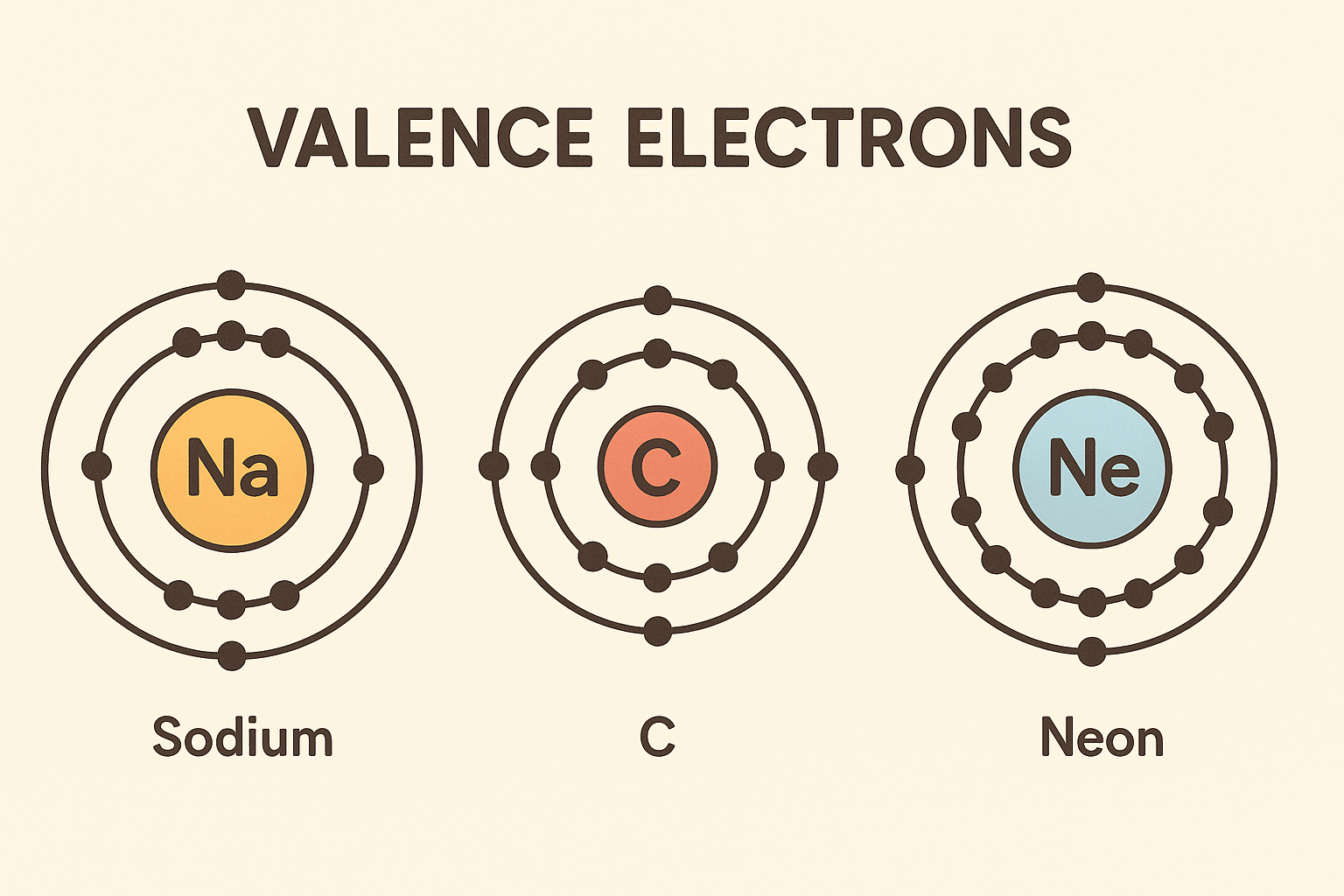
What Valence Electrons Are
In the simplified Bohr model, electrons orbit the nucleus in concentric shells. Each shell holds a maximum number of electrons (2 in the first shell, 8 in the second, 18 in the third, etc.). The shells fill from inside out as you go up the periodic table. The electrons in the outermost occupied shell are the valence electrons. The inner electrons (called core electrons) are usually not involved in bonding and are largely chemically inert.
The number of valence electrons matches the element’s chemical behavior more closely than total electron count. Two elements with the same number of valence electrons (say, lithium with 1 and sodium with 1) behave similarly chemically, despite having different total electron counts (3 vs 11). This is exactly why elements with the same valence electron count sit in the same vertical column (group) of the periodic table.
How to Count Valence Electrons
For most main-group elements (groups 1, 2, and 13-18), the count is straightforward, read it off the periodic table group number.
| Group | Examples | Valence electrons |
|---|---|---|
| Group 1 (alkali metals) | Li, Na, K, Rb, Cs | 1 |
| Group 2 (alkaline earth) | Be, Mg, Ca, Sr, Ba | 2 |
| Group 13 | B, Al, Ga, In | 3 |
| Group 14 | C, Si, Ge, Sn | 4 |
| Group 15 | N, P, As, Sb | 5 |
| Group 16 | O, S, Se, Te | 6 |
| Group 17 (halogens) | F, Cl, Br, I | 7 |
| Group 18 (noble gases) | He, Ne, Ar, Kr, Xe | 8 (He has 2) |
For transition metals (groups 3-12), the count gets messier because d-orbitals come into play and the simple shell model breaks down. Most transition metals have 1 or 2 valence electrons in their outermost s-orbital plus a variable number of d-electrons that can participate in bonding. This is why transition metals form so many different oxidation states and so many colorful compounds.
The Octet Rule
Most main-group elements bond in ways that give each atom 8 valence electrons, the same configuration as the noble gases. This is the octet rule. Atoms gain, lose, or share electrons to reach this stable configuration.
- Sodium (1 valence electron) loses its lone electron, becoming Na⁺ with the electron configuration of neon (8 valence electrons in the new outermost shell). The reaction is favorable.
- Chlorine (7 valence electrons) gains one electron, becoming Cl⁻ with the electron configuration of argon (8 valence electrons). Also favorable.
- Carbon (4 valence electrons) shares its 4 valence electrons with 4 other atoms (typically hydrogens in methane) to achieve 8 valence electrons through covalent bonds.
- Hydrogen (1 valence electron) is the exception, it bonds to reach a duet (2 valence electrons, the helium configuration), not an octet.
Exceptions to the octet rule do exist. Boron is happy with 6 (BF₃ has only 6 valence electrons around B). Phosphorus and sulfur can have expanded octets (PCl₅ has 10 around P; SF₆ has 12 around S, using d-orbitals). But for second-period elements (Li through Ne), the octet rule essentially holds.
Valence Electrons and Periodic Trends
Once you know an element’s valence count, you can predict its chemical behavior.
- Group 1 (1 valence electron): alkali metals. Very reactive, lose one electron to form +1 cations. Easily ionized.
- Group 2 (2 valence electrons): alkaline earth metals. Reactive, lose two electrons to form +2 cations.
- Group 17 (7 valence electrons): halogens. Very reactive, gain one electron to form -1 anions. Strong oxidizers.
- Group 18 (8 valence electrons): noble gases. Almost completely inert; their octet is already complete, so they have no thermodynamic incentive to react.
Reactivity peaks at the extremes (groups 1 and 17) and minimizes at group 18. The pattern follows directly from how close each element is to the noble-gas octet.
Valence Electrons in Bonding
All chemical bonding involves valence electrons. The three main bond types map cleanly onto how atoms manipulate their valence shells.
- Ionic bonding. One atom loses valence electrons; another gains them. The resulting positive cation and negative anion attract electrostatically. Typical between a metal (low ionization energy) and a nonmetal (high electron affinity). Example: NaCl.
- Covalent bonding. Two atoms share valence electrons. Each shared pair counts toward both atoms’ octets. Typical between two nonmetals with similar electronegativities. Example: O₂, CO₂, H₂O.
- Metallic bonding. A ‘sea’ of delocalized valence electrons that move freely among metal cations. Explains metallic conductivity and malleability. Example: pure copper, pure iron.
Related study notes: Periodic Table, Chemical Bonding, Electronegativity, Lewis Structure.
Frequently Asked Questions
What are valence electrons?
Valence electrons are the electrons in an atom’s outermost shell, the ones that participate in chemical bonding. They determine how an element reacts with others, what compounds it forms, and where it sits on the periodic table. Inner-shell (core) electrons usually do not participate in bonding and are chemically inert.
How do you find the number of valence electrons?
For main-group elements (groups 1, 2, and 13-18), read the group number. Group 1 elements have 1 valence electron; group 2 have 2; group 13 have 3; group 14 have 4; group 15 have 5; group 16 have 6; group 17 have 7; group 18 have 8 (except helium, which has 2). For transition metals (groups 3-12), it gets more complicated because of d-orbitals.
What is the octet rule?
The octet rule says that most main-group atoms gain, lose, or share electrons to reach 8 valence electrons, the same configuration as the noble gases. Sodium loses its 1 electron to become Na⁺ (neon configuration). Chlorine gains 1 to become Cl⁻ (argon configuration). Carbon shares its 4 electrons with 4 partners to reach 8 (methane). Hydrogen is the exception, it aims for a duet (2 electrons, helium configuration) instead.
Why are noble gases so unreactive?
Because they already have a complete valence shell of 8 electrons (or 2 for helium). They are at the lowest-energy configuration possible for an atom. They have no thermodynamic incentive to gain, lose, or share electrons. This is also why noble gases were the last family of elements discovered, they don’t form ordinary compounds.
Why does sodium lose 1 electron instead of gaining 7?
Energetically, losing 1 electron is far easier than gaining 7. Removing sodium’s single valence electron requires about 496 kJ/mol; bringing in 7 more electrons to fill its valence shell would require massive amounts of energy due to electron-electron repulsion. Going to Na⁺ (1 less electron, but same noble-gas configuration as neon) is the energetically downhill path.
What’s the difference between core electrons and valence electrons?
Core electrons are the inner-shell electrons (the ones in shells below the outermost). They are tightly held by the nucleus and do not normally participate in chemical bonding. Valence electrons are in the outermost shell, much less tightly held, and are the ones involved in forming bonds. For sodium (Na, 11 electrons), the 2 in shell 1 and the 8 in shell 2 are core electrons; the 1 in shell 3 is the valence electron.
Browse more in Chemistry.