by
by
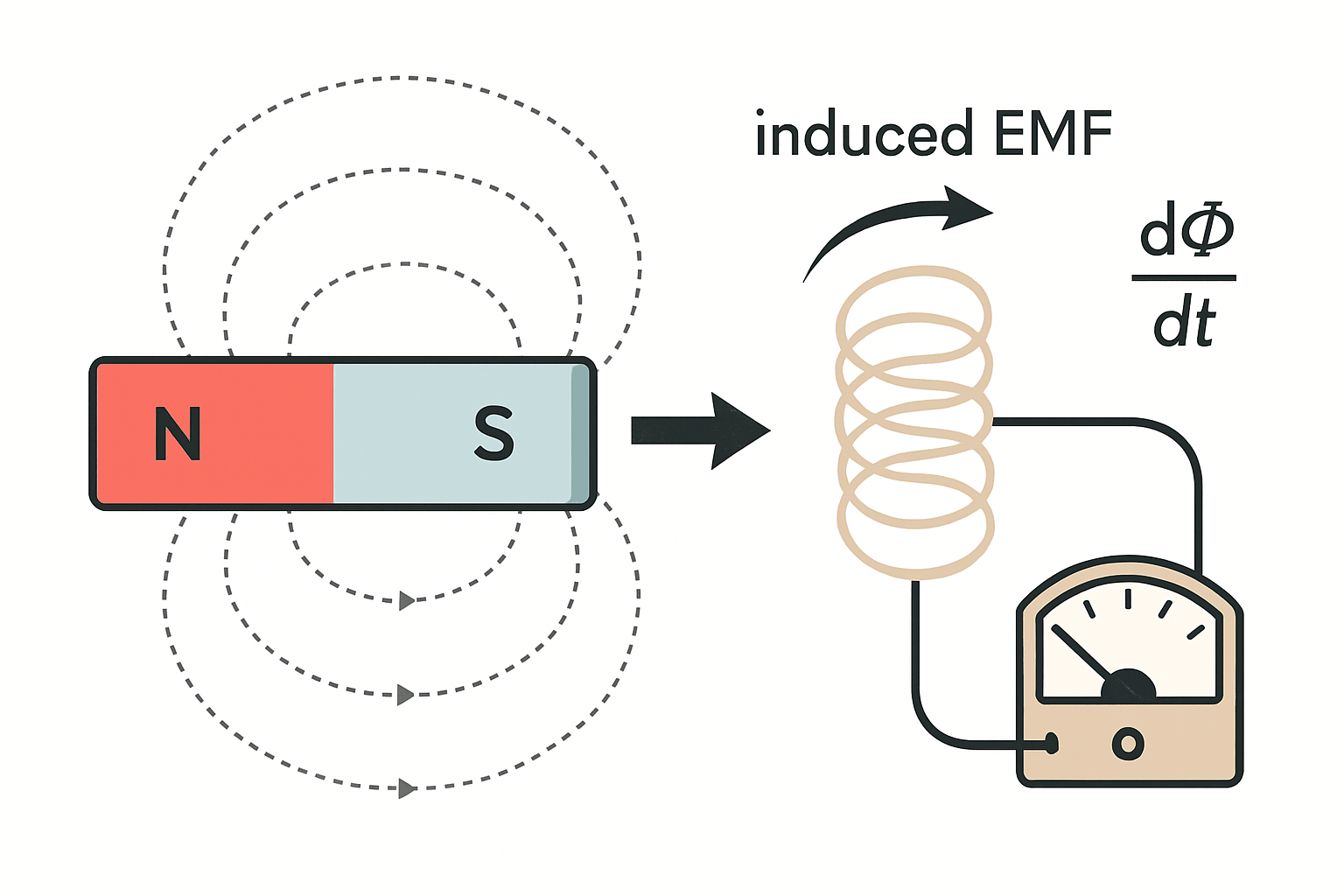
Faraday’s law of electromagnetic induction states that a changing magnetic flux through a closed loop induces an electromotive force (EMF) in that loop. Discovered by Michael Faraday in 1831, it’s the principle behind generators, transformers, electric motors, induction cooktops, microphones, and most of the electrical infrastructure of the modern world. Together with Ampère’s law and Maxwell’s equations, it links electricity and magnetism into a single unified theory.
An induced emf depends on the rate of change of magnetic flux linkage. The flux can change through field strength, orientation or the loop’s geometry.
The Law
The induced EMF in a circuit equals the negative rate of change of magnetic flux through the circuit:
$$ \varepsilon = -\frac{d\Phi_B}{dt} $$
For a coil with \( N \) turns, the EMFs add:
$$ \varepsilon = -N \frac{d\Phi_B}{dt} $$
The magnetic flux \( \Phi_B \) through a surface is the integral of the magnetic field \( \vec{B} \) over the surface area:
$$ \Phi_B = \int \vec{B} \cdot d\vec{A} $$
For a uniform field perpendicular to a flat area: \( \Phi_B = BA \). Units: webers (Wb = T·m²).
Lenz’s Law: the Minus Sign
The minus sign in Faraday’s law isn’t decoration, it encodes Lenz’s law: the induced current flows in the direction that opposes the change in flux. If the flux through a coil is increasing, the induced current creates a magnetic field pointing the opposite way to fight that increase. If the flux is decreasing, the induced current tries to maintain it. This is a consequence of conservation of energy: if induced currents reinforced the change, you’d get free energy.
Three Ways to Change the Flux
Flux through a loop changes if any of three things changes:
- The magnetic field \( B \). Moving a magnet toward or away from the loop changes \( B \) at the loop’s location. This is the most common textbook setup.
- The area \( A \). A loop expanding, contracting, or moving partly out of a magnetic field region changes the area enclosing flux.
- The angle between \( B \) and the loop’s normal. Rotating a loop in a uniform field changes the dot product \( B \cos\theta \). This is the basis of every electrical generator.
Worked Example: A Coil in a Changing Field
A circular coil with 50 turns and radius 0.10 m sits in a magnetic field that changes from 0.20 T to 0.50 T over 0.10 s. The field is perpendicular to the coil. Find the induced EMF.
Area \( A = \pi r^2 = \pi (0.10)^2 = 0.0314 \) m². Flux change per turn: \( \Delta \Phi = (0.50 – 0.20) \cdot 0.0314 = 0.00942 \) Wb. EMF: \( \varepsilon = -N \Delta\Phi / \Delta t = -50 \cdot 0.00942 / 0.10 = -4.71 \) V. Magnitude: 4.71 V.
Applications
- Generators. A coil rotating in a magnetic field has a sinusoidally varying flux, producing an AC EMF. Every power plant in the world, coal, gas, nuclear, hydro, wind, is a turbine spinning a generator.
- Transformers. An AC current in a primary coil produces a changing flux that induces an EMF in a secondary coil. The turns ratio determines the voltage ratio. Transformers are why long-distance power transmission is feasible.
- Induction cooktops. An AC current in a coil under the cooktop induces eddy currents in a ferromagnetic pan. The pan’s resistance turns those currents into heat.
- Microphones. A diaphragm moving in response to sound vibrates a coil attached to it within a magnetic field, inducing an EMF that mirrors the sound waveform.
- RFID and wireless charging. A changing magnetic field from a transmitter induces a current in a tuned receiver coil, used for contactless cards, key fobs, and phone charging pads.
Related study notes: Electromagnetic Induction, Lenz’s Law, Maxwell’s Equations, Ohm’s Law.
The OpenStax physics textbooks develop the corresponding physical models with further worked problems.
A Flux-Change Calculation
A 100-turn coil has area 0.010 m². A perpendicular uniform magnetic field increases from 0 to 0.20 T in 0.050 s. The average induced-emf magnitude is N A ΔB/Δt = 4 V.
The sign expresses Lenz’s law: the induced response opposes the change in flux, with orientation set by the chosen loop direction. This opposition concerns the change, not a rule that the induced field always opposes the original field. A decreasing external flux can induce a response in the same field direction.
The points to check in this example are:
- Flux uses the field component normal to the surface.
- A stationary magnet and loop can have nonzero flux but zero induced emf if that flux is constant.
- The coil-turn factor applies to linked flux through the turns.
Check Your Understanding
Try the questions before reading the answers.
Question 1. What is the flux per turn at 0.20 T here?
Answer. 0.002 Wb.
Question 2. Would taking twice as long halve the average emf?
Answer. Yes, for the same total flux change.
Practice Questions
Work each question before reading its solution. The set runs from direct recall and substitution to the applied questions that exams actually use to separate grades. The downloadable PDF includes these questions and their solutions.
Question 1. State Faraday’s law in words and as an equation.
Solution. The EMF induced in a loop equals the rate of change of magnetic flux through it: \(\mathcal{E} = -\frac{d\Phi_B}{dt}\), with \(\Phi_B = BA\cos\theta\). For a coil of \(N\) turns, multiply by \(N\). Only changing flux induces; steady flux, however strong, induces nothing.
Question 2. A magnet rests motionless inside a coil connected to a meter. What does the meter read, and why?
Solution. Zero. The flux through the coil is large but constant, and induction responds only to change. Move the magnet, or the coil, and the needle swings. This single observation is the heart of the law.
Question 3. The flux through a 50-turn coil rises from 0.02 Wb to 0.08 Wb in 0.3 s. Find the average induced EMF.
Solution. \(\mathcal{E} = N\frac{\Delta\Phi}{\Delta t} = 50 \times \frac{0.06}{0.3} = 10\) V. Each turn contributes the same 0.2 V, and the turns add like batteries in series.
Question 4. State Lenz’s law and explain what the minus sign in Faraday’s law encodes.
Solution. The induced current flows in the direction that opposes the change creating it. Push a north pole toward a loop and the loop’s face becomes a north pole to repel it; pull away and it becomes south to attract. The minus sign is energy conservation in disguise: an induction that aided the change would amplify itself into free energy.
Question 5. A conducting rod of length 0.5 m slides at 4 m/s along rails through a 0.2 T field perpendicular to the circuit plane. Find the motional EMF.
Solution. \(\mathcal{E} = BLv = 0.2 \times 0.5 \times 4 = 0.4\) V. The sliding rod sweeps out area, changing the circuit’s flux at rate \(BLv\); the formula is Faraday’s law for straight-line motion.
Question 6. Name the 3 independent ways to change the flux \(\Phi_B = BA\cos\theta\), and the machine built on the third.
Solution. Change the field strength \(B\) (move a magnet, vary a current), change the area \(A\) (slide a rod, deform a loop), or change the angle \(\theta\) (rotate the coil). Rotation at steady speed makes \(\cos\theta\) oscillate, giving alternating EMF: that machine is the AC generator, and it produces essentially all grid electricity.
Question 7. A coil rotating at frequency \(f\) in a field produces \(\mathcal{E} = \mathcal{E}_0\sin(2\pi f t)\). What happens to the peak EMF if the rotation speed doubles?
Solution. It doubles. The EMF is the time derivative of flux, and rotating twice as fast changes the same flux twice as quickly, so \(\mathcal{E}_0 = NBA \cdot 2\pi f\) scales with \(f\). Doubling speed also doubles the output frequency.
Question 8. Why does dropping a strong magnet down a copper pipe take visibly longer than dropping a steel bolt?
Solution. The falling magnet changes the flux through every ring of pipe it passes. Each ring develops eddy currents which, by Lenz’s law, oppose the motion: the rings below repel the approaching pole, the rings above attract the receding one. The magnet falls against a continuous magnetic brake. Copper is not magnetic; the braking is pure induction.
Question 9. A transformer works on mains AC but not on a battery’s DC. Explain with Faraday’s law.
Solution. The primary coil induces voltage in the secondary only while its flux changes. AC changes flux continuously, so the secondary sees continuous induction. A steady DC current makes a steady flux and induces nothing after the first instant; only at switch-on and switch-off does the secondary blip.
Question 10. An induction cooktop heats an iron pan but leaves the glass surface cool. What is happening?
Solution. A coil under the glass drives a rapidly alternating magnetic field. The conducting pan base sits in that changing flux, so large eddy currents circulate in it, and the pan’s own electrical resistance turns them into heat. Glass conducts no current and stays cool; the pan is literally the heating element.
Frequently Asked Questions
What is Faraday’s law of induction?
A changing magnetic flux through a closed loop induces an electromotive force (EMF) in that loop. The induced EMF equals the negative rate of change of flux: ε = -dΦ/dt. For a coil with N turns, the total EMF is N times the single-turn value.
Why is there a minus sign in Faraday’s law?
It encodes Lenz’s law, the induced current always flows in a direction that opposes the change in flux. This is required by conservation of energy: if the induced current reinforced the change, you’d be creating energy from nothing. The minus sign is the mathematical expression of this opposition.
How does a generator use Faraday’s law?
A coil rotates in a magnetic field. As the angle between the coil and the field changes, the flux through the coil changes sinusoidally, inducing a sinusoidal EMF. The frequency of the AC output equals the rotation frequency. Every commercial electric generator works this way.
What’s the difference between Faraday’s law and Lenz’s law?
Faraday’s law gives the magnitude of the induced EMF; Lenz’s law gives its direction. They’re really two parts of one statement, the minus sign in ε = -dΦ/dt is Lenz’s law expressed mathematically. Faraday discovered both; the sign convention bearing Lenz’s name was added by Heinrich Lenz in 1834.
How do transformers use Faraday’s law?
An AC current in the primary coil produces a changing magnetic flux in a shared iron core. That changing flux passes through a secondary coil and induces an AC EMF in it. The voltage ratio equals the turns ratio: V_secondary / V_primary = N_secondary / N_primary. Step-up transformers raise voltage for transmission; step-down transformers lower it for use.
Who was Michael Faraday?
An English experimental physicist (1791-1867) who came from a poor family with no formal education beyond grade school. Despite that, he discovered electromagnetic induction in 1831, invented the first electric motor and generator, established the laws of electrolysis, and introduced the concept of electric and magnetic fields. Einstein kept a portrait of Faraday on his wall alongside Newton and Maxwell.
Browse more in Physics.