
Ohm’s Law
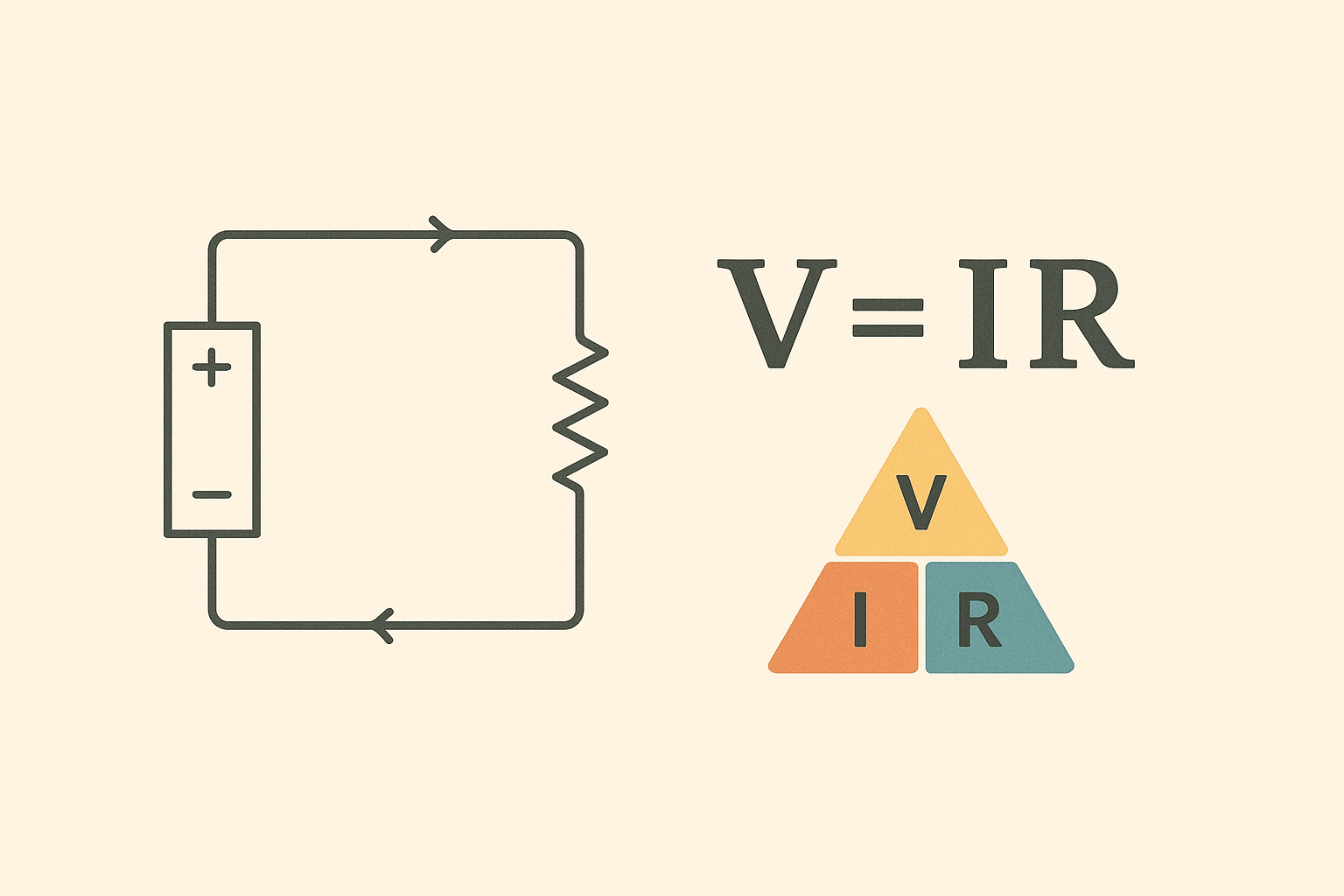
Ohm’s law is the most fundamental equation in electrical circuits: \( V = IR \). Voltage equals current times resistance. Once you know any two of those three quantities, you can calculate the third. Georg Simon Ohm published the relationship in 1827 after extensive experiments with copper wire, and it has been the backbone of circuit analysis ever since. Every electrical engineer, every electrician, every physics student starts here. The deceptive simplicity hides the fact that this one equation lets you design and analyze nearly every direct-current circuit you’ll encounter.
The Equation
Ohm’s law in its standard form:
$$ V = IR $$
Each symbol has a specific meaning and unit:
- V = voltage (potential difference), measured in volts (V). The ‘electrical pressure’ that pushes current through a conductor.
- I = current, measured in amperes (A). The rate at which charge flows. 1 ampere = 1 coulomb per second.
- R = resistance, measured in ohms (Ω). How much a material opposes the flow of current.
The equation is easily rearranged to solve for any unknown:
$$ V = IR \qquad I = \dfrac{V}{R} \qquad R = \dfrac{V}{I} $$
The classic ‘V-I-R triangle’ (V on top, I and R on the bottom) is a mnemonic: cover the quantity you want and the visible arrangement of the other two tells you the formula.
What Ohm’s Law Actually Says
The physical meaning: the current through a conductor is directly proportional to the voltage across it, with resistance as the constant of proportionality. Double the voltage and (for an ohmic material) the current doubles. Double the resistance and the current halves for the same voltage.
‘Ohmic’ is an important qualifier. A material is ohmic if its resistance is constant — independent of the voltage applied. Most common conductors (copper, silver, aluminum) are approximately ohmic at constant temperature. Some components (diodes, transistors, light bulbs at high current) are non-ohmic — their resistance changes with voltage or current, and Ohm’s law alone is not enough to describe them.
Worked Examples
Example 1. A 9-volt battery is connected to a 100-ohm resistor. What current flows?
\( I = V/R = 9 / 100 = 0.09 \,\text{A} = 90 \,\text{mA} \).
Example 2. A circuit draws 2 amperes when 12 volts is applied. What is its resistance?
\( R = V/I = 12 / 2 = 6 \,\Omega \).
Example 3. What voltage is needed to push 5 amperes through a 10-ohm coil?
\( V = IR = 5 \times 10 = 50 \,\text{V} \).
Power and Ohm’s Law
Closely related to Ohm’s law is the equation for electrical power:
$$ P = VI $$
Power is measured in watts (W). Substituting Ohm’s law gives three useful forms:
$$ P = VI = I^2 R = \dfrac{V^2}{R} $$
These are sometimes called Joule’s law (after James Prescott Joule). They tell you how much energy a circuit element dissipates per second. A 60-watt bulb at 120 V draws 0.5 A and has resistance 240 Ω. A toaster at 1000 W and 120 V draws 8.3 A and has resistance 14.4 Ω.
Series and Parallel Circuits
Real circuits combine multiple resistors. Two basic ways to wire them, with very different consequences.
Series
Resistors connected end-to-end. The same current flows through each. Total resistance is the sum:
$$ R_{total} = R_1 + R_2 + R_3 + \cdots $$
Voltages add: the supply voltage equals the sum of voltage drops across each resistor. If one resistor breaks (open circuit), the whole chain stops working — which is why old Christmas lights used to fail completely when one bulb died.
Parallel
Resistors connected side-by-side, each spanning the same two nodes. The same voltage appears across each. Total resistance is the reciprocal sum:
$$ \dfrac{1}{R_{total}} = \dfrac{1}{R_1} + \dfrac{1}{R_2} + \dfrac{1}{R_3} + \cdots $$
Currents add: total current equals the sum through each branch. If one branch breaks, the others keep working. Household wiring is parallel — that is why unplugging the toaster does not turn off the lamp.
When Ohm’s Law Breaks Down
Ohm’s law assumes a few things that are not always true:
- Temperature dependence. Resistance of most metals increases with temperature. A tungsten light bulb’s resistance is much higher when lit (hot) than when cold. Strictly speaking, Ohm’s law only holds at constant temperature.
- Non-ohmic devices. Diodes, transistors, semiconductors, gas discharge tubes — these have voltage-dependent resistance. Their current-voltage curves are not straight lines.
- Very high frequencies. At high frequencies, capacitance and inductance dominate, and you need impedance (the AC generalization of resistance) plus reactance to describe the behavior fully.
- Superconductors. At very low temperatures, certain materials have zero resistance. Ohm’s law in the form V = IR breaks down — V can be zero while I is finite.
Related study notes: Coulomb’s Law, Maxwell’s Equations, Special Relativity, International System of Units.
Frequently Asked Questions
What is Ohm’s law in simple terms?
Ohm’s law says voltage = current × resistance (V = IR). It is the fundamental equation of DC circuit analysis: if you know any two of voltage, current, and resistance, you can calculate the third. The law was published by Georg Simon Ohm in 1827 and is the foundation of every electrical engineering and physics course.
What are the units in Ohm’s law?
Voltage is in volts (V), current is in amperes (A), and resistance is in ohms (Ω). 1 ohm is defined as the resistance that produces 1 ampere of current under 1 volt of applied potential difference. The units are deliberately defined so that V = IR works directly with no conversion factors.
How do you calculate power using Ohm’s law?
Power equals voltage times current: P = VI. Substituting Ohm’s law gives two more useful forms: P = I²R and P = V²/R. These are sometimes called Joule’s law. Power is measured in watts. A 60-watt bulb at 120 V draws 0.5 A and has 240 Ω resistance.
What is the difference between series and parallel circuits?
In series, resistors are end-to-end and the same current flows through each — total resistance adds (R_total = R1 + R2 + …). In parallel, resistors share the same two nodes and the same voltage appears across each — total resistance follows the reciprocal sum (1/R_total = 1/R1 + 1/R2 + …). Series chains fail completely when one element breaks; parallel branches keep working independently.
When does Ohm’s law not apply?
Ohm’s law assumes a constant resistance — a so-called ohmic material. It breaks down for non-ohmic devices like diodes, transistors, and gas discharge tubes (where resistance depends on voltage), for components whose temperature changes significantly (most metals’ resistance rises with temperature), for very high-frequency AC circuits (where impedance matters more than resistance), and for superconductors (zero resistance).
What is the V-I-R triangle?
A mnemonic: draw a triangle with V on top and I and R on the bottom corners. To find any quantity, cover it with your finger; the visible arrangement gives the formula. Cover V to see I × R (V = IR). Cover I to see V over R (I = V/R). Cover R to see V over I (R = V/I). Useful for students who struggle with rearranging algebra under exam pressure.