
Coulomb’s Law
Coulomb’s law describes the electric force between two stationary point charges. Charles-Augustin de Coulomb worked it out in 1785 using a torsion balance, and it remains one of the most precisely tested laws in physics. The force is proportional to the product of the two charges and inversely proportional to the square of the distance between them. Same-sign charges repel; opposite-sign charges attract. The structural similarity to Newton’s law of gravitation is striking — both are inverse-square laws — and the consequences ripple through chemistry, atomic physics, and electromagnetism.
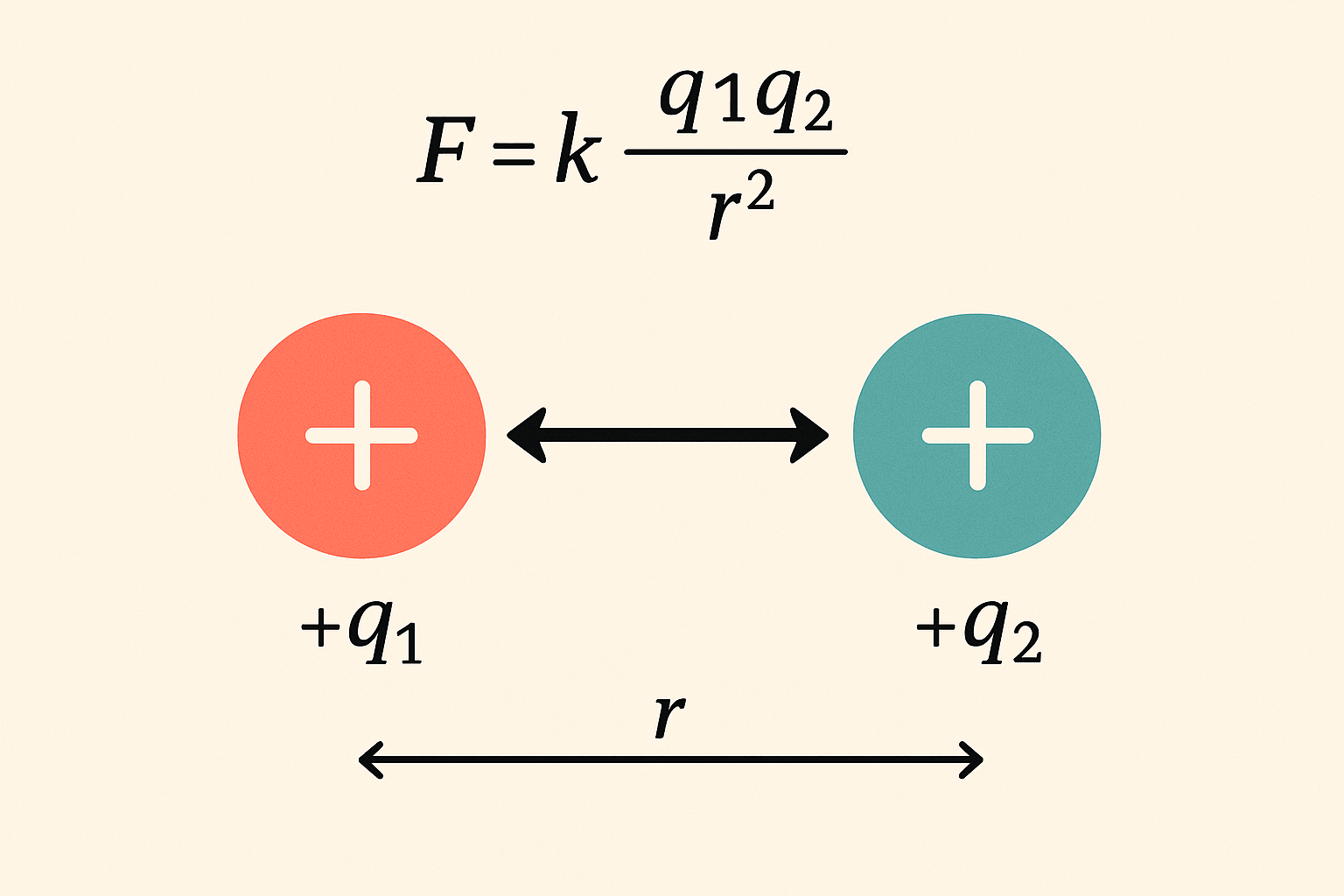
The Equation
Coulomb’s law for two point charges:
$$ F = k \dfrac{|q_1 q_2|}{r^2} $$
Each symbol:
- F = magnitude of the electric force, in newtons (N)
- q₁, q₂ = charges of the two particles, in coulombs (C)
- r = distance between them, in meters (m)
- k = Coulomb’s constant, \( k \approx 8.99 \times 10^9 \) N·m²/C²
The direction: force points along the line connecting the two charges. If \( q_1 \) and \( q_2 \) have the SAME sign, the force is REPULSIVE (each pushes the other away). If they have OPPOSITE signs, the force is ATTRACTIVE (they pull toward each other). Coulomb’s law gives only the magnitude — direction comes from the sign convention.
Coulomb’s constant is sometimes written as \( k = 1/(4\pi\epsilon_0) \), where \( \epsilon_0 \approx 8.854 \times 10^{-12} \) F/m is the permittivity of free space. Both forms are common in textbooks.
How Strong Is the Electric Force?
Astonishingly strong compared to gravity. Two electrons one meter apart repel with electric force \( \approx 2.3 \times 10^{-28} \) N. They attract gravitationally with force \( \approx 5.5 \times 10^{-71} \) N. The electric force is roughly \( 4 \times 10^{42} \) times stronger than gravity at the particle scale.
Why does gravity dominate at large scales then? Because matter is electrically neutral. Positive and negative charges balance almost exactly in any normal piece of matter, so the net electric force at large distances is essentially zero. Gravity has no opposite sign — masses always attract, so gravitational effects accumulate over large distances. Electric forces dominate inside atoms; gravity dominates between planets.
Worked Examples
Example 1. Two charges of +2 μC and +3 μC sit 0.5 m apart. Find the force between them.
\( F = (8.99 \times 10^9) \times (2 \times 10^{-6}) \times (3 \times 10^{-6}) / (0.5)^2 \approx 0.216 \) N. Repulsive (both positive).
Example 2. An electron orbits a proton at the Bohr radius \( a_0 \approx 5.29 \times 10^{-11} \) m. What is the attractive force?
\( F = (8.99 \times 10^9) \times (1.6 \times 10^{-19})^2 / (5.29 \times 10^{-11})^2 \approx 8.24 \times 10^{-8} \) N. This is the force that keeps the hydrogen atom together.
Example 3. Comparing to gravity: same electron-proton pair at the Bohr radius. Gravitational force \( F_g = G m_e m_p / r^2 \approx 3.6 \times 10^{-47} \) N. The Coulomb force is \( 2.3 \times 10^{39} \) times stronger. This is why inside atoms gravity is utterly negligible.
Inverse Square Law and Why It Matters
The \( 1/r^2 \) dependence has a clean geometric origin. Imagine the electric force from a point charge spreading out radially in all directions. The total ‘flux’ is conserved as you move outward, but the area of a sphere at radius \( r \) is \( 4\pi r^2 \). So the flux per unit area falls as \( 1/r^2 \). Newton’s gravitational law has the same form for the same geometric reason.
Experimentally, Coulomb’s law has been verified to extraordinary precision. The exponent in \( 1/r^n \) has been measured to be \( n = 2 \) to within parts per billion. Any deviation would imply the photon has nonzero mass, and decades of careful experiments place an upper bound on the photon mass of about \( 10^{-54} \) kg — essentially zero.
Superposition and Multiple Charges
Coulomb’s law tells you the force between two charges. For systems with more charges, the electric force on any one charge is the vector sum of the forces from each other charge separately. This is the principle of superposition, and it makes electric-force calculations tractable for any number of charges.
For \( N \) charges, the net force on charge \( q_0 \) is:
$$ \vec{F}_{net} = \sum_{i=1}^N k \dfrac{q_0 q_i}{r_i^2} \hat{r}_i $$
where \( \hat{r}_i \) is the unit vector from charge \( i \) to charge \( q_0 \). For continuous charge distributions, the sum becomes an integral.
Coulomb’s Law in Chemistry
Most of chemistry runs on Coulomb’s law one layer down. Ionic bonding is electrostatic attraction between cation and anion — Coulomb’s law explains the bond energy. Lattice energies of crystals come from summing Coulomb forces over all ion pairs. Bond strengths, melting points, solubilities of ionic compounds all trace back to Coulombic interactions.
Even covalent bonds have a Coulombic component. The nuclei of two bonded atoms attract the shared electron cloud between them; that attraction is Coulomb’s law operating between the nuclei and the bonding electrons. Quantum mechanics modifies the picture (electrons exist as probability clouds, not point particles), but the underlying electric force is still Coulomb.
Related study notes: Ohm’s Law, Electronegativity, Maxwell’s Equations, Chemical Bonding.
Frequently Asked Questions
What is Coulomb’s law?
Coulomb’s law describes the electric force between two stationary point charges: F = k q1 q2 / r², where k is Coulomb’s constant (about 8.99 × 10⁹ N·m²/C²), q1 and q2 are the charges in coulombs, and r is the distance in meters. Same-sign charges repel, opposite-sign charges attract. The force falls off as the inverse square of the distance.
How strong is the electric force compared to gravity?
Astonishingly stronger. Between two electrons, the electric force is about 4 × 10⁴² times stronger than gravity. Gravity dominates at planetary scales only because matter is electrically neutral — positive and negative charges cancel out. Inside atoms, electric forces overwhelm gravity by 40 orders of magnitude.
What is Coulomb’s constant?
Coulomb’s constant k = 8.99 × 10⁹ N·m²/C². It is the proportionality constant in Coulomb’s law. Equivalently, k = 1 / (4πε₀), where ε₀ is the permittivity of free space (about 8.854 × 10⁻¹² F/m). Both forms appear in textbooks; physics in SI units typically uses ε₀, while engineering practice often uses k directly.
Why is Coulomb’s law an inverse-square law?
For the same geometric reason that gravitational force is. A point source of any conserved flux spreading out radially has its flux distributed over a sphere of area 4πr². So flux per unit area falls as 1/r². Coulomb’s law and Newton’s gravitational law both have this form because both describe the field of a point source in three-dimensional space.
How precisely has Coulomb’s law been tested?
Extraordinarily precisely. The exponent in the 1/r^n dependence has been measured to be n = 2 within parts per billion. Any deviation would imply the photon has nonzero mass, and experiments place an upper bound on the photon mass at about 10⁻⁵⁴ kg — essentially zero. Coulomb’s law is one of the most thoroughly tested laws in all of physics.
What is the superposition principle?
The electric force on any one charge from multiple other charges is the vector sum of the individual Coulomb forces from each of the others, calculated as if no other charge existed. Superposition makes electric-force calculations tractable for any number of charges — you can solve them one pair at a time and add up the results. It is the basis for solving every multi-charge electrostatics problem.