by
by
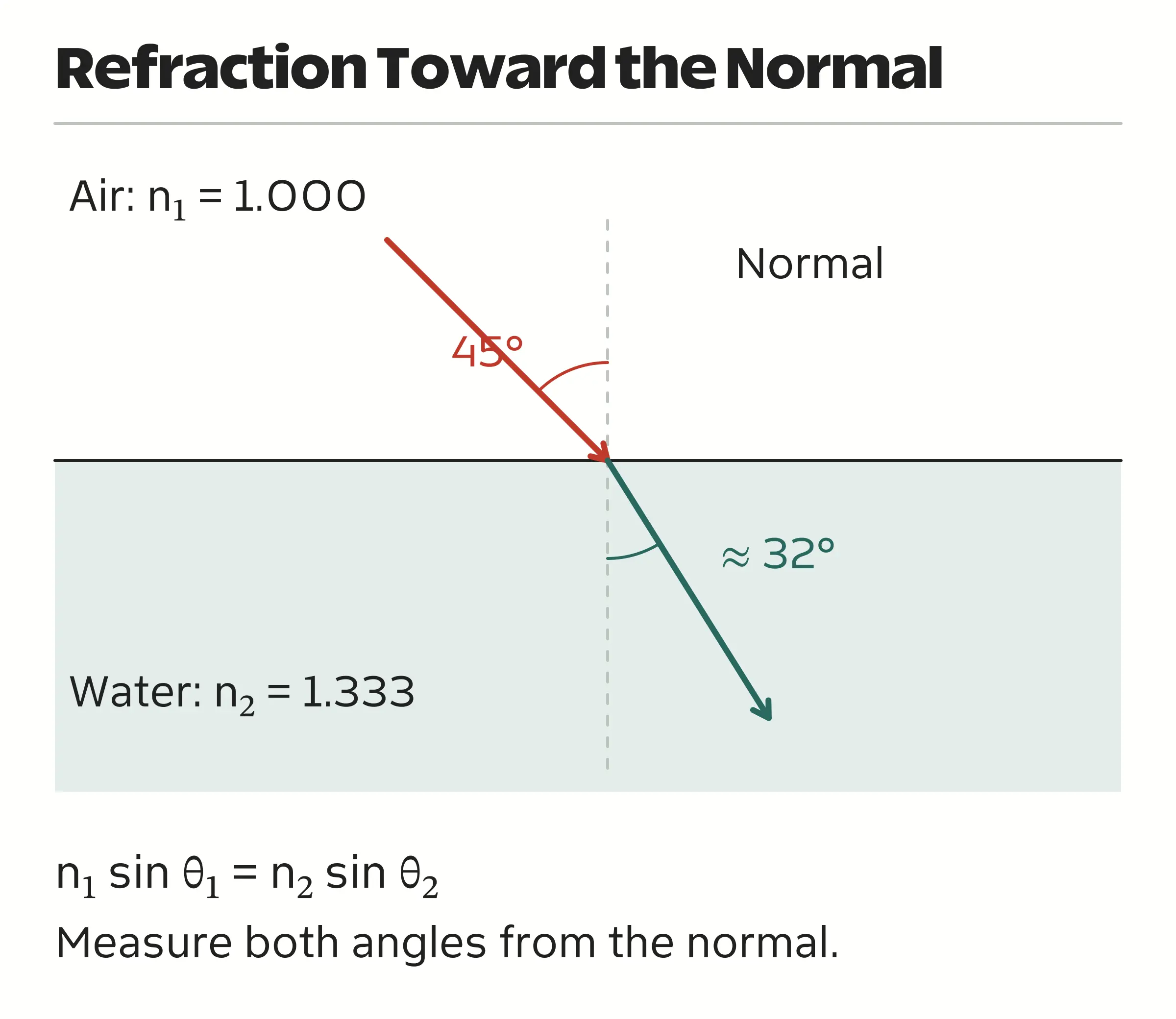
Snell’s law relates the incident and refracted angles when a wave crosses an interface between media. For ordinary optical materials, \(n_1\sin\theta_1=n_2\sin\theta_2\). Both angles are measured from the normal, not from the surface.
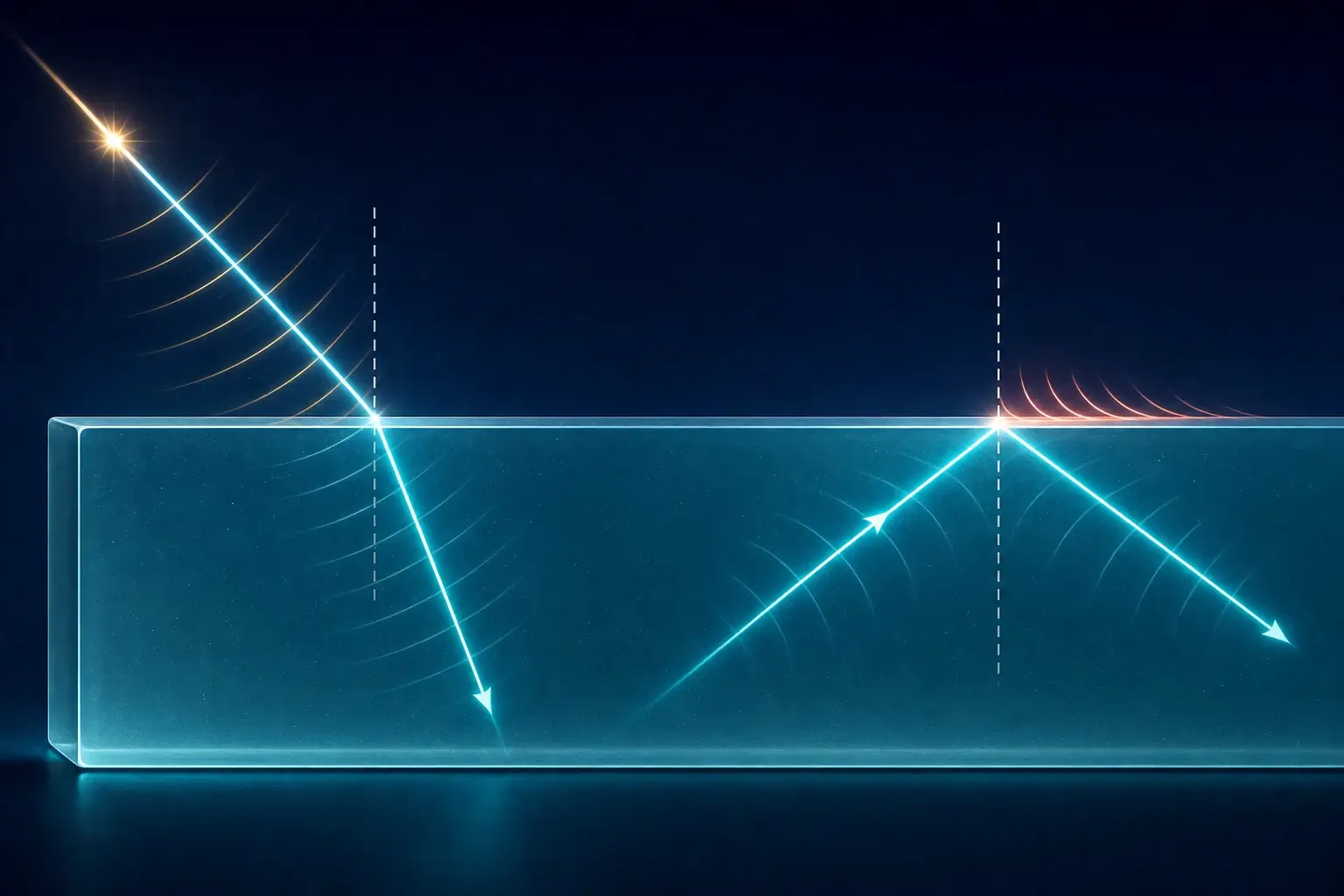
The incidence and refraction angles are measured from the normal. Total internal reflection requires travel from a higher refractive index toward a lower one.
That angle convention is the mistake to eliminate first. Light bends toward the normal when it enters a medium with higher refractive index and away from the normal when it enters a lower-index medium.
If you want to check a value before working it by hand, use the Snell’s law calculator. It keeps the unit conversion beside the result, which is where most avoidable mistakes happen.
What Is Snell’s Law?
$$n_1\sin\theta_1=n_2\sin\theta_2$$
Here \(n_1\) and \(n_2\) are refractive indices, \(\theta_1\) is the incidence angle, and \(\theta_2\) is the refraction angle. The incident ray, refracted ray, and normal lie in the same plane.
| Situation | Direction of bending | Speed change |
|---|---|---|
| \(n_2>n_1\) | Toward the normal | Wave slows |
| \(n_2<n_1\) | Away from the normal | Wave speeds up |
| \(n_2=n_1\) | No direction change | No speed change |
| \(\theta_1=0\) | No direction change | Speed and wavelength can still change |
The refractive index is \(n=c/v\), where \(c\) is light speed in vacuum and \(v\) is phase velocity in the medium. Frequency stays the same across a stationary interface, while speed and wavelength change.
How to Use Snell’s Law
A reliable solution begins with geometry. Label the incident medium before moving any terms, because an index swap reverses the physical interpretation.
- Draw the interface and a normal perpendicular to it.
- Measure or identify both angles from the normal.
- Assign the refractive index on each side.
- Rearrange for the unknown sine.
- Check that the sine is between zero and one.
- Use the physical direction of bending to catch index or angle swaps.
Worked Example: Air to Glass
Take \(n_1=1.000\), \(n_2=1.50\), and \(\theta_1=40.0^\circ\). Then
$$\sin\theta_2=\frac{n_1}{n_2}\sin\theta_1=\frac{1.000}{1.50}\sin40.0^\circ\approx0.4285$$
$$\theta_2\approx25.4^\circ$$
The refracted angle is smaller, so the ray bends toward the normal as expected when entering the higher-index medium.
Why Refraction Happens
At an interface, the wave’s frequency is fixed by continuity in time. The wave speed changes with the medium, so its wavelength changes. The part of an oblique wavefront that enters first changes speed first, rotating the wavefront and therefore the propagation direction.
$$v=f\lambda,\qquad n=\frac{c}{v}$$
The same relation can be derived from phase matching along the interface or from Fermat’s principle of stationary optical time. These are compatible descriptions, not rival causes.
Critical Angle and Total Internal Reflection
Total internal reflection can occur only when light travels from a higher refractive index to a lower one. As the incident angle increases, the refracted angle approaches \(90^\circ\). The incident angle at that limit is the critical angle.
$$\sin\theta_c=\frac{n_2}{n_1}\qquad(n_1>n_2)$$
Worked Example: Glass to Air
For \(n_1=1.50\) and \(n_2=1.00\)
$$\theta_c=\sin^{-1}\!\left(\frac{1.00}{1.50}\right)\approx41.8^\circ$$
At incident angles above \(41.8^\circ\), no propagating refracted ray carries energy into the air in the ideal model. The OpenStax total internal reflection guide develops this condition and its optical-fibre applications.
Optical Fibres and Numerical Aperture
An optical fibre traps light because its core has a slightly higher refractive index than its cladding. Rays that meet the core-cladding boundary above the critical angle undergo total internal reflection. Not every ray entering the fibre is accepted; the entrance geometry sets an acceptance cone.
$$\mathrm{NA}=\sqrt{n_{\mathrm{core}}^2-n_{\mathrm{clad}}^2}$$
For a fibre in air, the numerical aperture approximately equals the sine of the maximum acceptance half-angle. Real fibres also have bending loss, absorption, scattering, dispersion, and mode constraints.
Dispersion and Colour
Refractive index depends on wavelength. In ordinary transparent glass across much of the visible range, shorter wavelengths usually have a larger refractive index than longer wavelengths, so violet light bends more than red light in a prism.
Use \(n(\lambda)\) for precision work. A single quoted refractive index usually assumes a specified wavelength and temperature. The colour separation is not an exception to Snell’s law; it is Snell’s law applied with a wavelength-dependent index.
Apparent Depth
An object under water looks shallower because rays refract away from the normal as they leave water for air. Your eye extends the rays backward in straight lines and assigns the object an apparent position above its real position.
For nearly normal viewing across a flat interface, the paraxial approximation gives
$$\frac{\text{apparent depth}}{\text{real depth}}\approx\frac{n_{\text{observer}}}{n_{\text{object medium}}}$$
At larger angles, use Snell’s law and the geometry directly. The simple depth ratio is an approximation, not a universal formula.
Refraction is one part of wave optics. The physics basics study notes provide a wider map of waves, fields, and the models used across introductory physics.
What Snell’s Law Does Not Cover by Itself
- Reflection strength: use the Fresnel equations to find how much power reflects and transmits.
- Anisotropic crystals: refractive index can depend on direction and polarization, producing birefringence.
- Graded-index media: a continuously changing index bends rays gradually rather than at one sharp boundary.
- Strong diffraction: when structures are comparable to wavelength, ray optics can be inadequate.
- Negative-index metamaterials: require careful sign conventions and electromagnetic boundary analysis.
Common Mistakes
- Measuring from the surface: all Snell angles are measured from the normal.
- Swapping indices: label the incident side as medium 1 before substituting.
- Expecting frequency to change: frequency remains continuous at a stationary boundary.
- Claiming total internal reflection from low to high index: it requires travel from higher to lower index.
- Ignoring wavelength: refractive index and critical angle can vary with colour.
- Accepting a sine above one: that signals total internal reflection or a setup error.
Related Physics Guides
Use these next if you want to connect this result with the surrounding physics:
Key Takeaways
- Snell’s law is \(n_1\sin\theta_1=n_2\sin\theta_2\).
- Angles are measured from the normal.
- Light bends toward the normal on entering a higher-index medium.
- Total internal reflection requires travel from higher to lower refractive index and incidence above the critical angle.
- Frequency stays fixed while speed and wavelength change at the boundary.
Refraction and the Critical Angle
For light entering water from air at 45°, use n1 = 1.000 and n2 = 1.333. Snell’s law gives sin θ2 = sin 45°/1.333, so θ2 is about 32.0°. The ray bends toward the normal.
For water to air, the critical angle is arcsin(1/1.333), about 48.6°. Above that incidence angle, an ordinary propagating refracted ray does not carry light into the lower-index medium in the ideal interface model. The normal-angle convention keeps both calculations consistent.
The points to check in this example are:
- Refraction toward the normal occurs when the refractive index increases.
- The critical-angle formula requires the initial index to exceed the final index.
- Normal incidence produces no directional bending at a flat interface.
Check Your Understanding
Try the questions before reading the answers.
Question 1. What is the refraction angle at normal incidence?
Answer. 0°.
Question 2. Can air-to-water travel produce this total-internal-reflection condition?
Answer. No, because the final refractive index is higher.
Frequently Asked Questions
What is Snell’s law?
Snell’s law states that n1 sin θ1 = n2 sin θ2 for refraction at an interface. The angles are measured from the normal to the surface.
Does light bend toward or away from the normal?
Light bends toward the normal when it enters a higher refractive index and away from the normal when it enters a lower refractive index.
What stays constant when light enters another medium?
The frequency stays constant across a stationary boundary. The wave speed and wavelength change according to the refractive index.
What is the critical angle?
The critical angle is the incident angle in the higher-index medium for which the refracted ray in the lower-index medium reaches 90 degrees. Its sine is n2/n1.
When does total internal reflection happen?
It happens when light travels from a higher-index medium to a lower-index medium and strikes the boundary at an incident angle greater than the critical angle.
Why does a straw look bent in water?
Rays from the submerged part refract at the water-air boundary. Your eye traces those rays backward, so the underwater section appears displaced from its true position.
Draw the normal before writing the equation. If the normal is wrong, everything after it will be wrong too.
Browse more in Physics.