by
by
Pascal’s law states that any pressure applied to a confined, incompressible fluid is transmitted equally and undiminished to every point in the fluid and to the walls of its container. Formulated by Blaise Pascal in the 1650s, the principle is the foundation of every hydraulic system in use today, car brakes, aircraft controls, construction equipment, dental chairs, and the hydraulic press that turns a small force into a large one.
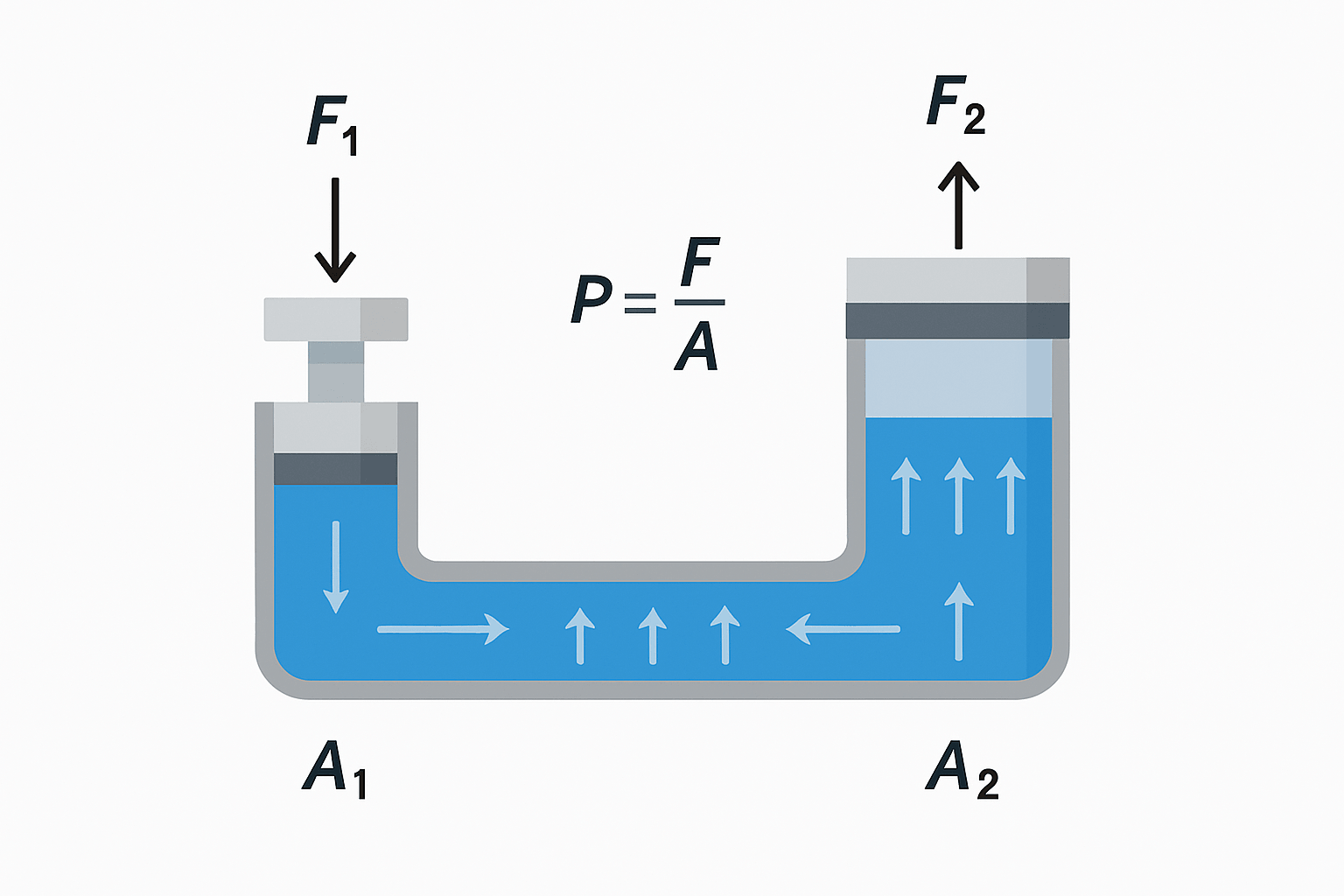
A hydraulic press transmits a pressure change through confined fluid. Its force advantage is accompanied by a displacement tradeoff.
Statement and Formula
Pressure is force per unit area:
$$ P = \frac{F}{A} $$
Pascal’s law: in a confined incompressible fluid, the change in pressure at any point is transmitted equally throughout the fluid. So if a force \( F_1 \) is applied to area \( A_1 \), the pressure increase \( P = F_1/A_1 \) is felt everywhere. The same pressure acting on a different area \( A_2 \) produces a different force:
$$ \frac{F_1}{A_1} = \frac{F_2}{A_2} \quad \Rightarrow \quad F_2 = F_1 \cdot \frac{A_2}{A_1} $$
This is the working equation of every hydraulic system.
The Hydraulic Press
A small piston of area \( A_1 \) is connected by an oil-filled tube to a large piston of area \( A_2 \). Push down on the small piston with force \( F_1 \) and the large piston pushes up with force \( F_2 = F_1 \cdot A_2/A_1 \). If \( A_2 = 100 A_1 \), a 100 N input produces 10,000 N of output force. That’s mechanical advantage.
Conservation of Energy
Force amplification doesn’t come free. The volume of fluid pushed out from under the small piston equals the volume pushed up under the large piston: \( A_1 d_1 = A_2 d_2 \). So the small piston moves a long distance \( d_1 \) for every tiny distance \( d_2 \) the large piston moves. The work done is the same: \( F_1 d_1 = F_2 d_2 \). Pascal’s law trades distance for force, exactly what a lever does, only with fluid instead of a rigid bar.
Worked Example: Car Brakes
A driver pushes a brake pedal that drives a master cylinder piston with area \( A_1 = 1.0 \) cm². The hydraulic fluid connects to four wheel-cylinder pistons each with area \( A_2 = 6.0 \) cm². The driver applies \( F_1 = 100 \) N.
Pressure: \( P = 100/(1.0 \times 10^{-4}) = 10^6 \) Pa (about 10 atm). At each wheel cylinder: \( F_2 = P \cdot A_2 = 10^6 \cdot 6.0 \times 10^{-4} = 600 \) N. With four wheels: 2,400 N of total braking force, 24× the pedal force.
Pressure in a Fluid Column
For a fluid at rest in a gravitational field, the pressure at depth \( h \) below the surface is:
$$ P = P_0 + \rho g h $$
where \( P_0 \) is the pressure at the surface (often atmospheric pressure, ~101 kPa). This is consistent with Pascal’s law, any change in \( P_0 \) (the surface pressure) shifts the entire pressure profile uniformly. Pascal’s law is the reason barometers work, why your ears pop on takeoff, and why dam walls are thicker at the bottom.
Applications
- Car brakes. Pedal force is converted to fluid pressure that pushes brake pads against wheel rotors at every wheel simultaneously.
- Hydraulic jacks and presses. Lift cars, crush scrap metal, stamp sheet steel, mould plastics, small input force, enormous output.
- Aircraft controls. Hydraulic systems move ailerons, rudders, elevators, landing gear, and flaps. Pilot inputs are amplified by hydraulics that can deliver megawatts of mechanical power.
- Excavators and construction equipment. Booms, buckets, and outriggers are all hydraulic.
- Dental and barber chairs. A pedal-operated hydraulic ram lifts an adult with light effort.
- Toothpaste tube. Squeeze anywhere, and Pascal’s law sends pressure to the open end uniformly.
Related study notes: Archimedes’ Principle, Pressure, Bernoulli’s Principle, Density.
The OpenStax physics textbooks develop the corresponding physical models with further worked problems.
Force and Displacement in a Press
A small piston has area 2 cm² and a large piston area 50 cm². Applying 100 N to the small piston produces a pressure increase of 500,000 Pa and an ideal large-piston force of 2,500 N.
If the small piston moves 10 cm, volume conservation makes the large piston move only 0.4 cm. The ideal input and output work are both 10 J. A force multiplier therefore does not create energy. Friction, leakage and fluid compression make a real press differ from the ideal calculation.
The points to check in this example are:
- Area ratios determine the ideal force ratio.
- Piston travel is inversely related to area under volume conservation.
- Hydrostatic pressure differences must be included if piston elevations differ materially.
Check Your Understanding
Try the questions before reading the answers.
Question 1. What is the ideal force ratio here?
Answer. 25.
Question 2. What happens to the output displacement if the output area doubles?
Answer. It halves for the same displaced fluid volume.
Practice Questions
Work each question before reading its solution. The set runs from direct recall and substitution to the applied questions that exams actually use to separate grades. The downloadable PDF includes these questions and their solutions.
Question 1. State Pascal’s law.
Solution. Pressure applied to an enclosed, incompressible fluid is transmitted undiminished to every point of the fluid and the container walls. Squeeze a sealed water bottle anywhere and the pressure rises by the same amount everywhere: the fluid has no way to favor a direction.
Question 2. A hydraulic lift has a 2 cm² input piston and a 400 cm² output piston. What output force does a 100 N push produce?
Solution. Equal pressure on both pistons: \(\frac{F_1}{A_1} = \frac{F_2}{A_2}\), so \(F_2 = 100 \times \frac{400}{2} = 20{,}000\) N, enough to hold a 2-tonne car. The area ratio is the whole machine.
Question 3. That 200-fold force gain looks like free energy. Where is the catch?
Solution. Volume must balance: \(A_1 d_1 = A_2 d_2\), so the small piston travels 200 times farther than the load rises. Work in \(= 100 \times d_1\) equals work out \(= 20{,}000 \times d_1/200\). Force is multiplied, distance is divided, energy breaks even. Hydraulics trade stroke for strength.
Question 4. Compute the pressure in the lift of Question 2, in pascals.
Solution. \(P = F_1/A_1 = 100 / (2 \times 10^{-4}\ \text{m}^2) = 5 \times 10^5\) Pa, about 5 atmospheres. Both pistons feel this same pressure; only the areas differ.
Question 5. Why must the working fluid be a liquid rather than a gas for stiff hydraulic response?
Solution. Liquids are nearly incompressible: applied pressure transmits almost instantly and the pistons move in lockstep. A gas would first compress, absorbing the input stroke as spongy volume change before the load moves. Air in brake lines is dangerous for exactly this reason, and bleeding the brakes removes it.
Question 6. Car brakes: you press the pedal with 50 N, the master cylinder piston is 1 cm², and each of the 4 caliper pistons is 5 cm². Find the force at each caliper (ignore the pedal’s lever gain).
Solution. Pressure \(= 50/10^{-4} = 5 \times 10^5\) Pa. Each caliper: \(F = PA = 5 \times 10^5 \times 5 \times 10^{-4} = 250\) N. One foot press becomes 1,000 N of total pad force before the pedal linkage even helps: Pascal’s law is the brake system.
Question 7. Does Pascal’s law say pressure is the same at every depth in a fluid? Clarify.
Solution. No. Gravity still adds \(\rho g h\) with depth: a lake’s bottom is at higher pressure than its surface. Pascal’s law says a change applied to the fluid appears equally at all points, on top of the depth-dependent baseline. In compact hydraulic machines the height differences are negligible, so the distinction hides.
Question 8. A sealed tube of toothpaste is squeezed at the bottom, yet paste exits at the top. Explain via Pascal.
Solution. The squeeze raises pressure throughout the enclosed paste, which behaves as a thick fluid. The only yielding boundary is the nozzle opening, so the pressure pushes paste out there, regardless of where you squeezed. The same logic drives spray bottles and syringes.
Question 9. A hydraulic press must lift 8,000 N using at most 200 N of input. What minimum area ratio is needed, and what is the distance cost?
Solution. Ratio \(\geq 8000/200 = 40\): the output piston needs at least 40 times the input area. The cost: the input piston moves 40 times the lift distance, so raising the load 5 cm takes 2 m of pumping, which is why real jacks use many short strokes with valves.
Question 10. Blaise Pascal reportedly burst a barrel with a thin 10 m tube of water. Why does so little water wreck a barrel?
Solution. Pressure depends on height, not volume: 10 m of water column adds \(\rho g h \approx 1000 \times 9.8 \times 10 \approx 10^5\) Pa, a full atmosphere, to the barrel’s interior. The barrel walls feel that pressure times their whole area, thousands of newtons, though the tube holds barely a glassful. Pressure cares about depth; force cares about area.
Frequently Asked Questions
What does Pascal’s law state?
Pressure applied to a confined, incompressible fluid is transmitted equally and undiminished to every point in the fluid and to the walls of its container. In equation form: a change ΔP at one point produces the same ΔP everywhere. This is the basis of all hydraulic systems.
How does a hydraulic press multiply force?
Pressure is the same throughout the fluid. If you push with force F1 on a small piston of area A1 and the fluid connects to a large piston of area A2, the same pressure P = F1/A1 acts on the larger piston, producing force F2 = P × A2 = F1 × (A2/A1). The larger the area ratio, the larger the force multiplication.
Does the hydraulic press violate conservation of energy?
No. The small piston must travel a much longer distance than the large piston to deliver the amplified force. Volume is conserved: A1 × d1 = A2 × d2. So the work done equals the work received: F1 × d1 = F2 × d2. You trade distance for force, exactly like a lever or a pulley system.
How do car brakes use Pascal’s law?
Pressing the brake pedal pushes a small master-cylinder piston into hydraulic brake fluid. The pressure increase travels through brake lines to four wheel cylinders, each with a much larger piston. The same pressure on the larger pistons produces a much larger force that squeezes brake pads against the wheel rotors, at every wheel simultaneously.
What’s the difference between Pascal’s law and Bernoulli’s principle?
Pascal’s law applies to fluids at rest, pressure is transmitted uniformly. Bernoulli’s principle applies to fluids in motion, along a streamline at the same height in steady ideal incompressible flow, a higher speed corresponds to lower static pressure. They describe different aspects of fluid behavior: static (Pascal) versus dynamic (Bernoulli). A car brake uses Pascal; an airplane wing uses Bernoulli.
Does Pascal’s law apply to gases?
Confined gases also transmit pressure, but their volume changes significantly under compression. Compressibility affects the volume response and transient behavior; it does not impose a universal short-distance limit. Hydraulic systems use liquids because their small volume changes make piston displacement more predictable.
Browse more in Physics.