
Slope-Intercept Form
Slope-intercept form is the most useful way to write the equation of a straight line: \( y = mx + b \), where \( m \) is the slope (how steep the line is) and \( b \) is the y-intercept (where the line crosses the vertical axis). Once you know these two numbers, you can sketch the line in under ten seconds and read off any point on it just by substituting an x-value. This is the form every algebra course teaches first because it converts a line from a mysterious abstraction into two concrete numbers that mean something visual.
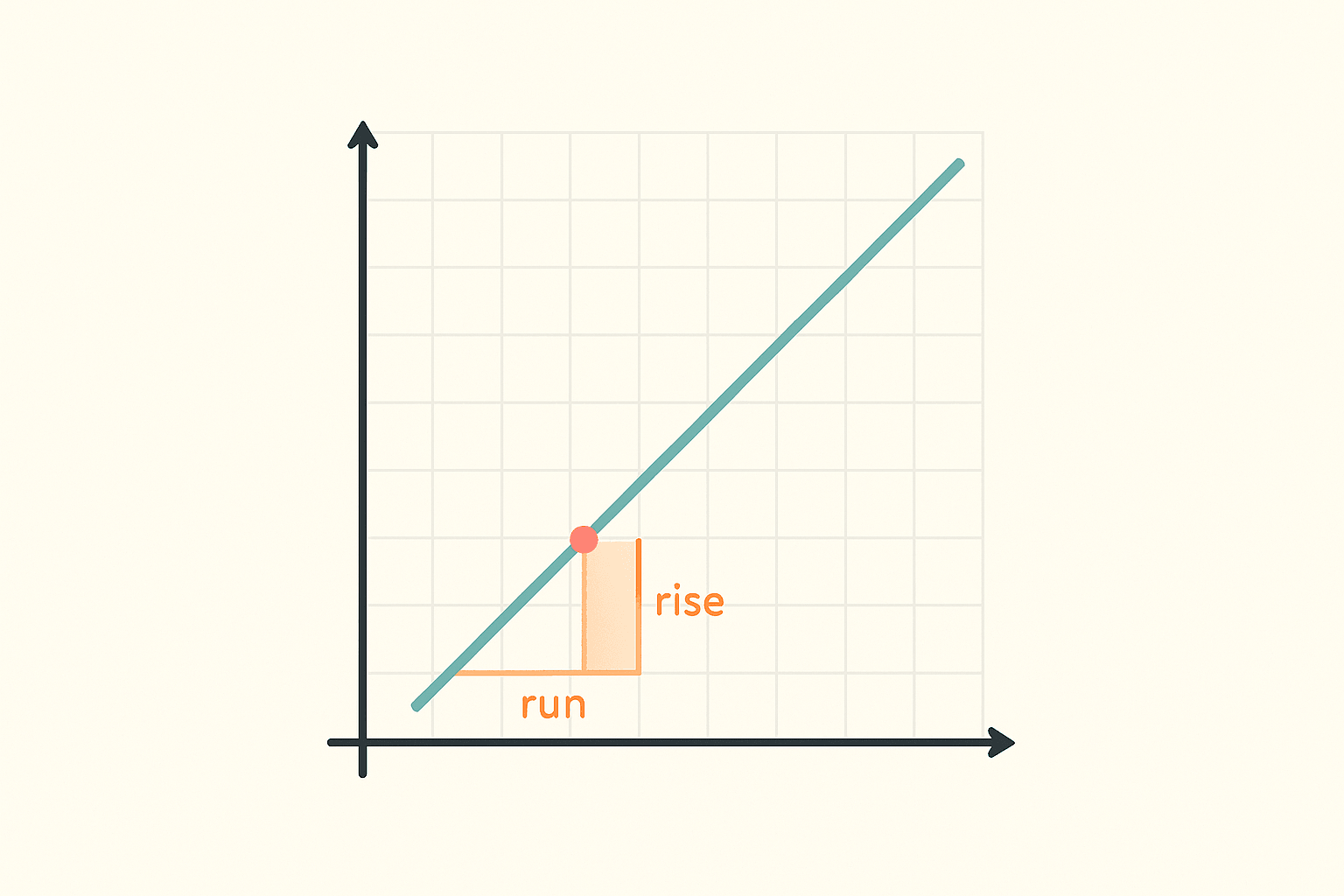
The Equation
The slope-intercept form is:
$$ y = mx + b $$
Two parameters control everything:
- \( m \) is the slope. Positive slope means the line rises from left to right; negative slope means it falls. A larger absolute value means a steeper line. Slope of 0 is a horizontal line; an undefined slope is a vertical line (and can’t be written in slope-intercept form).
- \( b \) is the y-intercept. It’s the y-coordinate of the point where the line crosses the y-axis, which always happens at \( x = 0 \). Set \( x = 0 \) in the equation and you get \( y = b \) directly.
What Slope Actually Measures
Slope is rise over run — the change in \( y \) divided by the change in \( x \) between any two points on the line:
$$ m = \dfrac{\Delta y}{\Delta x} = \dfrac{y_2 – y_1}{x_2 – x_1} $$
It does not matter which two points on the line you pick — a straight line has constant slope, so any two points give the same ratio. Pick the two easiest points (usually ones with integer coordinates) and you’re done.
Example: the line through \( (1, 3) \) and \( (4, 9) \) has slope \( m = (9 – 3) / (4 – 1) = 6 / 3 = 2 \). The line rises 2 units for every 1 unit you move right.
Reading the Y-Intercept
The y-intercept \( b \) is even easier — just look at the equation. The constant term (the number without an \( x \)) is the y-intercept. In \( y = 2x + 5 \), the y-intercept is 5: the line crosses the y-axis at the point \( (0, 5) \).
Sometimes the equation is written so the y-intercept is hidden. \( y = 3x – 7 \) has y-intercept \( -7 \), not 7 — pay attention to the sign. \( y = 4x \) is \( y = 4x + 0 \), so the y-intercept is 0 and the line passes through the origin.
Plotting a Line in Slope-Intercept Form
Two-step procedure that works every time:
- Plot the y-intercept. Put a dot at \( (0, b) \).
- Use the slope to find a second point. If the slope is \( m = a/c \), move \( c \) units right and \( a \) units up (or down if \( a \) is negative). Plot that point. Connect the two dots and extend.
Example: \( y = \dfrac{2}{3} x + 1 \). Y-intercept at \( (0, 1) \). Slope is \( 2/3 \) — from \( (0, 1) \) go 3 right and 2 up to reach \( (3, 3) \). Draw the line through those two points. Done in 15 seconds.
Converting Between Forms
Lines can be written in several forms. Slope-intercept is the most useful for graphing, but you’ll often need to convert.
From Standard Form
Standard form is \( Ax + By = C \). Solve for \( y \):
$$ Ax + By = C \;\;\Rightarrow\;\; y = -\dfrac{A}{B} x + \dfrac{C}{B} $$
So \( m = -A/B \) and \( b = C/B \). Example: \( 3x + 2y = 12 \) becomes \( y = -\tfrac{3}{2} x + 6 \) — slope \( -3/2 \), y-intercept 6.
From Point-Slope Form
Point-slope form is \( y – y_1 = m(x – x_1) \). Distribute and rearrange:
$$ y – y_1 = m(x – x_1) \;\;\Rightarrow\;\; y = mx + (y_1 – m x_1) $$
The y-intercept is \( b = y_1 – m x_1 \). Example: the line with slope 2 through \( (3, 5) \) is \( y – 5 = 2(x – 3) \), which becomes \( y = 2x – 1 \).
Special Cases
- Horizontal lines: slope \( m = 0 \). Equation reduces to \( y = b \). The line is flat — same y-coordinate everywhere.
- Vertical lines: slope is undefined. These can’t be written in slope-intercept form. Use \( x = c \) instead.
- Lines through the origin: y-intercept \( b = 0 \). Equation reduces to \( y = mx \). These are direct-proportion relationships.
- Parallel lines have the same slope but different intercepts. Perpendicular lines have slopes that are negative reciprocals: \( m_1 \cdot m_2 = -1 \).
Why Slope-Intercept Form Matters Beyond Algebra
Slope-intercept form is the entry point for every linear model in the real world. In economics, a demand curve is often written \( Q = a – bP \) — slope \( -b \), intercept \( a \). In physics, position-time graphs for constant-velocity motion are \( x = vt + x_0 \) — slope is velocity, intercept is starting position. In statistics, the linear regression line \( \hat{y} = mx + b \) gives the best-fit slope and intercept for a scatter of data points. Master this one form and dozens of applied subjects suddenly look familiar.
Related study notes: Quadratic Formula, Function Notation Rules, Zero of a Function, Venn Diagram.
Frequently Asked Questions
What is the slope-intercept form of a line?
The slope-intercept form is y = mx + b, where m is the slope (how steep the line is) and b is the y-intercept (where the line crosses the y-axis). Knowing these two numbers lets you graph the line in seconds and find any point on it by substituting an x-value.
How do you find the slope from a graph?
Pick any two clearly-marked points on the line, calculate the change in y divided by the change in x (the rise over the run), and you have the slope. m = (y₂ – y₁) / (x₂ – x₁). Any two points on the same straight line give the same answer.
What does the y-intercept tell you?
The y-intercept is the y-value of the point where the line crosses the vertical (y) axis. It is what y equals when x equals 0. In the equation y = mx + b, b IS the y-intercept — just read it off. Pay attention to signs: y = 3x – 7 has y-intercept -7, not 7.
Can every line be written in slope-intercept form?
Almost every line. Horizontal lines are fine — they have slope 0, so y = 0·x + b = b. The exception is vertical lines, which have undefined slope. Those have to be written as x = c instead of in slope-intercept form.
How do you convert standard form to slope-intercept form?
Solve for y. Standard form Ax + By = C becomes y = -(A/B)x + (C/B) after dividing by B. The slope is -A/B and the y-intercept is C/B. Example: 3x + 2y = 12 becomes y = -1.5x + 6.
What is the relationship between perpendicular slopes?
Two lines are perpendicular if and only if their slopes multiply to -1. In other words, the slopes are negative reciprocals of each other. If one line has slope 2, the perpendicular line has slope -1/2. Horizontal and vertical lines are perpendicular as a special case (one slope is 0, the other is undefined).