by
by
The binomial theorem gives a clean formula for expanding any power of a sum: \( (a+b)^n \) for any non-negative integer \( n \). It tells you exactly what coefficients appear in front of each term, without having to multiply the expression out manually. The coefficients follow Pascal’s triangle, the same triangle of numbers that shows up in combinatorics, probability, and surprisingly often in the rest of mathematics. Isaac Newton extended the theorem to non-integer exponents in 1665, but the integer case has been known since the medieval Arab and Indian mathematicians.
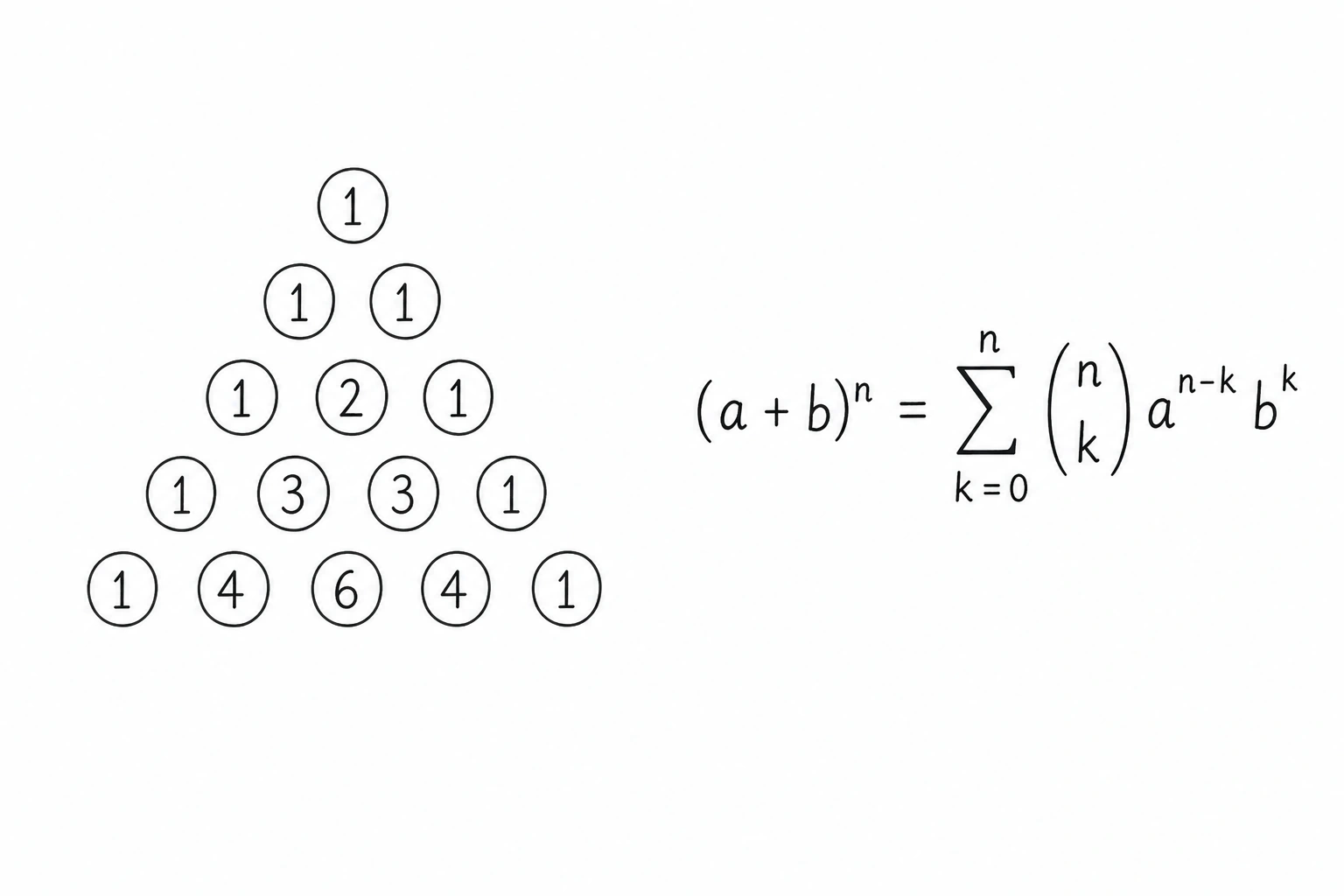
A binomial expansion combines coefficients with a decreasing power of the first term and an increasing power of the second.
The Theorem
For any positive integer \( n \):
$$ (a+b)^n = \sum_{k=0}^n \binom{n}{k} a^{n-k} b^k $$
where the binomial coefficient \( \binom{n}{k} \) (read ‘n choose k’) is:
$$ \binom{n}{k} = \frac{n!}{k!(n-k)!} $$
This single formula gives you every term in the expansion of \( (a+b)^n \) without manual multiplication.
Worked Examples
\( (a+b)^2 \): coefficients \( \binom{2}{0}, \binom{2}{1}, \binom{2}{2} = 1, 2, 1 \). Expansion: \( a^2 + 2ab + b^2 \). The familiar square-of-a-sum identity falls out directly.
\( (a+b)^3 \): coefficients 1, 3, 3, 1. Expansion: \( a^3 + 3a^2b + 3ab^2 + b^3 \).
\( (a+b)^4 \): coefficients 1, 4, 6, 4, 1. Expansion: \( a^4 + 4a^3b + 6a^2b^2 + 4ab^3 + b^4 \).
\( (2x+3)^5 \): coefficients 1, 5, 10, 10, 5, 1. Substituting \( a=2x, b=3 \): \( (2x)^5 + 5(2x)^4(3) + 10(2x)^3(3)^2 + 10(2x)^2(3)^3 + 5(2x)(3)^4 + (3)^5 = 32x^5 + 240x^4 + 720x^3 + 1080x^2 + 810x + 243 \).
Pascal’s Triangle
The binomial coefficients form Pascal’s triangle, each row gives the coefficients of the corresponding binomial expansion.
$$ \begin{array}{c} 1 \\ 1\;\;1 \\ 1\;\;2\;\;1 \\ 1\;\;3\;\;3\;\;1 \\ 1\;\;4\;\;6\;\;4\;\;1 \\ 1\;\;5\;\;10\;\;10\;\;5\;\;1 \end{array} $$
Each entry is the sum of the two directly above it. The triangle was known in China (Yang Hui, 13th century), Persia (al-Karaji, 10th century), and Europe (Pascal, 1654). The full structure is older than Pascal’s claim.
Why It Works
When you multiply out \( (a+b)^n = (a+b)(a+b) \cdots (a+b) \) with \( n \) factors, each term in the expansion comes from choosing either \( a \) or \( b \) from each factor. A term with \( k \) copies of \( b \) and \( n-k \) copies of \( a \) is \( a^{n-k} b^k \). The number of ways to choose which \( k \) of the \( n \) factors contribute a \( b \) is exactly \( \binom{n}{k} \). That’s the binomial coefficient. So the term \( a^{n-k} b^k \) appears \( \binom{n}{k} \) times in the expansion.
Applications
- Combinatorics. \( \binom{n}{k} \) is the number of ways to choose \( k \) items from \( n \), used everywhere in counting problems.
- Probability. The binomial distribution gives the probability of getting exactly \( k \) successes in \( n \) independent trials, each with success probability \( p \): \( P(X=k) = \binom{n}{k} p^k (1-p)^{n-k} \).
- Newton’s generalized binomial. Newton extended the theorem to fractional and negative exponents using infinite series: \( (1+x)^\alpha = 1 + \alpha x + \frac{\alpha(\alpha-1)}{2!}x^2 + \cdots \) for \( |x| < 1 \). This is the basis of Taylor approximations for fractional powers.
- Approximation. The first two terms of \( (1+x)^n \), namely \( 1 + nx \), give the linear approximation widely used in physics for small \( x \).
Related study notes: Permutations and Combinations, Taylor Series, Normal Distribution, Exponential Function.
The related OpenStax mathematics textbooks provide additional explanations and exercises for the mathematical definitions used here.
A Specific Coefficient
Find the coefficient of \(x^3\) in \((2+x)^5\). The general term is \(\binom5k2^{5-k}x^k\), so k = 3 gives \(\binom532^2=10\times4=40\). The coefficient depends on both the binomial coefficient and the remaining power of 2.
To check the expansion structure, the endpoint terms are 32 and \(x^5\). There are 6 terms before any collection. Substituting x = 1 into a complete expansion should give \(3^5=243\). This check does not prove every coefficient is correct, but it can reveal a missing factor or sign.
The points to check in this example are:
- For a nonnegative integer exponent n, the expansion has n + 1 terms.
- In each term, the 2 exponents add to n.
- An expansion of (a – b) to an integer power has alternating signs.
Check Your Understanding
Try the questions before reading the answers.
Question 1. What is the coefficient of \(x^2\) in \((1+x)^4\)?
Answer. 6.
Question 2. What is the constant term of \((2+x)^5\)?
Answer. 32.
Practice Questions
Work each question before reading its solution. The set runs from direct recall and substitution to the applied questions that exams actually use to separate grades. The downloadable PDF includes these questions and their solutions.
Question 1. State the binomial theorem and expand \((x + y)^3\).
Solution. $$(x+y)^n = \sum_{k=0}^{n} \binom{n}{k} x^{n-k}y^k$$ For \(n = 3\): \(x^3 + 3x^2y + 3xy^2 + y^3\), coefficients 1, 3, 3, 1 from Pascal’s row 3. Each term’s powers sum to \(n\): a built-in error check.
Question 2. Why is the coefficient of \(x^{n-k}y^k\) exactly \(\binom{n}{k}\)? Give the counting argument.
Solution. Expanding \((x+y)^n\) multiplies \(n\) brackets; each term picks \(x\) or \(y\) from every bracket. A term with \(k\) y’s arises once for each way of CHOOSING which \(k\) brackets contribute \(y\): that count is \(\binom{n}{k}\). The theorem is combinatorics wearing algebra’s clothes.
Question 3. Expand \((2x – 3)^4\).
Solution. With \(a = 2x\), \(b = -3\), coefficients 1, 4, 6, 4, 1: \(16x^4 – 96x^3 + 216x^2 – 216x + 81\). The alternating signs come from odd powers of \(-3\); losing a sign or forgetting to raise the 2 along with \(x\) are the standard slips.
Question 4. Find the coefficient of \(x^5\) in \((1 + x)^{12}\).
Solution. \(\binom{12}{5} = 792\). One term, no expansion: the theorem’s general term formula exists precisely so you never expand 13 terms to read off one.
Question 5. Find the term independent of \(x\) in \(\left(x^2 + \frac{1}{x}\right)^9\).
Solution. General term: \(\binom{9}{k}(x^2)^{9-k}x^{-k} = \binom{9}{k}x^{18-3k}\). Zero exponent: \(k = 6\), giving \(\binom{9}{6} = 84\). Set the exponent to the target and solve for \(k\): the routine works for any requested power.
Question 6. Use the theorem to estimate \((1.02)^{10}\) to 3 decimal places.
Solution. \((1 + 0.02)^{10} = 1 + 10(0.02) + 45(0.0004) + 120(0.000008) + \cdots = 1 + 0.2 + 0.018 + 0.00096 \approx 1.219\). Three terms deliver bank-grade accuracy because higher powers of 0.02 collapse; this truncation is the engine behind quick compound-interest and error estimates.
Question 7. Prove that the coefficients of any row sum to \(2^n\), and interpret the identity.
Solution. Set \(x = y = 1\): \((1+1)^n = \sum \binom{n}{k} = 2^n\). Interpretation: both sides count subsets of an \(n\)-element set, by size on the left, in total on the right. Substituting clever values into the theorem is a proof factory: \(x=1, y=-1\) similarly shows alternating coefficients cancel.
Question 8. Find the middle term of \((x – 2y)^{8}\).
Solution. Nine terms, so the middle is the 5th: \(k = 4\): \(\binom{8}{4}x^4(-2y)^4 = 70 \times 16\, x^4y^4 = 1120x^4y^4\). Even \(n\) gives one middle term at \(k = n/2\); odd \(n\) gives two.
Question 9. In the expansion of \((1+x)^n\), consecutive coefficients are in ratio 7 : 42 : 105 at some position. Wait: simplify to find \(n\) given \(\binom{n}{1} : \binom{n}{2} = 1 : 6\).
Solution. \(\dfrac{\binom{n}{2}}{\binom{n}{1}} = \dfrac{n-1}{2} = 6\), so \(n = 13\). Ratios of consecutive binomial coefficients collapse to \(\frac{n-k}{k+1}\), which converts ratio conditions into linear equations. That collapse is the tool for every such puzzle.
Question 10. A fair coin is tossed 10 times. Use a binomial coefficient to count sequences with exactly 4 heads, and give the probability.
Solution. Sequences: \(\binom{10}{4} = 210\); each of the \(2^{10} = 1024\) sequences is equally likely, so \(P = 210/1024 \approx 0.205\). The binomial DISTRIBUTION in statistics is the binomial THEOREM with probabilities substituted for \(x\) and \(y\): \((p + q)^n\) expanded term by term.
Frequently Asked Questions
What is the binomial theorem?
The binomial theorem gives a formula for expanding (a+b)^n for any non-negative integer n: (a+b)^n = sum from k=0 to n of C(n,k) × a^(n-k) × b^k. The coefficients C(n,k) are binomial coefficients, equal to n! / (k!(n-k)!), and they form the rows of Pascal’s triangle.
What is Pascal’s triangle?
Pascal’s triangle is the triangular array of binomial coefficients. Row n gives the coefficients of (a+b)^n. Each entry is the sum of the two directly above it. Named after Blaise Pascal (1654), but the structure was known much earlier to Chinese, Persian, and Indian mathematicians.
How do you calculate a binomial coefficient?
C(n,k) = n! / (k! × (n-k)!). Example: C(5,2) = 120/(2 × 6) = 10. Pascal’s triangle gives the same numbers visually, the kth entry in row n is C(n,k). For large n, software computes the coefficient via the factorial formula or via the recursion C(n,k) = C(n-1,k-1) + C(n-1,k).
What is the binomial distribution?
The probability distribution for the number of successes in n independent trials, each with success probability p. P(X = k) = C(n,k) × p^k × (1-p)^(n-k). Used everywhere in probability and statistics, coin flips, quality control, polling, A/B testing. The binomial theorem is the math that makes the distribution sum to 1 across all possible k values.
Did Newton invent the binomial theorem?
Not for integer exponents, that case was known centuries earlier. Newton’s contribution (1665) was extending the theorem to non-integer exponents (fractional, negative, irrational). His generalized binomial series is the basis for Taylor expansions of (1+x)^α and underlies much of calculus.
What is the binomial theorem used for in physics?
Mostly for first-order approximations. For small x, (1+x)^n ≈ 1 + nx. This linear approximation shows up in relativistic energy expansion, gravitational potential at large distances, Taylor expansion of arbitrary functions, error analysis, and dozens of other contexts. The full binomial theorem is also used in probability calculations and combinatorial counting.
Browse more in Mathematics.