
 by
by
Press releases still sound like credibility. The phrase conjures headlines, reporter callbacks, and a surge of referral traffic on Monday morning. That fantasy almost never shows up. Most releases land in a crowded inbox and die unread the same hour they’re sent.
A press release is a formal announcement sent to journalists and syndication networks — typically through a paid wire like PR Newswire, Business Wire, PRWeb, or EIN Presswire. The theory is simple: you write it, they distribute it, reporters pick the best stories and give you coverage. In practice, newsrooms cut 26% of their editorial staff between 2008 and 2024, and the reporters who remain don’t read mass-distributed releases. They read Twitter, Slack communities, tips from trusted sources, and their own Substack DMs.
That doesn’t mean press releases are worthless. It means their value depends on context, timing, and intent. The real question for most small and mid-sized businesses isn’t “should we do a press release this quarter?” It’s “is this the best use of the same dollars in 2026?”

When Press Releases Actually Make Sense
Some situations still justify the spend. Major funding rounds, mergers, acquisitions, IPO milestones, genuinely novel research, and regulatory disclosures attract real media interest. Public companies use releases to satisfy SEC and stock-exchange disclosure requirements. Large nonprofits use them for community-scale initiatives where the story affects thousands of people.
The common thread: clear, tangible public impact. A regional employer announcing 500 new jobs creates ripple effects journalists can write about. A health system launching a first-in-market treatment touches patient lives a reporter can quote. An engineering company open-sourcing a piece of infrastructure that 40,000 developers depend on gives a journalist a story angle. A new service line at a 15-person agency, however well-executed, doesn’t.
Press releases also serve a legitimate documentation purpose. They create a timestamped, citable, structured record. Investors and partners sometimes want to see a formal announcement before they’ll reference it. Search engines still index releases, and a well-written release on your own domain can pick up long-tail queries — though the SEO ceiling has dropped hard over the last decade.
The quick test: if a reporter’s editor would ask “why should our audience care?”, and you can answer it in one sentence with a number or named entity, the release has a shot. If you can’t, you’re paying for a press release to talk to yourself.
The Real Math: Distribution Cost vs Return
Distribution pricing in 2026:
- Entry-level wires (EIN Presswire, OpenPR): $99-$349 per release, mostly aggregator-site syndication.
- Mid-tier (PRWeb, Newswire.com): $329-$499 per release, better category targeting but still largely automated pickup.
- Premium wires (PR Newswire, Business Wire, GlobeNewswire): $800-$3,500+ for national or multi-regional distribution.
- Do-it-yourself outreach (custom pitch lists + tools like Muck Rack, Prowly, or Qwoted): $0 to $200/month for the tooling, plus your time.
Here’s what you actually get for the premium tier. A typical $1,500 Business Wire release lands on 100-300 aggregator sites (Yahoo Finance, MarketWatch, local ABC affiliates, several hundred near-identical republishers). Most of those sites average under 50 unique visitors per month per release page. Median referral traffic back to the source company’s website: under 40 clicks. Median qualified leads: zero to two. That’s $37-$75 per click at the high end of the market.
Before cutting a check, answer one question bluntly: what measurable outcome justifies this line item? “Brand awareness” is the category the return-on-investment discussion goes to die in. Pipeline, leads, and revenue are the benchmarks that hold up.
How Media Changed — and Why It Matters for Your Budget
Twenty years ago, if you wanted to reach The Wall Street Journal or a beat reporter at a regional paper, a press release was a reasonable attempt. In 2026, most of the reporters you want to reach are three places you can’t wire-syndicate into: their private Twitter/X feed, their Signal DMs, and the Slack community of their actual beat.
Direct, personalized pitches to specific reporters — the ones who have written about a topic adjacent to yours in the last 60 days — convert at roughly 10-30x the rate of mass distribution. That’s because you’re not fighting for attention in a dump of 5,000 daily releases. You’re landing in a warm inbox with a subject line the reporter can act on.
Owned media has eaten a lot of what press releases used to do. A well-kept blog, a consistent newsletter, and a real social presence let you reach the people who’d have read a press release anyway — without the editorial middleman. Brands that figured this out years ago (Basecamp, Intercom, Stripe, HubSpot) publish more in a month than most newsrooms do in a year. Their “press release” is just another Monday post.
Where the Same Budget Goes Further
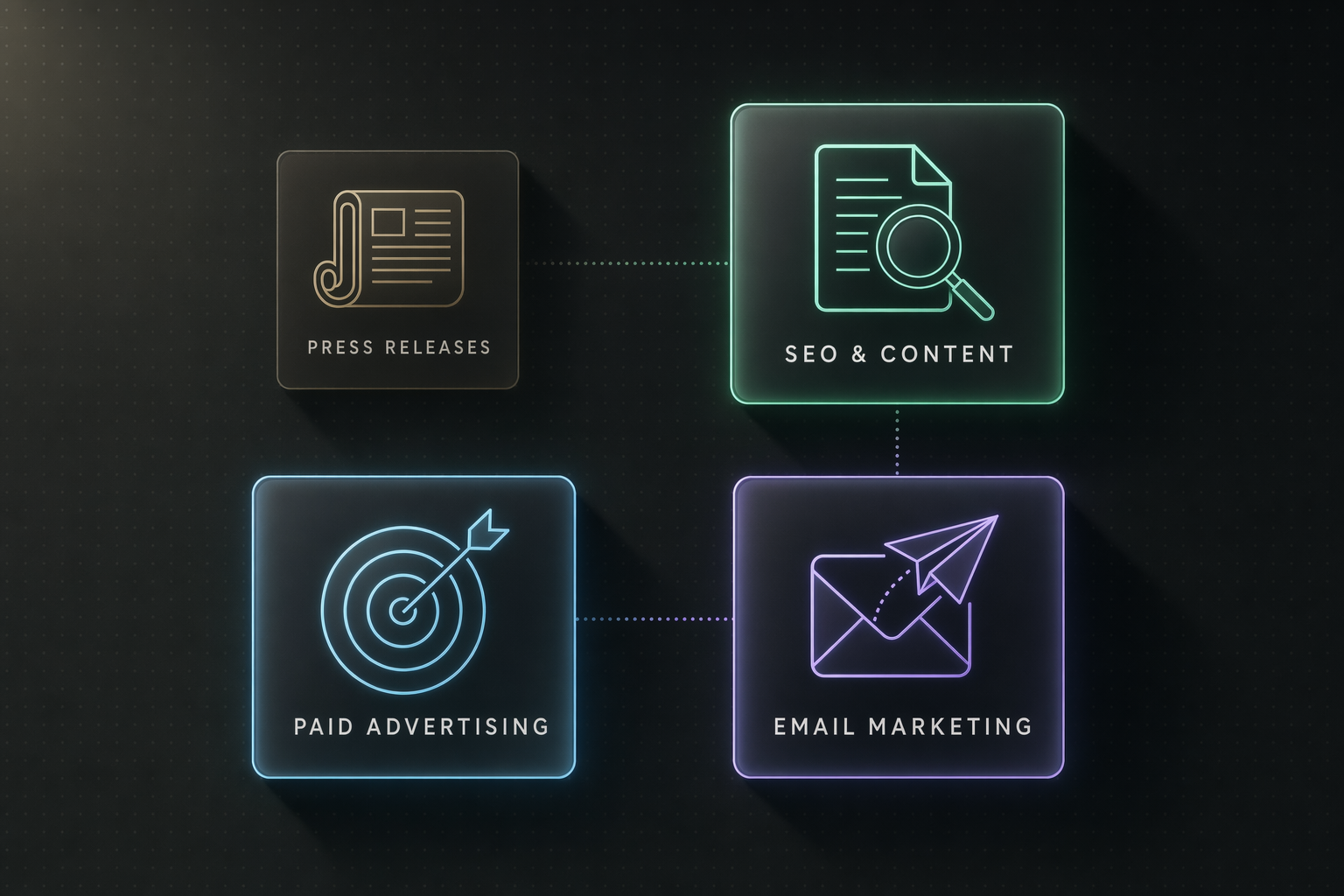
The $1,500 you’d spend on a single premium release could buy one of the following instead. Each has a clear, trackable return loop.
Customer experience infrastructure. It depends on your information stack, but retention compounds in a way brand awareness doesn’t. Investing in outsourced technical support directly cuts response times and bumps customer satisfaction from day one — a retention effect that matters far more to most SaaS and service businesses than a one-time mention on an aggregator. A single day’s worth of 24/7 coverage often costs less than a premium wire distribution.
Search engine optimization. A well-optimized 2,000-word guide on your site can pull 500-5,000 organic visitors per month for 3+ years. Press release: 40 clicks once, then gone. For the same $1,500 you could commission two well-researched pieces of evergreen content that compound.
Paid advertising. Search and social ad platforms give you real-time campaign feedback. Google Ads, Meta, LinkedIn, and Reddit all let you run a $1,500 test, see which creative converts, and reallocate within the same week. You can’t iterate on a press release.
Email marketing. A warm email list converts 10-40x better than cold-acquired traffic. $1,500 into a quality lead magnet + paid promotion of that lead magnet builds an asset that keeps converting long after the campaign ends. Press releases leave you nothing.
Short-form video. The same $1,500 can produce a batch of 5-10 vertical videos distributed across TikTok, Instagram Reels, YouTube Shorts, and LinkedIn. Visual formats match how most buyers under 45 actually consume product information in 2026.
Each of these has a tracker attached — impressions, click-throughs, MQL conversions, list growth. Press releases, by contrast, usually come back with a “reach” number that combines every aggregator site’s theoretical monthly visitor count, whether those visitors saw your release or not.
The SEO Case for Press Releases Is Mostly Over
For years, agencies sold press releases as a backlink shortcut. Distribute widely, get links from hundreds of domains, watch rankings climb. Then Google shipped Penguin in 2012, tightened nofollow rules in 2013, and introduced link-spam algorithm updates through 2022-2024. Syndicated release links now carry close to zero ranking weight. Most wire networks add rel="nofollow sponsored" by default.
A release on your own domain can still support SEO — but only if it’s treated as real content. Target a specific query, include data that’s useful outside the announcement, add media, link to related resources. A 200-word “Company X announces Y” stub doesn’t rank and doesn’t help.
If your goal is organic traffic, long-form evergreen content beats a press release almost every time. The gap isn’t marginal.
Credibility Is the One Thing Press Releases Still Buy
Here’s the case for them. If a reporter independently chooses to cover your story because the wire caught their eye, that earned mention on Reuters, AP, or a trade outlet carries real weight with investors, enterprise buyers, and procurement teams. Logos on your homepage matter.
The critical distinction: earned mentions (a reporter wrote a story) vs syndicated mentions (your release copy appeared on an aggregator). Sophisticated buyers read the difference instantly. “As seen on Yahoo Finance” that traces back to a Business Wire syndication doesn’t close deals. A 600-word TechCrunch writeup with a quote from your CEO does.
For many brands, third-party case studies, G2 or Capterra reviews, Trustpilot scores, customer quotes, and podcast appearances build more trust per dollar than routine press releases. The quality of the signal matters more than the quantity of placements.
Industry Matters More Than You’d Think
Certain industries still get real lift from press activity.
- Venture-backed startups use press coverage to attract investors, talent, and early adopters. A TechCrunch, The Information, or Axios piece is a recruiting asset for 12+ months.
- Nonprofits use press to amplify causes and campaigns where emotional and civic impact is the message.
- Public companies are legally required to issue releases for certain disclosures.
- Entertainment and consumer brands depend on publicity cycles tied to launches, tours, and seasonal events.
Local service businesses usually don’t. A plumbing company, a regional marketing agency, a dental practice — these win on local SEO, Google Business Profile optimization, Nextdoor presence, community sponsorships, and word-of-mouth. National distribution of any kind is wasted spend.
Most Press Releases Are Bad Because They’re Not Stories
Even when the topic warrants coverage, the craft kills it. The typical release reads like a press kit written by a committee: passive voice, opaque jargon, quotes that sound like quarterly-earnings filler, and a headline that buries the lede beneath three clauses of company name and product category.
Strong ones hit a reporter’s inbox and pitch themselves. Clear headline. Hard number in the first sentence. A concrete human angle by paragraph three. One usable 20-word quote that doesn’t sound like a lawyer wrote it. Publish-ready photography or data viz attached.
Even a perfectly crafted release can’t invent news value the story doesn’t have. That’s the honest check: would a reporter covering my beat email me back, unprompted, if I sent this? If the answer is no, the release isn’t ready. If you need to wire it just to tell existing customers, a blog post and an email blast will outperform the wire and cost nothing.
Measuring Whether It Worked
Marketing budgets demand receipts. A press release campaign should be measured against defined objectives before you approve the next one:
- Media pickup. How many earned (not syndicated) outlets wrote a story?
- Referral traffic. How many sessions hit your site from media domains? (Check GA4 referral report filtered to the 7 days post-release.)
- Qualified leads. Did sales flag any inbound inquiries mentioning the coverage?
- Sentiment and reach. Any meaningful mentions on X, LinkedIn, Reddit, or industry Slack communities?
- Brand search lift. Did branded queries in Google Search Console bump in the two weeks after?
If the answer to most of these is “not really,” the line item didn’t earn its slot. Do fewer, better releases. Or drop them entirely.
At a Glance: How the Tactics Compare
| Tactic | Typical budget | Feedback loop | Compounds over time? | Trackable? |
|---|---|---|---|---|
| Premium press release | $800-$3,500 each | Weeks; often zero signal | No | Weak |
| Direct reporter outreach | $0-$200/mo + time | Days | Somewhat (relationships) | Strong |
| SEO content | $500-$2,000 / piece | 3-6 months | Yes — 3+ year tail | Strong |
| Paid ads (Google / Meta) | $500+ test budget | Hours to days | No (requires ongoing spend) | Very strong |
| Email marketing | $20-$200/mo tool + lead magnet | Weeks | Yes — list grows | Very strong |
| Short-form video | $500-$2,000 / batch | Weeks | Yes (evergreen backlog) | Strong |
| Customer experience upgrade | $500+/mo | Immediate | Yes (retention) | Strong |
Blend, Don’t Choose Extremes
Press releases don’t have to be all-or-nothing. The sensible middle: one or two well-crafted, genuinely newsworthy releases per year tied to real company milestones — funding, hiring bursts, major customer wins, original research — and the bulk of the budget directed at SEO, targeted ads, content, and owned-media channels.
That approach keeps the credibility benefits without draining the rest of the marketing stack. It also forces honesty about what actually qualifies as news.
Making the Call
Rule of thumb: if the goal is immediate leads, skip press releases. If the goal is SEO, skip them. If the goal is investor-signaling or public-disclosure compliance, a release belongs in the plan. For everything in between, blend selectively and track results.
Budget size sets the guardrails. A $2M/year marketing org can absorb ongoing press activity as a small slice. A $25,000 annual budget can’t — every dollar needs a clearer payback, and press releases rarely deliver one. Clarity about objectives is what prevents budgets from scattering across tactics nobody’s measuring.
The Honest Answer
Press releases still have a place, but the place has shrunk. They work when the news is real, the audience is journalists who matter to your business, and the goal is credibility or compliance — not traffic or leads. Routine announcements almost never justify the spend.
Audit your last three marketing quarters honestly. If any release delivered measurable pipeline, by all means do more of those. If the data shows two years of wires with nothing to show for them, reallocate the budget to the tactics that actually move numbers. The marketing landscape rewards focus, measurement, and the willingness to kill habits that stopped working.
Press releases are a tool. Used deliberately, they support a broader strategy. Used reflexively, they burn budgets without returning much at all. The difference lies in discernment and disciplined allocation of resources.
FAQs About Press Releases
Do press releases still work in 2026?
Sometimes. They work well for major news with real public impact — funding rounds, mergers, genuinely novel research, SEC-mandated disclosures, or regulated industries. They rarely work for routine announcements from small and mid-sized businesses. Newsrooms have cut roughly 26% of editorial staff since 2008, and the reporters who remain source stories from direct pitches, Twitter/X, and Slack communities — not mass-distributed wires.
How much does a press release cost?
Entry-level wires (EIN Presswire, OpenPR) run $99-$349 per release. Mid-tier services (PRWeb, Newswire.com) are $329-$499. Premium wires like PR Newswire, Business Wire, and GlobeNewswire charge $800-$3,500+ for national or multi-regional distribution. Direct reporter outreach via tools like Muck Rack, Prowly, or Qwoted costs $0-$200/month plus your time — and tends to convert 10-30x better.
Are press releases good for SEO?
Not really anymore. Google shipped Penguin in 2012 and has rolled out link-spam updates through 2024, which stripped ranking value from syndicated release links. Most wire networks now add rel=”nofollow sponsored” by default. A press release on your own domain can support SEO if it’s built as real content — not a 200-word stub — targeting a specific query. Long-form evergreen guides outperform releases for organic traffic in almost every case.
What’s the difference between earned and syndicated media?
Earned media means a reporter independently chose to cover your story — that TechCrunch piece with a quote from your CEO. Syndicated media is your own release copy appearing on aggregator sites after a paid wire distribution. Sophisticated buyers read the difference instantly. A “As seen on Yahoo Finance” logo that traces back to a Business Wire syndication doesn’t move enterprise deals; a genuine editorial write-up does.
What should replace press releases in a small-business marketing budget?
For most small and mid-sized businesses, the same dollars go further in SEO content (3+ year traffic tail), paid ads on Google/Meta/LinkedIn (real-time feedback and iteration), email marketing (owned list compounds), short-form video across TikTok and LinkedIn, and customer-experience infrastructure like outsourced technical support (retention impact from day one). Each tactic has a measurable tracker attached; press releases rarely do.
When is a press release worth the cost?
When the story carries clear public impact a reporter would cover anyway. Funding rounds, mergers and acquisitions, first-in-market product launches, large-scale hiring announcements in a specific region, original research with surprising data, SEC-mandated disclosures, and executive appointments at public companies. The test: if a beat reporter would email you back unprompted after reading it, it’s worth sending. If not, it’s not.
How do I measure if a press release worked?
Look at five things in the 7-14 days after distribution: number of earned (not syndicated) outlets that wrote about you; referral traffic in GA4 from media domains; inbound sales inquiries that cited the coverage; meaningful mentions on X, LinkedIn, Reddit, or industry Slack communities; and branded-query lift in Google Search Console. If most of those show nothing, the spend didn’t earn its line item.
Is direct outreach to journalists better than a press release?
For most companies, yes. Personalized pitches to reporters who have written about an adjacent topic in the last 60 days convert at roughly 10-30x the rate of mass wire distribution. You’re landing in a warm inbox with a subject line the reporter can act on, rather than competing with thousands of daily releases. Tools like Muck Rack, Prowly, and Qwoted surface the right journalists by beat and recent coverage.
Tell Google you want more of this.
Add Gaurav Tiwari as a preferred sourceOne tap, and this site shows up more often in your own Top Stories, AI Overviews and AI Mode. Remove it any time.