The Advantages of Podcasts in Businesses
Use current Edison, Ofcom, YouTube, and Spotify audience data plus a worked $6,000 eight-episode pilot to decide whether a business podcast can clear its break-even threshold.
 by
by
Podcasts in business can create a useful body of expertise, sales conversations, and reusable content. They can also consume 80 hours and produce no qualified demand. If you’re deciding whether to launch one in 2026, judge the channel by audience fit and contribution, not by download counts alone.
My recommendation is an eight-episode pilot with one narrow buyer problem, one measurable call to action, and a cost ceiling. Do not promise a weekly show forever. Run the pilot, measure qualified plays, visits, leads, sales, reuse value, and total labor, then continue only when the evidence clears your threshold in 2026.
The practical verdict: the audience is large and podcasting is now a genuine audio-video medium, but audience scale does not establish business ROI. The model below puts a $6,000 cost on an eight-episode pilot and requires three whole clients at $2,500 contribution each to cover it.
What is a podcast, and why use one in business?
A podcast is a recurring program distributed for on-demand listening, viewing, or both. A business can use it to answer buyer questions, interview customers and specialists, document decisions, train a market, or create sales-enablement material. That is more specific than “build awareness,” and specificity makes measurement possible.
The format works best when the buyer benefits from explanation. A complex service, technical product, professional practice, or expertise-led brand can turn one recorded conversation into a complete answer. My guide to podcasting for brands covers the hosting layer; this page focuses on whether the business case deserves to exist.
What changed: business podcasting in 2026
Podcasting is no longer audio-only, but “film every episode” is also too blunt. Current US and UK research shows a dual-format market with meaningful audio-only demand.
- US reach: Edison’s Infinite Dial 2026 reports that 80% of Americans age 12+ had ever consumed a podcast, 58% had done so in the previous month, and 45% in the previous week. Its population estimates were 230 million, 167 million, and 130 million respectively.
- Format is mixed: the same Edison study says 57% of Americans age 12+ had both listened to and watched a podcast. The survey was supported by SiriusXM Media, so treat it as market research with a disclosed sponsor, not a guarantee for a new show.
- YouTube scale: YouTube reported more than 1 billion monthly active viewers of podcast content as of January 2025 and more than 400 million monthly podcast hours on living-room devices during the prior year. These are YouTube’s platform figures.
- Spotify video growth: in May 2026, Spotify reported that more than 500 million users had streamed a video podcast, up nearly 50% year over year. It is a vendor-reported cumulative user figure.
- UK weekly use: Ofcom’s 2026 Audio Report says 27% of UK adults age 15+ listened to podcasts weekly. Among podcast listeners, 39% preferred audio-only, 27% preferred video, and 26% let video play in the background.
The decision is not audio versus video in the abstract. Record clean audio first. Add video when the buyer benefits from demonstrations, facial context, clips, or television discovery and the extra production cost can be justified inside your content marketing strategy.
Advantages of podcasts in business growth
A podcast earns its place when it improves a real commercial job: teaching a difficult idea, creating qualified conversations, supplying sales material, or producing several useful assets from one research effort.
| Potential advantage | What to measure | Failure signal |
|---|---|---|
| Reach qualified buyers | Qualified plays and target-account listeners | Downloads rise while buyer fit falls |
| Explain complex offers | Episode-assisted visits, demos, and sales use | No episode connects to a buyer question |
| Create reusable content | Useful clips, articles, emails, and sales assets shipped | Editing backlog exceeds reuse value |
| Build relationships | Relevant guests, follow-up conversations, and opportunities | Guests are chosen for reach rather than fit |
| Develop category authority | Branded search, direct traffic, citations, and qualified replies | Episodes repeat commodity opinions |
Exposure to a large number of customers
The distribution platforms are large, but a new business podcast starts with no audience. Reach comes from a clear problem, useful guests, search demand, existing relationships, and consistent distribution. Use podcast episodes to boost awareness of your product only when the topic naturally leads to the product’s job.
Cost-effective marketing you can actually afford
A podcast can cost less in cash than TV ads, but labor is still a cost. In the model below, 80 hours at a $60 loaded hourly cost is $4,800 before equipment, software, hosting, or distribution. A remote cleanup tool such as Krisp can help bad room noise, but it cannot repair weak positioning or an unprepared interview.
Easy to create and upload
Publishing is technically easy. Discovery, editorial quality, consent, rights, accessibility, attribution, and measurement are not. Choose podcasting platforms based on feed control, analytics export, distribution, video needs, dynamic insertion, and migration rather than a free-plan headline.
Built for multitasking, saves everyone time
Audio can fit commuting, exercise, and routine work. Ofcom’s 39% audio-only preference among UK podcast listeners is a useful warning against treating video as mandatory. Publish an audio experience that works without watching, then add visuals where they carry information.
Highly engaging and trusted
Trust is an outcome, not a property of the file format. Measure repeat consumption, completion, qualified replies, direct traffic, and sales use. If the show increases audience engagement but produces no useful action, it may still be editorially valuable, but do not label that result revenue.
Makes complex offers easy to understand
This is the strongest business use. Take one objection, decision, implementation problem, or customer question and resolve it with examples and limitations. Give the sales team a time-stamped segment they can send instead of making the buyer decode a generic brochure.
An efficient, modern business tool
Efficiency appears only when one researched recording becomes several genuinely useful assets. A full episode, concise article, short clip, email, transcript extract, and sales answer can share the same core work, but every output still needs editing and context. Track the labor inside your content distribution system.
Creates jobs and lifts your whole strategy
Editors, producers, designers, researchers, and distribution specialists can improve a show. That is capability, not free leverage. Assign one owner, document the editorial standard, obtain guest permissions, define asset rights, and decide who approves claims before recording.
When a business podcast is a waste of time
A podcast is a poor choice when the business needs immediate pipeline, the buyer does not consume the format, the team cannot sustain the production cost, or no one can name the job each episode performs.
- No defined buyer: “Anyone interested in business” is not an audience.
- No measurable action: downloads cannot be connected to a visit, lead, sales asset, relationship, or reuse outcome.
- No editorial advantage: the planned episodes repeat answers already available from better sources.
- No production owner: booking, recording, editing, approval, publishing, and distribution float between people.
- No time to learn: one or two episodes are too little evidence, while an indefinite weekly promise creates unnecessary risk.
- No acceptable economics: the contribution and reuse value cannot plausibly clear the pilot’s labor and cash cost.
How to start a business podcast (the short version)
Run eight episodes as one bounded test. Use the same audience, format, publishing cadence, call to action, and attribution method long enough to learn. Change one major variable at a time.
- Choose one buyer and one recurring decision the show will improve.
- Define qualified play, CTA visit, lead, sale, assisted sale, reuse asset, and total labor before recording.
- Plan eight episodes as a connected sequence, not eight unrelated interviews.
- Record clean audio; add video only when its expected reuse and discovery value exceeds its cost.
- Publish an accessible summary, transcript or key points, and one useful action per episode.
- Distribute through owned email, relevant guests, search, and existing customer channels.
- Review the funnel after episodes four and eight without moving the goalposts.
If the business also produces music or creator-led audio, the same ownership and distribution discipline applies when you get started with music promotion.
The verdict on podcasts in business
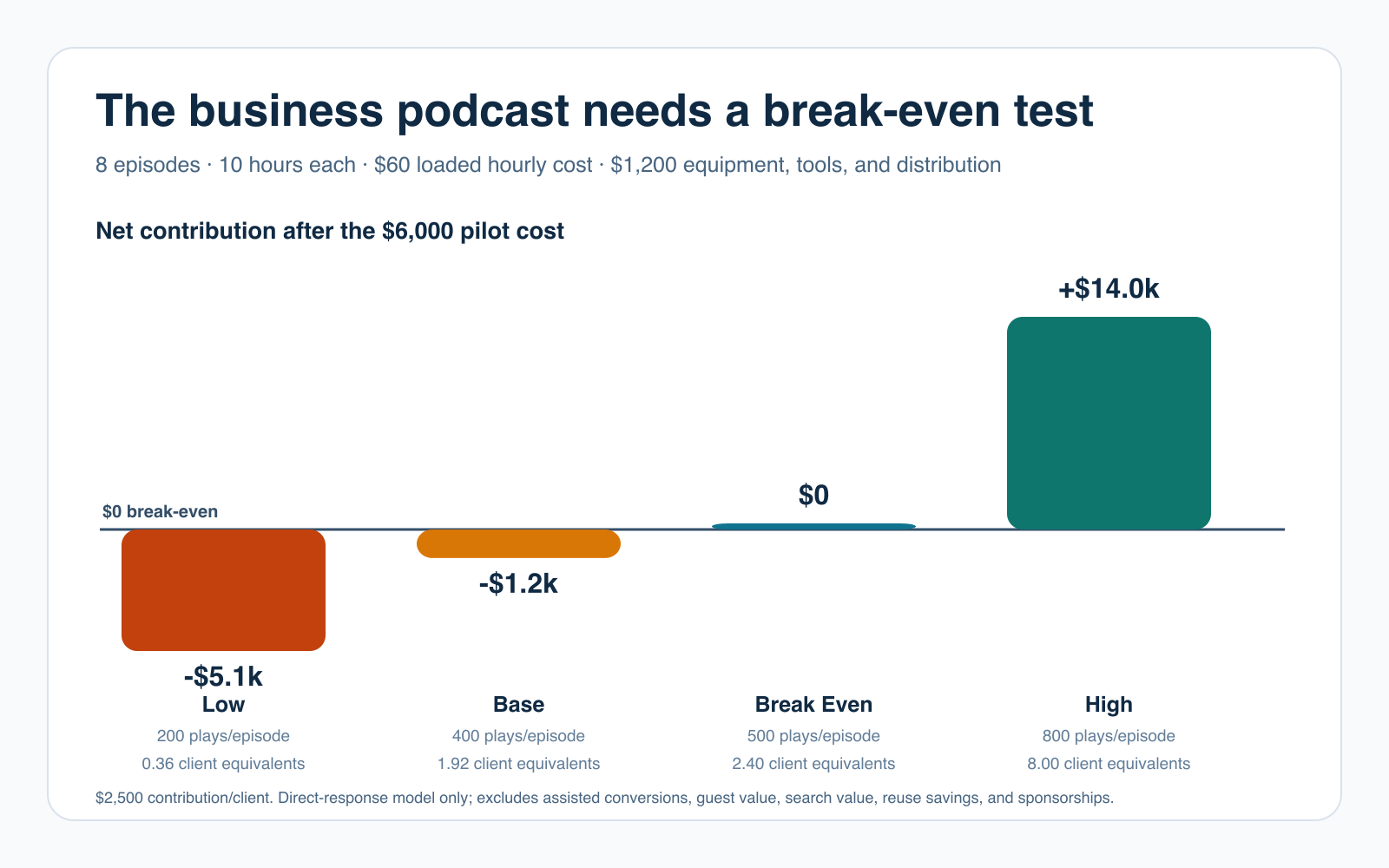
The audience case is real. The business case still has to be calculated. This reproducible model assumes eight episodes, 10 labor hours per episode, a $60 loaded hourly cost, $450 equipment, $150 software and hosting, $600 distribution, and $2,500 contribution per converted client.
- Total pilot cost: 8 x 10 x $60 + $450 + $150 + $600 = $6,000.
- Low case: 200 qualified plays per episode, 1% CTA visits, 15% lead conversion, and 15% close rate produce 0.36 modeled client equivalents and $-5,100 net contribution.
- Base case: 400 plays, 1.5% visits, 20% leads, and 20% closes produce 1.92 client equivalents, $4,800 contribution, and $-1,200 net.
- Break-even case: 500 qualified plays per episode at the base rates produce 2.40 client equivalents and $6,000 contribution. In whole-client terms, the pilot needs 3 sales.
- High case: 800 plays, 2% visits, 25% leads, and 25% closes produce 8 client equivalents and $14,000 net.
| Contribution per client | Expected client equivalents to break even | Whole clients | Qualified plays per episode at base rates |
|---|---|---|---|
| $1,000 | 6.0 | 6 | 1,250 |
| $2,500 | 2.4 | 3 | 500 |
| $5,000 | 1.2 | 2 | 250 |
Decision threshold: continue only when verified client contribution plus defensible content-reuse savings and assisted pipeline value exceed the full production cost, or when the pilot reveals a specific variable worth one more bounded test. Audience size alone is not a return.
Tell Google you want more of this.
Add Gaurav Tiwari as a preferred sourceOne tap, and this site shows up more often in your own Top Stories, AI Overviews and AI Mode. Remove it any time.