
7 Best VMware Alternatives in 2026 (And Who Each One Fits)
Seven VMware alternatives compared on migration effort, licensing cost, and AI readiness: Sangfor HCI, Nutanix, Proxmox VE, OpenShift Virtualization, Hyper-V, OpenStack, and Arcfra.
 by
by
Broadcom closed the VMware acquisition in late 2023, ended perpetual licenses within weeks, and folded most of the product line into a handful of subscription bundles. Since then, renewal quotes have been landing on IT desks as multiples, not percentages. Some teams saw double. Some saw eight times their old bill 1. The reported increases vary a lot by contract size and bundle. The pattern that repeats: fewer licensing options, bigger mandatory bundles, and renewal math that forces a re-evaluation nobody had budgeted time for. .
So the question isn’t whether VMware still works. It does. The question is whether it’s still the right fit at the new price. My short answer after comparing the field: Sangfor HCI is the VMware alternative I’d shortlist first for mid-market and enterprise teams that want a phased exit with familiar workflows. Proxmox VE wins if budget outranks vendor hand-holding. Nutanix stays the safe pick if money isn’t the constraint.
That’s also why conversations around VMware Replacement have moved from idle research to planning documents, especially in Singapore and the wider APAC region, where hybrid cloud is already the default and AI readiness keeps showing up as a line item in infrastructure reviews.
The Quick Comparison
Seven platforms cover the realistic replacement paths: Sangfor HCI, Nutanix, Proxmox VE, Red Hat OpenShift Virtualization, Microsoft Hyper-V, OpenStack, and Arcfra. Each one solves a different version of the same problem, so the honest way to compare them is by fit, not by feature count.
| Platform | Best for | Strength | The catch |
|---|---|---|---|
| Sangfor HCI | Phased enterprise exits from VMware | Unified, AI-ready platform with familiar workflows | Global partner density still growing outside APAC |
| Nutanix | Enterprises with budget for the safest stack | Most mature HCI platform, strong migration tooling | Premium pricing; you may trade one costly renewal for another |
| Proxmox VE | Budget-conscious teams with Linux skills | Open source, KVM-based, built-in ESXi import | You run it yourself; support is thin next to enterprise vendors |
| Red Hat OpenShift Virtualization | Kubernetes-native organizations | VMs and containers on one platform | A replatform, not a hypervisor swap; needs real expertise |
| Microsoft Hyper-V | Windows-heavy shops with Datacenter licenses | Often already paid for | Management tooling feels dated next to vCenter |
| OpenStack | Large-scale, custom environments | Maximum control and customization | Needs a dedicated platform team |
| Arcfra | Singapore-based teams wanting a local vendor | Singapore-native, full-stack HCI platform | Very new company (founded 2024) with a limited enterprise track record |
Why Teams Are Leaving VMware Now
The trigger is licensing, not technology. Broadcom moved VMware to subscription-only bundles built around VMware Cloud Foundation, and the renewal quotes that followed turned a settled platform decision into an open one. Nobody rips out a working hypervisor for fun. They do it when the invoice changes the math.
In Singapore, cloud is already part of the ecosystem. Hybrid models are common, and the focus has moved from adoption to optimization. Enterprises want stricter control over workloads without losing flexibility, which is driving interest in private cloud deployments alongside hybrid strategies. If the private, hybrid, and public cloud split still feels fuzzy, I’ve broken down how the main cloud models actually differ in a separate guide.
The second shift: AI readiness has become a practical requirement, not a slide in a vision deck. Teams want platforms that won’t hold them back when GPU workloads arrive. That’s what the search for the best VMware alternatives is really about, supporting the future without disrupting the present.
How I Picked These
This comparison is built from vendor documentation, migration guides, pricing models, and Gartner Peer Insights data, weighed against the four questions every real evaluation comes down to:
- Will our team need to relearn everything from scratch?
- Can we migrate workloads without downtime?
- Will current workflows still make sense on the new platform?
- How future-ready is this system for cloud and AI?
One bias I’ll admit up front: predictable beats clever. A platform that simplifies operations wins over one that adds layers, even when the second one demos better.
The 7 Best VMware Alternatives, Compared
Ranked by how well each one balances migration effort against long-term fit. The top pick is the one I’d put in front of a CIO planning a gradual exit; the rest win their own specific scenarios.
1. Sangfor HCI: Best for a Phased Enterprise Exit
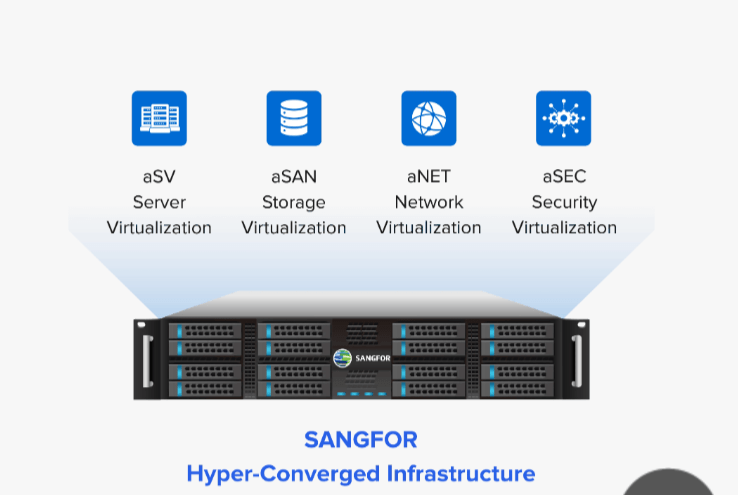
Sangfor HCI is a hyperconverged platform that folds server virtualization (aSV), storage (aSAN), networking (aNET), and security (aSEC) into one system, built as part of a broader cloud platform that spans private and hybrid deployments. That consolidation is the point: fewer moving parts to license, patch, and monitor.
What separates it from most VMware competitors is the deliberate effort to keep things familiar. The interface, workflows, and system behavior stay close to what vSphere teams already know, so there’s no steep relearning cliff. Migration isn’t pushed as a single cutover either, which matters more than any feature checkbox when the platform underneath is deeply embedded.
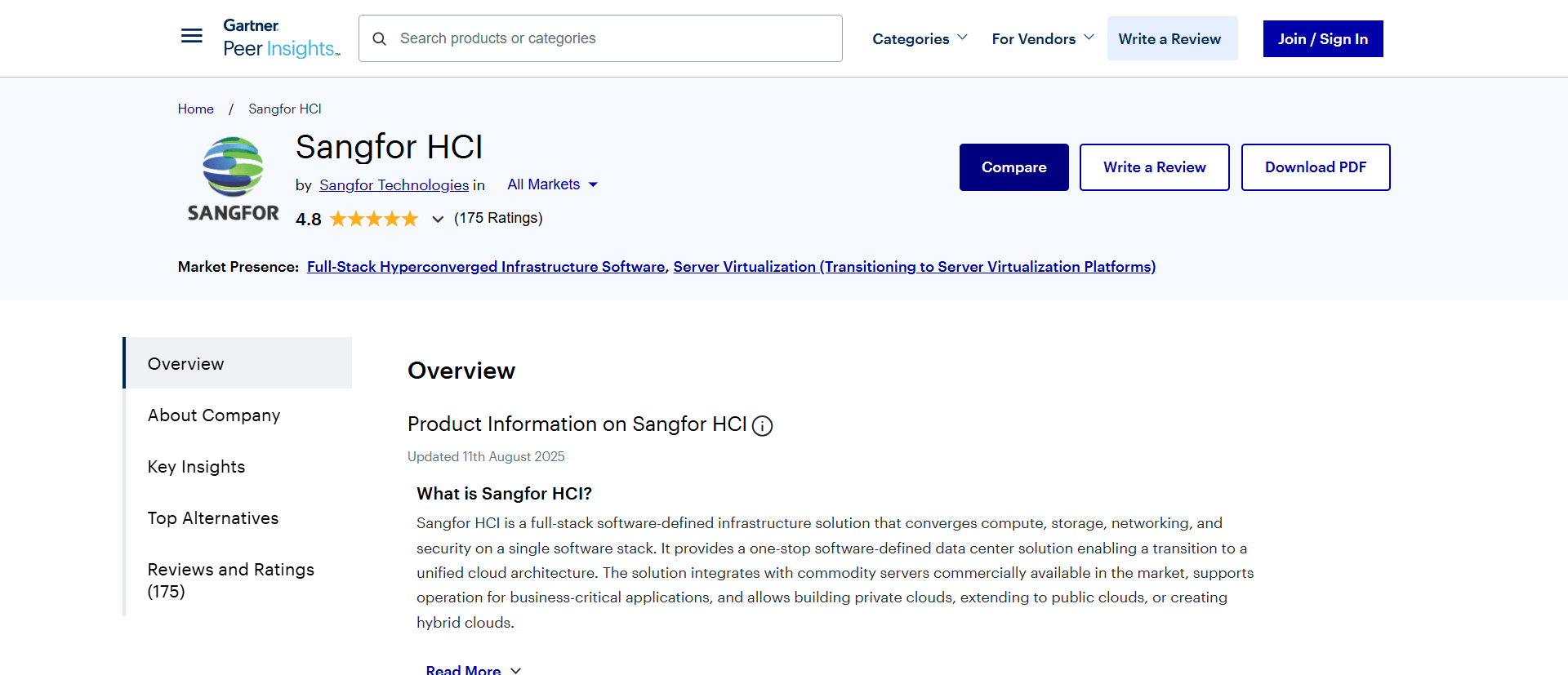
The proof holds up outside the marketing. Sangfor HCI sits at 4.8 out of 5 on Gartner Peer Insights across 175 ratings 2. A rating alone means little. The volume is the signal: 175 enterprise reviews is a real sample for an infrastructure product, not a handful of cherry-picked quotes. , appears in Gartner’s 2026 coverage of top HCI vendors in APAC, and picked up multiple category mentions in the G2 Summer 2026 Reports. Tecnostamp Triulzi Group, a global manufacturer, consolidated its worldwide sites onto Sangfor HCI for unified management, which is exactly the kind of workload consolidation this platform is built for.
The honest catch: Sangfor’s partner and hiring ecosystem is strongest in Asia-Pacific and still expanding elsewhere. VMware has two decades of third-party tooling and a deep talent pool behind it. If your operations team sits in Europe or North America, check local partner coverage before you commit.
2. Nutanix: The Mature-Stack Default
Nutanix is the name most consultants reach for first, and for defensible reasons. Its AHV hypervisor ships inside the platform at no separate license cost, the HCI stack is the most battle-tested in the category, and the Nutanix Move tool handles VMware migrations with minimal drama. The catch is cost: for some environments you’re trading one premium renewal for another, and the platform brings complexity of its own. Shortlist it if stability outranks savings.
3. Proxmox VE: The Budget Pick That Holds Up
Proxmox VE is an open-source, Debian-based platform running KVM virtual machines and LXC containers, and since version 8.2 it ships a built-in import wizard that pulls VMs straight off ESXi hosts. The enterprise repository subscription starts at roughly €115 per CPU socket per year 3. Proxmox bills per CPU socket, in euros, and the repository subscription is separate from the support tiers. Check the current price list before you budget. , which is a rounding error next to enterprise virtualization quotes. The trade: you’re the vendor now. Small and mid-size teams with Linux skills love it; enterprises that need someone to call at 3 a.m. should look up the list.
4. Red Hat OpenShift Virtualization: For Kubernetes-Native Teams
OpenShift Virtualization runs traditional VMs beside containers on the same Kubernetes control plane, built on the KubeVirt project. If your organization already thinks in pods and pipelines, folding VMs into that world beats maintaining a separate hypervisor stack, and it pairs naturally with practices like using hardened base images for Kubernetes deployments. Understand what you’re signing up for, though: this is a replatform, not a hypervisor swap, and it demands genuine Kubernetes expertise.
5. Microsoft Hyper-V: The One You Might Already Own
Hyper-V ships with Windows Server, so a shop holding Datacenter licenses may already own its VMware exit without a new line item. For Windows-heavy fleets it’s a pragmatic, boring choice, and boring is underrated in infrastructure. The catch: the management tooling around System Center feels dated next to vCenter, and Microsoft’s energy visibly flows toward Azure rather than on-premises virtualization.
6. OpenStack: Maximum Control, Maximum Responsibility
OpenStack gives you a fully customizable private cloud, which is why telcos and large-scale operators keep choosing it. For everyone else, the license is free but the platform team isn’t. Unless you can staff engineers dedicated to running the control plane, the customization you gain costs more than the licenses you saved.
7. Arcfra: The Singapore-Native Wildcard
Arcfra is a Singapore-native, full-stack HCI platform, which makes it interesting for teams that want a local vendor with local support. It’s also a very new company, founded in 2024, with a limited enterprise track record. Watch it, pilot it if the local angle matters to you, but be honest about the risk of betting core infrastructure on a vendor this young.
Plan the Migration as Phases, Not an Event
Gradual migration is the single biggest risk control you have. On paper a VMware migration looks straightforward; in practice there are layers of teams, processes, backup jobs, and monitoring tools wrapped around the hypervisor 4. The estimate teams usually get wrong is the window itself. Moving the VMs is the fast part. Re-pointing backup jobs, monitoring, and runbooks is where the calendar slips. . Platforms that let you move at your own pace turn a disruptive project into a sequence of small, reversible steps.
Before anything moves, settle these four points:
- Migration should be phased, not forced
- Infrastructure should align with hybrid cloud strategies
- Built-in management simplifies long-term operations
- AI readiness should be part of the decision
The same logic applies one level up. Whether you rebuild applications for the new platform or move them as they are is the classic cloud-native development versus legacy modernization decision, and it deserves its own planning cycle rather than a footnote in the migration project.
AI Readiness Is Now an Infrastructure Question
AI workloads need two things from a platform: container orchestration and efficient GPU sharing. Sangfor HCI covers both by integrating an enterprise-grade Kubernetes engine directly into the stack, alongside vGPU slicing and scheduling 5. vGPU slicing means one physical GPU is shared between several virtual machines. For inference workloads that rarely saturate a full card, that is the difference between buying four GPUs and buying one. . In plain terms: your virtualization cluster can also run private AI and LLM inference workloads when they arrive, without a second infrastructure silo.
For Singaporean enterprises keeping data in-country, that combination carries extra weight. Legacy virtualization workloads keep running today, and GPUs slot in tomorrow without changing the core architecture.
The Final Word on VMware Alternatives
VMware isn’t disappearing, and not every enterprise needs to move. But the evaluation phase has clearly begun, driven by renewal math that keeps surprising people, and pretending otherwise just shortens your planning runway.
Bottom line: if you want a phased, low-disruption exit with familiar workflows and a platform that’s already AI-ready, shortlist Sangfor HCI first, with its 4.8 Gartner Peer Insights rating and growing APAC enterprise base as the supporting evidence. Pick Proxmox VE if budget is the constraint, Nutanix if maturity is, and OpenShift Virtualization if Kubernetes is already home. The wrong move is waiting for the next renewal quote to decide for you.
FAQ
What are the best VMware alternatives?
The strongest options in 2026 are Sangfor HCI, Nutanix, Proxmox VE, Red Hat OpenShift Virtualization, Microsoft Hyper-V, OpenStack, and Arcfra. Sangfor HCI stands out for phased enterprise migrations with familiar workflows, Proxmox VE wins on budget, and Nutanix offers the most mature HCI stack.
Why are companies moving away from VMware?
Broadcom moved VMware to subscription-only bundles after the 2023 acquisition and ended perpetual licenses. Renewal quotes for many organizations arrived at several times the previous cost, which turned a settled platform decision into an active evaluation of alternatives.
Is Sangfor a good VMware replacement?
Sangfor HCI is built specifically as a VMware alternative for mid-market and large enterprises. It keeps workflows familiar, supports phased migration instead of a single cutover, and holds a 4.8 out of 5 rating on Gartner Peer Insights across 175 reviews. Its ecosystem is strongest in APAC.
What is the cheapest VMware alternative?
Proxmox VE is the least expensive serious option. The software is open source, and the enterprise repository subscription starts around €115 per CPU socket per year. Hyper-V can be effectively free for shops that already hold Windows Server Datacenter licenses.
How long does migration from VMware usually take?
Timelines range from weeks for small clusters to several quarters for large estates. Moving the virtual machines is the fast part; re-pointing backups, monitoring, and runbooks takes longer. Platforms that support phased transitions, like Sangfor HCI, let teams migrate at a manageable pace.
Can Sangfor support hybrid and private cloud strategies?
Yes. Sangfor supports both private cloud deployments and hybrid cloud strategies from a single platform, and its integrated Kubernetes engine plus vGPU scheduling extend the same infrastructure to container and AI workloads without a separate silo.
Footnotes
- The reported increases vary a lot by contract size and bundle. The pattern that repeats: fewer licensing options, bigger mandatory bundles, and renewal math that forces a re-evaluation nobody had budgeted time for. ↩
- A rating alone means little. The volume is the signal: 175 enterprise reviews is a real sample for an infrastructure product, not a handful of cherry-picked quotes. ↩
- Proxmox bills per CPU socket, in euros, and the repository subscription is separate from the support tiers. Check the current price list before you budget. ↩
- The estimate teams usually get wrong is the window itself. Moving the VMs is the fast part. Re-pointing backup jobs, monitoring, and runbooks is where the calendar slips. ↩
- vGPU slicing means one physical GPU is shared between several virtual machines. For inference workloads that rarely saturate a full card, that is the difference between buying four GPUs and buying one. ↩
Tell Google you want more of this.
Add Gaurav Tiwari as a preferred sourceOne tap, and this site shows up more often in your own Top Stories, AI Overviews and AI Mode. Remove it any time.