
Get Ticket Alerts in ChatGPT Dots with Site Agent
A dot is OpenAI’s always-on agent in ChatGPT, and it can keep an eye on work while you do something else. The help desk is a good job for it, because a customer reply can sit for hours when nobody looks at wp-admin.
Once your dot is connected to your site, it checks for new tickets, customer replies and feature requests on a schedule and messages you when something arrives. It stays quiet when nothing is new. The screens below are illustrations, so the wording in your ChatGPT app may differ.
What You Need
- Core Support on a site served over HTTPS.
- Site Agent, a free plugin that lets AI assistants connect to WordPress. Core Support installs it for you in the next section.
- A site administrator account. Your dot signs in as you, so it sees what your account sees.
- A dot on your ChatGPT account. OpenAI lists Pro, Business Premium and Enterprise plans for dots and is rolling them out gradually. On Enterprise, a workspace administrator has to turn them on. OpenAI’s dots page has the current list.
On a Business or Enterprise workspace, an administrator may also need to allow custom app connections before your dot can reach your site.
Install Site Agent
Site Agent is the bridge between your dot and your site. It serves Core Support’s tools to the assistant and keeps a record of every call.
- Open Core Support → Settings → Team alerts and scroll to Alerts from your AI assistant.
- Choose Install Site Agent. Core Support downloads its latest release and activates it. If Site Agent is already installed but switched off, the button reads Activate Site Agent.
- Open Tools → Site Agent and tick Enable Site Agent. OAuth connections (recommended) is on by default, so your dot can sign in without a password.
- Tick Core Support tools and save.
The Core Support tools switch is what lets the assistant see your tickets. Without it, your dot can connect but can’t read the help desk.
If WordPress can’t write to the plugins folder on your host, the install button says so. Download Site Agent from its product page instead and upload it under Plugins → Add New.
Ask Your Dot to Watch Your Help Desk
Open your dot’s conversation and tell it what you want in plain words. A request like this one works:
Use Site Agent and set up a recurring check that tells me whenever a new ticket
is created or replied to on example.com.
Your dot works out that it needs Site Agent connected first, and asks to connect it for your site. If it asks for an address, copy the one shown in Tools → Site Agent.
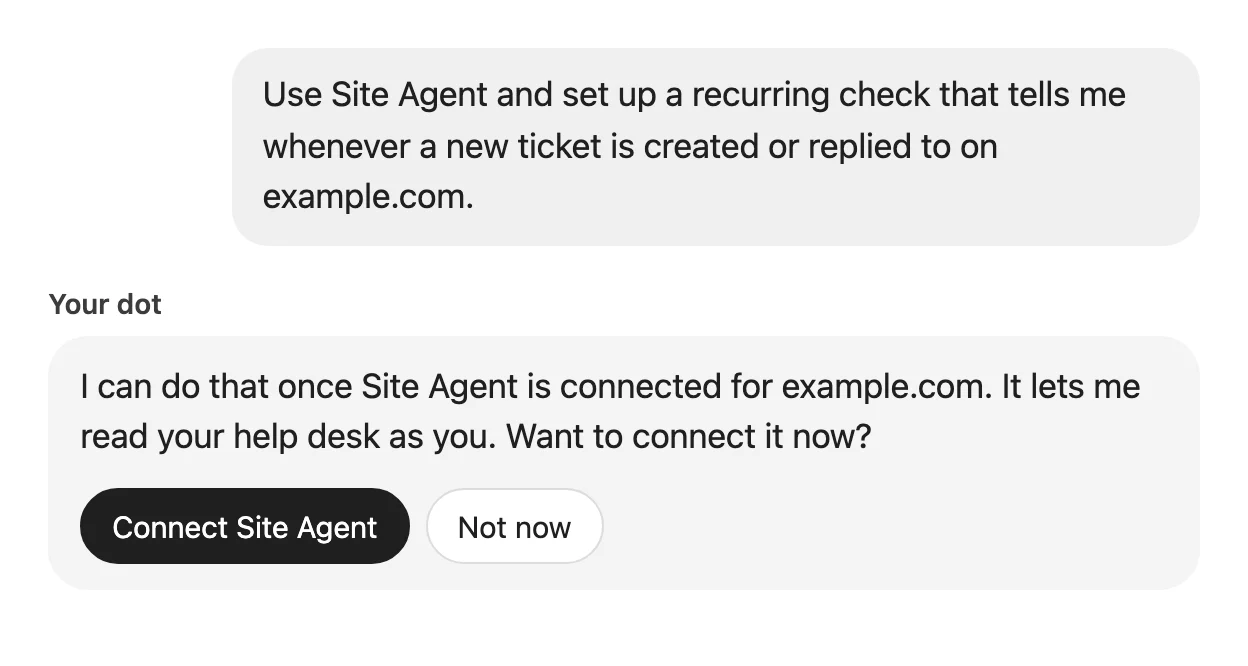
Connect Site Agent
- Approve the connection when your dot asks. A WordPress sign-in opens.
- Sign in with your administrator account, if you aren’t already.
- Read the Connect to Site Agent screen. It names the app that asked and the site it wants to reach.
- Under Allow it to also, tick Check Core Support tickets and feature requests, send team alerts and work the roadmap. Leave the rest unticked unless you want your dot to do more on the site.
- Choose Allow. You land back in ChatGPT.
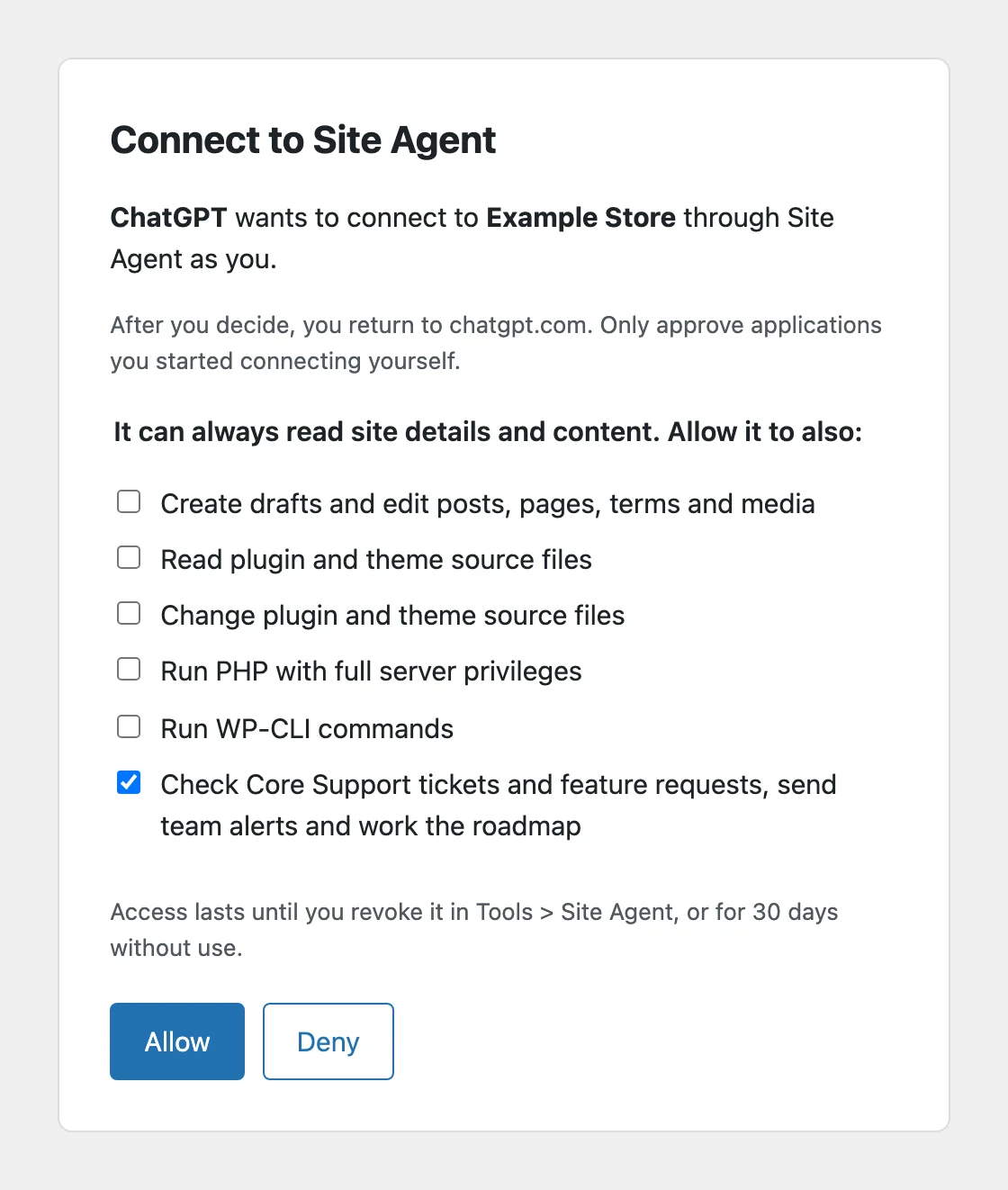
A watch needs only the Core Support line. Running PHP, running WP-CLI and changing plugin files are full-power permissions, and a ticket alert has no use for them. Your dot can always read site details and content on top of what you tick.
The screen also says when access ends: when you revoke it in Tools → Site Agent, or after 30 days without use. Only approve a connection you started yourself.
Confirm the Recurring Check
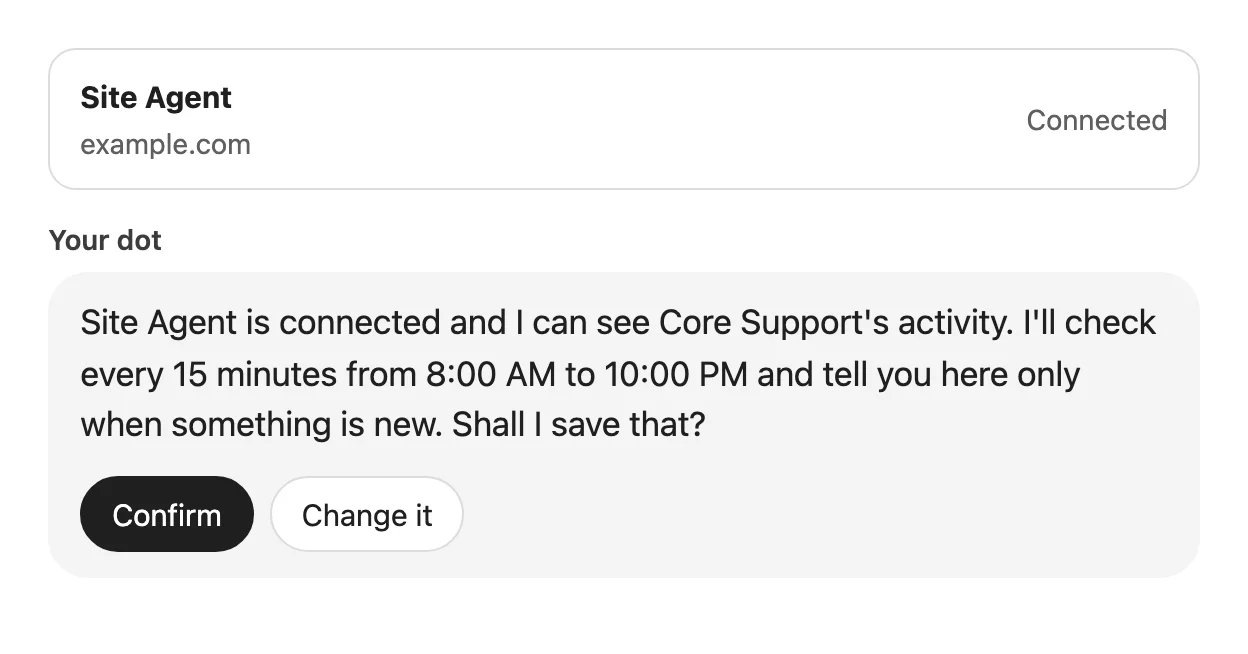
A dot needs a saved schedule for work that repeats at fixed times. Tell it four things, then confirm the schedule when it reads them back:
- What to check: new tickets, customer replies and feature requests in Core Support.
- When to run: every 15 minutes during your working hours, with your time zone.
- What deserves a message: only new activity.
- Where to tell you: this conversation, or Slack if you’ve added it to your dot.
On its first run the check records where things stand, so you don’t get a dump of every old ticket. After that, each run asks Core Support what happened since the last check:
- New tickets, with the subject, the customer and a link to the ticket.
- Customer replies on existing tickets.
- Feature requests from your roadmap pages, while the Roadmaps module is on.
Your dot messages you only when one of these comes back. A quiet help desk means a quiet chat.
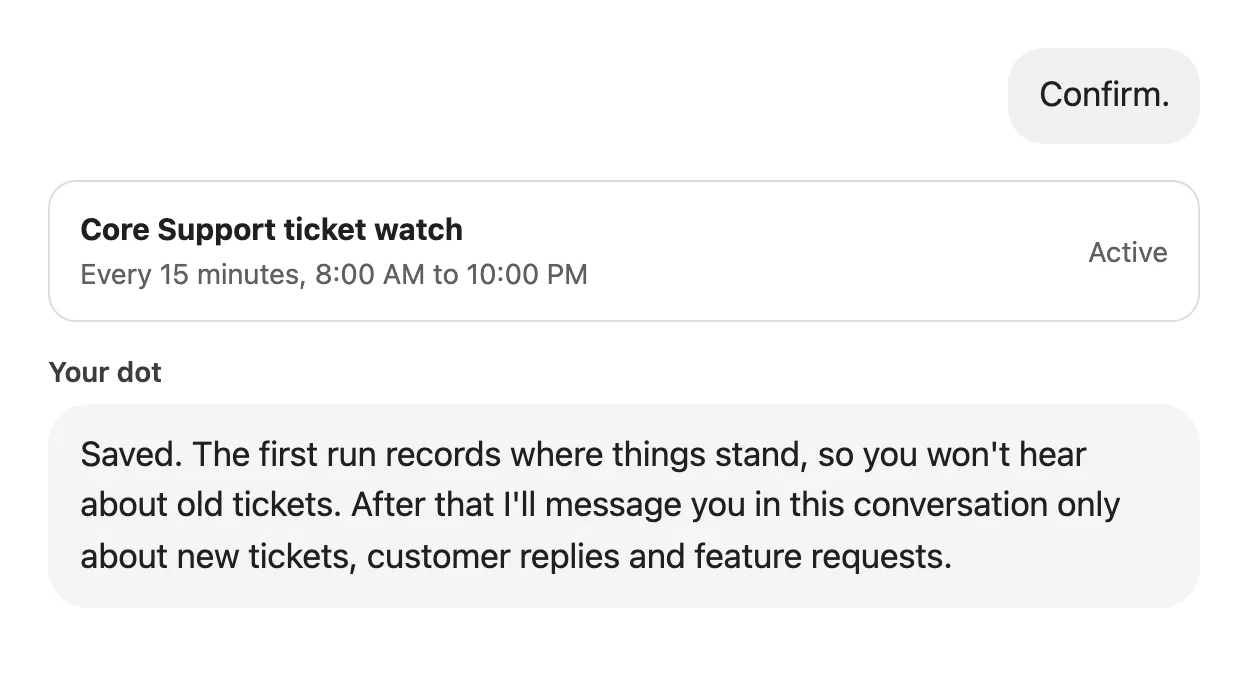
OpenAI doesn’t publish a minimum interval, so read what your dot confirms. To change or cancel the check, ask your dot in the same conversation, or open Scheduled. Pause stops your dot’s current task but doesn’t cancel future scheduled runs.
What a Message Contains
Each alert names the ticket or request and links to it in wp-admin. The customer’s message text comes along only when Include a message preview is on under Core Support → Settings → Team alerts. It’s the same switch the app alerts use, so one setting covers both.
With the preview on, your dot can say in a sentence what the customer wanted, which is usually enough to decide whether it needs you right now.
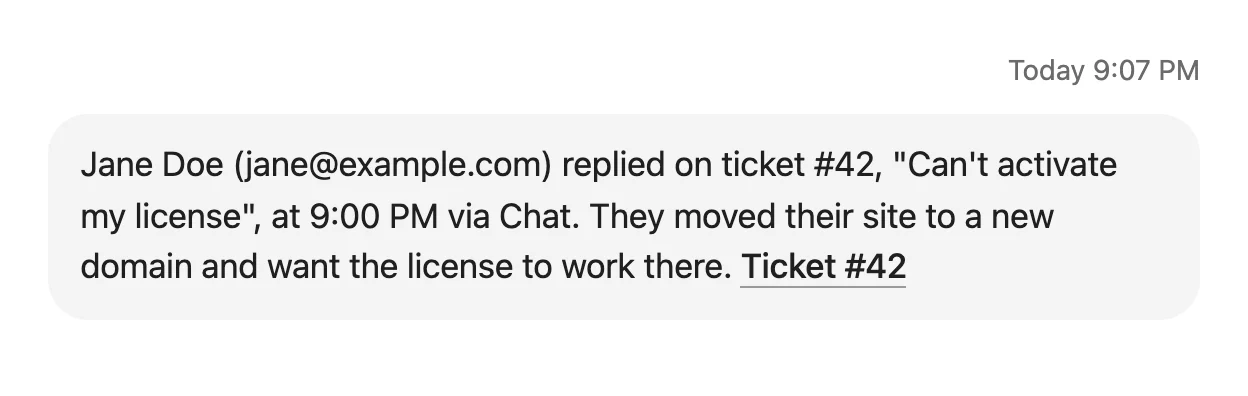
I’d leave the preview off at first. The text passes through OpenAI’s servers, and customer messages can hold order details or personal information. With the preview off, you still get the subject, the customer and the link.
Other Things You Can Ask
The same connection lets your dot help with more than the watch. Each request runs as your account, with your permissions:
- “Summarize ticket #123 and suggest a reply.” Your dot reads the ticket and drafts text for you to send yourself.
- “Which open tickets are unassigned?”
- “Send a team alert that the payment gateway is down.” It goes to your Telegram, Pushover, Discord, Slack or webhook channels.
- “Move the CSV export item to Planned on the Core Support roadmap.”
- “Show me the feature requests waiting for review.”
Nothing here replies to a customer. A draft stays in the chat until you paste it into the ticket.
Good to Know
- It isn’t instant. A check that runs every 15 minutes can take up to 15 minutes to tell you. For an alert within seconds, set up team alerts on Telegram, Pushover, Discord, Slack or a webhook as well.
- The schedule is ChatGPT’s. ChatGPT runs the check on its side. If the check is disabled or deleted there, the checks stop.
- Reading a ticket returns internal notes. The activity check follows the preview setting, but “summarize ticket #123” returns its latest messages and notes, as an agent would see them.
- Unused connections expire. After 30 days without a call, Site Agent ends the access. Ask your dot to reconnect, and approve the screen again.
- You can see every change. Tools → Site Agent keeps an audit history of the last 100 records, with the tool, the time and the result. Successful read-only checks stay out of it, so a watch doesn’t crowd it.
- Disconnecting is one click. Revoke the connection in Tools → Site Agent. That stops the watch.
Grok Bot and Claude Duet connect the same way. See Get Ticket Alerts in Grok Bot and Get Ticket Alerts in Claude Duet.