
 by
Did Salon’s shutdown just prove that blogs can’t make money from ads anymore? If a publisher that ran for 31 years couldn’t make the numbers work, can a small blog still earn anything from display ads?
Those questions spread fast after Salon announced it was ceasing publication. The risk is drawing the wrong lesson from it, in either direction. Some bloggers will rip ads off pages that earn well from them, and others will stack more ad units onto pages that are already losing clicks.
My answer is yes, with conditions. Ads still pay some blogs well as one layer of income on pages real people read. What Salon’s end shows is how hard it is to carry a newsroom’s costs on open-web publishing economics, and it isn’t proof that display ads stopped working for everyone.
Below I cover the verified facts about Salon, how blog ad revenue is calculated, what the main ad networks require and a simple test for your own site.
Display ads work best as one income layer on informational pages with real human traffic. They make a poor primary plan for an expert site that should be selling a service or a product.
What Happened to Salon
Salon announced on November 5, 2026, that it is ceasing publication after 31 years. These are the facts that hold up:
- Salon launched on November 20, 1995.
- Find.co, a performance marketing company, bought 100% of Salon on November 8, 2023, without disclosing terms.
- Deadline reported that the site would go dark later on the day of the announcement.
- Chief content officer Erin Keane said the archive would “stay live for now,” as The Verge reported.
What Salon Said and Didn’t Say
Salon’s goodbye post gives one reason. It says the business realities of independent digital journalism have changed profoundly, and that “our publishing model is no longer sustainable.”
It doesn’t name a cause. There’s no mention of ad rates, Google, AI tools or traffic, and no breakdown of revenue or costs. The Verge noted that many websites are dealing with “Google Zero” and AI tools, but that was the outlet’s own context. Salon’s general manager only pointed The Verge back to the announcement.
Reading one cause into a vague farewell is how bad advice spreads on social media. I’d take the announcement at its word: the whole model stopped working, and the detailed numbers stayed private.
The Lesson That Transfers
Deadline reported that Salon once employed nearly 150 people, and that the 2010s and 2020s were far less kind to web businesses that relied on advertising. That is the closest thing to an explanation in the coverage, and it describes an industry trend rather than Salon’s own books.
A staffed newsroom pays reporters, editors, lawyers, benefits and office costs before it earns a dollar. A niche WordPress site might pay for hosting, a few tools and the owner’s time. Both live on the same open web, but they are very different businesses.
So the lesson I’d take from Salon is about margin and dependence. A business that needs a lot of revenue every month, from sources it doesn’t control, is fragile whether it runs ads or not. Deleting AdSense from a small blog doesn’t fix that.
Are Display Ads Dead?
No. IAB and PwC’s annual report put US internet advertising revenue at $294.6 billion for 2025, up 13.9% from the year before. So the money is still there, and the total is still growing.
The growth is uneven, though. Display advertising, the format most blogs run, grew 9.8% to $81.6 billion, while social media advertising grew 32.6%. So blogs sit in one of the slower-growing parts of the market, and the report says the top 10 companies still take the majority of it.
“Ads are dead” is false. The harder truth for bloggers is that most of that growth goes to companies that own logged-in users, purchase data or video feeds. An independent site sells what’s left: attention on open-web pages that have to stay brand-safe and human.
Who Owns the Customer
Advertisers pay for results they can measure. That pushes their budgets toward platforms that can tie an ad to a sale inside their own walls, such as search, social apps and retail media on store sites.
A blog sits outside those walls. It doesn’t know who the visitor is, it can’t prove the purchase happened and it depends on search or social for most of its visitors. So your competition for ad budgets isn’t only other blogs. It is TikTok, Amazon’s ad business and creators who sell sponsorships directly.
That doesn’t make blog ads worthless. It means the price of your ad space is set by buyers who have many other places to spend, and you control very little of it.
How Blog Ad Revenue Is Calculated
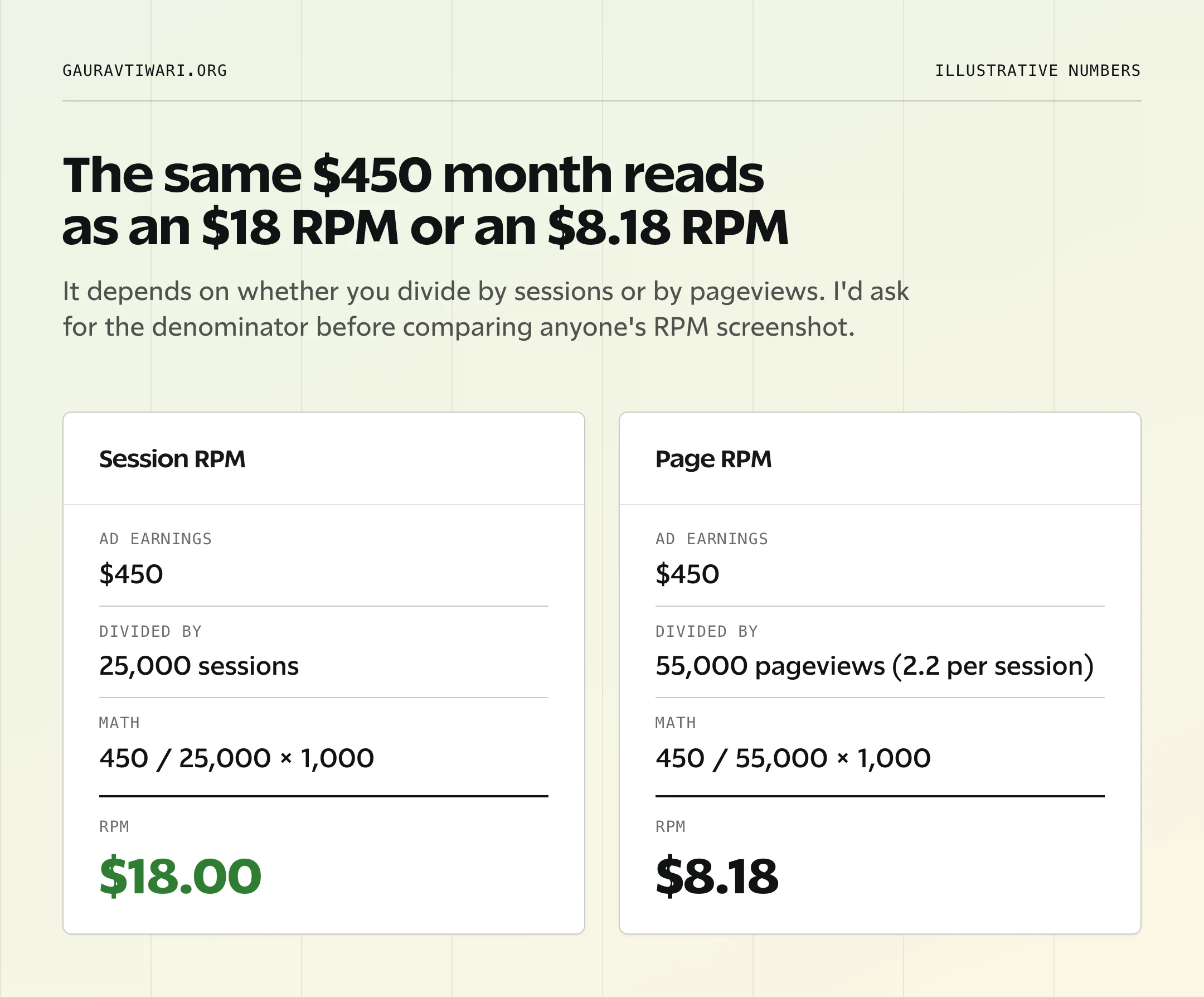
Most ad income talk breaks down because people compare numbers with different bases. These are the 2 formulas that matter:
- Page RPM: earnings divided by pageviews, multiplied by 1,000
- Session RPM: earnings divided by sessions, multiplied by 1,000
A session is one visit, and a visit often includes several pageviews. So the same month of earnings gives a much higher session RPM than page RPM. Ad network dashboards can also count impressions and viewability differently from GA4, so I’d only compare RPMs that use the same base and the same tool.
Gross and Net
The number in an ad dashboard is your share after the network takes its cut. For AdSense for content, Google says publishers receive 80% of the revenue after the advertiser platform takes its fee. When Google Ads is the buyer, that works out to about 68% overall. Mediavine publishes a flat share for newer sites starting at 75%, and Raptive says it pays 75% to creators. That figure still isn’t profit. These come out of it before anything reaches you:
- hosting and a CDN that can handle ad scripts
- a consent tool, if you have visitors from regions that require one
- speed fixes, because ad scripts slow pages down
- writing and editing time
- the conversions you lose when ads distract from a newsletter signup or an affiliate link
What Moves RPM
RPM isn’t a fixed property of a niche. It moves with things you only partly control:
- the share of visitors from high-paying countries
- niche and brand safety, since advertisers avoid some topics
- device mix, because mobile layouts hold fewer ad slots
- the season, with the last quarter of the year usually strongest
- consent rates in regions that require opt-in
- ad blockers
- ad density and how many ads are actually seen
- invalid traffic filters
- where visitors come from, since search visitors behave differently from social or paid ones
Worked Examples
These are made-up numbers to show the arithmetic. They are not benchmarks or promises, and your own dashboard is the only RPM that matters.
| Example | Monthly traffic | RPM used | Gross | Monthly costs | Net | What it shows |
|---|---|---|---|---|---|---|
| A: small site on AdSense | 40,000 pageviews | $4 page RPM | $160 | $50 | $110 | Approval is not meaningful income |
| B: growing site, mixed countries | 120,000 pageviews | $6 page RPM | $720 | $150 | $570 | Fine as extra income; one client project may pay more |
| C: premium network candidate | 25,000 sessions (55,000 pageviews) | $18 session RPM | $450 | not counted | not counted | The base you divide by changes the story |
| D: example B with heavy ads | 120,000 pageviews | $9 page RPM | $1,080 | $150 | $930 | More gross, but fewer signups and affiliate sales |
Example D is the one I’d think hardest about. It looks better on the ad dashboard, but the extra ads push people away from the email list and the affiliate links that build the site’s future. That is spending next year’s income to raise this month’s RPM.
Ad Network Requirements
The networks a blog can join set very different bars. I’d check these pages again before applying, because thresholds change.
| Network | Entry bar | Traffic location rule | Other screens |
|---|---|---|---|
| Google AdSense | No published traffic minimum | None published | Age 18 or older, HTML access, original content, program policies |
| Journey by Mediavine | 1,000 premium sessions in 30 days | Premium traffic, with no country list published | GA4 connected; Wix and Blogspot sites and excessive AI use are disqualified |
| Mediavine Official | $5,000 or more in annual ad revenue | Not stated | Original, audience-first content and no active Google policy issues |
| Raptive | 25,000 pageviews a month | 50% from the US, UK, Canada, New Zealand or Australia below 100,000 pageviews, 40% above | Long-form content, human involvement, analytics set up, domain at least 6 months old |
Google AdSense
AdSense eligibility asks for a publisher aged 18 or older, access to the site’s HTML and content that is original and attracts an audience, plus compliance with the program policies. Google publishes no monthly traffic minimum.
Payment starts once earnings reach the $100 threshold, which varies by reporting currency. The rule that matters most is invalid traffic. Clicking your own ads counts as invalid traffic, and Google says publishers closed for it can’t participate in AdSense again.
AdSense is still the sensible first ad layer for many sites. It just isn’t a living at low traffic.
Journey and Mediavine
Mediavine runs 2 tiers through one application. Journey needs at least 1,000 premium sessions over 30 days, a connected GA4 account and brand-safe original content. It lists automatic disqualifiers, including Wix and Blogspot sites and excessive use of AI.
Mediavine Official now uses one bar: $5,000 or more in annual ad revenue, with original, audience-first content and no active Google policy problems. Meeting either number starts a review, and approval still depends on the whole site. For a growing site with strong US traffic, Journey is the network I’d aim for after AdSense, because its bar is the lowest of the premium options.
Raptive
Raptive asks for at least 25,000 pageviews a month. These are its other rules:
- for 25,000 to 99,999 pageviews, 50% of traffic from the US, UK, Canada, New Zealand or Australia, and long-form content on most pages
- for 100,000 pageviews or more, 40% of traffic from those countries
- high-quality, original content with meaningful human involvement
- Google Analytics set up correctly
- a domain at least 6 months old
For a site with mostly Indian or Southeast Asian traffic, the country rule is a bigger barrier than the pageview count.
If you’re comparing more options, my list of Google AdSense alternatives covers the other networks bloggers use.
Policy and Concentration Risk
An ad-only site can lose a month of income to one policy decision. These are the risks I’d watch:
- Invalid traffic. Clicking your own ads, paying for traffic or asking people to click can get an account closed.
- Brand safety. Some topics get restricted ads or none at all, even when the content is legal.
- One network. A rejection, suspension or rate change hits all your income at once.
- One traffic source. A search update or a platform change can cut visits overnight.
My rule of thumb is simple. If ads bring in most of your revenue and one channel brings in most of your traffic, the site is leveraged like a day trader with a WordPress theme.
AI Search and the Shrinking Click
A Pew Research Center study tracked the Google searches of 900 US adults in March 2025. Users clicked a traditional result in 8% of visits when an AI summary appeared, against 15% when none did. They clicked a link inside the summary in just 1% of visits.
That is one country and one month, so I’d treat it as measured behavior rather than a forecast. It still matters for ads, because display income is pageviews multiplied by RPM, and fewer clicks means fewer pageviews to multiply.
So the click that survives is rarer, and often more deliberate. If it’s a high-intent visitor, ads can still monetize it. If commodity pages are losing visits, the sensible response is better pages and an audience you own, not more ad units on pages fewer people see. I covered the traffic side in AI Overviews Are Killing Your Blog Traffic, and what schema can and can’t do in schema markup for AI Overviews.
When Ads Make Sense
Whether ads belong on a site depends on what the site is for. This is how I’d decide by site type:
| Site type | Ads? | Why | Better first income layer |
|---|---|---|---|
| Brand-new blog with a few thousand visits | Wait, or test lightly | Setup and slower pages cost more than ads pay | Email list, affiliate links or a service |
| Growing informational site with brand-safe content | Yes, as one layer | Leftover attention can earn steadily | Keep affiliate links and email alongside |
| Expert or consultant site with high-value offers | Usually no on money pages | Ads distract from the sale | Services |
| Large content library with steady traffic | Yes, and aim for a better network when eligible | Volume makes ads worth it | Sponsorships, and a membership only with real cadence |
| Sensitive or policy-edge niche | With caution | Restricted ads and closure risk | Direct sponsorships, or no ads |
| Thin AI-written content site | No | Networks reject it and search policies target it | Rebuild the content first |
The Opportunity-Cost Test
Before ads go on any template, I’d answer 3 questions for it:
- What is one visit worth if it turns into an email subscriber, an affiliate sale or a client?
- What is one visit worth in ad revenue?
- Do the ads reduce the first number by more than they add in the second?
This example is hypothetical, but the shape is common. A service page converts 1 in 500 visitors into a lead, and 1 in 5 leads becomes a $2,000 project. That page earns about $0.80 per visit. The same visit at a $6 page RPM earns $0.006 from ads.
If ads cut that page’s lead rate by just 1%, the page loses $0.008 per visit, which is more than the ads earn. Most service businesses fail this test, and I’d keep ads off their money pages entirely.
What People Say About Ads
The same 4 claims show up in almost every argument about blog ads, and each one has some truth in it.
“Premium networks prove ads still print cash.” For an eligible site with the right traffic mix, ads can be strong. But eligibility and variation are the whole story, and a network’s marketing page isn’t your profit and loss statement.
“Subscriptions replace ads.” They can, with recurring value and the discipline to keep members. Most blogs can’t support a paid membership yet, and an empty paywall earns less than a modest ad layer.
“Affiliate links always beat ads.” Only on pages with buying intent and a reader who trusts you. Many informational visits have no product worth recommending, and forcing one hurts trust.
“Salon died, so stop running ads.” Salon was a different business with a different cost base. The warning is real, but copying its conclusion onto a 2-person blog makes no sense.
My view sits between them. Ads are worth running where they pay without hurting the pages that build your future, and nowhere else.
Diversifying Without Building 4 Weak Systems
Other income layers can sit next to ads, and each one has a real cost:
- Direct sponsorships, which need a clear audience and time spent selling. My guide to working with brands as a blogger covers how they work.
- An email list, which costs a tool, a schedule and steady writing. It is the layer I’d add first, because it makes every other layer less dependent on search. My email marketing guide covers the setup.
- Affiliate links on pages with buying intent, with disclosure and honest testing. The basics are in affiliate marketing for beginners.
- Services or productized consulting, which pay fastest but take your time.
- Small digital products, which need support, refunds and updates.
- A membership, only when you can deliver on a schedule people will pay for.
Diversification is risk management, not a slogan. Four half-built income systems are worse than one measured system with ads as an optional extra. For the full map, I’d start with how to monetize your blog and blog income diversification.
A 30, 60 and 90 Day Plan for Ads
This is the order I’d follow to make an ad decision with evidence instead of screenshots:
| Window | Work | Decision at the end |
|---|---|---|
| Days 1 to 30 | Export 90 days of sessions, pageviews, countries, devices and landing pages. Separate money pages from informational pages. Note current ad earnings, page speed and consent rates. Estimate the opportunity cost on the top 10 URLs. | Which pages could carry ads |
| Days 31 to 60 | Remove ads from high-value templates if the test says so. Improve or cut thin pages. Check live network thresholds against real GA4 data, without faking geography. | Which network fits, if any |
| Days 61 to 90 | Measure one non-ad income layer. Run ads on the remaining pages with a restrained layout. Recalculate gross ads, costs, other revenue and how concentrated income is. | Keep, cut or upgrade the ad setup |
FAQs on Blog Ad Revenue
There is no universal number. AdSense publishes no traffic minimum, and the premium networks publish entry bars that still don’t guarantee approval or profit. I’d run the worked math with your own RPM, costs and the value of the pages ads would sit on.
It is a weak plan. Journey disqualifies sites for excessive use of AI, Raptive asks for meaningful human involvement, and Google’s spam policies target scaled low-value pages. An ad business built on disposable text tends to lose both its network and its traffic.
They can still earn, but RPMs are usually lower and the premium networks are harder to join, since Raptive counts traffic from 5 English-speaking countries. I’d model ads with your real country mix and build other income layers earlier.
Only when the content, the traffic quality and the page experience are ready. A minimum is a screen for an application, and these networks review the whole site before approving it.
Usually not on pages that sell the service. One lost lead is often worth more than months of ad revenue from that page, so I’d keep ads off money pages and test them, if at all, on purely informational posts.
Final Remarks
If you’re still unsure whether to keep ads after the Salon news, I’d let your own numbers decide rather than the headlines. Run the opportunity-cost test on your top pages, keep ads where they earn more than they cost and take them off the pages that sell something. I’d also start an email list this month. A direct line to readers is the one income layer that doesn’t depend on an ad network’s approval or a search update.
Tell Google you want more of this.
Add Gaurav Tiwari as a preferred sourceOne tap, and this site shows up more often in your own Top Stories, AI Overviews and AI Mode. Remove it any time.