
Free exam prep study notes, lecture summaries, and subject guides for students at all levels. I’ve spent around two decades creating educational content and building resources that help people actually understand what they’re studying. Not just memorize it for the test and forget it a week later.
These aren’t generic notes copied from textbooks. They’re materials I’ve developed and refined based on real feedback from thousands of students. When something doesn’t click, I rewrite it. When exam boards update their requirements, I adjust the notes to match.
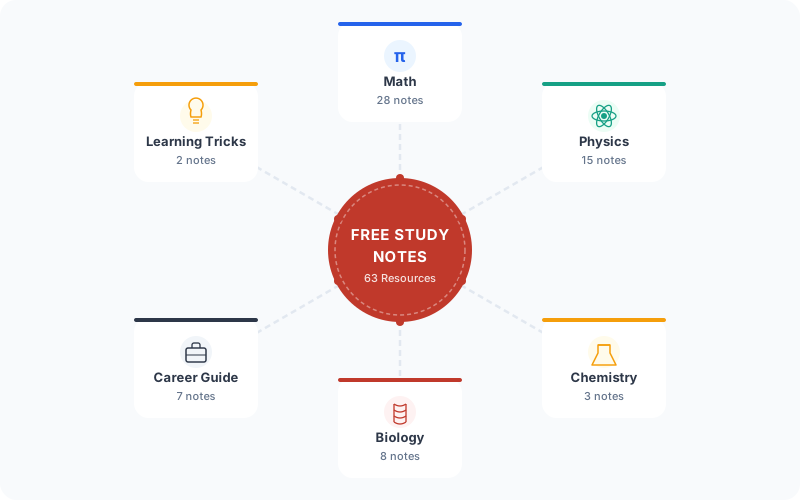
Everything here is organized by subject: Mathematics, Physics, Chemistry, Biology, Career Guidance, and Learning Tricks. Each resource is written in plain language, formatted for easy reading on any device, and updated regularly.
Why give this away for free? Because I’ve been the student scrambling to find decent study materials the night before an exam. Good resources shouldn’t be locked behind expensive subscriptions or buried in cluttered websites full of ads.
What you’ll find on this page:
- Subject-specific study notes covering key concepts, formulas, and worked examples that show you how to actually solve problems, not just what the answer is
- Lecture summaries that condense hours of material into focused reviews you can read in one sitting
- Exam prep tips based on patterns I’ve noticed across years of helping students prepare
- Practice problems with step-by-step solutions you can follow without getting lost
- Career guidance for students planning their next steps after exams
- AI study tools you can use alongside these notes to study more effectively
Math
Math builds on itself. Miss one concept and the next three won’t make sense. These notes break down topics step by step, with worked examples that show you the “why” behind each solution. From basic algebra to calculus, you’ll find explanations that actually stick. If you’re a college student, you might also want to check out these recommended physics textbooks that complement these math foundations.
- Zero of a Function
- Whole Numbers
- Trigonometric Identities
- Triangle Inequality
- Best Time Saving Mathematics Formulas & Theorems
- The Area of a Disk
- Supremum and Infimum
- Square Integrable Functions, Norms, Trial Method in Integral Equations
- Definitions and Types of Integral Equations
- Significant Figures: Definition, Usage and Examples
- Set
- Real Sequences: Definitions, Theorems, and Examples
- Irrational Numbers and The Proofs of their Irrationality
- Numbers - The Basic Introduction
- How to convert Integral Equations into Differential Equations?
- Important Definitions in Functional Analysis
- Function: Notations and Rules
- Fermat Numbers (Important Theorems & Examples)
- Fox-Rabbit Chase Problem [Solution & Math Proof]
- Equations: A Basic Introduction
- Everywhere Continuous Non-differentiable Function
- Dirichlet's Theorem and Liouville's Extension of Dirichlet's Theorem
- Difference Paradox
- Dedekind's Theory of Real Numbers
- Circumcenter of a Triangle: Definition, Types and Examples
- How to change Differential Equations into Integral Equations?
- Find the Day of a Date using this Calendar Formula
- Mathematical Logic - The basic introduction
Physics
Physics is just math with real-world context. Once you see it that way, everything clicks. These notes connect formulas to what’s actually happening, so you’re not just memorizing equations but understanding the mechanics, motion, and forces behind them. Watch some of the best physics YouTube channels alongside these notes for visual explanations.
- Wein’s Formula & Wein’s Laws
- What is a Transistor and How does it work?
- The Four Fundamental Forces of Nature
- Symmetry in Physical Laws
- Macrostates and Microstates and their relations with Thermodynamic Probability
- Standard Model
- Special Relativity
- Significant Figures: Definition, Usage and Examples
- Quantum Computing for Beginners: A Simple Guide
- Kinematic Equations Made Easy
- Jablonski Diagram: Energy Levels, Fluorescence & Phosphorescence Explained
- The International System of Units
- Einstein Field Equations
- Bosons
- Boltzmann Constant
Chemistry
Chemistry has a reputation for being tough. It doesn’t have to be. These notes simplify reactions, bonding, and calculations into language you can actually follow. I focus on the concepts that show up repeatedly in exams because that’s where your marks are.
Biology
Biology is more about understanding systems than rote memorization. These notes help you see how things connect: cells to organs, genetics to evolution, ecosystems to organisms. Diagrams, clear definitions, and exam-focused summaries are all here. For visual learners, pair these with top biology YouTube channels.
Career Guidance
Passing exams is one thing. Knowing what to do next is another. These career guidance resources help you plan beyond the classroom: choosing the right degree path, understanding job market realities, and building skills employers actually care about. Whether you’re deciding between university programs or exploring education business ideas, these guides will help.
- How to Remember Better for Your Exams: Science-Backed Memory Techniques
- The Best Public Places to study in for the Best Effect
- How to Get Research Paper Ideas: A Complete Guide for 2026
- How can Class 9 Math NCERT Solutions help the students?
- How to Choose the Right Online Degree Program?
- 10 Best IT Certifications For Beginners
Learning Tricks
Study smarter, not harder. These learning techniques are based on proven methods: spaced repetition, active recall, the Feynman technique, and others that cognitive science has validated. If you’re spending hours studying with little to show for it, these tricks will change your approach. Use mind mapping tools to apply these techniques digitally.
Don’t just read these notes passively. The most effective study method is active recall: read a section, close it, and try to explain the concept from memory. Then check what you missed. This single technique has been shown to improve exam scores by 20-30% compared to re-reading alone.
How to Use These Notes Effectively
I’ve watched thousands of students use study notes the wrong way. They read them like a novel, highlight everything, and wonder why they can’t remember anything during the exam. Here’s what actually works:
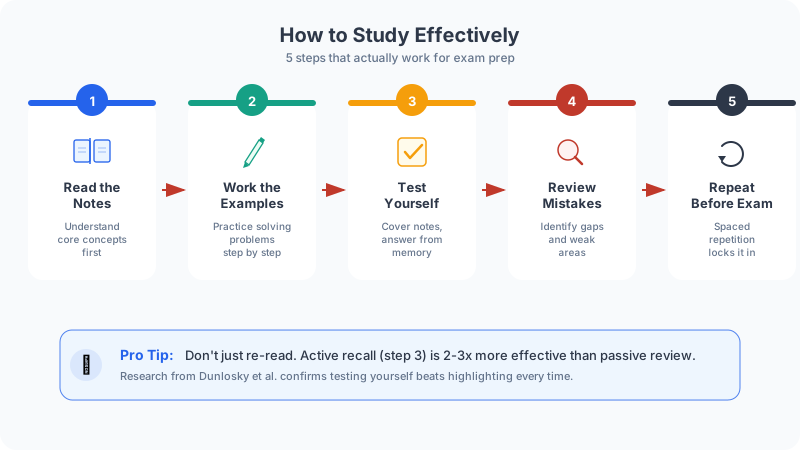
- First pass: skim for structure. Read headings and key terms to get the big picture before you go deep
- Second pass: work the examples. Don’t just read worked problems. Cover the solution, try it yourself, then compare
- Test yourself constantly. After each section, close the notes and write down everything you remember. Gaps in recall = gaps in understanding
- Focus on mistakes. When you get something wrong, that’s the most valuable moment. Understand why you got it wrong, not just what the right answer is
- Space your sessions. Three 30-minute sessions spread across a week beat one 3-hour marathon. Use a time management app to schedule them
Best Free AI Study Tools in 2026
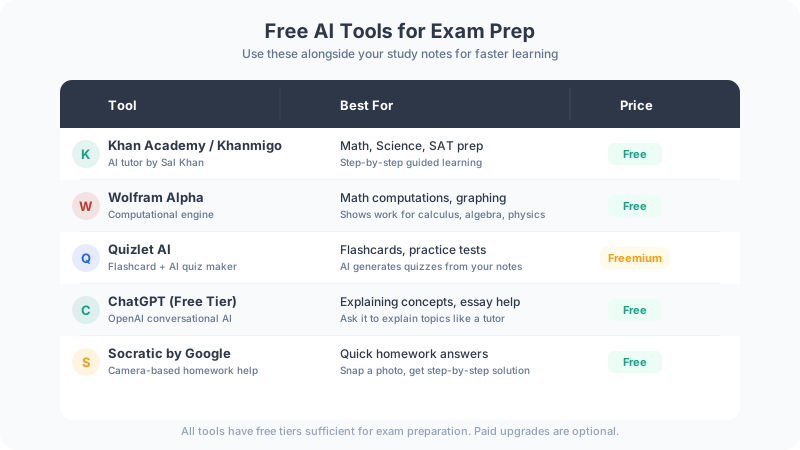
AI tools have changed how students study. They won’t replace understanding the material, but they’re excellent for getting unstuck on specific problems, generating practice questions, and explaining concepts in different ways. Here are the ones worth your time:
Khan Academy (Khanmigo)
Khan Academy remains the gold standard for free education. Their AI tutor, Khanmigo, doesn’t just give you answers. It asks guiding questions to help you figure out the solution yourself. It covers math, science, computing, economics, and SAT/AP prep. The free tier is generous enough for most students.
Wolfram Alpha
Wolfram Alpha is indispensable for math and science students. Type in any equation, integral, chemical formula, or physics problem, and it shows you the step-by-step solution. The free version handles most homework-level problems. Pro ($5/month for students) unlocks extended step-by-step solutions.
Quizlet AI
Quizlet has evolved beyond simple flashcards. Their AI features now generate practice tests from your notes, explain wrong answers, and create spaced repetition schedules based on what you’re struggling with. The free tier covers basic flashcard creation and study sets from other students.
Socratic by Google
Socratic lets you take a photo of a homework problem and get instant explanations. It’s powered by Google’s AI and works well for math, science, literature, and social studies. Completely free with no limits.
ChatGPT (Free Tier)
ChatGPT is useful for explaining complex topics in simple language, generating practice questions, and checking your understanding. It can make mistakes on math calculations though, so always verify numerical answers with Wolfram Alpha. The free tier (GPT-4o mini) handles most study tasks.
AI tools are study aids, not substitutes for understanding. If you use ChatGPT to generate answers without working through the logic yourself, you’ll fail the exam. These tools work best when you’ve already attempted a problem and need help understanding where you went wrong.
More Resources for Students
Beyond these study notes, here are some additional resources that my readers have found helpful:
- 12 best websites for free online short courses to supplement your studies
- 10 best educational podcasts for learning on the go
- Best study chairs for longer study sessions (your back will thank you)
- How to make money online as a student without sacrificing your grades
- Best peer-to-peer tutoring platforms if you need one-on-one help
Looking for more? Reach out
Got a specific topic you’re struggling with? Use the form below to ask. I read every question. If it’s something other students would benefit from too, I’ll create a resource for it.
Frequently Asked Questions
Are these study notes completely free?
Yes. All the exam prep study notes on this page are 100% free to access and use. No sign-up required, no paywall, no hidden fees. I believe quality educational resources should be accessible to everyone.
Can I download these notes as PDF?
Yes. You can download PDF versions of these notes from the downloads page. The PDFs are formatted for printing so you can study offline.
What exam boards do these notes cover?
The notes are designed to be broadly useful across major exam boards including CBSE, ICSE, state boards, GCSE, A-Levels, AP, and IB. I focus on core concepts that appear across curricula rather than board-specific formatting. The math and physics notes align particularly well with CBSE and ICSE syllabi.
How often are the notes updated?
I update notes whenever curricula change or when student feedback reveals gaps in coverage. Math and physics notes get updated most frequently since those subjects have the most content. You can check the last modified date on each individual note page.
Can I use AI tools like ChatGPT instead of studying from notes?
AI tools are supplements, not replacements. They work well for getting unstuck on specific problems, generating practice questions, and hearing explanations in different words. But they can make calculation errors, and more importantly, you need to build understanding in your own head. Use AI after you have attempted problems yourself, not before.
I found an error in one of the notes. How do I report it?
Use the contact form on this page or email me directly. I take accuracy seriously, and if there is an error, I want to fix it immediately. Include the specific note, the section, and what you believe the correction should be. I will review and update within 48 hours.
Do you offer tutoring or one-on-one help?
I do not offer personal tutoring, but I recommend checking out peer-to-peer tutoring platforms where you can find affordable help. For self-paced learning, try free online course platforms.