
 by
by
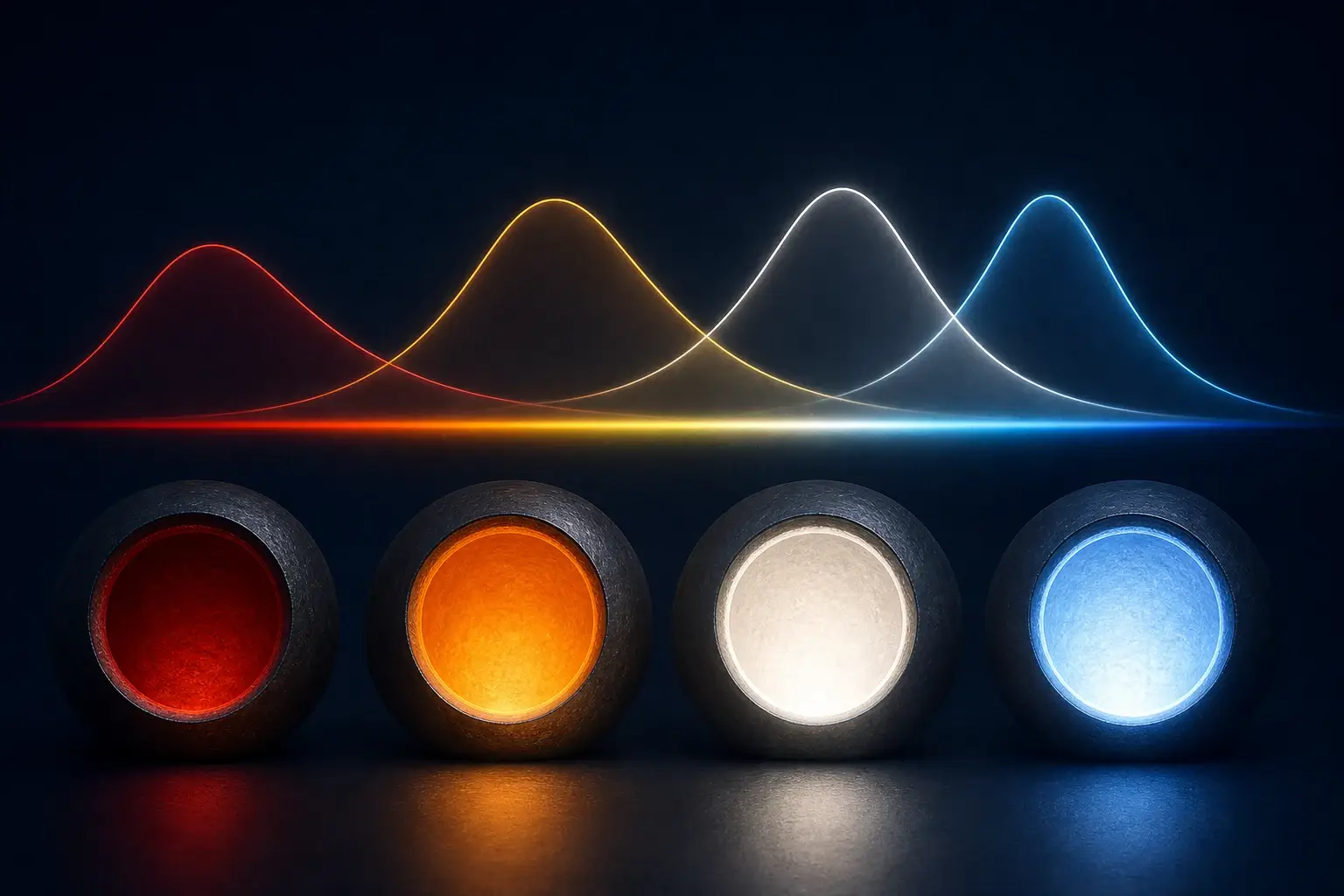
Wien’s displacement law says that the wavelength at which a blackbody spectrum reaches its maximum is inversely proportional to absolute temperature. Hotter objects peak at shorter wavelengths. Cooler objects peak farther into the infrared.
The compact formula is easy. Its interpretation is where students get trapped. You must use kelvin, keep the wavelength and frequency versions separate, and remember that the peak depends on how the spectrum is plotted.
What Is Wien’s Displacement Law?
For spectral radiance expressed per unit wavelength, Wien’s displacement law is
$$\lambda_{\max}T=b$$
where \(\lambda_{\max}\) is the peak wavelength, \(T\) is thermodynamic temperature in kelvin, and \(b=2.897771955\times10^{-3}\,\text{m K}\). The value is fixed by the shape of Planck’s blackbody law, not fitted separately for every object.
| Quantity | Symbol | SI unit | Meaning |
|---|---|---|---|
| Peak wavelength | \(\lambda_{\max}\) | metre (m) | Wavelength at the maximum of the wavelength spectrum |
| Absolute temperature | \(T\) | kelvin (K) | Thermodynamic temperature of the blackbody |
| Wavelength displacement constant | \(b\) | m K | \(2.897771955\times10^{-3}\,\text{m K}\) |
The NIST CODATA constants are the right reference for the current constant value. Do not copy a rounded classroom value into precision work without checking the required significant figures.
How To Use Wien’s Displacement Law
Start by converting temperature to kelvin. Rearrange only if needed, substitute the units, and check whether the answer belongs in visible, infrared, or ultraviolet radiation. This quick region check catches most powers-of-ten errors.
If you want to check a value before working it by hand, use the Wien’s law calculator. It keeps the unit conversion beside the result, which is where most avoidable mistakes happen.
- Write \(\lambda_{\max}=b/T\).
- Use kelvin, never degrees Celsius, in the denominator.
- Keep the wavelength unit in metres until the final step.
- Convert with \(1\,\text{m}=10^9\,\text{nm}=10^6\,\mu\text{m}\).
- Check whether a hotter body produced a shorter peak wavelength.
Example: Estimate the Sun’s Surface Temperature
The Sun’s visible spectrum is not a perfect blackbody, but a peak near \(500\,\text{nm}=5.00\times10^{-7}\,\text{m}\) gives a useful estimate.
$$T=\frac{b}{\lambda_{\max}}=\frac{2.8978\times10^{-3}}{5.00\times10^{-7}}\approx5.80\times10^3\,\text{K}$$
The result is about 5800 K. Absorption lines and the solar atmosphere complicate the observed spectrum, but the estimate lands close to the Sun’s effective temperature.
Example: Find the Peak Wavelength of a Person
For a body temperature near 310 K,
$$\lambda_{\max}=\frac{2.8978\times10^{-3}}{310}\approx9.35\times10^{-6}\,\text{m}=9.35\,\mu\text{m}$$
That peak lies in the thermal infrared. Human skin can feel warm and emit strongly without glowing visibly because its blackbody peak is far beyond visible red.
Wien’s Distribution Law and the Historical Approximation
Before Planck found the full blackbody formula, Wilhelm Wien proposed a distribution that described the short-wavelength side well. One common wavelength form is
$$B_{\lambda}(\lambda,T)=\frac{c_1}{\lambda^5}\exp\!\left(-\frac{c_2}{\lambda T}\right)$$
Here \(c_1\) and \(c_2\) collect physical constants according to the radiance convention being used. The exponential form works when \(hc/(\lambda k_{\mathrm B}T)\) is large. It fails at long wavelengths because it predicts too little energy there.

The opposite classical limit is the Rayleigh-Jeans law. It works at long wavelengths but diverges at short wavelengths, producing the ultraviolet catastrophe. Planck’s law connects both limits and gives the correct full spectrum.
Wien’s Fifth-Power Law
Wien’s fifth-power law compares the peak spectral radiance of two blackbodies. Because the shape of the wavelength spectrum stays similar while its peak shifts, the peak height is proportional to the fifth power of absolute temperature.
$$\frac{B_{\lambda,\max}(T_2)}{B_{\lambda,\max}(T_1)}=\left(\frac{T_2}{T_1}\right)^5$$
Equivalently, \(B_{\lambda,\max}/T^5\) is constant for ideal blackbodies when \(B_\lambda\) is measured per unit wavelength. If one blackbody is twice as hot, its wavelength-spectrum peak is \(2^5=32\) times as high.
Do not confuse this with the Stefan-Boltzmann law, which says total emitted power is proportional to \(T^4\). The fifth-power result describes the height of the wavelength-spectrum peak, not the area under the whole spectrum.
Where the Displacement Formula Comes From
Planck’s spectral radiance per unit wavelength can be written as
$$B_{\lambda}(\lambda,T)=\frac{2hc^2}{\lambda^5}\frac{1}{\exp\!\left(\frac{hc}{\lambda k_{\mathrm B}T}\right)-1}$$
To locate the maximum, differentiate with respect to \(\lambda\) at fixed \(T\), set the derivative to zero, and define \(x=hc/(\lambda k_{\mathrm B}T)\). The result is the transcendental equation
$$5(1-e^{-x})=x$$
Its nonzero solution is \(x\approx4.965114\). Substitution gives \(\lambda_{\max}T=hc/(xk_{\mathrm B})\), which is the wavelength displacement constant \(b\). The Boltzmann constant sets the temperature-to-energy scale inside this result.
Why Wavelength and Frequency Peaks Differ
This is the subtle point worth learning properly. A spectrum plotted per unit wavelength peaks at one converted location, while the same radiation plotted per unit frequency peaks at another. You cannot calculate \(\nu_{\max}\) by simply writing \(c/\lambda_{\max}\).
The reason is that equal wavelength intervals do not map to equal frequency intervals. Because \(\nu=c/\lambda\), the interval transformation contributes a Jacobian factor. The functions \(B_{\lambda}\) and \(B_{\nu}\) describe energy density using different horizontal bins, so their maxima do not label the same packet of bins.
| Spectrum plotted as | Peak relation | Displacement constant |
|---|---|---|
| Per unit wavelength | \(\lambda_{\max}T=b_{\lambda}\) | \(b_{\lambda}\approx2.8978\times10^{-3}\,\text{m K}\) |
| Per unit frequency | \(\nu_{\max}/T=b_{\nu}\) | \(b_{\nu}\approx5.879\times10^{10}\,\text{Hz K}^{-1}\) |
| Photon number or logarithmic interval | A different maximum again | Depends on the chosen spectral quantity |
What Wien’s Law Can and Cannot Tell You
Wien’s displacement law is powerful when the source is close to thermal equilibrium and its continuum resembles a blackbody. Astronomers use it to estimate effective temperatures of stars, dust, planets, and the cosmic microwave background. Thermal cameras work in bands chosen around the emission of objects near ordinary temperatures.
- It can estimate temperature from a well-measured thermal peak.
- It can identify the useful detector band for a temperature range.
- It cannot prove a source is a perfect blackbody. Real emissivity, absorption, reflection, and atmospheric transmission reshape spectra.
- It does not give total emitted power. Use the Stefan-Boltzmann law for the total flux of an ideal blackbody.
- It does not replace a spectral model. Multiple temperature components can produce a broad or misleading peak.
Common Mistakes
- Using Celsius: the formula requires kelvin because zero must be absolute zero.
- Mixing metres and nanometres: write the conversion explicitly before dividing.
- Assuming \(\nu_{\max}=c/\lambda_{\max}\): the frequency and wavelength spectra have different maxima.
- Reading colour too literally: a star’s perceived colour depends on the whole visible spectrum and human vision, not only the peak.
- Applying the law to line spectra: Wien’s displacement law describes a thermal continuum, not isolated atomic emission lines.
Related Physics Guides
Use these next if you want to connect this result with the surrounding physics:
- Rayleigh-Jeans law and the ultraviolet catastrophe
- Boltzmann constant and thermal energy
- Planck’s constant study notes
Key Takeaways
- Wien’s displacement law is \(\lambda_{\max}T=b\) for a spectrum expressed per unit wavelength.
- Hotter blackbodies peak at shorter wavelengths.
- The formula requires absolute temperature in kelvin.
- Wien’s historical distribution is a short-wavelength approximation, while Planck’s law describes the full spectrum.
- Frequency and wavelength spectra peak at different locations, so their peak values cannot be converted with one use of \(c=\lambda\nu\).
Frequently Asked Questions
What is Wien’s displacement law?
Wien’s displacement law states that the peak wavelength of an ideal blackbody spectrum is inversely proportional to its absolute temperature: λmaxT = b, where b is about 2.8978 × 10^-3 m K.
Why must temperature be in kelvin for Wien’s displacement law?
Kelvin is an absolute temperature scale. The derivation depends on thermal energy measured from absolute zero, so Celsius values would shift the scale and produce physically wrong answers.
Does a hotter object always look bluer?
For a thermal spectrum, the peak shifts to shorter wavelengths as temperature rises. Perceived colour also depends on the entire visible spectrum, brightness, material emissivity, filters, and human vision.
Can I find the frequency peak from c divided by the wavelength peak?
No. Spectral power per unit wavelength and per unit frequency use different interval widths. Their maxima occur at different physical positions on their respective plots.
What is the difference between Wien’s law and Planck’s law?
Planck’s law gives the full blackbody spectrum. Wien’s historical distribution approximates its short-wavelength side, while Wien’s displacement law identifies how a chosen spectral peak shifts with temperature.
What is Wien’s law used for?
It is used to estimate thermal-source temperatures, choose infrared detector bands, interpret stellar and planetary spectra, and check whether a measured peak is consistent with blackbody radiation.
Use the formula as a temperature check, not as permission to ignore how the spectrum was measured.
Tell Google you want more of this.
Add Gaurav Tiwari as a preferred sourceOne tap, and this site shows up more often in your own Top Stories, AI Overviews and AI Mode. Remove it any time.
Browse more in Physics.