
 by
by
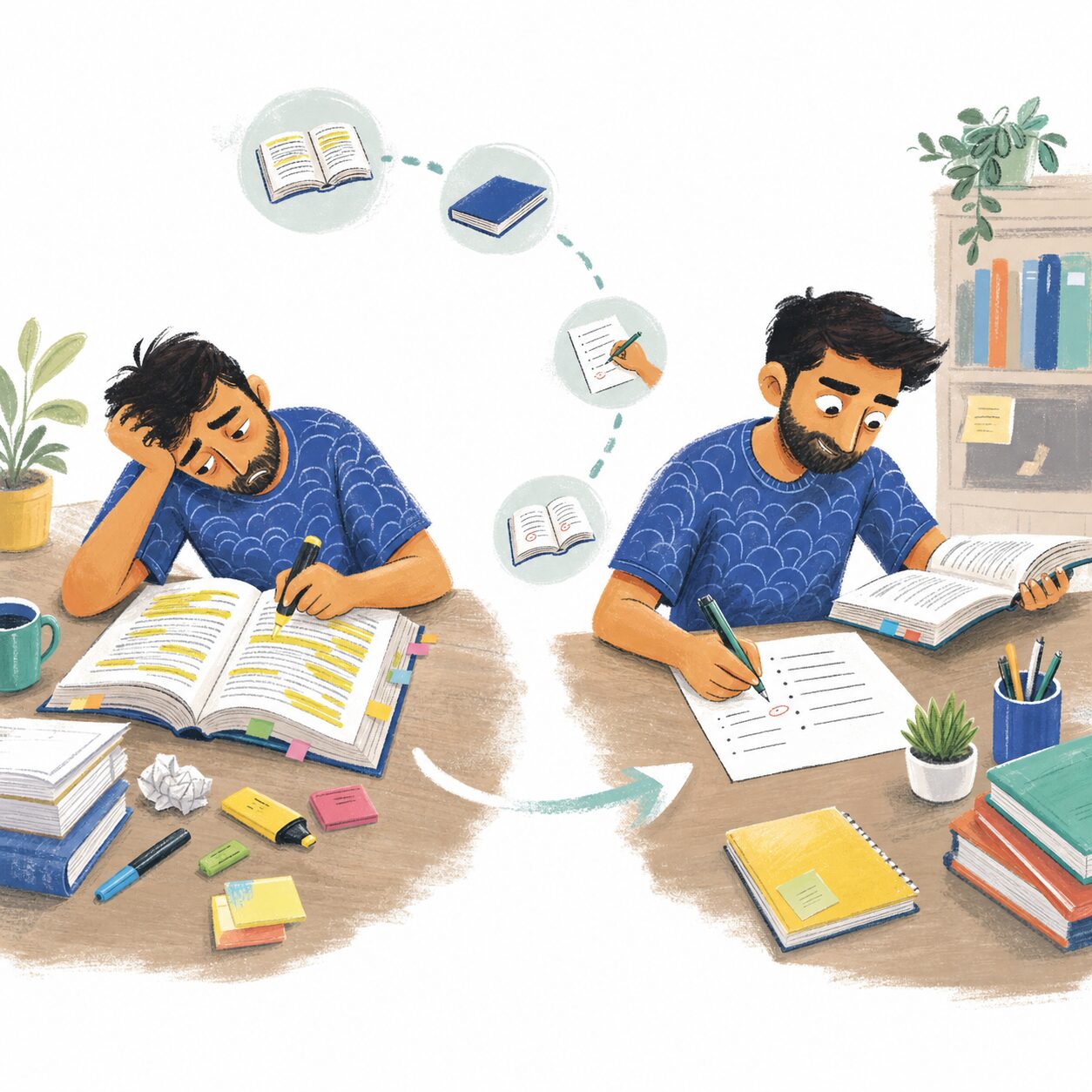
If a page looks familiar but the answer disappears when you close the book, you haven’t failed to study. You have practiced recognition instead of recall. To remember better for exams, read once, close the source, retrieve the answer, check it, correct it, and repeat after a delay.
That loop works because it gives you evidence. A highlighted page shows what you saw. A closed-book attempt shows what you can produce under exam conditions. The second result is less comfortable, but it is the one that can guide your next hour.
- Retrieve: answer a question, solve a problem, draw a diagram, or outline an essay without notes.
- Check: compare the attempt with a reliable source or worked solution.
- Correct: repair the exact missing step, fact, or misconception.
- Space: test the same idea again after a delay.
How to Remember Better for Exams: Start With the Evidence
The strongest general advice is not to read more creatively. It is to make retrieval and spacing the center of revision. A major review of ten learning techniques rated practice testing and distributed practice as high-utility methods. Highlighting and rereading were much weaker when used alone. Read the Dunlosky et al. review.
This is the practical answer to how to remember better for exams: match the technique to the task, then judge it by delayed performance rather than how smooth the study session felt. The evidence is broad, but it is not a promise that every technique works equally well for every subject.
| Technique | Research signal | Best use | Main limitation |
|---|---|---|---|
| Retrieval practice | High utility; classroom review covered 50 experiments | Questions, blank-page recall, essays, and problem sets | Wrong answers need feedback and correction |
| Distributed practice | High utility; 2006 synthesis covered 317 experiments | Reviewing across days or weeks | The useful gap depends on the retention goal |
| Interleaving | Useful when similar problems require different methods | Math, physics, grammar, and visual categories | Often lowers practice performance before helping later tests |
| Self-explanation | 2018 meta-analysis reported a moderate mean effect | Explaining steps, causes, and connections | A fluent but wrong explanation still needs checking |
| Mnemonics | Useful for ordered recall and arbitrary associations | Lists, sequences, vocabulary, and classifications | Recall is not the same as understanding |
Use Active Recall Before You Reread
Active recall means producing an answer without the source in front of you. That can be a short-answer question, a formula from a blank page, a labelled diagram, an essay plan, or the next step of a proof. The format matters less than removing the cues.
A 2021 systematic review screened nearly 2,000 abstracts and coded 50 classroom experiments with 5,374 students. Of the 49 reported effect sizes, 57% showed medium or large benefits from retrieval practice. The authors also noted a limitation worth keeping in view: only 6% of the experiments were conducted in non-WEIRD countries. Read the classroom systematic review.
In two experiments using prose passages, repeated study helped on a test after five minutes, but prior testing produced better retention after two days and one week. That is the tradeoff: rereading can raise immediate familiarity, while retrieval is better aligned with delayed performance. Read the testing-effect study.
Use a simple 0-1-2 score after each attempt: 0 means you could not start, 1 means the core idea was present but incomplete, and 2 means the answer was correct and complete. Revisit the zeros first. For the ones, write the missing step. Let the twos wait longer before the next test.
Do not stop at retrieval. Test yourself, check the answer, correct the error, and test the same idea after a delay. Repeating a wrong answer is still practice, just not the kind you want.
Space Retrieval Across the Time You Have
Spaced repetition is not a sacred Day 1, Day 3, Day 7 calendar. Cepeda and colleagues synthesized 839 assessments from 317 experiments in 184 articles and found that the useful spacing gap changes with the time you need to retain the material. See the meta-analysis.
If you are asking how to remember better for exams with limited time, start with a delay that makes recall effortful but possible. Shorten the next interval after a zero. Keep it similar after a partial answer. Lengthen it after two accurate attempts. This feedback rule is more useful than copying somebody else’s beautiful revision timetable.
| Time left | First pass | Next retrieval | Final check |
|---|---|---|---|
| 2 days | Map every topic and test the weakest | Retest failed items later the same day | Closed-book mixed check the next morning |
| 7 days | Run a diagnostic across the syllabus | Retest weak topics after 1 to 2 days | Mixed paper 1 to 2 days before the exam |
| 3 weeks | Diagnose and build question sets | Widen successful reviews across several days | Timed mixed papers in the final week |
Tools such as Anki can schedule prompts, but the software cannot rescue a weak card. Ask for an answer, step, diagram, comparison, or example. Avoid cards that can be answered by recognizing one highlighted word.
Interleave Similar Problems So You Must Choose the Method
Blocked practice tells you what to do before you read the problem. If a worksheet contains twelve questions on the same formula, selecting the formula is not part of the task. An exam mixes topics. Interleaving adds that decision back into practice.
A preregistered cluster-randomized trial involved 54 seventh-grade mathematics classes. Interleaved assignments prevented consecutive problems from requiring the same strategy, so students had to identify the applicable method. Read the randomized classroom trial.
Use blocked practice briefly when a method is new. Once you can execute the steps, mix it with two or three similar problem types. For each item, name the cue that made you choose the method. If you cannot explain the choice, another correct answer may only be a lucky match.
Use Self-Explanation, Not a Feynman Performance
The Feynman Technique is useful when it is treated as checked self-explanation: explain the idea without notes, mark the vague or missing steps, repair them from a reliable source, and explain it again. The value comes from exposing gaps, not from sounding simple or recording a polished monologue.
A 2018 meta-analysis combined 69 effect sizes from 64 reports and found a weighted mean effect of g = 0.55 for induced self-explanation. Effects still depend on the prompt, subject, comparison condition, and assessment. See the self-explanation meta-analysis.
A good explanation answers three questions: what is happening, why does this step follow, and how would I know if the answer were wrong? For history, name a causal link and the evidence for it. For biology, connect structure to function. For a language, produce an original sentence and check the grammar.
Worked Recall Example: Derive, Retrieve, Verify
Suppose you need the constant-acceleration relation v = u + at. Memorizing the final line gives you nothing to fall back on if a symbol disappears under pressure. Deriving it creates a route back.
- Start with the definition of constant acceleration:
a = (v - u) / t. - Multiply both sides by
t:at = v - u. - Add
uto both sides:v = u + at. - Check the units:
uandvare length per time, whileatis (length per time squared) times time. - State the condition: the relation assumes constant acceleration over the interval.
Now close the page and reproduce all five parts: starting definition, two algebra steps, unit check, and assumption. If you remember only the final formula, score it as partial. Exams often change the surface details; the derivation and checks are what let you recover.
Use Chunking and Mnemonics for the Right Kind of Memory
Chunking groups related details into a meaningful unit. A history chapter can become causes, turning points, key actors, and consequences. A biology process can become inputs, location, sequence, and outputs. The categories reduce a scattered list, but you still need retrieval to learn what belongs inside each group.
Do not choose a technique because a quiz labelled you a visual or auditory learner. A review of learning-styles evidence found insufficient support for matching instruction to an assessed style. Use diagrams when spatial relationships matter, speech when pronunciation matters, and practice problems when execution matters. Read the learning-styles review.
Acronyms and the method of loci can help with ordered lists. A 2025 method-of-loci meta-analysis reported a large effect on immediate serial recall compared with rehearsal, but rated the evidence low to very low quality because of bias and other limitations. Use a memory palace for an ordered sequence, not as proof that you understand the topic. Read the method-of-loci meta-analysis.
Mind maps are useful when the layout makes a relationship visible. They are less useful when drawing the map replaces testing what the branches mean. Use mind mapping apps to build the map once, then hide branches and reconstruct them from memory.
Match Practice to the Exam Output
You remember what you practice producing. A multiple-choice exam still requires recall because you must interpret the stem, select a method, and reject plausible distractors. Essay exams require organized recall. Math and science exams require method selection and execution, not formula recognition alone.
| Exam output | Retrieval prompt | How to check it |
|---|---|---|
| Facts and definitions | Write the answer before viewing options | Compare meaning, conditions, and one example |
| Essay | Build a thesis, three claims, and evidence from memory | Check coverage, accuracy, and logical order |
| Math or physics | Choose and solve a mixed problem without a method label | Check units, assumptions, signs, and the final value |
| Diagram or process | Draw and label it from a blank page | Check missing stages, directions, and relationships |
| Language | Produce a new sentence or spoken response | Check vocabulary, grammar, pronunciation, and meaning |
Practice under time only after you can complete the task correctly. Speeding up an error makes it harder to diagnose. When using math and science apps, choose tools that show worked feedback, not just a green tick.
A Seven-Day Plan Based on Outputs, Not Chair Time
If you want to know how to remember better for exams with one week left, track completed retrieval and corrected errors. Hours are a poor measure because two hours of highlighting can produce less evidence than twenty minutes of closed-book work.
| Day | Required output | Decision for the next day |
|---|---|---|
| 1 | One diagnostic set across all topics | Rank topics by 0-1-2 recall scores |
| 2 | Closed-book attempts on every zero | Keep unresolved errors in the daily queue |
| 3 | Mixed problems plus one explanation per weak concept | Separate knowledge gaps from method-selection errors |
| 4 | A timed half-paper or representative question set | Build an error log with cause and correction |
| 5 | Retest the error log without notes | Remove only items answered correctly twice |
| 6 | A full or scaled mock under exam conditions | Prepare a short final-retrieval list |
| 7 | Brief recall of the final list, then stop | Protect sleep, food, hydration, and arrival time |
For multiple subjects, time management apps can protect the blocks, but do not let the calendar become the work. Put a deliverable in every block: twenty mixed questions, one recalled essay plan, or five corrected derivations.
Protect Sleep and Treat Exercise as Support
Sleep supports memory consolidation, but the effect is not a universal percentage that can be pasted onto every task. Reviews describe selective reactivation and reorganization of new memories during sleep. This review explains the active-system consolidation model.
For teenagers aged 13 to 18, the American Academy of Sleep Medicine recommends 8 to 10 hours of sleep per 24 hours on a regular basis. Adults generally need at least seven hours, though individual needs differ. See the AASM sleep recommendation.
Exercise can support health and attention, but timing and intensity matter. A 2019 meta-analysis of 25 articles found different effects when acute exercise happened before encoding, during encoding, or during consolidation. Exercise during encoding had a small negative effect in that synthesis. See the exercise meta-analysis.
Do not trade an entire night of sleep for more passive exposure. Close the book, sleep, and use a brief closed-book check the next morning. If sleep problems persist, speak with a qualified health professional rather than trying to fix them with study hacks.
Use Study Tools Without Outsourcing the Thinking
A useful study tool reduces scheduling or organization work while leaving the recall to you. A weak tool produces summaries, cards, and answers that you never verify. The test is simple: does the tool make you produce and check an answer?
Anki schedules spaced flashcards on desktop and mobile. It is well suited to facts, vocabulary, formulas, and short distinctions. Its limitation is the same as every flashcard system: card quality and honest review determine the value.
Note-taking apps can hold question banks, error logs, and revision maps. Keep the answers collapsible or on a separate page so the tool does not supply cues before you attempt retrieval.
Use mind mapping tools for hierarchies and relationships, then redraw the structure from memory. Use AI-powered study tools to draft practice questions or variations, but verify every answer against the syllabus, textbook, teacher, or an official source.
Common Memory Mistakes to Stop Making
The hardest part of learning how to remember better for exams is giving up study habits that look productive. Most failed revision plans are not short on effort. They are short on diagnostic information. Stop the habits that hide what you cannot yet produce.
- Rereading before every attempt: close the source first, then use rereading only to repair a known gap.
- Making cards for everything: use cards for compact prompts; use problems, diagrams, or essays for larger performances.
- Counting hours: count retrieved answers, corrected errors, and mixed problems instead.
- Practicing only familiar topics: schedule the zeros and recurring errors before the twos.
- Confusing preference with effectiveness: test a method by delayed recall, not by whether it feels enjoyable.
- Using answer-generating tools as substitutes: an answer you did not produce or verify is not exam practice.
Frequently Asked Questions
How can I remember what I study for exams?
Read a small section once, close the source, retrieve the answer or process, check it, correct the exact gap, and repeat after a delay. This retrieve-check-correct-space loop produces evidence about what you can recall without the cues an exam will remove.
How many hours should I study per day before exams?
There is no universal number. Set output targets such as mixed questions completed, essay plans recalled, or errors corrected. Stop when fatigue turns retrieval into guessing or passive rereading, and protect enough sleep.
Is active recall better than rereading?
For delayed retention, retrieval practice generally outperforms restudy, although effects vary by material, test format, feedback, and delay. Rereading is still useful for the first pass and for repairing a specific gap found during retrieval.
What is the best spaced-repetition schedule for an exam?
There is no universal Day 1, Day 3, Day 7 schedule. Use shorter gaps after failed recall and longer gaps after accurate recall. The useful interval also depends on how far away the exam is.
How do I memorize formulas for math and science exams?
Derive or explain the formula, retrieve it from a blank page, state its assumptions, check the units, and apply it to mixed problems. Formula flashcards can test symbols, but method selection and execution need problem practice.
Does a memory palace help with exams?
A memory palace can help with ordered lists and arbitrary associations. It is less suitable for understanding a concept or choosing a problem-solving method. Current meta-analytic evidence is promising for recall but has important quality limitations.
Is it better to study at night or in the morning?
Use a time when you can protect attention consistently, but do not sacrifice sleep. Compare the two times with the same retrieval task and keep the one that produces better answers, not merely the one that feels easier.
If you remember one rule, make it this: the page should be closed for part of every serious study session. To remember better for exams, produce the answer, inspect the gap, correct it, and come back after a delay. Everything else, from flashcards to memory palaces, is useful only when it strengthens that loop.
Tell Google you want more of this.
Add Gaurav Tiwari as a preferred sourceOne tap, and this site shows up more often in your own Top Stories, AI Overviews and AI Mode. Remove it any time.
Browse more in Career Guidance.