by
by
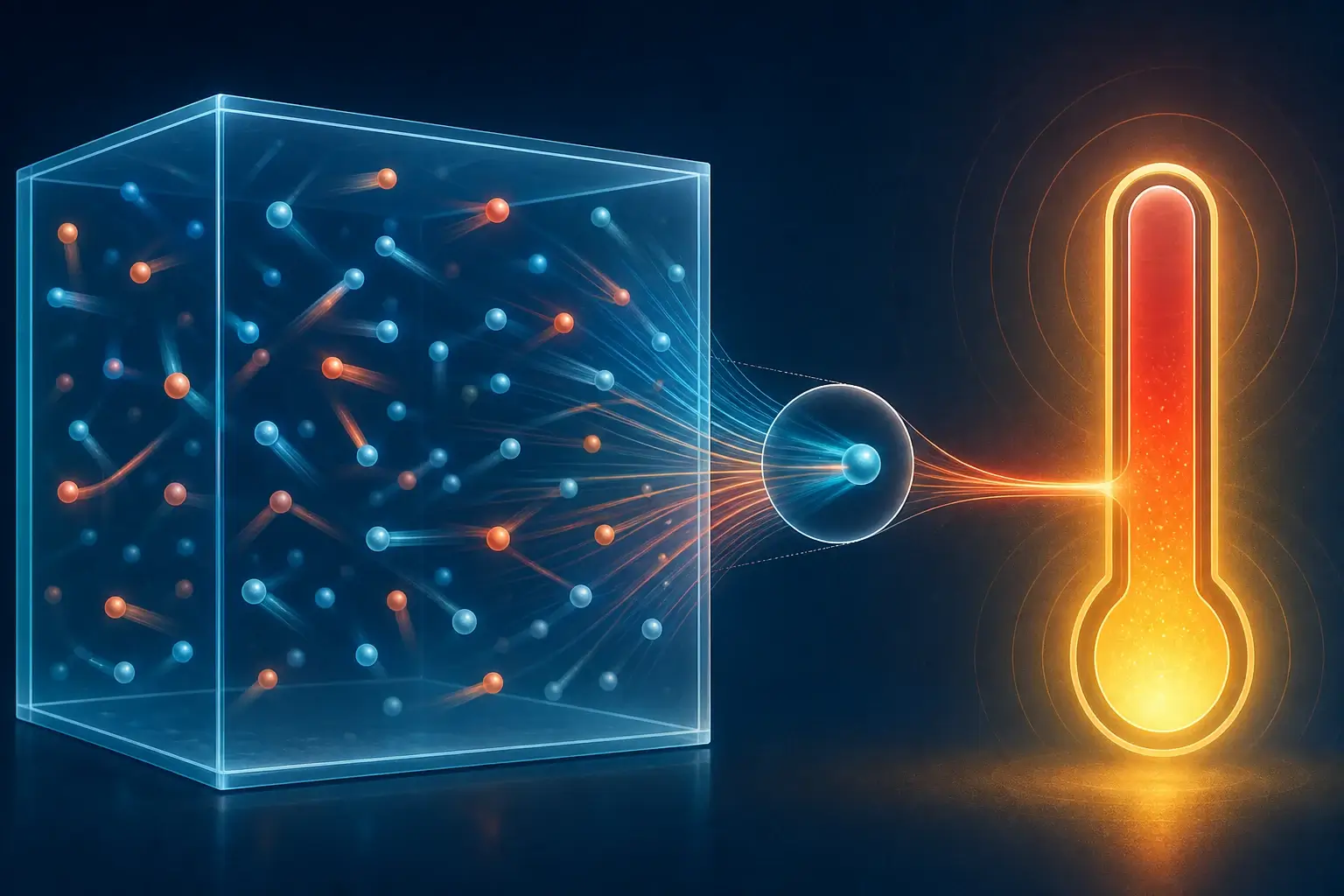
The Boltzmann constant converts thermodynamic temperature into an energy scale for individual particles. Its exact SI value is \(k_{\mathrm B}=1.380649\times10^{-23}\,\text{J K}^{-1}\). Multiply it by temperature and you get a characteristic thermal energy.
The Boltzmann constant links absolute temperature to microscopic energy scales. A temperature difference in Celsius has the same size as the corresponding kelvin difference, but kT uses absolute kelvin.
That tiny number is the bridge between the microscopic and macroscopic worlds. It links molecular motion to temperature, counts microstates through entropy, weights energy states through probability, and connects the particle form of the ideal-gas law to the molar form.
If you want to check a value before working it by hand, use the Boltzmann constant calculator. It keeps the unit conversion beside the result, which is where most avoidable mistakes happen.
What Is the Boltzmann Constant?
The Boltzmann constant is a universal proportionality constant that relates energy to absolute temperature. One kelvin corresponds to an energy increment of \(1.380649\times10^{-23}\) joule per particle on the scale \(k_{\mathrm B}T\).
$$k_{\mathrm B}=1.380649\times10^{-23}\,\text{J K}^{-1}\quad\text{(exact)}$$
The value is exact because the 2019 revision of the International System of Units fixed \(k_{\mathrm B}\) by definition. The kelvin is now defined through the Boltzmann constant rather than through the triple point of water. NIST explains the change in its kelvin and Boltzmann constant guide.
| Form | Value | Useful context |
|---|---|---|
| \(k_{\mathrm B}\) | \(1.380649\times10^{-23}\,\text{J K}^{-1}\) | SI energy per particle |
| \(k_{\mathrm B}\) | \(8.617333262\times10^{-5}\,\text{eV K}^{-1}\) | Atomic and semiconductor energy scales |
| \(R=N_{\mathrm A}k_{\mathrm B}\) | \(8.314462618\ldots\,\text{J mol}^{-1}\text{K}^{-1}\) | Energy per mole |
The Thermal Energy Scale KBT
The product \(k_{\mathrm B}T\) is not the energy of every particle. It is the energy scale that decides whether thermal fluctuations can populate states separated by an energy gap \(\Delta E\). When \(\Delta E\ll k_{\mathrm B}T\), thermal access is easy. When \(\Delta E\gg k_{\mathrm B}T\), it is strongly suppressed.
Room-Temperature Example
At \(T=300\,\text{K}\)
$$k_{\mathrm B}T=(1.380649\times10^{-23})(300)=4.141947\times10^{-21}\,\text{J}$$
$$k_{\mathrm B}T\approx0.02585\,\text{eV}$$
The electron-volt form is especially useful in atomic physics and electronics. A 1 eV energy gap is about 38.7 times \(k_{\mathrm B}T\) at 300 K, so ordinary room-temperature fluctuations rarely cross it without another source of energy.
Boltzmann Constant and Temperature
Temperature is not the total energy of a body. It is a thermodynamic variable tied to how entropy changes with energy. In statistical mechanics, \(k_{\mathrm B}\) sets the units so microscopic energy changes and macroscopic temperature use the same probability laws.
For a monatomic ideal gas in thermal equilibrium, the mean translational kinetic energy per particle is
$$\langle K\rangle=\frac32k_{\mathrm B}T$$
At 300 K this mean is about \(6.21\times10^{-21}\) J, or 0.0388 eV. Individual molecules have a distribution of speeds and energies; they do not all carry exactly the mean value.
Boltzmann Constant and Entropy
Boltzmann’s famous relation is
$$S=k_{\mathrm B}\ln\Omega$$
Here \(\Omega\) is the number, or appropriate measure, of microscopic states compatible with the macrostate. The logarithm makes entropy additive when independent multiplicities multiply. The macrostates and microstates guide works through that counting logic.
In more general statistical mechanics, entropy can be written \(S=-k_{\mathrm B}\sum_i p_i\ln p_i\). If all \(\Omega\) accessible microstates have equal probability \(p_i=1/\Omega\), the formula reduces to \(S=k_{\mathrm B}\ln\Omega\).
The Boltzmann Factor
For a system exchanging energy with a heat reservoir at temperature \(T\), a state’s relative statistical weight contains the Boltzmann factor
$$e^{-E/(k_{\mathrm B}T)}$$
Two states separated by \(\Delta E\) have the population ratio \(P_2/P_1=\exp[-\Delta E/(k_{\mathrm B}T)]\), apart from degeneracy factors. Raising temperature makes high-energy states less strongly suppressed.
Example: A 0.10 eV Energy Gap
At 300 K, \(k_{\mathrm B}T\approx0.02585\,\text{eV}\). Ignoring degeneracy
$$\frac{P_2}{P_1}=e^{-0.10/0.02585}\approx2.09\times10^{-2}$$
The upper state has about 2.1% of the lower state’s weight. At higher temperature that ratio rises; at lower temperature it falls.
Boltzmann Constant in the Ideal-Gas Law
The particle form of the ideal-gas equation is
$$PV=Nk_{\mathrm B}T$$
where \(N\) is the number of molecules. The molar form is \(PV=nRT\). Since \(N=nN_{\mathrm A}\), consistency requires \(R=N_{\mathrm A}k_{\mathrm B}\). Use \(k_{\mathrm B}\) for individual particles and \(R\) for moles.
The ideal gas law guide shows how to choose units and solve pressure-volume-temperature problems.
Where the Constant Appears
| Topic | Relation | What kB does |
|---|---|---|
| Thermal energy | \(E_{\mathrm{thermal}}\sim k_{\mathrm B}T\) | Turns temperature into energy per particle |
| Ideal gas | \(PV=Nk_{\mathrm B}T\) | Connects pressure-volume work to particle count |
| Entropy | \(S=k_{\mathrm B}\ln\Omega\) | Gives microscopic counting macroscopic entropy units |
| Canonical probability | \(p_i\propto e^{-E_i/(k_{\mathrm B}T)}\) | Sets thermal suppression of high-energy states |
| Equipartition | \(\frac12k_{\mathrm B}T\) per quadratic degree | Sets mean energy contribution under classical conditions |
| Semiconductors | \(e^{-E/(k_{\mathrm B}T)}\) | Controls thermal carrier activation and diode behaviour |
Common Confusions
- Boltzmann constant vs gas constant: \(k_{\mathrm B}\) is per particle; \(R\) is per mole.
- Boltzmann constant vs Stefan-Boltzmann constant: \(k_{\mathrm B}\) links temperature and particle energy; \(\sigma\) appears in blackbody power \(j^\star=\sigma T^4\).
- kBT vs exact particle energy: \(k_{\mathrm B}T\) is a scale, not a claim that every particle has one identical energy.
- Kelvin vs Celsius: statistical formulas require absolute temperature.
- Classical vs quantum limits: equipartition can fail when quantum energy spacings are not small compared with \(k_{\mathrm B}T\).
Related Physics Guides
Use these next if you want to connect this result with the surrounding physics:
Key Takeaways
- The Boltzmann constant has the exact value \(1.380649\times10^{-23}\,\text{J K}^{-1}\).
- The product \(k_{\mathrm B}T\) is the characteristic thermal energy per particle.
- Entropy and multiplicity are related by \(S=k_{\mathrm B}\ln\Omega\).
- The Boltzmann factor \(e^{-E/(k_{\mathrm B}T)}\) weights energy states in the canonical ensemble.
- The gas constants satisfy \(R=N_{\mathrm A}k_{\mathrm B}\).
A Thermal-Energy Scale
At 300 K, \(k_BT\) is about \(4.14\times10^{-21}\) J, or 0.0259 eV. This is an energy scale, not a universal energy possessed by every particle. The average translational kinetic energy of a classical monatomic ideal-gas particle is \(3k_BT/2\).
For that gas at 300 K, the average translational energy is about 6.21 × 10⁻²¹ J per particle. Molecular rotations, vibrations and quantum effects require additional analysis. Multiplying the per-particle description by Avogadro’s constant connects it with the molar gas constant.
The points to check in this example are:
- The exact SI value is 1.380649 × 10⁻²³ J/K.
- Absolute temperature should be used in kT.
- The number of active degrees of freedom matters when equipartition is applicable.
Check Your Understanding
Try the questions before reading the answers.
Question 1. What happens to kT when kelvin temperature doubles?
Answer. It doubles.
Question 2. Why is 27°C not entered as 27 in kT?
Answer. The absolute temperature is approximately 300 K.
Practice Questions
Work each question before reading its solution. The set runs from direct recall and substitution to the applied questions that exams actually use to separate grades. The downloadable PDF includes these questions and their solutions.
Question 1. State the value of the Boltzmann constant and what it converts between.
Solution. \(k = 1.380649 \times 10^{-23}\) J/K, exact by definition since the 2019 SI reform. It converts temperature into energy at the scale of single particles: kelvin on one side, joules per molecule on the other.
Question 2. Show that \(R = N_A k\) reproduces the gas constant.
Solution. \(N_A k = 6.022 \times 10^{23} \times 1.381 \times 10^{-23} = 8.314\) J/(mol·K), which is \(R\). The gas constant is just the Boltzmann constant scaled from 1 molecule to 1 mole.
Question 3. Find the average translational kinetic energy of a gas molecule at 300 K.
Solution. \(\langle E \rangle = \frac{3}{2}kT = 1.5 \times 1.381 \times 10^{-23} \times 300 = 6.2 \times 10^{-21}\) J. Every ideal-gas molecule averages this, regardless of its mass: heavier molecules just move slower to carry the same energy.
Question 4. Compute \(kT\) at room temperature (300 K) in joules and electronvolts.
Solution. \(kT = 1.381 \times 10^{-23} \times 300 = 4.14 \times 10^{-21}\) J. Dividing by \(1.602 \times 10^{-19}\) J/eV gives 0.026 eV, about \(\frac{1}{40}\) eV. This number is the thermal energy yardstick for chemistry, semiconductors, and biology alike.
Question 5. Use \(pV = NkT\) to count the molecules in 1 liter of air at 1 atm and 300 K.
Solution. \(N = \dfrac{pV}{kT} = \dfrac{101{,}325 \times 0.001}{4.14 \times 10^{-21}} \approx 2.4 \times 10^{22}\) molecules. Twenty-four thousand billion billion molecules in a soda bottle of air: the constant’s tiny size is the flip side of matter’s enormous granularity.
Question 6. Find the rms speed of a nitrogen molecule (\(m = 4.65 \times 10^{-26}\) kg) at 300 K.
Solution. \(v_{rms} = \sqrt{3kT/m} = \sqrt{1.243 \times 10^{-20} / 4.65 \times 10^{-26}} = \sqrt{2.67 \times 10^{5}} \approx 517\) m/s. The air in this room is a hail of molecules moving faster than sound; pressure is their collective drumming.
Question 7. State Boltzmann’s entropy formula and what \(W\) counts.
Solution. \(S = k \ln W\), where \(W\) counts the microstates: the number of distinct molecular arrangements consistent with what you can measure macroscopically. Entropy is literally a count of possibilities, scaled by \(k\) into thermodynamic units. The formula is carved on Boltzmann’s gravestone.
Question 8. How does the SI define the kelvin since 2019?
Solution. By fixing \(k = 1.380649 \times 10^{-23}\) J/K exactly and defining 1 kelvin as the temperature change that shifts \(kT\) by that many joules. Temperature is now defined through energy, not through water’s triple point, which is measured rather than defined.
Question 9. Why does the factor \(e^{-E/kT}\) appear throughout physics and chemistry?
Solution. It is the Boltzmann factor: the relative probability that thermal jostling assembles energy \(E\) in one place. Reaction rates, vapor pressures, semiconductor currents, and even the atmosphere’s thinning with altitude all follow it, because each asks the same question: how often does random thermal motion supply this much energy? The ratio \(E/kT\) decides everything.
Question 10. A chemical bond stores roughly 4 eV. Compare this with \(kT\) at room temperature and explain the consequence.
Solution. \(4\ \text{eV} / 0.026\ \text{eV} \approx 150\), so a bond stores about 150 times the typical thermal kick. The Boltzmann factor \(e^{-150}\) is about \(10^{-65}\): thermal motion essentially never breaks a bond by chance. That is why molecules survive at room temperature, and why heating, catalysts, or enzymes are needed to make chemistry happen on human timescales.
Frequently Asked Questions
What is the exact value of the Boltzmann constant?
The Boltzmann constant is exactly 1.380649 × 10^-23 joule per kelvin in the SI. Its numerical value has been fixed since the 2019 SI redefinition.
What does the Boltzmann constant mean physically?
It converts absolute temperature into an energy scale for one particle. The product kBT indicates how important thermal fluctuations are compared with an energy gap.
Why is the Boltzmann constant so small?
A joule is a macroscopic unit, while kB applies to one particle. Multiplying by Avogadro’s constant gives the molar gas constant R, which is about 8.314 J mol^-1 K^-1.
What is kBT at room temperature?
At 300 K, kBT is 4.141947 × 10^-21 J, about 0.02585 eV. The exact value at a stated room temperature changes in direct proportion to T.
How is the Boltzmann constant related to entropy?
It sets the scale in S = kB ln Ω and in S = -kB Σp ln p. This converts microscopic state counting into entropy measured in joules per kelvin.
Is the Boltzmann constant the same as the Stefan-Boltzmann constant?
No. kB relates temperature to particle energy and probability. The Stefan-Boltzmann constant σ relates a blackbody’s total emitted power per area to the fourth power of temperature.
Whenever you see \(k_{\mathrm B}\), read it as the conversion rate between kelvin and microscopic energy.
Browse more in Physics.