by
by
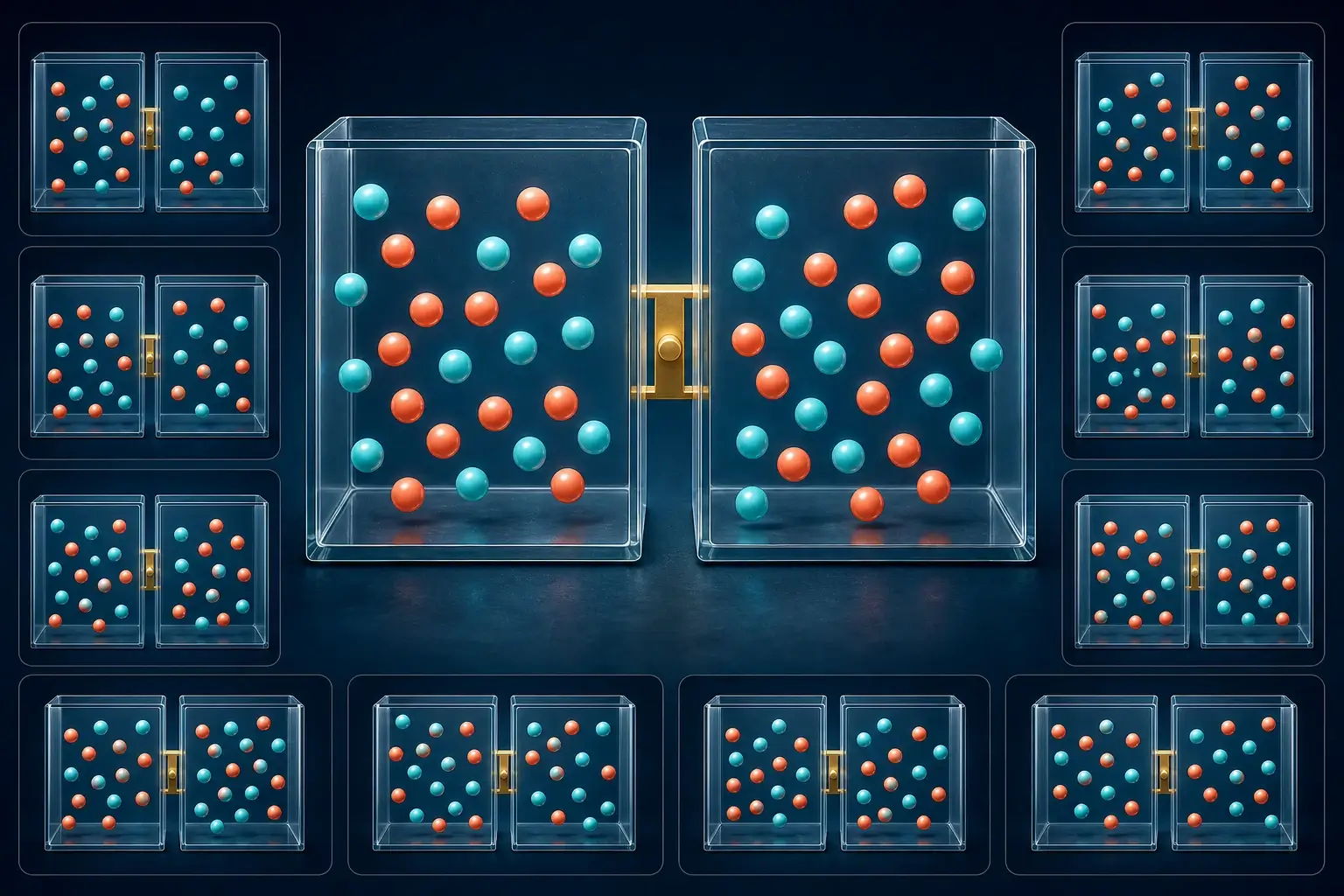
Macrostates and microstates are two descriptions of the same physical system. A macrostate specifies large-scale quantities such as energy, volume, pressure, temperature, or particle count. A microstate specifies the microscopic coordinates or quantum states consistent with those constraints.
The important idea is not that a system “wants disorder.” It is that some macrostates can be realized in far more microscopic ways than others. When the accessible microstates are treated as equally likely, the macrostate with the greatest multiplicity is overwhelmingly probable.
If you want to check a value before working it by hand, use the microstate calculator. It keeps the unit conversion beside the result, which is where most avoidable mistakes happen.
What Are Macrostates and Microstates?
A macrostate is the information you can usually measure without tracking every particle. A microstate is one complete microscopic configuration compatible with that measured information. Many microstates can correspond to one macrostate, and that many-to-one mapping is the basis of statistical physics.
In other words, macrostates and microstates separate what an experiment reports from all the microscopic details it leaves unresolved. That separation lets probability produce stable thermodynamic predictions.
| Description level | Specifies | Example for gas in a box |
|---|---|---|
| Macrostate | A few bulk variables | N particles, volume V, total energy E |
| Microstate, classical | Every particle’s position and momentum | \((\mathbf q_1,\mathbf p_1,\ldots,\mathbf q_N,\mathbf p_N)\) |
| Microstate, quantum | An allowed many-particle quantum state | Occupation numbers or a many-body state vector |
| Multiplicity | Number or phase-space measure of compatible microstates | \(\Omega\) |
A thermometer does not report the velocity of each molecule. It reports a macrovariable connected to a vast collection of microscopic arrangements. That is why thermodynamics can be accurate even though no one follows \(10^{23}\) individual trajectories.
A Four-Particle Counting Example
Put four distinguishable particles into a box divided into left and right halves. A microstate records the side occupied by each labelled particle. A macrostate records only the number on each side.
| Macrostate (left, right) | Multiplicity | Fraction of 16 microstates |
|---|---|---|
| (4, 0) | 1 | 1/16 |
| (3, 1) | 4 | 4/16 |
| (2, 2) | 6 | 6/16 |
| (1, 3) | 4 | 4/16 |
| (0, 4) | 1 | 1/16 |
The balanced macrostate is not guaranteed in a single observation, but it has six compatible microstates, more than any other. The two extreme macrostates have only one microstate each. With hundreds or trillions of particles, the relative dominance of near-balanced macrostates becomes enormous.
Multiplicity and the Binomial Formula
For \(N\) distinguishable particles, with \(n\) on the left and \(N-n\) on the right, the multiplicity is the binomial coefficient
$$\Omega(N,n)=\binom{N}{n}=\frac{N!}{n!(N-n)!}$$
For \(N=4\) and \(n=2\), \(\Omega=4!/(2!2!)=6\). If every particle independently has equal left and right probability, the macrostate probability is
$$P(n)=\frac{\Omega(N,n)}{2^N}$$
This example is simple because the particles are labelled and the cells are only left or right. Real quantum particles may be indistinguishable, and the counting rules for bosons and fermions are different. The definition of a microstate must match the physical model.
Why Equilibrium Is the Most Probable Macrostate
Equilibrium is the macrostate occupying almost all of the accessible microscopic phase space. A gas spreads through a container because there are vastly more arrangements with particles distributed throughout the volume than arrangements with every particle crowded into one corner.
Microscopic mechanics may be reversible, yet macroscopic evolution has a preferred direction because an initially special low-multiplicity state typically moves into the much larger region of phase space representing equilibrium. A spontaneous fluctuation back is not forbidden in a finite system. It is simply fantastically unlikely for a macroscopic number of particles.
Entropy Counts Microstates
Boltzmann’s entropy relation connects thermodynamics to multiplicity:
$$S=k_{\mathrm B}\ln\Omega$$
The logarithm is essential. For two statistically independent systems, multiplicities multiply, \(\Omega_{AB}=\Omega_A\Omega_B\), while thermodynamic entropies add. The logarithm turns multiplication into addition: \(\ln(\Omega_A\Omega_B)=\ln\Omega_A+\ln\Omega_B\).
The Boltzmann constant gives entropy its macroscopic unit of joules per kelvin. Entropy is not a vague synonym for mess. It is a state function tied to the number or measure of microscopic possibilities compatible with specified constraints.
Entropy Change in a Simple Expansion
Suppose \(N\) independent particles initially occupy only the left half of a box. After a partition is removed, each particle can occupy twice the volume. The accessible multiplicity grows by a factor \(2^N\), so
$$\Delta S=k_{\mathrm B}\ln(2^N)=Nk_{\mathrm B}\ln2$$
For one mole, \(Nk_{\mathrm B}=R\), giving \(\Delta S=R\ln2\) for this idealized free expansion. The result turns a counting argument into a measurable thermodynamic change.
Phase Space and Coarse Graining
In classical mechanics, positions and momenta vary continuously, so microstates are points in a \(6N\)-dimensional phase space. Counting literal points would give an unhelpful infinity. Statistical mechanics therefore uses phase-space volumes and a physically justified cell scale, with quantum mechanics supplying the natural scale through Planck’s constant.
A macrostate corresponds to a region of phase space. Coarse graining means that measurements ignore distinctions smaller than the chosen resolution. Changing that resolution can add a constant to entropy, but observable entropy differences remain well defined when the counting is done consistently.
Macrostates, Microstates, and Ensembles
An ensemble is a probability distribution over possible microstates for a specified set of constraints. It is not a bag of physical copies you must build. It is a calculation device that replaces impossible microscopic tracking with averages.
| Ensemble | Fixed macroscopic constraints | Typical use |
|---|---|---|
| Microcanonical | \(N,V,E\) | Isolated system |
| Canonical | \(N,V,T\) | System exchanging energy with a heat bath |
| Grand canonical | \(\mu,V,T\) | System exchanging energy and particles |
The statistical mechanics ensembles guide develops those probability distributions. The macrostate sets the constraints; the ensemble assigns weights to the compatible microstates.
For a broader thermodynamic connection, the laws of thermodynamics show how state functions and the second law summarize the same large-number behaviour. OpenStax gives another worked counting treatment in its statistical interpretation of entropy.
Common Counting Mistakes
- Not defining distinguishability: labelled particles, identical bosons, and identical fermions do not use the same counting.
- Changing the constraints: microstates compatible with fixed energy are not the same set as those compatible with fixed temperature.
- Counting arrangements twice: swapping identical particles does not always create a new physical microstate.
- Calling every macrostate equally likely: probability follows multiplicity or ensemble weight, not the number of macrostate labels.
- Equating entropy with visual disorder: use \(S=k_{\mathrm B}\ln\Omega\) or the appropriate ensemble entropy, not an aesthetic judgment.
Related Physics Guides
Use these next if you want to connect this result with the surrounding physics:
Key Takeaways
- A macrostate specifies bulk constraints; a microstate specifies microscopic detail.
- Macrostates and microstates are connected by multiplicity, the number or measure of microscopic arrangements compatible with one bulk description.
- Multiplicity \(\Omega\) counts the compatible microstates or their phase-space measure.
- Equilibrium dominates because it occupies an overwhelmingly large share of accessible microstates.
- Boltzmann’s relation \(S=k_{\mathrm B}\ln\Omega\) makes entropy additive.
- Counting rules depend on whether particles are distinguishable, bosonic, or fermionic.
Frequently Asked Questions
What is the difference between macrostates and microstates?
A macrostate gives bulk information such as energy, volume, and particle number. A microstate gives the detailed microscopic arrangement consistent with those bulk values. Many microstates can represent one macrostate.
What is multiplicity in statistical physics?
Multiplicity, written Ω, is the number or phase-space measure of microstates compatible with a macrostate. A macrostate with larger multiplicity is more probable when its microstates have equal statistical weight.
How are macrostates and microstates related to entropy?
For an isolated system with equally likely accessible microstates, Boltzmann entropy is S = kB ln Ω. More compatible microstates mean greater multiplicity and therefore greater entropy.
Why is equilibrium the most probable macrostate?
The equilibrium macrostate corresponds to far more accessible microstates than visibly unbalanced macrostates. For macroscopic particle numbers, its share of phase space is so dominant that large spontaneous departures are extraordinarily unlikely.
Is a microstate the same in classical and quantum physics?
No. A classical microstate specifies positions and momenta in phase space. A quantum microstate is an allowed quantum state or occupation-number configuration. Indistinguishability changes the counting.
Can entropy decrease?
Entropy can decrease in a subsystem, and small fluctuations can occur in finite systems. For an isolated macroscopic system, a large spontaneous decrease is overwhelmingly improbable because it requires entering a tiny region of phase space.
The clean mental model for macrostates and microstates is simple: macroscopic laws work because they summarize which microscopic regions are overwhelmingly large.
Tell Google you want more of this.
Add Gaurav Tiwari as a preferred sourceOne tap, and this site shows up more often in your own Top Stories, AI Overviews and AI Mode. Remove it any time.
Browse more in Physics.