by
by
Blood and blood cells make up the only liquid organ in your body. Blood is a connective tissue, and it’s roughly 55% plasma and 45% formed elements, the red blood cells, white blood cells, and platelets that do the heavy lifting. It transports oxygen, fights infection, clots wounds, regulates temperature, balances pH, and carries hormones. Every other organ depends on it. Without blood, nothing else works.
The average adult carries about 5 liters (1.3 gallons), roughly 7-8% of body weight. A newborn has approximately one cup. This is your exam-ready guide to blood and blood cells: what the components of blood are, what each one does, the normal counts your biology textbook keeps in tiny print, and the facts that make the topic genuinely interesting.
Key facts: Blood and blood cells = ~55% blood plasma + ~45% formed elements. Red blood cells (4.2-6.1 million/µL) carry oxygen. White blood cells (4,000-11,000/µL) run immune defense. Platelets (150,000-400,000/µL) clot wounds. Your bone marrow makes about 2.4 million red blood cells every second.
The components of blood at a glance
Blood splits into two parts: a liquid (plasma) and the cells suspended in it (formed elements). Spin a tube of blood in a centrifuge and you see the split directly, a pale yellow plasma layer on top, a thin buff-colored band of white blood cells and platelets in the middle, and a dense red column of red blood cells at the bottom. Here are the four components of blood, what each does, and the normal counts you should know.
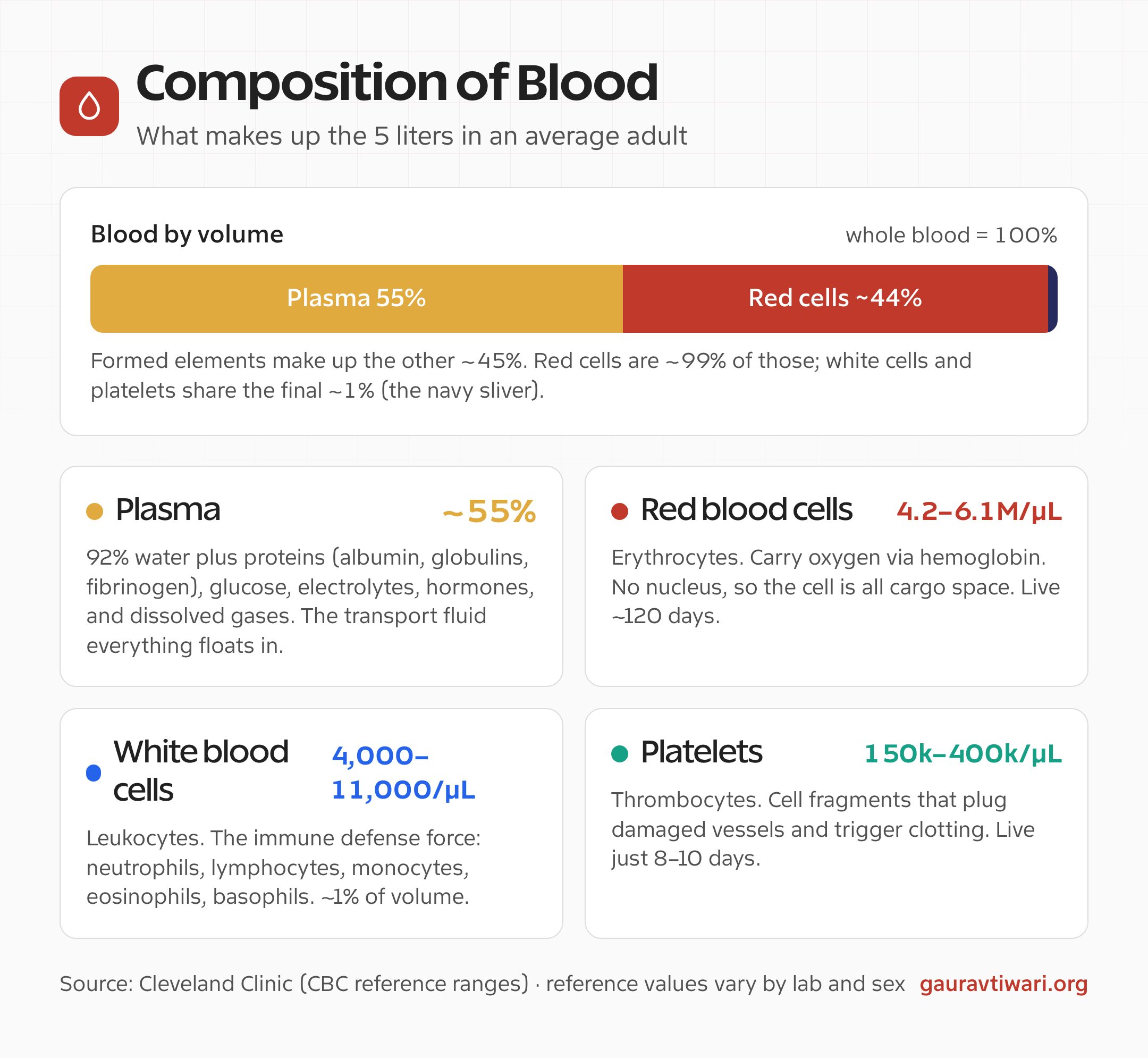
| Component | Share of blood | Normal count (adult) | Main job |
|---|---|---|---|
| Blood plasma | ~55% | 92% water | Transport medium; carries proteins, nutrients, hormones, wastes |
| Red blood cells | ~44% | 4.2-6.1 million/µL | Carry oxygen via hemoglobin; remove carbon dioxide |
| White blood cells | ~1% | 4,000-11,000/µL | Immune defense against infection |
| Platelets | <1% | 150,000-400,000/µL | Clotting; seal damaged blood vessels |
Red blood cells: the delivery trucks of your body
An adult has roughly 25 trillion red blood cells (erythrocytes), the most numerous of all blood cells. Your bone marrow produces about 2.4 million new ones every second. Each one lives approximately 120 days before the spleen breaks it down and recycles its components. That’s a production and demolition cycle running nonstop, at industrial scale, inside you right now.
Red blood cells carry about 70% of your body’s total iron, bound within hemoglobin molecules. Each hemoglobin molecule contains 4 heme groups, and each heme group can bind one oxygen molecule. The hemoglobin picks up oxygen in the lungs and releases it in tissues where oxygen concentration is lower. This isn’t random diffusion. It’s a precisely engineered binding-and-release mechanism governed by partial pressure gradients. Normal hemoglobin runs 13-18 g/dL in adult men and 12-16 g/dL in adult women.
Here’s what makes red blood cells unusual: they have no nucleus. Mammalian RBCs eject their nucleus during maturation, which maximizes the space available for hemoglobin. More hemoglobin means more oxygen carried per cell. It’s an evolutionary trade-off: the cell gives up its ability to divide or repair itself in exchange for maximum oxygen transport efficiency. A cell that sacrificed its own future for better performance. There’s a lesson in that, the kind of vivid hook that makes a fact stick. If you want more of those, my notes on how to remember better for your exams show why concrete images beat rote repetition.
White blood cells: 1% of your blood, 100% of your defense
White blood cells (leukocytes) make up only about 1% of blood volume, but they’re the entire immune system’s field force. Five main types, each with a specialized role:
Neutrophils (60-70% of WBCs): First responders. They arrive at infection sites within minutes and engulf bacteria. They live only 5-90 hours, essentially suicide fighters that sacrifice themselves to contain an infection.
Lymphocytes (20-25%): The strategic division. B-cells produce antibodies. T-cells kill infected cells directly. Memory cells remember past infections for decades, which is how vaccines work.
Monocytes: Heavy cleanup. They mature into macrophages that consume dead cells, debris, and pathogens. Think of them as the demolition crew after the battle.
Eosinophils and basophils: Specialists for parasites and allergic responses. Rare but critical for specific threats that other WBCs can’t handle efficiently.
Your white blood cell count is a reliable indicator of health. Elevated counts suggest infection. Depressed counts suggest immune suppression. Wildly elevated counts with abnormal cells suggest leukemia. A simple blood test (CBC, Complete Blood Count) measures all of this, which is why it’s the most commonly ordered lab test in medicine.
Platelets: the emergency construction crew
Platelets (thrombocytes) circulate at 150,000-400,000 per microliter of blood. They live only 8-10 days. Their job is simple and critical: when a blood vessel is damaged, platelets rush to the site, stick to the exposed collagen, and form a plug. Then they release chemical signals that activate the coagulation cascade, a complex chain reaction that converts fibrinogen into fibrin threads, creating a stable clot.
Too few platelets (thrombocytopenia) and you bleed uncontrollably from minor injuries. Too many (thrombocytosis) and you’re at risk of dangerous clots that can cause strokes or pulmonary embolisms. The narrow healthy range isn’t arbitrary. It’s a precisely calibrated balance between bleeding and clotting.
Blood plasma: the liquid you forget about
Blood is about 55% plasma, and plasma is about 92% water. The remaining 8% contains proteins (albumin, globulins, fibrinogen), glucose, electrolytes, hormones, carbon dioxide, and dissolved gases. Plasma is the transport medium. Everything else, including all the blood cells, floats in it.
Plasma donations are critically important and often in shorter supply than whole blood donations. Plasma-derived therapies treat hemophilia, immune deficiencies, burns, and shock. The proteins in plasma can be fractionated and concentrated into specific treatments that whole blood can’t provide.
Blood types: Karl Landsteiner’s Nobel Prize-winning discovery
Before 1901, blood transfusions were essentially gambling. Sometimes they saved lives. Sometimes they killed the patient. Nobody knew why. Karl Landsteiner solved it by discovering the ABO blood group system, identifying that red blood cells carry antigens on their surface that determine compatibility. He received the Nobel Prize in Physiology or Medicine in 1930.
The ABO system plus the Rh factor gives us the 8 common blood types. O-negative is the universal donor (no A, B, or Rh antigens to trigger a reaction). AB-positive is the universal recipient (already has all antigens, so nothing is “foreign”). In emergencies when there’s no time to type a patient’s blood, O-negative is what goes in.
The rarest known blood type is Rh-null, sometimes called “golden blood.” Fewer than 50 people worldwide are known to have it. Their red blood cells lack all 61 possible Rh antigens. Golden blood can be donated to anyone with rare Rh blood types, making these donors extraordinarily valuable. But they can only receive blood from other Rh-null donors, making any medical emergency potentially life-threatening.
10 facts that make blood and blood cells genuinely fascinating
1. Your blood travels approximately 19,000 kilometers (12,000 miles) through your body every day, through about 100,000 kilometers of blood vessels.
2. A single drop of blood takes 20-60 seconds to travel from the heart to the rest of the body and back.
3. Human blood contains trace amounts of gold, approximately 0.2 milligrams. Not enough to extract profitably, but it’s there.
4. Spiders and octopuses have blue blood (copper-based hemocyanin instead of iron-based hemoglobin). Cockroaches bleed white. Some marine worms have green blood.
5. Mosquitoes show a statistical preference for Type O blood over other types, though the mechanism isn’t fully understood.
6. Coconut water has a similar electrolyte composition to blood plasma. During WWII, it was reportedly used as an emergency intravenous fluid in Pacific theater field hospitals when saline wasn’t available.
7. Red blood cells can’t use the oxygen they carry. They have no mitochondria (ejected along with the nucleus during maturation), so they rely entirely on glycolysis for energy.
8. William Harvey, an English physician, first described the complete circulatory system in 1628 in his work “De Motu Cordis.” Before Harvey, the prevailing theory (from Galen, 2nd century) was that blood was continuously produced and consumed, not circulated.
9. A person can lose up to 40% of their blood volume before it becomes immediately life-threatening. Below that threshold, the body compensates by constricting blood vessels and increasing heart rate. Above it, hemorrhagic shock sets in.
10. Your bone marrow produces approximately 500 billion blood cells per day. That’s more than every factory on Earth combined produces of any physical product. The most productive manufacturing facility in existence is inside your bones.
What to remember for exams
Quick revision: Blood = 55% plasma + 45% formed elements. Plasma is 92% water. Red blood cells carry oxygen with hemoglobin and have no nucleus. White blood cells (five types: neutrophils, lymphocytes, monocytes, eosinophils, basophils) fight infection. Platelets clot blood. Normal counts: RBC 4.2-6.1 million/µL, WBC 4,000-11,000/µL, platelets 150,000-400,000/µL. Landsteiner discovered ABO blood groups in 1901. O-negative is the universal donor; AB-positive is the universal recipient.
If you’re revising biology like this for an exam, the trick isn’t reading these facts once. It’s spacing them out and testing yourself. My guides on memory methods for revision and study techniques that actually work turn pages like this into long-term recall instead of pre-exam panic. And if you’re building study habits from scratch, the life skills every student should learn are the foundation that makes the rest stick.
Frequently Asked Questions
What are the components of blood?
Blood and blood cells have four components. Plasma (about 55%) is the liquid transport medium, 92% water. The formed elements (about 45%) are red blood cells that carry oxygen, white blood cells that fight infection, and platelets that clot wounds. Red blood cells make up about 99% of the formed elements.
What is the rarest blood type?
Rh-null, called “golden blood.” Fewer than 50 people worldwide are known to have it. Their red blood cells lack all 61 Rh antigens. They can donate to anyone with rare Rh types but can only receive from other Rh-null donors, making emergencies extremely dangerous.
What are the normal blood cell counts?
Normal adult reference ranges are: red blood cells 4.2 to 6.1 million per microliter, white blood cells 4,000 to 11,000 per microliter, and platelets 150,000 to 400,000 per microliter. Hemoglobin runs 13 to 18 g/dL in men and 12 to 16 g/dL in women. Ranges vary slightly by lab and sex.
Why don’t red blood cells have a nucleus?
Mammalian red blood cells eject their nucleus during maturation to maximize space for hemoglobin. More hemoglobin means more oxygen per cell. The trade-off: they can’t divide or repair themselves, which is why they only live about 120 days. It’s an evolutionary optimization for oxygen transport efficiency.
What percentage of blood is plasma?
About 55%. Blood plasma is 92% water and 8% proteins (albumin, globulins, fibrinogen), glucose, electrolytes, hormones, and dissolved gases. It’s the liquid transport medium that all the blood cells float in. Plasma donations are critically important for treating hemophilia, burns, and immune deficiencies.
Do mosquitoes prefer certain blood types?
Studies show mosquitoes land on people with Type O blood significantly more often than other types. The exact mechanism isn’t fully understood, but it may relate to chemical markers secreted through the skin that signal blood type. Other factors like body heat, CO₂ output, and skin bacteria also affect attraction.
Tell Google you want more of this.
Add Gaurav Tiwari as a preferred sourceOne tap, and this site shows up more often in your own Top Stories, AI Overviews and AI Mode. Remove it any time.
Browse more in Biology.