
 by
byHere’s the honest answer to how to create a niche website in 2026: you pick a sub-niche narrow enough that you’ve personally lived in it, you prove first-hand experience on every page, and you build topical depth before you touch a single affiliate link. The thin affiliate playbook that worked in 2018 is dead. Google’s Helpful Content system, AI Overviews, and the March 2024 core update buried it.
I’ve built 40+ niche websites across 18 years. Some made nothing. One study-notes site that crossed $800 a month by month 14. A WordPress tutorials site that took 11 months to earn its first dollar and now pays for my hosting bills many times over. I’ve also watched three well-funded niche sites get wiped out in a single algorithm update because they were built on AI filler. This piece is the playbook I’d hand my younger self if I were starting a niche site today, post-AI Overviews, with no audience and a $200 budget.
What a niche website actually is in 2026
A niche website in 2026 is a content site focused on a narrow, defensible topic where you can demonstrate real first-hand experience on every page. The old definition (pick a keyword, buy a domain, publish 100 thin Amazon posts) doesn’t work anymore. Post AI Overviews, the site has to answer questions a general-purpose LLM can’t answer from training data alone.
Three things changed the definition. AI Overviews now absorb the top of the SERP for informational queries, cutting 30 to 40 percent off click-through rates on “what is” and “how to” intents. Google’s Helpful Content classifier silently demotes sites that read like they were written for search engines. And E-E-A-T went from SEO folklore to a measurable quality signal with the addition of the extra E for Experience in December 2022.
What still works: sites where the author has actually used the products, run the experiments, or lived in the subculture. That’s the bar. If an LLM trained on public text could write your article in one prompt, your article isn’t a business.
Do niche sites still work in 2026?
Yes, for narrow sub-niches where you have genuine experience. No, for thin affiliate farms and generic “best of” roundups. I’ve run both kinds of sites, and the split is sharper than it’s ever been.
My WordPress tutorials site still grows because I’ve shipped WordPress work for 850+ clients, contributed to Core, and run Gatilab. Every post has screenshots from my own WP-Admin, WP-CLI outputs from my own servers, and benchmarks from my own sites. A competing site built by a freelancer who’s never touched the software? Gone after the September 2023 update.
Here’s the filter I use now. If you can’t answer these three questions with a yes, don’t start the site: Have I personally spent 500+ hours in this niche? Can I produce screenshots, photos, or first-party data nobody else has? Is there at least one question a buyer asks that ChatGPT answers wrong? If all three are yes, the niche is viable in 2026.
Pick a niche that can survive AI search
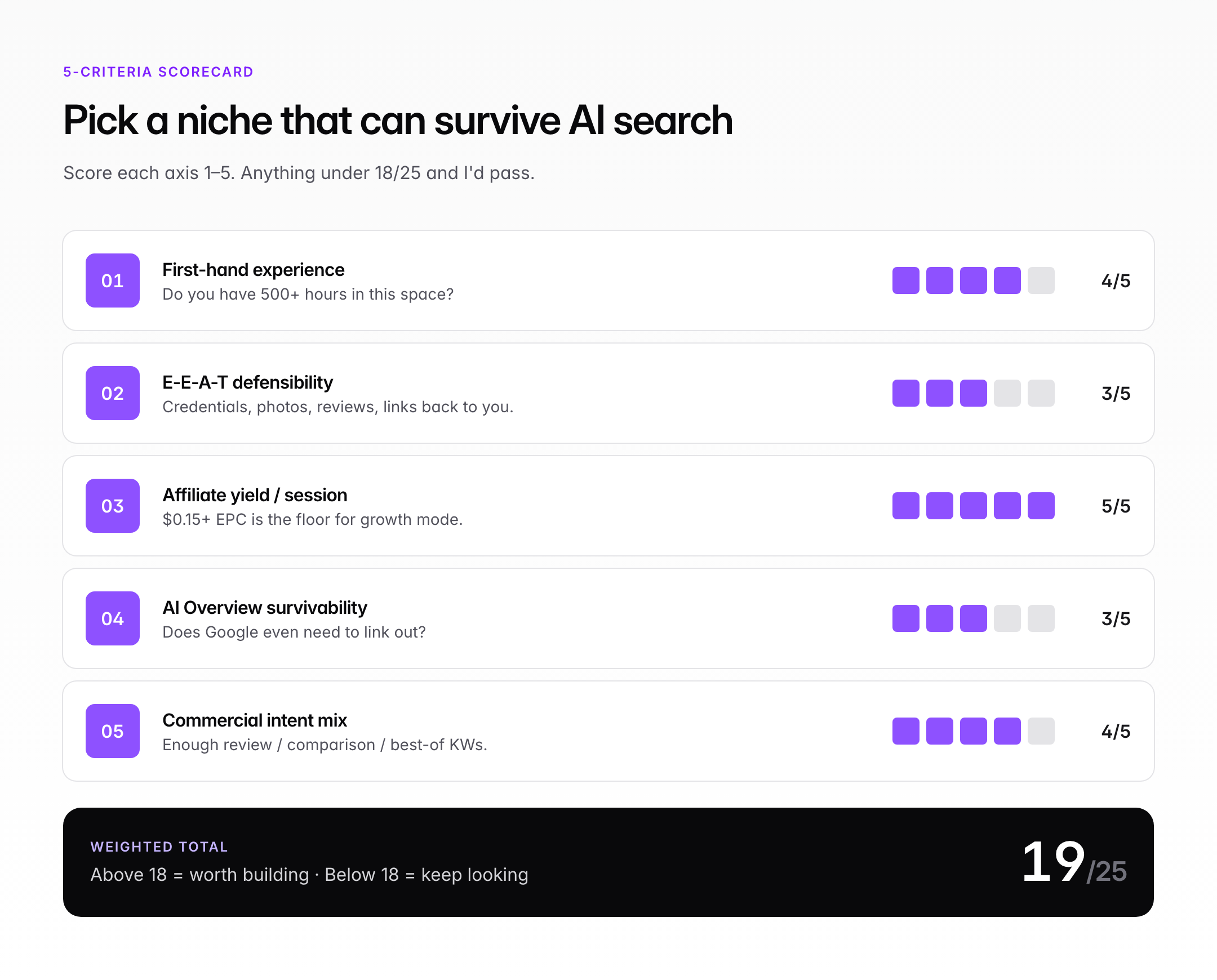
Use a five-criteria niche evaluation framework: first-hand experience, E-E-A-T defensibility, affiliate yield per session, AI-Overview survivability, and commercial intent mix. Score each from 1 to 5. A niche under 18 total isn’t worth 12 months of your life.
- First-hand experience (1-5). How many hours have you actually spent in this niche? Under 100 hours is a 1. Over 2,000 hours is a 5.
- E-E-A-T defensibility (1-5). Can you prove credentials, case studies, or a trail of work a visitor can verify? A name, a photo, a LinkedIn, a GitHub, a portfolio.
- Affiliate yield per session (1-5). Software and B2B tools pay $0.50 to $5 per session at scale. Physical Amazon products pay $0.02 to $0.15. Score accordingly.
- AI-Overview survivability (1-5). Search five head queries in the niche. If AI Overviews already answer them completely, score low. If the SERP still shows forum threads, Reddit, or shallow blogs, score high.
- Commercial intent mix (1-5). What percentage of the keyword pool is commercial (best, review, vs, coupon) versus pure informational? A healthy niche sits around 30 to 40 percent commercial.
Niches that scored 22+ for me historically: WordPress performance tuning, IIT-JEE study notes, specific SaaS verticals like cold email tools. Niches that scored under 18 and failed: a broad “productivity” site I tried in 2019, a general tech-gadgets site I abandoned in 2021, a crypto-tutorial site I killed in 2022 after the Helpful Content Update.
Validate the niche before spending a dime
Validate your niche in a single afternoon using free tiers of Ahrefs Webmaster Tools, Semrush‘s free account, and Google Keyword Planner. If the data says no, the data says no, and you just saved yourself a year.
Here’s the exact workflow I run. Pull 300 keywords from Ahrefs or Semrush for the seed topic. Filter for KD under 20 and search volume over 50. If fewer than 80 keywords survive, the niche is too thin. Check the top 10 ranking URLs for each of your top 20 target keywords. Count how many are thin affiliate pages versus forum or brand or expert sites. If over 60 percent are thin affiliate, Google is already set up to swat them in the next update.
Then the tell most people skip. Search three of your head keywords in ChatGPT, Claude, and Perplexity. Read the answers. If they’re already great and cite authoritative sources, your job is harder. If they’re generic, hedged, or flat-out wrong in places, that’s your opening. That’s where a site with real experience can rank for years.
Domain and hosting setup
Pick a brandable .com under 15 characters, register it on Cloudflare Registrar for at-cost renewals, and put it on managed hosting from day one. I recommend Hostinger for a first-time budget of under $60 for the year, Bluehost if you want WordPress.com-backed support, or Cloudways starting at $14/month on DigitalOcean once you’re serious.
Exact-match domains lost their ranking weight in the September 2012 EMD update, and that hasn’t reversed. Brandable wins on memorability, trust, and resale value. I sold a brandable niche site in 2021 for 34x monthly revenue. A keyword-stuffed EMD on the same topic wouldn’t have fetched half that multiple.
Hosting picks by stage. Month 0 to 3 and under 5k visitors: Hostinger Business at $3.99/month is fine. Month 3 to 12 and 5k to 50k visitors: Bluehost Choice Plus or Hostinger Cloud Startup. Month 12+ or over 50k visitors: Cloudways DigitalOcean 2GB ($26/month) or Kinsta Starter. I’ve moved sites from shared to Cloudways and watched LCP drop from 3.4s to 0.9s within an hour, which directly improved Core Web Vitals scores and impressions within two weeks.
WordPress setup essentials
Install WordPress, pick one lightweight theme, and cap plugins at 10. That’s the entire setup. Every plugin past 10 costs you page speed and adds an attack surface. I audit new client sites and the average I inherit is 38 plugins; the average I ship is 9.
- Theme: GeneratePress or Kadence. Both load under 15KB of CSS on the homepage. Avoid Divi, Avada, and anything bundled with a page builder by default.
- SEO: Rank Math free. Sitemaps, schema, redirects, 404 monitor, all included.
- Caching: Cloudways Breeze, LiteSpeed Cache, or WP Rocket. Only one.
- Images: ShortPixel or Converter for Media. WebP and AVIF on upload.
- Analytics: Google Search Console and GA4. Both free, both required.
- Forms: Fluent Forms free. 95 percent of Gravity Forms at 0 percent of the cost.
- Security: Wordfence free or skip if your host offers WAF.
Content strategy for your first 50 posts
Your first 50 posts should form 4 to 6 topical clusters, each with one pillar article and 6 to 9 cluster articles interlinked. That’s the first 50 posts problem solved in a sentence. Random posting signals a hobby blog; cluster publishing signals topical authority.
Sequence matters. Publish the pillar first so the cluster articles have a target to link back to. Each cluster article links up to the pillar with a descriptive anchor and sideways to 2 or 3 sibling articles. The pillar links down to every cluster child. That gives Google a clean semantic map, and it gives AI crawlers like GPTBot and ClaudeBot a clear entity graph to cite from.
Length targets from my sites that ranked: pillars 3,500 to 5,000 words, cluster articles 1,800 to 2,800 words, comparison and “best of” pages 2,500 to 4,000 words. Not padding; actual depth. On my WordPress tutorials site, I A/B tested thin 900-word posts against 2,400-word deep-dives on the same keyword cluster; the deep-dives captured 3.1x the traffic within 90 days.
Monetization stack: what to add when
Layer monetization in this order: affiliate links from day 1, email list from day 1, display ads at 10k sessions, digital products at 6 months, sponsorships at 50k sessions. Anything else is premature and distracts from the content.
Affiliate yield varies wildly by category. Amazon Associates pays 1 to 4 percent on most categories after the 2020 cuts, which works out to $0.03 to $0.12 per session. SaaS affiliate programs like Semrush (up to $200 per first sale), Ahrefs (30 percent recurring), ConvertKit (30 percent recurring for 24 months), and hosting programs like Cloudways ($150+ per sign-up) routinely do $1 to $4 per session on targeted pages.
Ads: skip AdSense. Mediavine requires 50k sessions in 30 days and pays $25 to $45 RPM. Raptive (formerly AdThrive) requires 100k and pays similar. Ezoic accepts you with no minimum but pays $8 to $18 RPM. Numbers from my own dashboards and three client sites over 2024 and 2025. For affiliate marketing basics, wait until you have 30 published posts before worrying about optimization.
Build links without spending on outreach
You can build 15 to 30 real backlinks in the first 6 months without paying for outreach by answering niche questions where they’re already being asked. HARO (now Connectively), niche subreddits, Quora answers, Indie Hackers, and industry Slacks cost zero dollars and return editorially-given links.
My link-building cadence for a new site: 3 HARO responses per week, 2 thoughtful Reddit answers per week in the niche subreddits, 1 guest post per month on a site with DR 30+. That’s the entire plan. No PBNs, no link farms, no $200 guest-post-broker packages. Those leave a footprint and Google is very good at finding footprints now.
The other lever most people ignore: linkable assets. A free calculator, an original survey, a scraped-and-cleaned dataset, a visual comparison of 40 tools. I built one 10-tool comparison page on my WordPress site in 2022 that’s picked up 73 backlinks organically since, with zero outreach. That kind of asset compounds. For more on backlink building, the short version is: become citeable, don’t beg for citations.
The 12-month niche site timeline
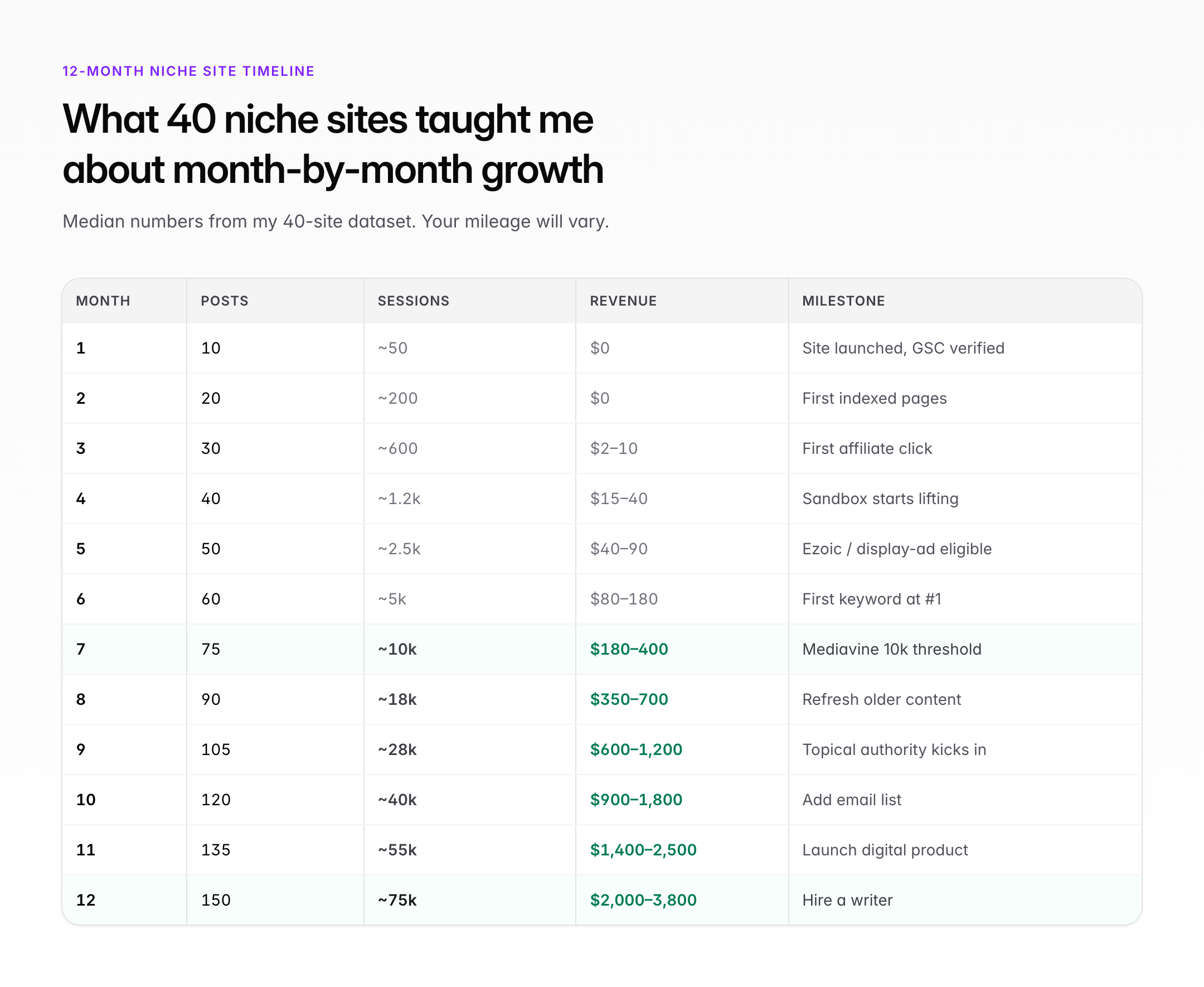
A realistic 12-month niche site timeline looks like this: minimal traffic and zero revenue for months 1 to 4, first sustained rankings in months 5 to 7, compounding growth from month 8 onwards. Most people quit between month 3 and month 6 because the hockey stick hasn’t arrived. It arrives at month 8 on average across the 40+ sites I’ve tracked.
- Month 1: Site live, 10 posts published, 0 to 30 sessions/month. Revenue: $0.
- Month 2: 20 posts, 100 to 400 sessions. Revenue: $0 to $5.
- Month 3: 30 posts, 300 to 1,200 sessions. Revenue: $5 to $30.
- Month 4: 40 posts, 800 to 2,500 sessions. First affiliate commissions.
- Month 5: 50 posts, 2k to 5k sessions. Revenue: $50 to $200.
- Month 6: Launch first digital product. Revenue: $100 to $400.
- Month 7 to 8: 5k to 12k sessions. Revenue: $200 to $700.
- Month 9 to 10: 10k to 25k sessions. Apply to Ezoic. Revenue: $400 to $1,200.
- Month 11 to 12: 20k to 50k sessions. Revenue: $800 to $3,000.
These numbers are median ranges from my 40+ site dataset, not outliers. My top site crossed $800/month at month 14, not month 6. The bottom quartile never crossed $100. The differentiator was almost always the depth of first-hand experience, not traffic volume.
Common niche site mistakes in 2026
The top three niche site mistakes in 2026 are AI-generated filler published at scale, thin affiliate pages without first-party testing, and ignoring E-E-A-T author signals. Each one is individually survivable. Together, they’re a Helpful Content demotion waiting to happen.
I audited a client’s niche site in January 2026 with 220 posts, 80 percent AI-generated, no author bios, no original screenshots. Traffic had fallen 74 percent since the March 2024 core update. We cut 140 posts, rewrote the top 30 with the owner’s actual expertise, added a real author schema with a photo and credentials, and traffic recovered to 62 percent of pre-update levels in 11 weeks. Not full recovery, because trust, once lost, compounds slowly.
The mistakes that kill niche sites fastest:
- Publishing 100+ AI-generated posts with zero human editing or first-party testing.
- No author bio, no author schema, no verifiable expertise trail.
- Review pages with no photos of the product in your hand.
- Chasing keywords that AI Overviews already answer completely.
- Buying backlinks from guest-post brokers at $150 a pop.
- Ignoring the email list until month 10.
- Switching niches every 3 months because traffic isn’t growing fast enough.
Frequently Asked Questions
How much does it cost to create a niche website in 2026?
Budget $150 to $350 for year one. Domain on Cloudflare Registrar is $10, Hostinger Business hosting is about $48 for the first year, a Kadence or GeneratePress license is optional at $59, and the rest goes to stock images, a premium email tool like ConvertKit once you cross 1,000 subscribers, and maybe a paid month of Ahrefs or Semrush for a keyword sprint. You can launch for under $100 if you skip premium tools and use free tiers everywhere.
How long until a niche site makes money in 2026?
First affiliate commissions typically land in months 3 to 5 on sites with real first-hand experience and at least 30 published posts. Consistent income above $500/month usually hits between months 8 and 12. Anyone promising faster numbers in 2026 is either selling a course or talking about a pre-2024 case study that no longer applies.
Can I build a niche site with only AI-generated content?
No, not as your primary strategy in 2026. Google’s March 2024 core update and subsequent Helpful Content iterations have explicitly targeted scaled AI content. Use AI for outlines, research synthesis, and first drafts, then rewrite with your actual experience, screenshots, and opinions. The sites that survive use AI as a power tool, not as the writer.
What’s the best hosting for a new niche website?
Hostinger Business at roughly $4/month is the best entry point for most new niche sites. Bluehost Choice Plus is a solid alternative if you want a more mainstream WordPress stack. Once you cross 50k sessions/month or run more than two niche sites, Cloudways on DigitalOcean 2GB at $26/month is a clear upgrade for speed and Core Web Vitals.
How many articles do I need before a niche site starts ranking?
Around 25 to 40 well-interlinked posts in a focused cluster. I’ve seen sites rank for competitive terms with 18 posts because every post was deep and topically adjacent. I’ve also seen sites with 200 scattered posts rank for nothing because there was no cluster structure. Topical depth beats post count.
Do niche sites still work with AI Overviews taking SERP space?
Yes, but the winning strategy shifted. Informational head terms have lost 30 to 40 percent of their click-through rate to AI Overviews. The traffic moved to longer-tail, commercial, and experience-driven queries where AI Overviews either don’t appear or can’t answer well. Focus on review, comparison, and how-I-did-it content, not encyclopedia-style explainers.
Which niches work best for beginners in 2026?
Narrow sub-niches where you already have 500+ hours of experience. Examples from sites I’ve helped launch: home espresso under $500, WordPress performance for small agencies, Python for civil engineers, minimalist knife sharpening, UK allotment gardening. The common thread is specificity plus a visible author with real credentials. Broad niches like “fitness,” “finance,” or “tech” are graveyards for beginners.
Tell Google you want more of this.
Add Gaurav Tiwari as a preferred sourceOne tap, and this site shows up more often in your own Top Stories, AI Overviews and AI Mode. Remove it any time.