
 by
byIt’s easy to join the Amazon affiliate program after reading “earn up to 10%” and then find that the products your readers buy pay 3% or 4%. A few months later, Amazon can withdraw the application because the site never made three sales, or a link in a newsletter can break the rules of the Indian program.
All of this is avoidable once you know how Amazon Associates works. Start with one useful article in a category your readers already buy and make the links with Amazon’s own free tools. Then follow the rules of the marketplace you joined, because Amazon.com and Amazon.in run separate programs with different rates.
I link to both Amazon.com and Amazon.in on this site, so the rates and rules below are labeled by marketplace. If affiliate marketing itself is new to you, my affiliate marketing guide for beginners explains the model first.
Amazon Associates at a Glance
Here is the short version for both marketplaces. The exceptions, and there are quite a few, come in the sections after it.
| Term | Amazon.com (US) | Amazon.in (India) |
|---|---|---|
| Cost to join | Free | Free |
| Application review | 3 qualifying sales within 180 days | 3 qualifying sales within 180 days |
| Content guideline | About 10 posts, updated within the last 60 days | About 10 posts, updated within the last 60 days |
| Highest standard rate | 10% (luxury beauty) | 10% (apparel, shoes, luggage, watches, beauty) |
| Session | 24 hours from the click | 24 hours from the click |
| Cart deadline | Order within 89 days of the click | Order within 89 days of the click |
| Minimum payout | $10 by direct deposit or gift card, $100 by check | INR 1,000 by NEFT, INR 2,500 by cheque |
| Payment timing | About 60 days after the month ends | About 60 days after the month ends |
| Links in email | Allowed to subscribers who opted in | Not allowed |
| International traffic | OneLink can route visitors to 13 other Amazon stores | Not part of OneLink |
You apply through the Amazon Associates US portal or the Amazon Associates India portal. Both are free to join, so any paid “approval service” is selling you something Amazon gives away.
How the Amazon Affiliate Program Works
You publish useful content with links tagged with your Store ID, and you earn a commission when a reader buys through them. Amazon pays only on qualifying revenue, so returned or cancelled orders earn nothing. One commission goes through these stages:
- A reader clicks your tagged link and lands on Amazon.
- They buy within the 24-hour session, or add the item to the cart then and buy it within 89 days of the click.
- The purchase appears in your Order report as an ordered item.
- It moves to your Earnings report once the item ships.
- Amazon pays the month’s earnings about 60 days after the month ends, once you cross the minimum payout.
The gap between ordered and shipped matters more than most beginners expect. An ordered item can still be cancelled, returned or excluded, and if it never ships within the rules, the commission you saw in the Order report disappears. Treat the Earnings report as the real number and the Order report as a forecast.
How to Join Amazon Associates
Signing up is quick. The real approval comes later, when Amazon reviews your account after your first three sales, so most of the work happens before and after the form.
Prepare Your Site Before You Apply
Amazon’s application review guidance is the same for both marketplaces, and it is stricter than the sign-up form makes it look:
- The site has to be public and yours. A closed group or paywalled site is not enough for the review.
- Content should be recent, generally within the last 60 days.
- About 10 posts is Amazon’s rule of thumb for enough original content, though reaching that number doesn’t guarantee approval.
- The content must add your own commentary, analysis or comparison. A product description rewritten from the listing does not count.
Useful content answers a question the Amazon listing cannot. Three examples of what I mean:
- A USB-C hub compatibility comparison that tells readers which hubs drive two external monitors from a MacBook Air and which only mirror one screen.
- A study desk size guide that starts from the room and the chair, then lists desks that actually fit a 4-foot wall.
- A microphone setup tutorial that covers gain, distance and the cable the reader will need, with the microphone link at the step where it matters.
If you don’t have a site yet, start with my guide on how to start a blog. When you plan which articles to write first, a content matrix keeps your planned comparisons and tutorials in one place, and my notes on writing honest product reviews cover the review side.
Apply on the Right Marketplace
Amazon.com and Amazon.in are separate programs. A US account earns on Amazon.com purchases, and an India account earns on Amazon.in purchases, so pick the marketplace where your readers actually shop. If they shop in both, you need two accounts and two sets of links. For the Amazon affiliate program in India, you also need your PAN and an Indian bank account before payments start.
- List every website, app and social account where you will place links. Links on a site you haven’t declared can cost you commissions.
- Accepted social networks are Facebook pages, Instagram, Twitter, YouTube, TikTok and Twitch.
- For a social application, Amazon looks for an established public account with, in most cases, at least 500 organic followers. A website is judged on its content instead.
Make Three Sales in 180 Days
After you sign up, you can create links straight away, but Amazon only completes the review after three qualifying sales within the first 180 days. Your own purchases don’t count, and neither do orders you ask friends or family to place.
If the sales don’t arrive in time, Amazon withdraws the application. The rejected account and its Associates ID can’t be reinstated, though you can reapply later with new links once the site is established. I would not apply until the pages where the links will go already get steady search traffic, because the 180-day clock starts on the day you sign up.
How to Create Your First Amazon Affiliate Link
You don’t need a plugin or a paid tool for this. Amazon gives you two free ways to create a tagged link, and both work on Amazon.com and Amazon.in.
SiteStripe
SiteStripe is a bar that appears at the top of every Amazon product page when you are signed in to your Associates account in the same browser. Its Get Link button builds a short or full text link with your Store ID already in it.
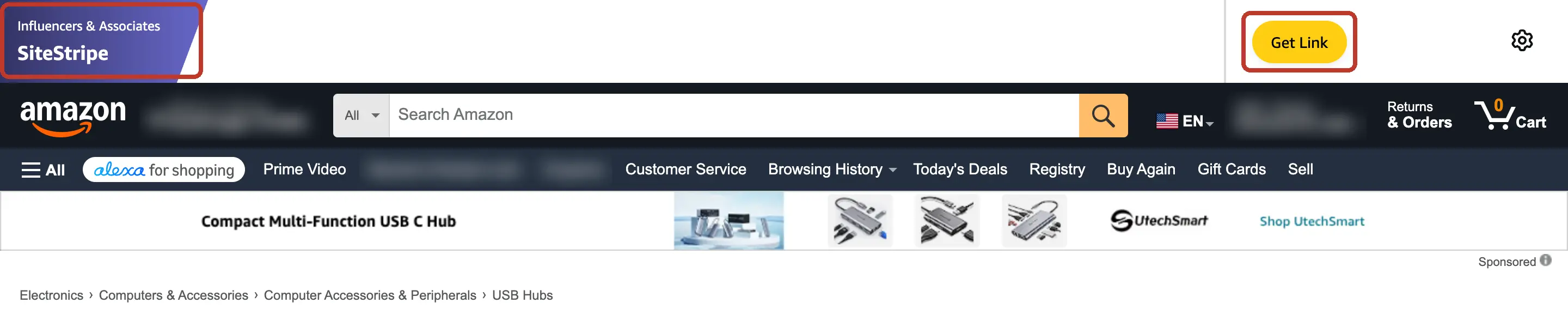
- Sign in to Associates Central in the browser you shop with.
- Open the product page you want to recommend.
- Click Get Link in the SiteStripe bar.
- Pick the Tracking ID for the site or article you are publishing on.
- Copy the short link or the full link and paste it into your article.
Tracking IDs are worth setting up early. You can create up to 100 Tracking IDs per account, and one per site or content type tells you later which pages actually earn.
Mobile GetLink
On a phone, Mobile GetLink does the same job inside the Amazon Shopping app. Tap Share on a product page and choose Copy Associates Link.
- It works only on product detail pages.
- It skips eBooks, Audible, digital magazines, digital music and luxury stores.
- It is available on iPhone and Android in every Amazon store except China.
Check the Link Before You Publish
A link that goes to the wrong store or misses your tag earns nothing, and you won’t find out until the report stays empty. Before you publish, check these:
- The tag is in the URL. US Store IDs end in -20 and India Store IDs end in -21.
- The link opens the marketplace your readers use.
- The right Tracking ID is selected for this site or article.
- A short disclosure sits near the link. A footer notice on its own isn’t enough.
- Nothing hides that the link goes to Amazon. Cloaking and shorteners that disguise the destination are not allowed.
A WordPress plugin becomes useful once you manage dozens of product boxes or comparison tables. The Amazon affiliate plugins for WordPress comparison covers the options, and showing live prices or star ratings needs Amazon’s API, which comes with its own requirements below.
Amazon Affiliate Commission Rates
Amazon affiliate commission rates depend on the product category and on the marketplace. Both marketplaces advertise “up to 10%”, and 10% is the highest product rate on both tables, but most categories pay a lot less. Plan around the categories your readers actually buy.
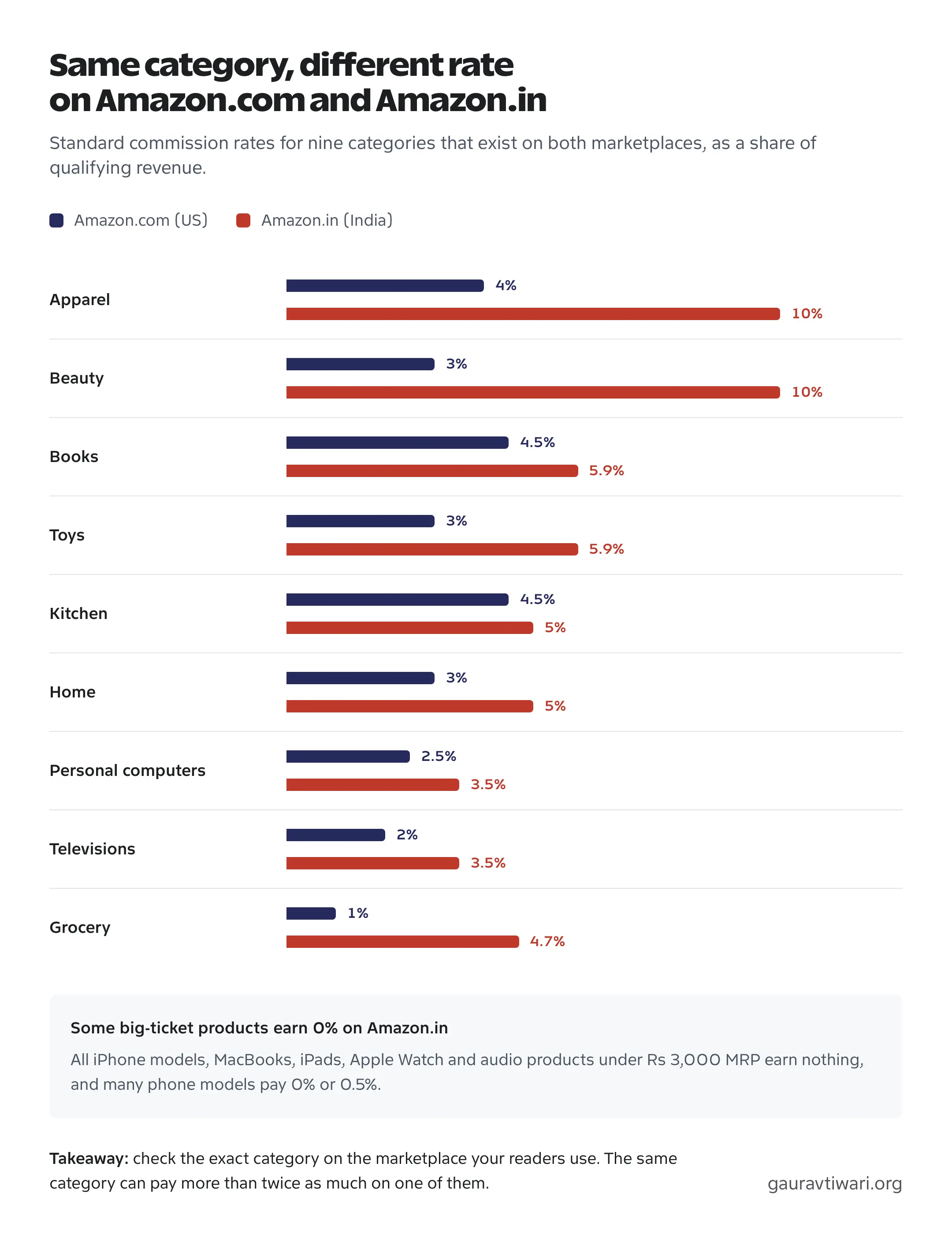
Amazon.com (US) Commission Rates
These are the standard rates from Amazon’s US commission schedule:
| Category | Rate |
|---|---|
| Luxury Beauty, Luxury Stores Beauty, Amazon Explore | 10% |
| Digital Music, Physical Music, Handmade, Digital Videos | 5% |
| Physical Books, Kitchen, Automotive | 4.5% |
| Apparel, Shoes, Watches, Jewelry, Luggage, Handbags, Luxury Stores Fashion, Kindle and Fire devices, Echo, Ring, Fire TV | 4% |
| Home, Furniture, Toys, Home Improvement, Lawn and Garden, Pets, Beauty, Headphones, Musical Instruments, Sports, Outdoors, Tools, Baby, Business and Industrial Supplies | 3% |
| PC, PC Components, DVD and Blu-ray | 2.5% |
| Televisions, Digital Video Games | 2% |
| Grocery, Amazon Fresh, Health and Personal Care, Physical Video Games and Consoles | 1% |
| Gift Cards, Wireless Service Plans, Alcohol, Kindle subscriptions, Vehicles, Pet Rx, restaurant food, Appstore, Coach and a few others | 0% |
| All other categories | 4% |
Older guides still quote 20% for Amazon Games and 7% for Amazon Haul. Neither row is in the current US table. Amazon Haul now pays a $4 bounty for a customer’s first Haul purchase instead of a percentage.
Amazon.in (India) Commission Rates
The Amazon affiliate program in India publishes its own advertising fee schedule. It is labeled August 2026 and pays more than the US in most comparable categories:
| Category | Rate |
|---|---|
| Apparel and Accessories, Shoes, Luggage and Bags, Watches, Beauty | 10% |
| Books, Toys, Personal Care Appliances, Baby Products, Automotive, Sports | 5.9% |
| Kitchen, Furniture, Home, Echo and Alexa devices, Fire TV devices, all other categories | 5% |
| Grocery, Amazon Fresh, Health and Personal Care, Pet Products | 4.7% |
| Mobile Accessories | 4% |
| Personal Computers, Smart Watches, Electronics, Large Appliances, Televisions, Video Games, Lawn and Garden, Business and Industrial Supplies | 3.5% |
| Bicycles and Heavy Gym Equipment, Tyres and Rims | 2.5% |
| Data Storage Devices | 2% |
| Mobile Phones (many models pay 0% or 0.5%) | 1% |
| Bill Payment and Recharges | 30%, capped at INR 3 |
Read the exceptions before you plan a technology article for Indian readers. A generic “Electronics 3.5%” tells you very little about a phone or an Apple product, as the next list shows.
Bounties and 0% Exceptions
Both marketplaces also pay fixed bounties for sign-ups and first purchases, and both list products that earn nothing:
- US bounties: $3 for a Prime free trial or paid membership, Kindle Unlimited trial, Music Unlimited, Baby Registry or Wedding Registry; $4 for a first Amazon Haul purchase; $5 for an Audible Premium Plus trial or a first Prime Video stream; $15 for an Amazon Business registration; $20 for an Audible Standard trial; $30 for Prime for Young Adults.
- India bounties: INR 100 for a paid Prime membership, Prime Video paid Prime or Prime Music; INR 150 for an Audible trial or paid plan; INR 200 for an Amazon Business registration; INR 400 for a GST-validated Sell on Amazon registration.
- India 0%: all iPhone models, MacBooks, iPads, Apple Watch and Apple PC accessories, every earphone, headphone and speaker under Rs 3,000 MRP, microwaves and semi-automatic washing machines.
- India no fee: flight bookings, gift cards, gaming consoles and hardware, Prime membership fees, Kindle eBooks, gold and silver coins.
- US 0%: gift cards, wireless plans, alcohol, Kindle subscriptions, vehicles and the other rows listed in the US table.
How Much Can Amazon Affiliates Earn?
I would estimate Amazon earnings from earnings per click. Someone else’s income screenshot reflects their audience and their categories, while earnings per click folds the commission rate and the conversion rate into one number you can compare across pages and programs.
The calculation is: clicks × conversion rate × average order value × commission rate. Here is a worked example with assumed numbers:
- An article sends 1,000 clicks to Amazon.com.
- 5% of those clicks become qualifying orders, which is 50 orders.
- The average qualifying order is $60.
- The blended commission rate across those orders is 3%.
That gives 1,000 × 5% × $60 × 3% = $90, or $0.09 per click. These numbers only illustrate the calculation. They aren’t an Amazon benchmark or my own earnings. Change the conversion rate or the category and the result moves a lot, which is why each page should be judged by its own earnings per click.
Give the numbers time before you judge a page. Purchases can land up to 89 days after the click, and Amazon’s reports separate ordered items from shipped items, so comparing three days of clicks with three days of earnings will mislead you.
Session, Payment and Account Rules
Four separate rules decide whether a click turns into money you receive. They are easy to mix up, so here they are side by side before the details.
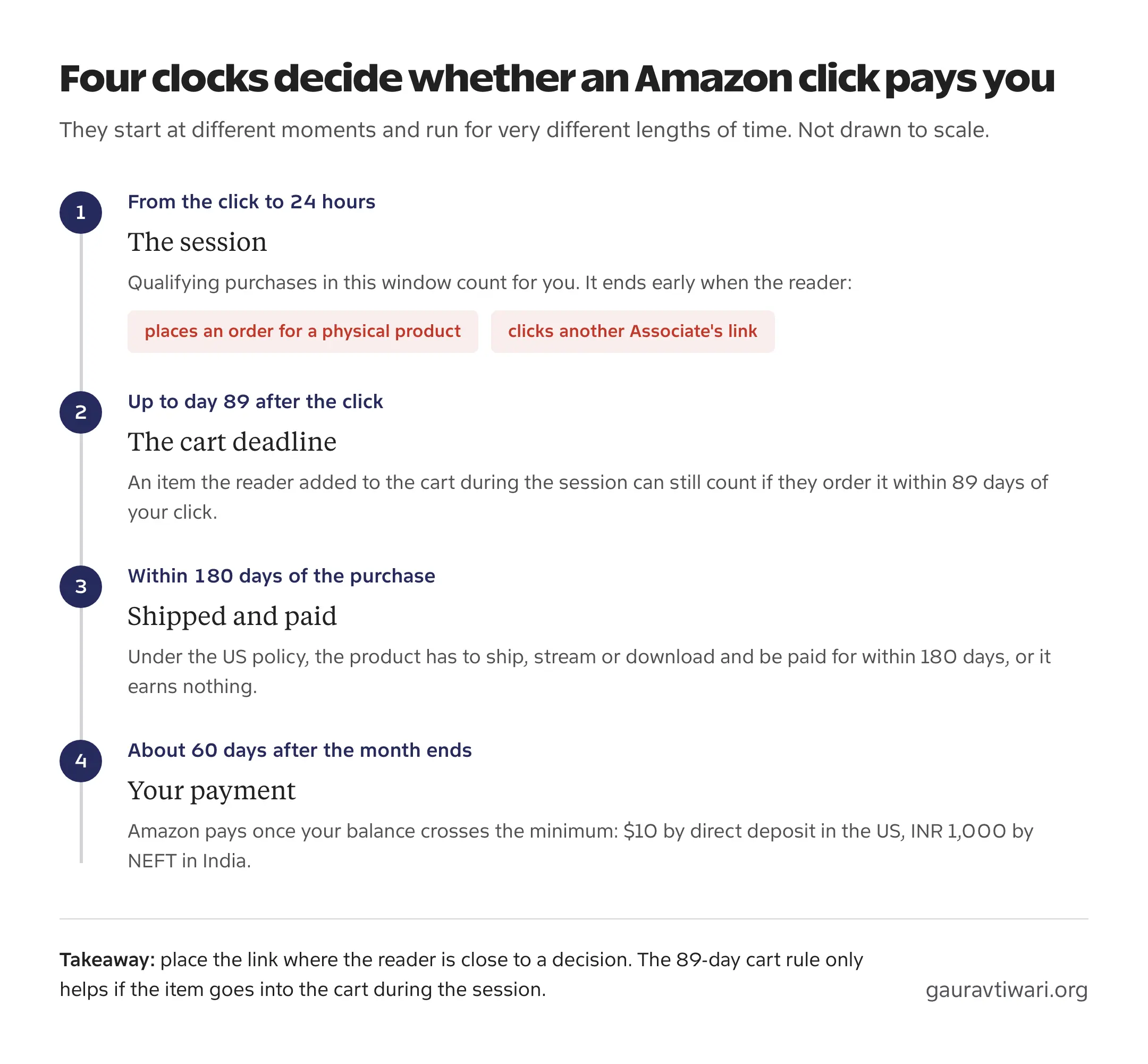
The 24-Hour Session and the 89-Day Cart
The session starts when a reader clicks your link and lasts up to 24 hours. Amazon’s Program Policies end it earlier in two cases:
- the reader places an order for a physical product, or
- the reader clicks another Associate’s link.
An item added to the cart during the session can still earn you commission if the reader orders it no later than 89 days after your click. Some Amazon help pages still say 90 days, but the operating rules say 89. In the US, the product also has to ship, stream or download and be paid for within 180 days of the purchase.
So put the link where the reader is close to a decision. A link in the first paragraph of a long research article can use up its 24 hours before the reader chooses anything.
Payment Thresholds and Timing
Amazon pays about 60 days after the end of the month in which the commission was earned, and only once your balance crosses the minimum. Anything below it rolls over to the next month.
- Amazon.com: $10 by direct deposit or Amazon gift card, $100 by check with a $15 processing fee.
- Amazon.in: INR 1,000 by NEFT bank transfer and INR 2,500 by cheque, according to the India operating agreement and its payment help pages.
- Both need valid tax information before payments start. In India that includes your PAN, and Amazon withholds tax at the rate set by law.
Disclosure
Amazon requires this exact statement to appear clearly on your site: “As an Amazon Associate I earn from qualifying purchases.” Its disclosure guidance also asks for a short notice near each affiliate link or review, such as “(paid link)”.
The FTC’s endorsement guide FAQ makes the same point for US readers: the closer the disclosure is to the recommendation, the better, and a single notice on the home page is easy to miss. A theme or plugin can add the disclosure for you. What matters is that a reader sees it near the link on both desktop and mobile.
Rules That Get Accounts Closed
Amazon can close an account or withhold commissions for any of the following. The US rules below include the April 14, 2026 update, and the India rules differ in a few places:
- Buying through your own links, or asking friends, family or colleagues to buy through them.
- Offering rewards, discounts, cashback or donations for clicking or buying.
- Copying Amazon prices, availability, customer reviews or star ratings by hand. Amazon allows them only through its API, and images can’t be stored on your server.
- Cloaking the link or using a shortener that hides the Amazon destination.
- Paid ads: in the US, any paid or boosted ad that links straight to Amazon disqualifies the sale, with limited exceptions. Paid search that sends people to your own site is fine. India also bans bidding on Amazon trademarks.
- Email: in the US, Special Links are allowed in email, SMS and direct messages to people who opted in. In India, they are not allowed in email or other offline promotions.
- Thin content: since April 2026, the US rules define original content as commentary, analysis or transformation that adds value.
- In India, price tracking or price alerts need Amazon’s permission, and tagged links can only go on sites you own.
Free Tools for Amazon Affiliates
You can run an Amazon affiliate site with nothing but free tools. These are the ones I would set up first:
| Tool | What it does | Watch out for |
|---|---|---|
| SiteStripe | Creates tagged links from any Amazon product page | Works only when you are signed in to the right Associates account |
| Mobile GetLink | Copies an Associates link from the Amazon Shopping app | Product pages only, with some digital categories excluded |
| Tracking IDs | Separates earnings by site, article type or channel | Up to 100 per account |
| Order and Earnings reports | Shows clicks, ordered items, shipped items and commission | Short date ranges misread delayed purchases |
| OneLink | Sends US-account visitors to their local Amazon store | Covers Canada, the UK, EU stores, Japan, Australia and a few others; India isn’t included |
| Google Search Console | Shows the queries, clicks and positions for each page | Knows nothing about Amazon sales |
| GA4 outbound clicks | Counts clicks on links that leave your domain | A click is not a sale |
Beyond Amazon’s own dashboard, keep a simple worksheet with one row per article. These columns are enough:
- Marketplace
- Tracking ID
- Clicks
- Shipped items
- Earnings
- Earnings per click
After a month, the sheet shows which pages deserve a better comparison and which should send readers elsewhere. For link management and reporting beyond Amazon, see the affiliate marketing tools I actually use.
One WordPress detail: GA4 counts an outbound click only when the link leaves your domain. If you send readers through a /go/ redirect on your own site, GA4 won’t record it as outbound automatically, so track those redirects separately.
Creators API for Developers
Amazon has deprecated its old Product Advertising API (PA-API 5), and calls to it now return an access error. The Creators API replaces it on both marketplaces. You need it only to show live prices, availability or ratings, which is what most product-box plugins do.
API access has its own gate: at least 10 qualifying sales in the past 30 days. That is separate from the three sales that complete your application review, so a newly approved account may still be locked out of the API.
Associates, Influencer and Onsite Earnings
Amazon runs several related ways to earn, and they are often explained as one. Since April 14, 2026, US Associates also get a storefront and a Unique Creator Link, which used to be an Influencer feature.
| Route | Where your content lives | Useful when | Boundary |
|---|---|---|---|
| Amazon Associates | Your website, app or declared social account | You publish articles, comparisons or tutorials | The 24-hour session and 89-day cart rules apply |
| Storefront and Unique Creator Link (US) | A page on Amazon you curate | You want one link to share in a bio or video | Open to every registered Associate as well as Influencers |
| Amazon Influencer Program | Your storefront and a vanity URL such as amazon.com/shop/yourname | A social audience needs one shopping destination | Amazon checks quality and audience thresholds; an existing Associate can apply with the same account |
| Onsite earnings | Your videos or posts shown inside Amazon | Amazon features your content on product pages | Pays only on direct purchases of the same product variant and excludes traffic you send |
When Another Affiliate Program Makes More Sense
I’d keep Amazon as the default for everyday physical products, because readers trust the checkout and the basket can include more than the item you linked. I’d switch the destination only when the reader needs something Amazon doesn’t sell well, or when the brand itself pays better for the same reader.
| Program | Best fit | What is different | Watch out for |
|---|---|---|---|
| eBay Partner Network | Used, refurbished, auction and collectible items | Buy It Now and Best Offer count within 24 hours; an auction bid placed within 24 hours counts if won within 10 days | Rates of 1% to 4% with a per-sale cap, $550 in most categories |
| Etsy Affiliates | Handmade, vintage and craft products | Runs through Rakuten with a 30-day cookie for affiliates | The commission rate is shared after approval |
| Walmart Creator | US creators with social or shopping content | Links and a storefront, paid through impact.com | US residents 18 and over with a US bank account; rates are inside the portal |
| impact.com | Brand programs across retail, software and services | One free account to apply to many brands | Each brand sets its own commission, cookie and approval rules |
| PartnerStack | B2B software and SaaS | Built around software partner programs | Payouts and approval vary by vendor |
| Direct brand program | Readers who already want one brand | Sends them to the official store, trial or demo | Separate dashboards, terms and payments |
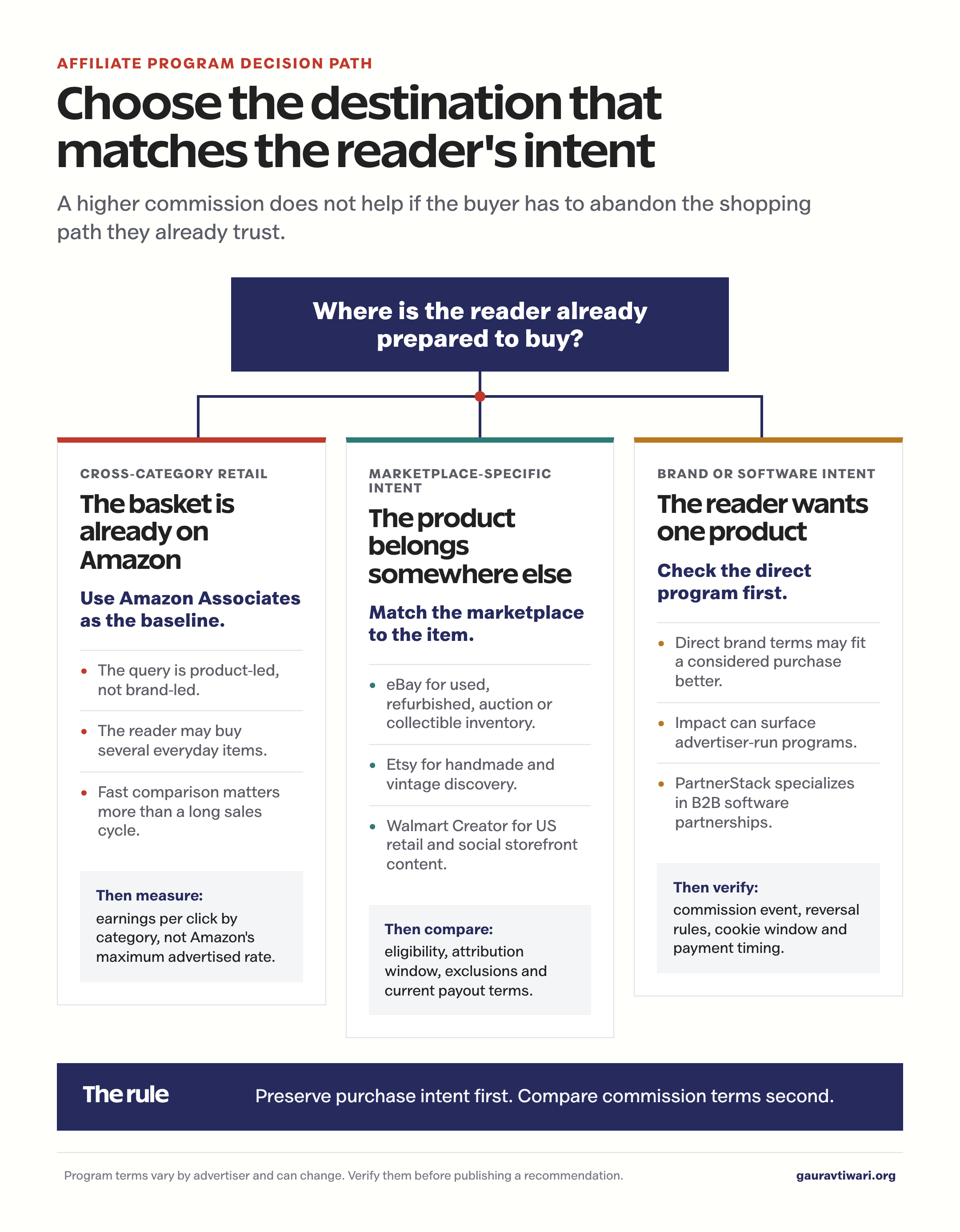
If you want to test an alternative, don’t replace every Amazon link at once. I would do it this way:
- Pick one category where another store fits the reader better, like used camera gear on eBay.
- Note the Amazon earnings per click for those pages over a month.
- Switch the links on those pages only.
- Compare earnings per click, reversals and payment timing after another month, then keep the better route.
For a wider list of programs, see the best affiliate marketing programs for beginners, and my guide to blog income diversification covers income beyond affiliate links.
FAQs on the Amazon Affiliate Program
Is the Amazon affiliate program free?
Yes. Amazon Associates is free to join on both Amazon.com and Amazon.in. You don’t need to pay anyone for setup or approval.
What is the Amazon affiliate commission rate?
Both marketplaces pay up to 10%, but most categories pay less. In the US, most everyday categories pay 1% to 4.5%. In India, most product categories pay 2% to 10%, with 0% for iPhones, several Apple products and many phone models.
How many sales do you need for Amazon affiliate approval?
You need three qualifying sales within the first 180 days on both marketplaces. Your own purchases and orders from friends or family don’t count.
Do I need 500 followers to join Amazon Associates with a website?
No. The 500-follower guideline applies to social media applications. A website is reviewed on its content: public, recent and original, with about 10 posts as a rule of thumb.
What happens if I don’t get three sales within 180 days?
Amazon withdraws the application, and that account and Associates ID can’t be reinstated. You can reapply later with new links once your site is established.
Does the 24-hour Amazon cookie mean the customer must buy within 24 hours?
Not always. An item added to the cart during the 24-hour session still counts if the customer orders it within 89 days of the original click, as long as the other rules are met.
Can I use Amazon affiliate links in email?
In the US, yes, for subscribers who opted in, as long as you follow the program policies and the law. In India, no. Amazon.in does not allow Special Links in email or other offline promotions.
What is the minimum Amazon affiliate payout?
On Amazon.com it is $10 by direct deposit or gift card and $100 by check. On Amazon.in it is INR 1,000 by NEFT bank transfer and INR 2,500 by cheque. Balances below the minimum roll over.
How long does Amazon take to pay affiliates?
About 60 days after the end of the month in which the commission was earned, once you cross the minimum payout and your tax and payment details are complete.
Do I need a WordPress plugin or the Amazon API to create affiliate links?
No. SiteStripe and Mobile GetLink create tagged links for free. The Creators API is needed only to show live prices, availability or ratings, and it requires 10 qualifying sales in the past 30 days.
Do Amazon.com affiliate links earn on Amazon.in purchases?
No. The two are separate programs. A US link earns only on Amazon.com and the OneLink stores, which do not include India. For Indian readers, you need an Amazon.in account and links with your India Store ID.
Does Amazon pay affiliates for clicks?
No. Amazon pays on qualifying purchases and on specific bounty events such as Prime or Audible sign-ups. A click is useful to measure, but it does not earn anything by itself.
Where I Would Start
I would start with one category your readers already buy and one article that helps them choose. Make the links with SiteStripe on the marketplace they shop on. That gives you something concrete to measure, and within a few months you’ll know whether the Amazon affiliate program suits your site.
Add another store only when it sells what the reader needs better, or when the numbers show it earns more per click. A higher percentage on someone else’s rate card is not a reason on its own to move a reader away from a checkout they already trust.
Tell Google you want more of this.
Add Gaurav Tiwari as a preferred sourceOne tap, and this site shows up more often in your own Top Stories, AI Overviews and AI Mode. Remove it any time.