Blogging for Students: From Zero to First $100
Build a student blog with a 90-day plan, first-party Search Console data, verified platform fees, and worked affiliate, product, and service models for your first $100.
 by
by
Blogging for students can build income, proof of work, and career skills, but your first $100 is not a timetable. It is a small business target. You still need a useful topic, an offer that matches the reader’s next step, clean measurement, and enough time for the page to earn attention.
The practical path is smaller than most guides make it: choose one audience problem, publish ten evidence-led posts, build one direct way to reach readers, and test one revenue model. Protect your coursework with a fixed weekly time budget. If the blog needs daily content or borrowed claims to survive, the model is wrong.
I started my first blog in 2008 as a student. I used Blogger, wrote without a clear audience, and waited for traffic that did not arrive. The useful lesson was not persistence by itself. It was learning to connect a reader problem, a specific page, distribution, and a measurable outcome. I have been testing that loop for 18 years.
The verdict: Blogging for students is worth testing in 2026 when you treat the site as a small portfolio business. Do not promise yourself $100 in six months. Build the assets, measure the funnel, and let verified demand decide whether you continue.
This guide stays narrow. It covers the first site, first ten posts, first measurement loop, and first revenue test. Read why blogging is a career worth having for the wider career question and study how successful bloggers built repeatable systems rather than relying on a single post.
Search has changed, but the response is not to chase a secret AI formula. This is how to create source material that remains useful: original examples, screenshots, calculations, decisions, and limits.
Why Blogging for Students Still Works in 2026
A student blog works best as a public proof system. It can show how you research, explain, compare, design, code, test, or teach. Revenue may follow, but the first asset is the archive itself.

The site’s own data is a useful warning against easy-money claims. This page recorded 53 Google web-search impressions and zero clicks from its first impression on September 8, 2025 through its latest recorded impression on March 29, 2026. Its weighted average position was 5.77. That does not mean it ranked fifth everywhere, and the sample is far too small to diagnose one cause.
| Metric | Prior 182 days | Recent 182 days | Change |
|---|---|---|---|
| Matched pages | 12 | 12 | Same cohort |
| Impressions | 2,408 | 1,462 | -946 (-39.29%) |
| Clicks | 8 | 2 | -6 (-75.00%) |
| CTR | 0.33% | 0.14% | -0.19 percentage points |
| Weighted average position | 43.25 | 20.31 | 22.94 places better |
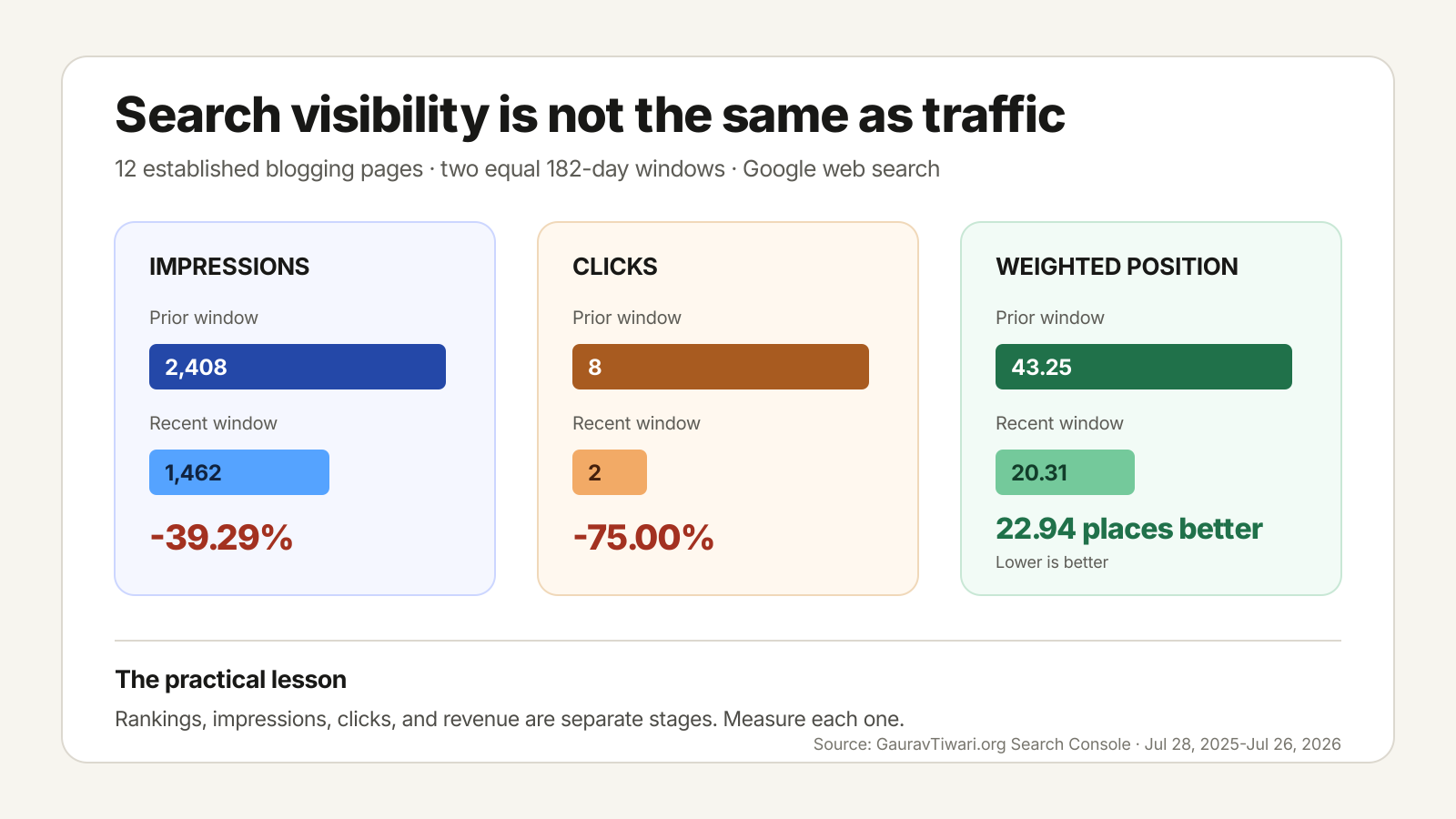
Position improved while discovery and traffic fell. That is the point. A better average position does not guarantee more queries, impressions, clicks, subscribers, or revenue. The cohort is descriptive, not a controlled SEO experiment. Search demand, SERP layouts, indexing, competition, and content changes all moved during the year.
Google’s Search Console metric definitions explains that an impression, click, CTR, and average position measure different things. For your blog, add email signups, outbound clicks, orders, refunds, fees, and cash received. A single dashboard number cannot tell the whole story.
Blogging in 2026 still works when the page carries proof. Build around disciplined niche selection, a clear content strategy, and evidence a generic summary cannot reproduce.
- Time flexibility: use a fixed block that does not compete with classes, sleep, or exams.
- Current perspective: document the tools, costs, constraints, and decisions you are actually facing.
- Portfolio value: ten useful posts show more than a claim that you can research or communicate.
- Transferable skills: writing, analytics, design, WordPress, email, and offer testing carry into paid work.
Picking a Niche That Actually Makes Money
A profitable niche is not a topic with a high commission. It is a recurring audience problem you can solve credibly, with a commercial next step that does not distort the advice.
My detailed guide on choosing a profitable niche covers the wider process. For a student site, make the proof requirement stricter because you have less time and less authority to waste.
The Three-Circle Test
Score each possible niche from zero to two on four criteria. Publish only when the total reaches six out of eight.
| Criterion | 0 points | 1 point | 2 points |
|---|---|---|---|
| Experience | No direct access | Actively learning | Can show repeated use or tests |
| Questions | No clear reader problem | Some recurring questions | Specific decisions recur |
| Evidence | Only summaries | Some screenshots or examples | Original data, tests, or artifacts |
| Revenue fit | No honest next step | One weak option | Useful product, service, or resource |
Student Niches That Work in 2026
Study productivity and tools: compare what you use, record the task, test the workflow, and show the limit. The best study tools for college students category is useful only when the recommendation comes from evidence. If you mention Grammarly, show what it caught, what it missed, and who should not pay.
Budget student living: document a real constraint such as a weekly food budget, room size, commute, or regional price. Include the date and what the total excludes.
Your field of study: translate one difficult concept, tool, lab, project, or career decision. Do not impersonate an expert. Show your sources and label what you are still learning.
Student technology: compare devices against course software, repair options, battery needs, accessibility, and total cost. A product roundup without a test method is just a catalog.
Skip the broad lifestyle niche. Narrow the reader, constraint, and outcome. ‘Budget cooking for first-year hostel students’ gives you decisions to test. ‘Lifestyle’ does not.
Setting Up Your Blog (Spend Under $50)
Treat $50 as a first-year target, not a guaranteed checkout price. Currency, tax, term length, bundled domains, and renewal prices vary. Compare the total due today and the next renewal before entering a card.
Domain Name
A short name that can survive a niche adjustment is safer than a clever keyword domain. Check Namecheap, but compare registration, renewal, transfer, privacy, and redemption prices in your country. Do not buy add-ons you cannot explain.
- Prefer a name you can say and spell once.
- Avoid a trademark, product name, or university name you do not own.
- Check social handles only after the domain passes the legal and renewal-cost checks.
- Record the renewal date and enable account security before launch.
Hosting
Hostinger and Bluehost are reasonable places to compare beginner plans, but the front-page monthly number is not the bill. Check the billing term, first invoice, renewal, backups, email, storage, traffic limits, data-center location, cancellation window, and migration path.
The best hosting services for beginners guide explains the tradeoffs. For a first site, I care more about a recoverable backup, current PHP, SSL, and support you can reach than a long list of bundled features.
A free hosted site is valid for testing your habit. The WordPress.com plan comparison shows that WordPress.com free sites cannot install plugins, while paid plans add that access. Understand the difference between WordPress.com and WordPress.org before deciding whether self-hosted WordPress control is worth the extra cost and maintenance.
WordPress Setup (30 Minutes)
Thirty minutes is enough for a clean first pass, not a finished brand. Install WordPress, keep the default block theme or one lightweight theme, enable backups and SSL, create Home, About, Contact, and Privacy pages, then publish. Do not spend the first week tuning fonts.
- Security: use a unique password, multi-factor authentication where available, and the fewest administrator accounts.
- Recovery: create a backup and prove you know where the restore control is.
- Measurement: connect Search Console after launch.
- Disclosure: prepare a clear affiliate disclosure before adding paid links.
Your First 10 Posts (The Foundation)
Your first ten posts should test four intents and one coherent audience. Random volume gives you less information than a small, connected set.
Post Types to Write
- Three decision posts: ‘Best X for Y’ only when you can state criteria, evidence, and exclusions. Use the affiliate marketing for beginners guide before adding paid links.
- Three tutorials: reproduce the steps, include failure cases, and state the version or date.
- Two experience posts: ‘My 30-day review of [popular product]’ and one cost or workflow log.
- Two comparison or opinion posts: ‘Why I moved from [popular app] to [alternative]’ with a decision matrix.
Before publishing, ask one classmate to follow the tutorial or make the decision using only the page. Record where they get stuck. That small test is more useful than assuming the draft is clear.
How Long Should Posts Be?
There is no Google-preferred word count. Google’s people-first content guidance explicitly warns against writing to a number because you heard search prefers it. Stop when the reader can understand, decide, implement, verify, or act without searching for the missing step.
Start with one strong post every two weeks. Increase only when the quality survives exams and other commitments. The process for write blog posts faster without sacrificing quality should remove wasted drafting, not evidence.
SEO That Actually Works for New Blogs
New-blog SEO is a feedback loop: discover a real question, publish the best answer you can prove, help Google crawl it, then use impressions and clicks to decide what to improve.
Keyword Research (The Free Way)
Use autocomplete and related questions to collect language, not to declare search volume. Read the results and identify the decision, freshness gap, missing proof, and audience constraint. A suggestion means the phrase exists; it does not guarantee traffic.
Rank Math can help you remember page fields, and the wider on-page SEO guide explains the mechanics. A plugin score is not a ranking probability. The page still needs a useful answer.
On-Page Basics
- Use a descriptive title and answer the main question early.
- Give every major section an answer-first opening.
- Use alt text to describe the image’s useful subject or evidence.
- Link related pages where the reader’s next question changes.
- Add dates, entities, versions, assumptions, and limits where they affect the decision.
The One Thing Most Beginners Skip
Internal links should move a reader to the next useful question. Use the internal linking process when a new page earns a place in the cluster. That also keeps readers on your site when the next step is genuinely relevant.
Google’s generative-AI content guidance says generative AI can help with research and structure, but producing many pages without added value may violate the scaled content abuse policy. The rule is not ‘AI text never ranks.’ The rule is accuracy, quality, relevance, and useful original value.
Building an Email List From Day One
Email gives a small blog one direct measurement channel. You can see signups, sends, opens, clicks, replies, and sales without pretending every search impression belongs to an audience.
MailerLite’s current pricing page listed 250 subscribers and 2,500 monthly sends on its free plan on July 29, 2026. A send is one email to one subscriber. Those limits can change. If you prefer a site-owned workflow, compare a WordPress newsletter plugin, deliverability requirements, backups, and sending costs before choosing.
Create one resource that saves ten minutes or prevents one mistake. A printable planner made in Canva, a course-specific checklist, or a spreadsheet can work. Do not claim a GPA, result, or saving you cannot document.
Put one signup form after relevant posts and send only when you have something useful. Weekly is not automatically better than monthly. The sustainable cadence is the one your evidence and schedule can support.
Monetization: How to Hit $100
Define the $100 first. Gross revenue, commission income, net platform revenue, profit, and cash received are different numbers. The how to make money blogging question becomes useful only after the measurement boundary is clear.
Path 1: Affiliate Marketing (Easiest for Students)
Affiliate income is not sessions multiplied by a magic RPM. Model the chain: page sessions x outbound click rate x merchant conversion rate x average qualifying revenue per order x commission rate.
| Illustrative case | Sessions | Outbound rate | Merchant conversion | Order value | Commission | Modeled income |
|---|---|---|---|---|---|---|
| Low | 1,000 | 4% | 2% | $40 | 2% | $0.64 |
| Base | 5,000 | 8% | 3% | $60 | 3% | $21.60 |
| High | 10,000 | 12% | 5% | $80 | 4% | $192.00 |
The spread is the lesson. In the base case, 5,000 sessions become 400 merchant clicks, 12 modeled orders, and $21.60. The high case crosses $100 only because every input improves. Amazon Associates Program Policies says its standard commission is a percentage of qualifying revenue, sessions usually end after 24 hours, returns can disqualify purchases, and rates or promotions can change.
FTC endorsement guidance says the relationship should be disclosed clearly and conspicuously near the recommendation. ‘Affiliate link’ by itself may not tell a reader you earn money. State the commission relationship in plain language and never endorse a product you have not used.
The broader blog monetization guide can help after one channel produces a measurable signal. Do not add five income streams to a site that has not earned its first relevant click.
Path 2: Digital Products (Highest Margin)
A small product makes the math easier to inspect. Gumroad’s fee schedule listed a 10% + $0.50 platform fee for direct sales, plus 2.9% + $0.30 card processing, on July 29, 2026. A $10 direct sale therefore nets $7.91 before refunds and your other expenses. Thirteen sales net $102.83.
Gumroad Discover sales use a 30% fee that includes processing. A $10 sale nets $7, so 15 sales net $105. This is platform revenue, not after-tax profit. A study planner, template, or checklist also needs original value, accurate claims, support, and a refund policy.
Path 3: Freelance Writing
A blog can earn its first $100 indirectly as a portfolio. Two $60 assignments produce $120 gross, but that is an illustrative quote, not a market rate or promise. Scope the word count, research, edits, deadline, rights, payment timing, and revision limit before accepting.
Service work needs fewer visitors but more direct selling and delivery. Affiliate content can compound but depends on traffic, program terms, and merchant conversion. A digital product sits between them. Pick the path that fits your skill and available time.
Realistic Timeline
Use stage gates instead of income dates. Move forward only when the previous stage has evidence.
- Stage 1: site works, backups exist, and four core pages are published.
- Stage 2: ten posts solve one audience’s connected questions and are internally linked.
- Stage 3: pages are indexed and earn relevant impressions, clicks, replies, or direct referrals.
- Stage 4: one offer earns a first tracked action.
- Stage 5: fees, refunds, and cash timing are reconciled before calling the channel profitable.
The Mistakes I See Student Bloggers Make
The biggest mistake is confusing activity with evidence. A new theme, ten AI drafts, or a high plugin score feels productive. None proves that a reader found the page, trusted it, or acted.
- Design before publishing: keep a simple theme until ten posts reveal the content’s real needs.
- Topic sprawl: stay with one audience and one cluster long enough to collect a signal.
- Unverified AI copy: test claims, open sources, and remove anything you cannot defend.
- Search folklore: basic keyword research is useful, but autocomplete, word count, and a green plugin score are not demand or ranking guarantees.
- Income before disclosure: add the plain-language relationship disclosure before the first paid link.
- Quitting or scaling on tiny samples: use the discipline to turn knowledge into action and stay the course, but do not confuse persistence with repeating a broken model.
Tools You Actually Need (And Nothing More)
The complete student stack in 2026 is one publishing system, one analytics source, one image tool, one email method, and a backup. Add a subscription only when a measured bottleneck justifies it.
- Hosting: compare Hostinger and Bluehost by full checkout, renewal, backups, limits, and support.
- Theme: use Kadence, Astra, or a core block theme, then stop customizing.
- SEO: use a free plugin for fields and sitemaps, not as a ranking score.
- Images: use Canva or another editor you can operate quickly, and compress uploads.
- Editing: use Grammarly as a second pass, not an authority on meaning or facts.
- Search measurement: connect Google Search Console and record impressions, clicks, CTR, and position separately.
- Email: start with the free tier that fits your current list and export subscribers regularly.
Your real cost is the first-year invoice plus renewal, optional tools, tax, and time. Keep a spreadsheet. If the stack costs $80 and the blog earned $100 net platform revenue, your pre-tax operating surplus is $20, not $100.
The 90-Day Action Plan
The 90-day plan in 2026 is a learning cycle, not a revenue promise. Use the hosting comparison to set the cost ceiling, the Rank Math to configure essential fields, and the blogging checklist to keep each post complete.
| Weeks | Deliverable | Verification gate |
|---|---|---|
| 1-2 | Site, core pages, backup, one audience statement | Restore path recorded; site indexable; no unnecessary plugins |
| 3-6 | Four connected posts | Each page answers one query and cites or shows its proof |
| 7-10 | Four more posts, email form, internal links | Form tested; links useful; Search Console connected |
| 11-12 | Two posts and one offer experiment | Disclosure visible; conversion event recorded; costs logged |
Week one should end with your first blog post, not a perfect homepage. During weeks three to ten, keep a three-hour weekly ceiling and pause during exams. At day 90, review the funnel: indexed pages, impressions, clicks, signups, outbound clicks, orders, fees, refunds, and cash.
Run three error checks before deciding the plan worked: confirm that your analytics event fires once, exclude your own test actions, and reconcile platform reports with actual payouts. If you cannot trace the number, do not optimize against it.
Frequently Asked Questions
How long does it take for a student blog to make its first $100?
There is no reliable universal timeline. In 2026, treat $100 as a measured business target, not a deadline. Track indexed pages, impressions, clicks, email signups, outbound clicks, orders, fees, refunds, and cash received. A small service can reach the target with two clients, while low-rate affiliate content may need thousands of relevant sessions.
What niche should a student choose for a blog?
Choose a narrow audience problem you understand, can document, and can serve repeatedly. Confirm that readers ask related questions and that there is an honest next action such as a product, service, template, or email resource. Reject a niche that depends on claims you cannot verify or products you have not used.
How much does it cost to start a student blog?
The minimum depends on country, tax, billing term, renewal price, and whether a domain is included. A free hosted site can validate your writing habit. A self-hosted site adds a domain and hosting but gives you more control. Compare the full first-year checkout and renewal total instead of a monthly teaser price.
Can you blog seriously while managing college coursework?
Yes, if the workload has a fixed ceiling. Start with one useful post every two weeks, a three-hour weekly block, and a pause rule during exams. If the blog harms sleep, grades, or health, reduce the cadence. The business should fit around the degree, not compete with it.
Is blogging still worth it with AI-generated content everywhere?
It can be, but generic volume is a weak strategy in 2026. Use AI for research organization, outlines, transcription, or editing only when you verify the output. Your advantage is evidence: original screenshots, tests, costs, examples, limitations, and decisions that a generic summary cannot reproduce.
Should the first $100 target mean revenue or profit?
Choose one definition before measuring. Gross revenue is money charged before fees, refunds, costs, and taxes. Net platform revenue subtracts platform and processing fees. Profit also subtracts your operating costs. Cash received can arrive later than the sale. This guide models net platform revenue for digital products and commission income for affiliate scenarios.
Tell Google you want more of this.
Add Gaurav Tiwari as a preferred sourceOne tap, and this site shows up more often in your own Top Stories, AI Overviews and AI Mode. Remove it any time.