
How to Make Money Blogging: What Actually Works
I started blogging in 2008. The first check I ever received from Google AdSense was $127. It took four months of daily posting to earn that. Today, this site generates revenue through a mix of affiliate partnerships, digital products, and services. The path wasn’t linear, and most advice about making money blogging skips the hard parts.
This guide covers what actually works, based on 18 years of doing it. Not theory. Not a course pitch. Just the mechanics of building a blog that pays for itself and eventually pays you.
How Blogs Actually Make Money
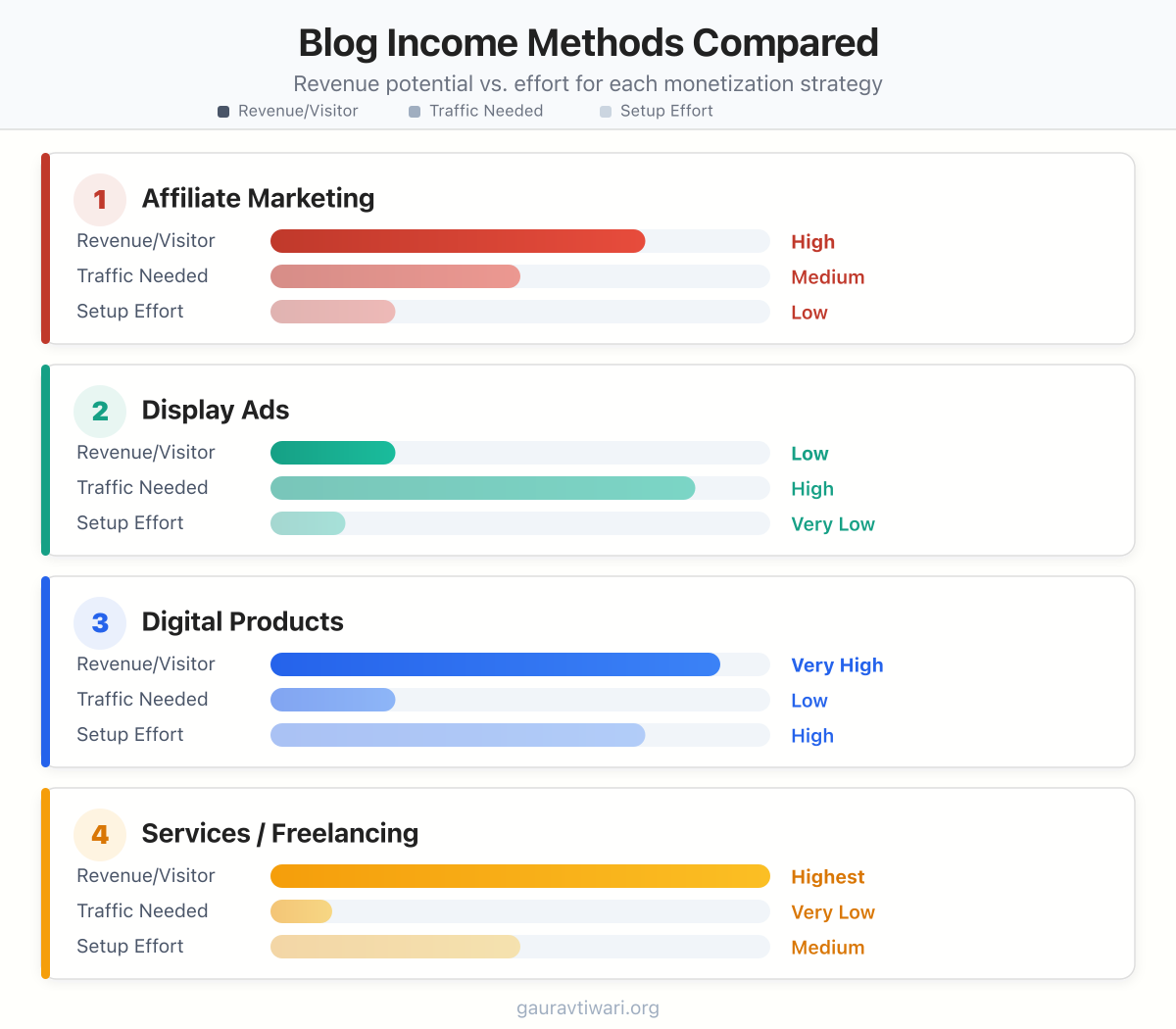
There are four main monetization paths. Most successful blogs use a combination:
- Affiliate marketing — Earning commissions by recommending products you use and trust
- Display advertising — Ad networks like Mediavine, AdThrive (now Raptive), or Google AdSense
- Digital products — Courses, ebooks, templates, plugins, tools
- Services — Consulting, freelancing, done-for-you work based on your blog‘s expertise
Affiliate marketing and services have the best revenue-per-visitor ratio. Display ads require massive traffic (100,000+ monthly visitors before it becomes meaningful). Digital products have the best margins but require the most upfront work.
Recommended reading:
- Blog Income Diversification — Why you shouldn’t rely on one revenue stream
- Affiliate Marketing Guide — Complete getting started guide
- Affiliate Marketing for Beginners — The basics explained clearly
Getting Started: The Technical Foundation
You need hosting, a WordPress installation, and a solid theme. That’s it for day one. Everything else (email lists, social media, fancy design) comes later.
For hosting, start with something affordable. You don’t need a $30/month managed host for a new blog. A $5-7/month VPS or basic shared plan is fine until you’re past 10,000 monthly visitors. See my hosting comparison for affordable options that scale.
Recommended reading:
- How to Start a Blog — Step-by-step setup guide
Content and Traffic Strategy
Content is the engine. SEO is the distribution channel. Together, they bring readers who are actively looking for what you write about. Social media drives spikes. Search drives steady, compounding traffic.
Focus on writing articles that answer specific questions or solve specific problems. “How to Start a Blog” is better than “Why Blogging is Great.” Product comparisons and reviews convert better than opinion pieces. Tutorials build trust and authority over time.
Recommended reading:
- Guest Posting Sites List — Build backlinks and traffic through quality guest posts
- The Affiliate Blogger’s System — My content and monetization framework
Monetization: Affiliate Programs
Affiliate marketing is my recommended starting point. You don’t need huge traffic to earn commissions. A well-placed recommendation in a helpful article can generate revenue from day one.
Recommended reading:
- Best Affiliate Marketing Programs — Programs worth joining across niches
- Gaming Affiliate Programs — Niche-specific programs if you’re in gaming
- Semrush Affiliate Program — One of the highest-paying SEO tool programs
Making Money as a Student
If you’re a student, blogging is one of the most flexible side income options. You can write about what you’re already studying and learning.
- Make Money Online as a Student — Practical approaches that work around class schedules
- Earn Money with Chegg — Subject matter expert earnings
- Websites That Pay Online — Verified earning opportunities
All Blogging and Income Articles
| Article | Type | Best For |
|---|---|---|
| How to Start a Blog | Getting started | Complete beginners |
| Affiliate Marketing Guide | Strategy | New bloggers ready to monetize |
| Affiliate Marketing Basics | Beginner guide | Understanding how affiliates work |
| Best Affiliate Programs | Roundup | Finding programs to join |
| Income Diversification | Strategy | Bloggers with one revenue stream |
| Affiliate Blogger’s System | Framework | Systematic approach to affiliate content |
| Guest Posting Sites | Resource list | Link building and traffic |
| Cold Email Outreach Tools | Roundup | Freelancers building client base |
The biggest mistake new bloggers make is trying to monetize before they have anything worth reading. Write 30 genuinely useful articles first. Start the email list on day one. Then add affiliate links only where they actually fit. The money follows the value, never the other way around.
How Much Do Bloggers Actually Make?
Blogging income follows a power law. A small percentage of bloggers earn most of the money. The majority earn little or nothing, usually because they quit before their content compounds.
Here is what the data shows. Surveys from Productive Blogging and RyRob (both based on thousands of blogger responses) paint a consistent picture:
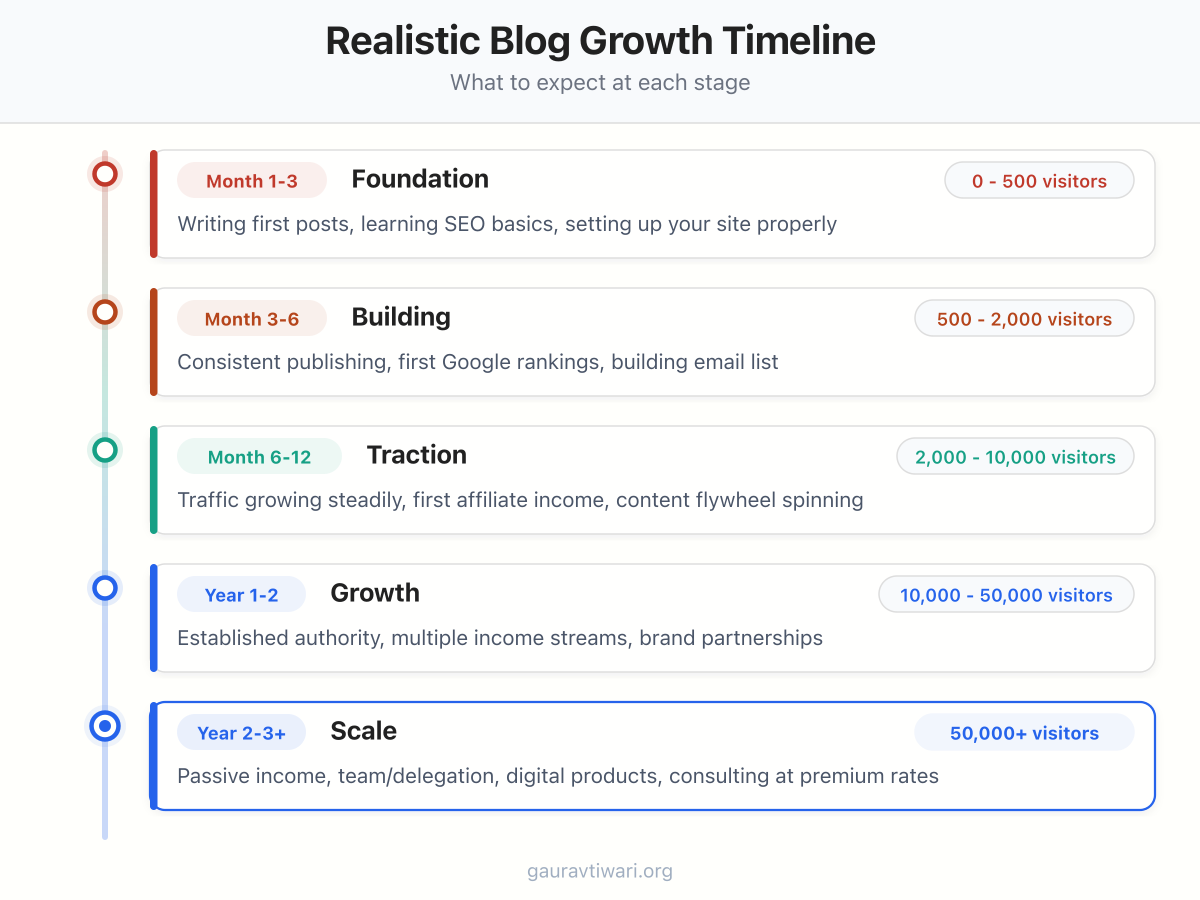
- Year 1: Most bloggers earn $0 to $500 total. Some earn nothing. A few with experience in high-value niches break $1,000/month by month 8-12.
- Year 2: Consistent bloggers average $1,000 to $2,500 per month. This is where affiliate income starts to compound as older posts gain authority.
- Year 3+: Average monthly income climbs to $2,200 to $4,000 for bloggers who stuck with it. Full-time bloggers in profitable niches (tech, finance, B2B) earn $5,000 to $15,000+ per month.
- Top earners: The top 5-10% of bloggers earn $10,000+ per month. These are typically in high-RPM niches with diversified income (affiliates + products + services).
My own trajectory: $127 in month 4, $1,000/month around month 14, full-time income by year 3. The first year is the hardest. The second year is where most bloggers either quit or break through.
How Long Does It Take to Make Money Blogging?
On average, 22 months to earn consistent income. About 4 years to reach full-time income. But these averages hide a wide range.
30% of bloggers start earning within 6 months. 28% reach full-time income within 2 years. The difference is not luck. It is niche selection, content quality, and whether you write for search intent or for yourself.
The timeline depends on three things:
- Niche value. A blog about credit cards earns faster than a blog about journaling because affiliate commissions are 10x higher.
- Publishing frequency. 2-3 quality posts per week builds topical authority faster than 1 post per month. But quality always beats quantity.
- Monetization strategy. Affiliate marketing can generate revenue with 500 monthly visitors if you target buyer-intent keywords. Display ads need 25,000+ sessions to be meaningful.
Do not expect income in month 1. Expect to learn, write, and build. The money follows the content, not the other way around.
7 Ways Blogs Make Money (Beyond Affiliate Marketing)
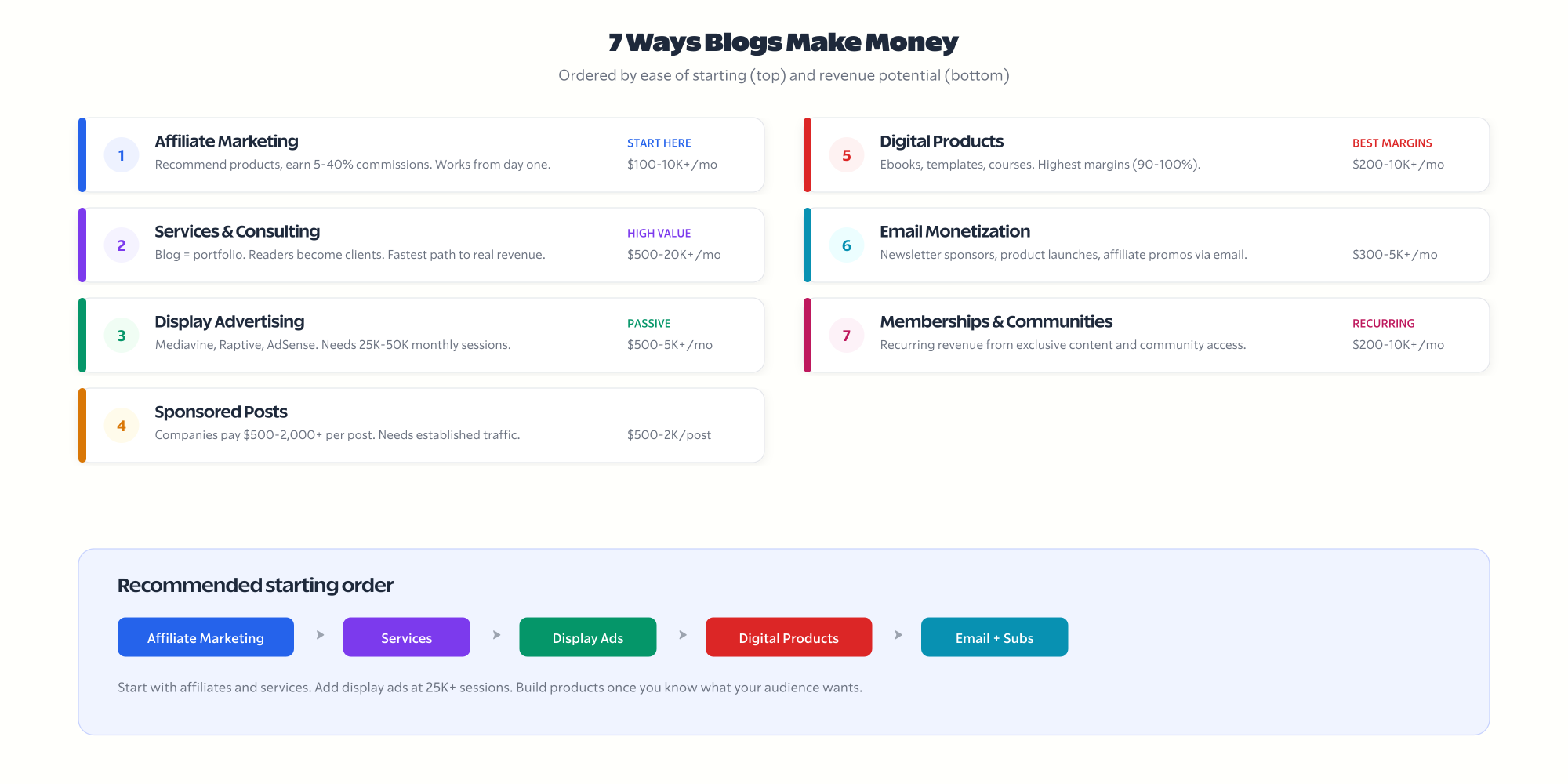
Most blogging income guides only cover affiliate marketing. That is one of seven monetization methods I have used or seen work consistently.
1. Affiliate marketing. Recommend products, earn commissions. Works from day one with the right content. My primary income source. Commissions range from 5% (Amazon) to 40%+ (SaaS products like Semrush).
2. Display advertising. Ad networks (Mediavine, Raptive, Google AdSense) place ads on your pages. You earn per impression or click. Requires significant traffic. Mediavine requires 50,000 sessions/month. RPMs range from $10-40 depending on niche.
3. Sponsored posts. Companies pay you to write about their products. Rates depend on your traffic and niche authority. A blog with 50,000 monthly visitors in tech can charge $500 to $2,000 per sponsored post. Always disclose sponsorships.
4. Digital products. Ebooks, templates, courses, printables. Highest margins (you keep 90-100% after payment processing). Requires an audience that trusts you enough to buy. I sell courses and guides through my own shop.
5. Services and consulting. Your blog is a portfolio. Readers become clients. I built a WordPress development business entirely from blog traffic. Service income is the fastest path to significant revenue if you have a marketable skill.
6. Email monetization. Build an email list, sell to it. Newsletter sponsorships, product launches, and affiliate promotions all convert better through email than through blog posts alone. My newsletter drives a meaningful percentage of my affiliate revenue.
7. Memberships and communities. Recurring revenue from paid access to exclusive content, forums, or groups. Works best for bloggers with a loyal, engaged audience. Harder to build, but the most predictable income once established.
My recommendation: start with affiliate marketing and services. Add display ads when traffic allows. Build digital products once you know exactly what your audience needs.
Blogging Income by Niche
Not all niches pay equally. The difference between a high-RPM and low-RPM niche can be 10x or more, even with the same traffic.
| Niche | Avg RPM (Display Ads) | Affiliate Potential | Why |
|---|---|---|---|
| Finance / Insurance | $25-50 | Very high | High CPC keywords, expensive products |
| Technology / SaaS | $15-35 | Very high | Recurring affiliate commissions, high ticket items |
| Health / Fitness | $12-25 | High | Supplements, programs, equipment |
| Education / Online Courses | $10-20 | High | Course affiliate programs pay $50-500 per sale |
| Home / DIY | $10-18 | Medium | Amazon affiliate volume, tool recommendations |
| Travel | $8-15 | Medium | Hotel and flight bookings, travel gear |
| Food / Recipes | $8-15 | Low-Medium | High traffic potential, lower affiliate value |
| Lifestyle / General | $5-10 | Low | Broad audience, lower purchase intent |
The best niche for you is one where you have genuine expertise AND the economics work. I write about WordPress and tech because I have 18 years of hands-on experience and SaaS affiliate commissions are high. Writing about a topic you do not care about just because the RPM is high leads to burnout and generic content that does not rank.
Is Blogging Still Profitable in 2026?
Yes. But the bar is higher than it was five years ago.
AI content tools have flooded the internet with mediocre articles. Google’s E-E-A-T (Experience, Expertise, Authoritativeness, Trustworthiness) updates have made first-hand experience a ranking factor. AI search engines like ChatGPT, Perplexity, and Google AI Overviews are changing how people find information.
All of this actually favors experienced bloggers. Generic content gets buried. Content written by someone who has actually tested the product, built the thing, or solved the problem stands out more than ever.
The bloggers who are struggling in 2026 are the ones who relied on thin content and low-effort SEO tricks. The bloggers who are thriving are practitioners who share real experience, specific data, and genuine opinions.
Blogging is not dead. Lazy blogging is dead. There is a difference.
Blogging vs YouTube vs Newsletter: Which Makes More Money?
All three work. The right choice depends on your strengths and your niche.
Blogging has the best long-tail compounding. A well-written article can drive traffic for 3-5 years with occasional updates. Setup cost is minimal. You own the platform. Revenue comes from affiliates, ads, and products. Downside: takes 6-12 months to see meaningful traffic.
YouTube has higher per-view revenue potential (CPMs of $5-25 depending on niche vs blog RPMs of $5-50). Video content builds personal trust faster. Downside: higher production cost (camera, editing, time per video), and you do not own the platform. One algorithm change can destroy your channel.
Newsletters have the most direct relationship with your audience. No algorithm between you and your readers. Monetization through sponsorships, paid subscriptions, or affiliate links. Downside: growing a list is slow without another traffic source (usually a blog or social media).
My approach: blog as the foundation, newsletter as the relationship layer, and let YouTube be optional. A blog drives search traffic, builds SEO authority, and feeds your email list. The newsletter converts readers into buyers and keeps them engaged between posts. YouTube amplifies reach but is not required.
How to Earn Your First $1,000 from Blogging
Here is the exact sequence I would follow if I were starting a blog today with the goal of earning $1,000/month as fast as possible.
Month 1-2: Foundation. Pick a niche with affiliate potential. Set up WordPress on affordable hosting. Install Rank Math. Write 10 articles targeting low-competition, buyer-intent keywords (“best X for Y”, “X review”, “X vs Y”). Apply to 3-5 affiliate programs in your niche.
Month 3-4: Volume. Publish 2-3 articles per week. Mix informational content (builds authority) with commercial content (drives revenue). Start an email list with a simple lead magnet. Share every article on one social platform where your audience hangs out.
Month 5-6: Optimization. Check Google Search Console for which keywords you are ranking for. Update and improve articles that are on page 2 (positions 11-20). Add internal links between related articles. Your first affiliate commissions should start appearing.
Month 7-12: Scale. Double down on what is working. Write more content in the clusters that drive traffic. Build backlinks through guest posting. Optimize conversion (better CTAs, product comparisons, email sequences). $1,000/month is realistic by month 10-14 in a decent niche with consistent effort.
The key is buyer-intent content. “Best web hosting for small business” converts at 10x the rate of “what is web hosting.” Write for people ready to buy, not people casually browsing.
Frequently Asked Questions
Last updated: August 31, 2026