
 by
by
You published a solid product review. You put real effort into it. Then you check Google and see a competitor’s result with bright yellow stars, a price and an availability badge right in the snippet. Your listing? Plain blue text. No stars, no special formatting, no reason for anyone to click yours over theirs.
That visual gap costs you clicks every single day. Stars in particular grab attention because they signal trust and quality before anyone reads a word.
Here’s the problem: Google changed the rules in August 2023. Stars no longer appear for most blog posts. The old CreativeWorkSeries hack that worked for years? Dead. I’ll show you exactly which schema types still produce star ratings in 2026, which rich results are available for every WordPress blogger, and how to implement each one using Rank Math, ACF blocks and manual JSON-LD. No outdated tricks. Only methods that work right now.
What Changed: Google’s August 2023 Review Rich Results Update
Google’s review rich results update (rolled out August 2023) fundamentally changed which content types can display star ratings in search. Before this update, you could slap a CreativeWorkSeries schema on any blog post, set a rating and watch stars appear in your search listing. Thousands of bloggers did exactly this. I did it too on several sites. It worked beautifully for years.
Then Google shut it down. The update restricted review snippets (the stars you see in search) to specific schema types only. Here’s the full list of schema types that still produce star ratings in Google Search as of 2026:
- Product (physical goods, digital products)
- SoftwareApplication (apps, SaaS tools, plugins)
- LocalBusiness (restaurants, stores, service providers)
- Recipe (food and drink recipes)
- Movie (film reviews)
- Book (book reviews)
- Course (educational courses)
Everything else, including CreativeWorkSeries, Organization aggregate ratings and Event aggregate ratings, lost star eligibility. If your old blog posts still have CreativeWorkSeries schema, those stars aren’t showing anymore. Google simply ignores the rating data for ineligible types.
This doesn’t mean schema markup is dead for bloggers. Far from it. But be honest about what changed: Google killed FAQ rich results for everyone on May 7, 2026, and HowTo rich results were already gone back in 2023. The visual extras that survive are review stars on eligible types, breadcrumbs, video thumbnails, sitelinks and merchant listings. FAQ and HowTo markup still has a job in 2026, just not the one it used to. More on that below.
Schema Types That Still Work for WordPress Bloggers
Even without stars on every post, structured data gives you a significant advantage in search. Here are the schema types I use across my WordPress sites in 2026, ranked by impact.
Article Schema (Every Post)
Article schema is the foundation. It tells Google your content’s headline, author, publish date, modified date and featured image. This is what powers those clean search listings with author bylines and dates. Rank Math adds Article schema automatically to every post. You don’t need to do anything except make sure your author profiles are filled out with name, bio and social links.
Article schema won’t produce stars. But it establishes authorship, which matters more than ever for E-E-A-T signals. Google’s quality raters specifically look for identifiable authors with demonstrable expertise. And AI search engines like Semrush’s data shows that content with clear authorship attribution gets cited more frequently by Perplexity and ChatGPT Search.
FAQ Schema (High-Impact Posts)
Here’s the honest 2026 status: FAQ rich results are dead. Google limited them to government and health sites in August 2023, then pulled the feature entirely on May 7, 2026. The expandable question-answer dropdown that used to triple your SERP footprint is gone for everyone. I watched my own FAQ rich results disappear that week, same as every other site.
So why keep FAQ sections at all? Because readers still scan them, and ChatGPT Search, Perplexity and Google’s AI Overviews lift question-answer pairs straight out of the page. I write mine in the GT ACF Blocks Accordion, which renders them as native collapsible details. It stopped printing FAQPage markup in version 2.9.1, after Google retired the rich result and this site no longer carries that markup at all.
Treat FAQs as an AI-readability play now, not a SERP-stars play. The dropdown isn’t coming back. If you still want FAQPage markup for other consumers, Rank Math’s FAQ block or the manual template further down adds it.
Product and SoftwareApplication Schema (Review Posts)
If you write genuine product or software reviews, these two schema types still get stars. The key word is “genuine.” Google’s product review system evaluates whether your content demonstrates hands-on experience. A thin 500-word overview with affiliate links won’t cut it. You need screenshots, specific testing details, pros and cons, and comparisons with alternatives.
For physical products, use Product schema. For software, apps and SaaS tools, use SoftwareApplication schema. In Rank Math Pro, you can set either type from the Schema tab on any post. Fill in the name, rating, price and operating system (for software), and you’re set.
I typically add SoftwareApplication schema to my WordPress plugin reviews and SaaS tool reviews. Product schema goes on physical product roundups. The stars appear within 2-14 days after Google crawls the updated page.
HowTo Schema (Tutorials)
HowTo schema used to show numbered steps right inside the search result. Past tense matters here. Google deprecated HowTo rich results in September 2023 and removed them from Search entirely. As of 2026, HowTo markup earns you nothing in Google, and it was dropped from the Rich Results Test too. I’m covering it only so you stop chasing a feature that no longer exists.
If you still want the markup for AI parsing, Rank Math can generate it from the Schema tab. But spend your real effort on the schema types that still produce something visible: Product and SoftwareApplication for stars, Breadcrumb for the clean URL path. HowTo is a retired feature, not a strategy.
Breadcrumbs and Sitelinks
BreadcrumbList schema replaces the ugly green URL in search results with a clean navigational path like “Home > WordPress > Plugins > Rank Math Review.” It looks more professional and helps users understand where the page sits in your site structure. Rank Math adds breadcrumb schema automatically. You just need breadcrumbs enabled in your theme or via Rank Math’s breadcrumb settings.
Sitelinks (the sub-links that appear under your main result for branded searches) aren’t directly controlled by schema, but having clear site structure, good internal linking, and proper navigation schema increases your chances of earning them. I’ve seen sitelinks appear more consistently on sites with strong site structure that include well-structured content hierarchies.
Google retired FAQ and HowTo rich results. Review stars survived. The lesson: build schema that matches real products and real reviews, not schema that games a feature Google can switch off overnight.
Adding Schema Markup with Rank Math
Rank Math is my go-to for schema management on WordPress. The free version handles Article, Breadcrumbs and basic schema automatically. Rank Math Pro unlocks the full schema editor with every type you’ll need: Product, SoftwareApplication, HowTo, FAQ, Recipe, Course and custom JSON-LD.
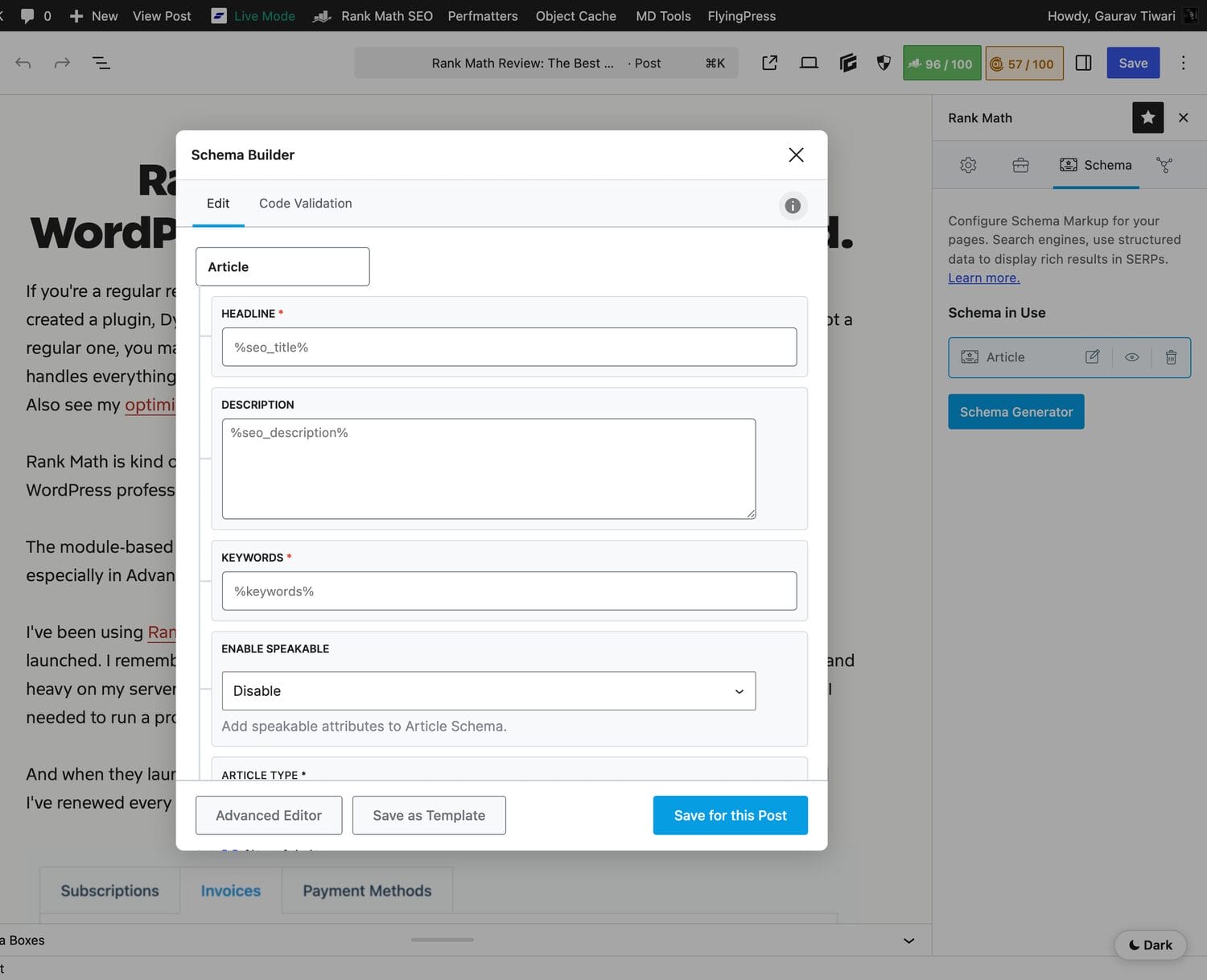
Here’s how to add schema to any post in Rank Math Pro. The Schema Generator opens right inside the WordPress editor:
Step 1: Open the Schema Tab
In the WordPress editor, click the Rank Math icon in the top toolbar. Navigate to the “Schema” tab. You’ll see the default Article schema that Rank Math adds automatically. Click “Schema Generator” to add a new schema type.
Step 2: Select Your Schema Type
Choose from the available types. For a software review, select “SoftwareApplication.” For a product review, select “Product.” For a tutorial, select “HowTo.” You can add multiple schema types to a single page, which is useful when a post includes both a review and a FAQ section.
Step 3: Fill in the Required Fields
Each schema type has required and optional fields. For Product schema, you need the product name, image, description and at least one of: review, aggregateRating or offers (price). For SoftwareApplication, you also need the applicationCategory and operatingSystem. Fill in everything you can. More complete schema = better chances of rich results.
Step 4: Set the Rating
For Product and SoftwareApplication, add your rating under the Review section. Set the rating value (e.g., 4.5), the best rating (usually 5), and the worst rating (usually 1). If you have aggregate ratings from multiple reviewers, use the AggregateRating section instead. Be honest with ratings. Google’s algorithms cross-reference your rating with your content’s sentiment. A 5-star rating on a review that mentions several drawbacks looks suspicious.
Step 5: Validate Before Publishing
Rank Math has a built-in schema validator. Click “Validate” to check for errors. Then test your page with Google’s Rich Results Test at search.google.com/test/rich-results after publishing. Fix any warnings or errors immediately. Submit the URL through Search Console to request a crawl.

- Track keyword rankings and schema rich result performance
- Site audit catches schema errors automatically
- On-page SEO checker recommends schema improvements
- Position tracking shows which pages have rich results
- Competitive analysis reveals competitors' schema strategy
Schema with ACF Blocks: Product Reviews and Star Ratings
The ACF blocks I keep pointing to aren’t built into ACF itself. They come from my own free plugin, GT ACF Blocks, which adds 29 content blocks to the editor. Two of them write review schema from what you type into the block: Product Review and Star Rating. The rest, including Product Box, Pros & Cons and Accordion, are layout blocks with no schema of their own. You can grab it free through the direct checkout if you want to follow along.
Product Review Schema via the Product Review Block
The Product Review block is the one that can earn stars. Turn on Enable Schema Markup in its Schema & SEO tab and it prints Product or SoftwareApplication JSON-LD built from the same fields readers see: the product name, a Review with your overall rating, your pros and cons as positive and negative notes, and the offer price.
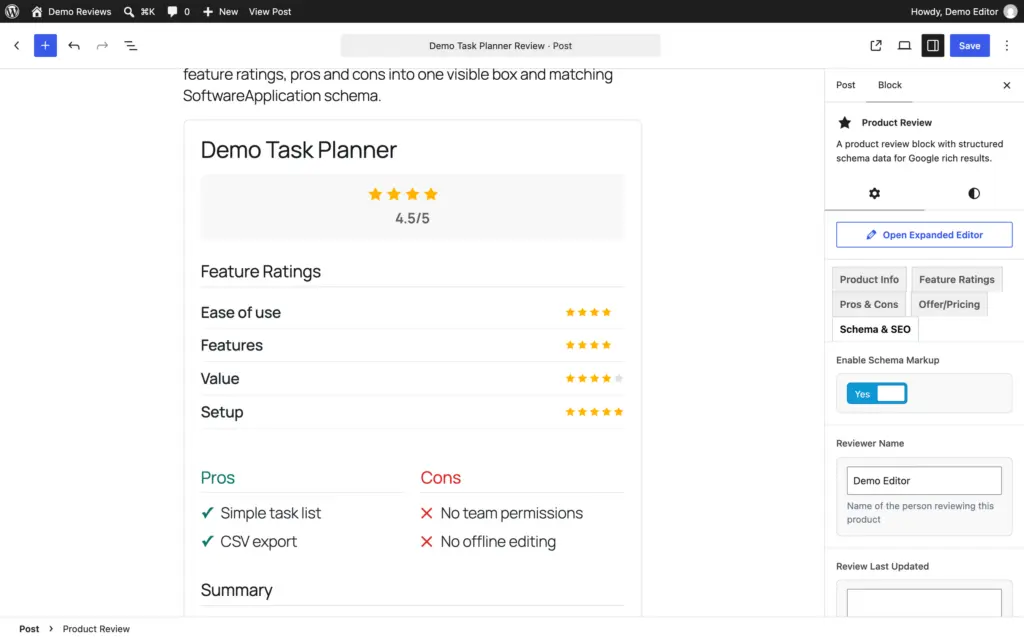
Fill in the Reviewer Name field. The block only adds a review author when that field has a name, and Google’s review snippets need one. On the demo review below, the block printed SoftwareApplication schema with a 4.5 rating, the reviewer’s name, two positive notes, two negative notes and a $29 offer, all matching the visible box.
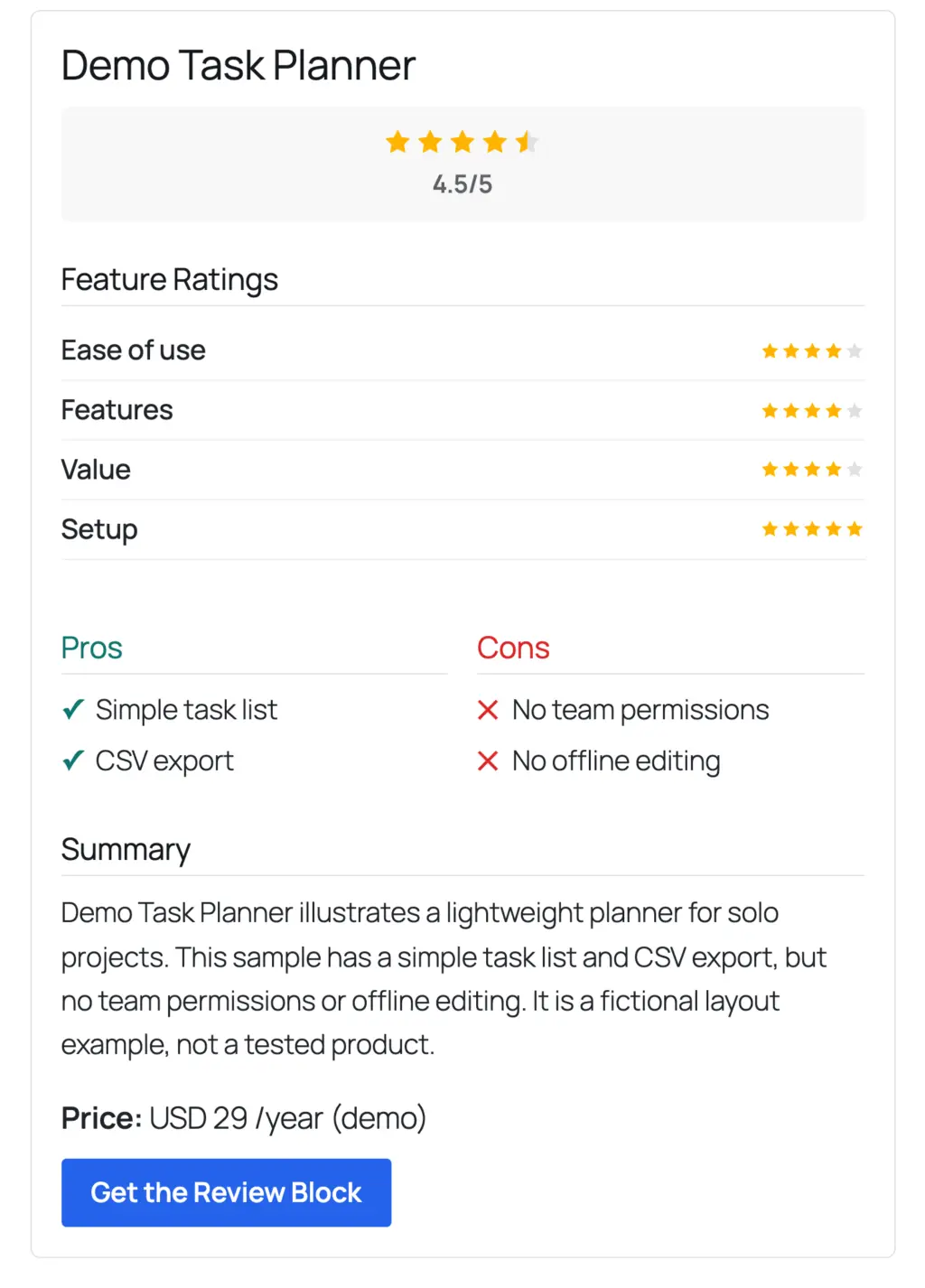
The Product Box block is a different tool. It’s a visual product card with an image, a feature list and buttons, and it prints no schema. For stars on a single-product review, use Product Review and don’t add Rank Math’s Product schema for the same product on top of it, or the page ships two competing Product entities.
Reader Ratings via the Star Rating Block
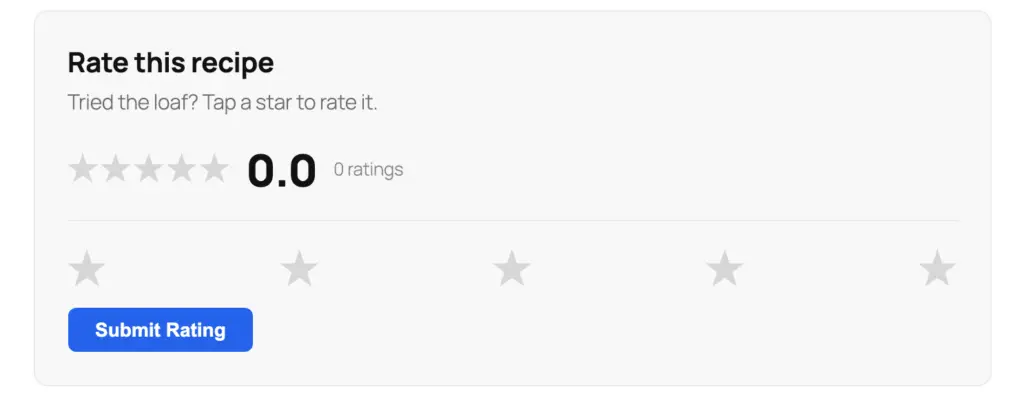
The Star Rating block collects ratings from readers and shows the average. With schema on, it prints an AggregateRating for the page, but only after the first vote arrives. Its schema type decides whether those votes can ever become stars.
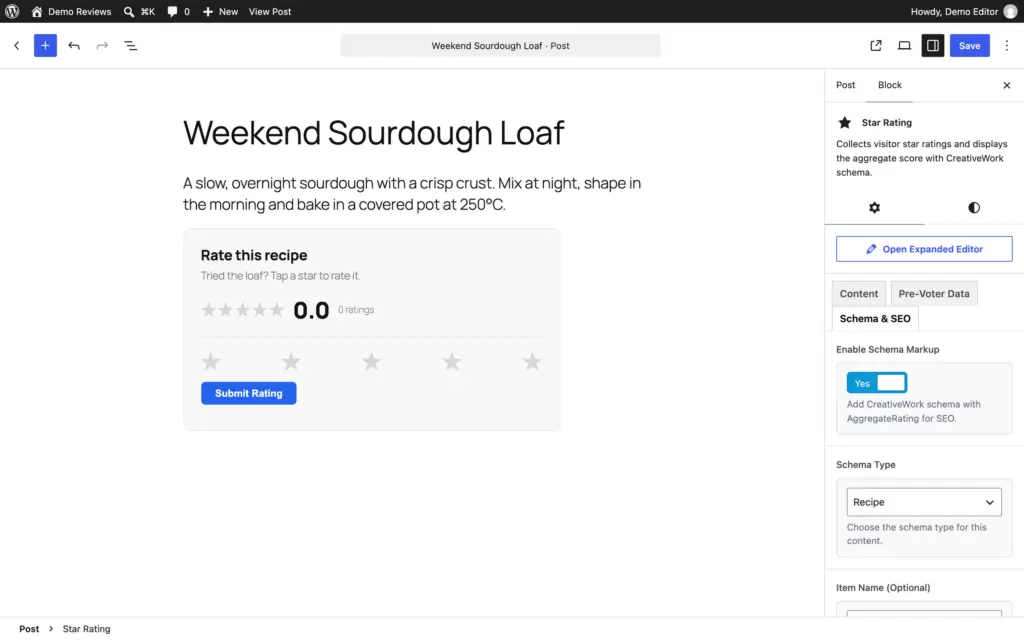
The type defaults to Creative Work, which no longer earns review stars. Switch it to Recipe, Software/App or Product only when the page really is that thing, as on the recipe demo below, and turn schema off on an ordinary blog post. Keep expectations modest even then. Since January 2026, Google’s review snippet documentation recommends accepting only ratings that come with a written comment and the reviewer’s name, and this block collects bare star votes. Leave the Pre-Voter Data fields at 0 too: seeded votes aren’t ratings from real readers, and Google added a guideline against fake reviews in July 2026.
What Happened to FAQ Schema in the Accordion
The Accordion block used to have an FAQ schema toggle. Version 2.9.1 removed it, so the block now renders your questions and answers without FAQPage markup, and older blocks that still carry the setting print none either. Keep using it for FAQ sections readers can scan, and add FAQPage markup separately only if you have a reason to.
Plugins That Add Star Ratings Visually with Blocks
Don’t want to open Rank Math’s sidebar or hand-write JSON-LD? A few Gutenberg block plugins let you drop a review block straight into your post, drag a slider to set the rating and they write the schema for you. One caveat first, and it’s the important one: only blocks that output Product or Review schema still earn star ratings in Google. The FAQ and HowTo blocks that Yoast and others ship lost their rich results in the 2023-to-2026 deprecation wave, so treat those as AI-readability tools, not star machines.
Before the third-party options, the honest disclosure: the product card and the FAQ accordion on this page come from my own plugin, GT ACF Blocks. I built it because I was tired of bolting five different block plugins onto every site just to get a review box here and a comparison table there. It ships 29 blocks in one install, including Product Review, Star Rating, Pros & Cons, Accordion, Compare and Product Box, and Product Review and Star Rating write their own review schema. No page-builder weight, no schema plugin on top.
The part that matters for most readers: it doesn’t need a paid ACF license. It runs on ACF Pro or the free SCF (Secure Custom Fields) fork that ships in the WordPress plugin directory, so you can get the whole block library for nothing. It’s GPL, gets automatic updates and only loads a block’s CSS and JS when that block is actually on the page. Grab it through the direct checkout below (free, takes 30 seconds), and the review schema comes from fields you already fill in.
- 29 editor blocks: Product Review, Star Rating, Pros & Cons, Accordion, Compare
- Product Review and Star Rating write review schema automatically, no code
- Runs on ACF Pro or the free SCF (Secure Custom Fields) fork
- Zero config, conditional asset loading, automatic updates, GPL
These are the block plugins I’d actually trust for visual review schema in 2026:
| Plugin | Block to use | Earns stars? | Price | Best for |
|---|---|---|---|---|
| GT ACF Blocks (mine) | Product Review + Star Rating | Yes (Product Review; Star Rating on eligible types) | Free | 29 blocks, with review schema, in one free install |
| Otter Blocks | Product Review block | Yes (Review schema) | Free + Pro | Pretty review boxes with pros, cons and a rating out of 5 |
| Ultimate Blocks | Review block | Yes (Review schema) | Free + Pro | Bloggers who want a basic review box for free |
| Spectra | Star Rating + review schema | Yes (Review schema) | Free + Pro | Astra and Spectra users already in that ecosystem |
| Yoast SEO | FAQ and How-to blocks | No, AI value only | Free | Structured Q&A for AI engines, not for stars |
Otter Blocks is my pick if you want the best-looking result with the least effort. Its Product Review block gives you a visual rating slider, pros and cons columns, a product image and CTA buttons, then writes valid Review schema in the background. The free version covers the review block. You only reach for Pro when you want the fancier layouts.
Ultimate Blocks covers the basics for free. Its Review block takes a product name, a feature list, a summary and a star rating, then outputs the schema. Pros and cons inside the review box need Ultimate Blocks Pro. If you just want stars on one review post without paying, start here.
Spectra earns its spot if you already build with it or run the Astra theme, since it ships a Star Rating block plus review schema and saves you from adding yet another plugin just for ratings. For a more performance-obsessed, code-style toolkit, Greenshift also has schema-aware blocks worth a look. And if you already run Rank Math, you don’t strictly need any of these. The sidebar Schema Generator I covered above does the same job.
Whichever you choose, the rule from earlier still holds: the rating in the block has to match the rating in your actual content. A block that outputs 4.8 stars on a review where you spent 600 words listing problems is the fastest way to get your rich results pulled. Visual is convenient. Honest is what keeps the stars.
Manual JSON-LD Schema Templates
Sometimes you need schema that Rank Math doesn’t support natively, or you want precise control over every property. Manual JSON-LD is the answer. You add it via a Custom HTML block in the WordPress editor, or through Rank Math’s custom code editor in the Advanced tab.
Here are copy-paste templates for the most useful schema types.
FAQ Schema Template
<script type="application/ld+json">
{
  "@context": "https://schema.org",
  "@type": "FAQPage",
  "mainEntity": [
    {
      "@type": "Question",
      "name": "Your first question here?",
      "acceptedAnswer": {
        "@type": "Answer",
        "text": "Your answer to the first question. Keep it concise but complete."
      }
    },
    {
      "@type": "Question",
      "name": "Your second question here?",
      "acceptedAnswer": {
        "@type": "Answer",
        "text": "Your answer to the second question."
      }
    }
  ]
}
</script>
HowTo Schema Template
<script type="application/ld+json">
{
  "@context": "https://schema.org",
  "@type": "HowTo",
  "name": "How to Add Schema Markup to WordPress",
  "description": "A step-by-step guide to adding structured data to your WordPress site.",
  "totalTime": "PT15M",
  "step": [
    {
      "@type": "HowToStep",
      "name": "Install Rank Math",
      "text": "Download and activate Rank Math from the WordPress plugin repository.",
      "url": "https://yoursite.com/guide/#step-1"
    },
    {
      "@type": "HowToStep",
      "name": "Configure Schema Settings",
      "text": "Navigate to Rank Math > Titles & Meta > Posts and set your default schema type.",
      "url": "https://yoursite.com/guide/#step-2"
    }
  ]
}
</script>
SoftwareApplication Schema Template
<script type="application/ld+json">
{
  "@context": "https://schema.org",
  "@type": "SoftwareApplication",
  "name": "Tool Name",
  "applicationCategory": "BusinessApplication",
  "operatingSystem": "Web, Windows, macOS",
  "offers": {
    "@type": "Offer",
    "price": "29.99",
    "priceCurrency": "USD"
  },
  "aggregateRating": {
    "@type": "AggregateRating",
    "ratingValue": "4.5",
    "bestRating": "5",
    "ratingCount": "150"
  }
}
</script>Validating Your Schema Markup
Adding schema is only half the job. If your markup has errors, missing required fields or content mismatches, Google ignores it silently. You won’t get an error message. You just won’t get rich results. Here’s my validation workflow that catches problems before they cost you clicks.
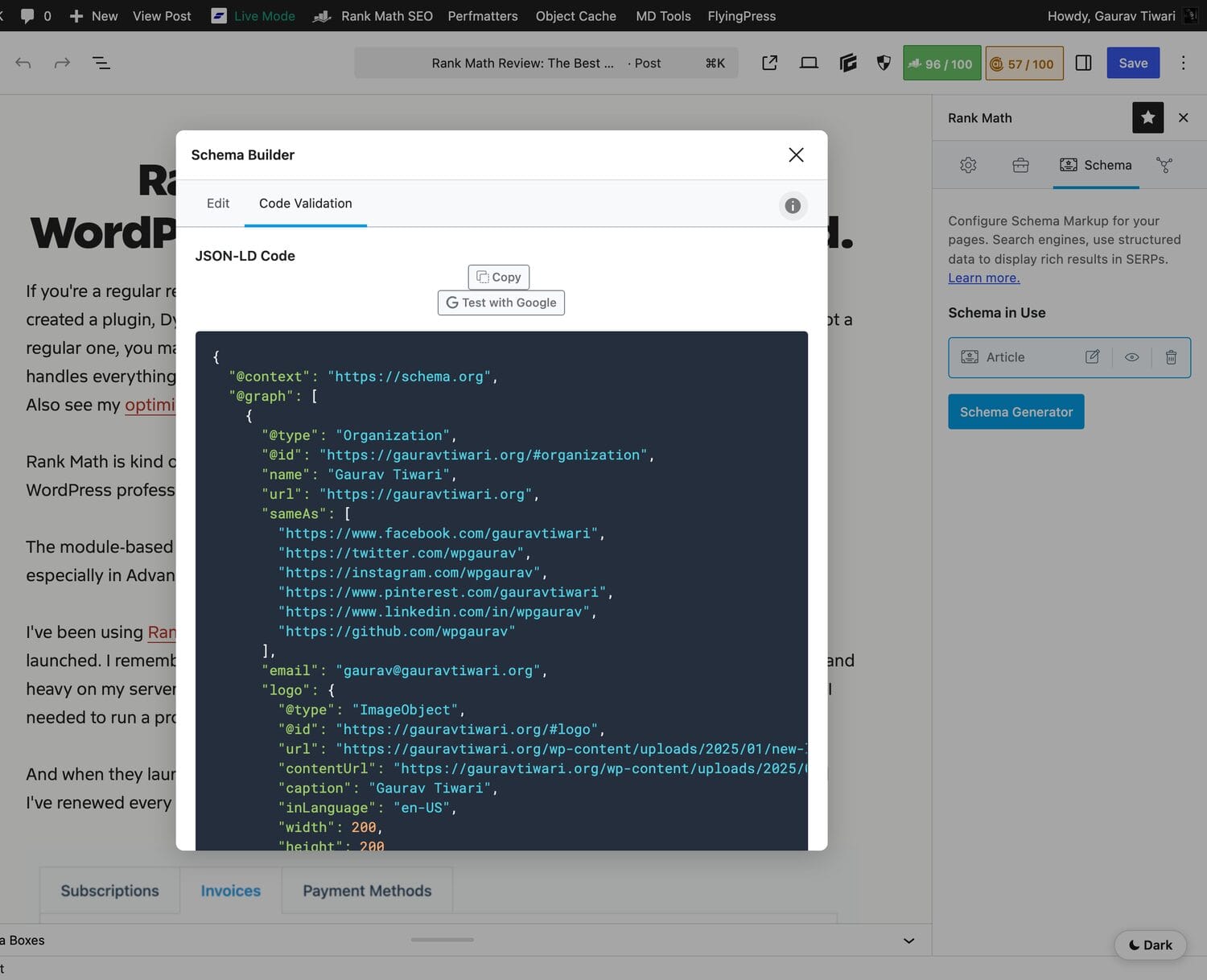
Google Rich Results Test
Go to search.google.com/test/rich-results and enter your page URL. This tool shows exactly which rich results your page is eligible for and flags any errors or warnings. I run every page through this test after publishing and after any content update that touches schema. It takes 30 seconds and has saved me from broken schema more times than I can count.
Schema Markup Validator
The Schema.org validator at validator.schema.org checks your markup against the official schema specification. It catches issues the Rich Results Test might miss, like deprecated properties, incorrect data types and missing recommended fields. Use this as your second check.
Google Search Console
In Google Search Console, open the “Enhancements” section in the left sidebar. The reports that still exist in 2026 are Breadcrumbs, Merchant listings, Review snippets and Videos. The FAQ enhancement report was removed in June 2026 along with the rich result, and HowTo disappeared years ago. Each remaining report shows which pages have valid markup, which have warnings and which have errors. Check it monthly. Schema breaks silently when you update plugins, change themes or edit posts, and this is where you catch it.
After validating, submit your URL through Search Console’s URL Inspection tool and request indexing. Rich results typically appear within 2-14 days after Google recrawls the page. For high-priority pages, submitting the URL manually speeds up the process.
Schema markup without validation is like sending an email without checking the recipient. You think it’s working, but nobody’s receiving anything.
Schema Markup for GEO and AI Search Engines
Here’s something most schema guides miss entirely: structured data doesn’t just help you in Google. It helps AI search engines like Perplexity, ChatGPT Search, Google AI Overviews and Gemini understand, extract and cite your content.
AI engines parse structured data to identify authoritative sources. When Perplexity answers a question about “best WordPress SEO plugins,” it doesn’t just read your text. It also reads your schema to verify your content’s type, author, ratings and factual claims. Pages with well-structured data get cited more often because the AI can trust the information is organized and intentional.
Three schema types matter most for AI citation:
- Article + Author schema: Establishes who wrote the content and their credentials. AI engines use this for source attribution in citations.
- FAQ schema: The question-answer format maps directly to how users query AI engines. Your FAQ answers become extractable, quotable content. This is huge for business lead generation because AI citations drive qualified traffic.
- Speakable schema: Marks sections of your content as suitable for text-to-speech and voice search. Google Assistant and similar voice interfaces prioritize content with Speakable markup. This is still relatively rare, so adding it gives you an edge.
I’ve started adding Speakable schema to the intro paragraphs and key takeaway sections of every major article. It’s a small addition (just a few lines of JSON-LD) that positions your content for the voice search and AI assistant wave that’s already here.
Common Schema Mistakes That Block Rich Results
The same schema mistakes show up on WordPress sites again and again. Here’s what to avoid.
Missing Required Fields
Every schema type has required properties. Product schema needs at least a name and one of: review, aggregateRating or offers. SoftwareApplication needs a name and offers. Skip a required field and Google ignores the entire schema block. No partial credit. Check Google’s structured data documentation for required fields per type.
Content Mismatch
Your schema data must match your visible page content. If your Product schema says “4.8 stars from 500 reviews” but your page shows “4.2 stars based on our testing,” that’s a mismatch. Google’s algorithms detect these inconsistencies and can issue manual actions. I’ve seen sites lose all rich results for months because of schema-content mismatches. Always derive schema values from your actual content.
Duplicate Schema Types
Running two SEO plugins that both inject Article schema? You’ve got duplicate schemas. Using Rank Math for FAQ schema AND a manual JSON-LD FAQ block? Duplicates again. Google handles some duplicates gracefully, but others cause errors. Audit your page source (Ctrl+F for “application/ld+json”) and make sure each schema type appears only once unless intentionally nested.
Using the Wrong Schema Type
A common mistake: adding Product schema to a “best of” listicle that reviews 10 products. Product schema is for single-product reviews. For multi-product comparison pages, use ItemList schema wrapping individual Product schemas. Or simply use Article schema with Rank Math’s Pros and Cons feature, which Google also supports for product-related content.
Another one: adding HowTo schema to content that isn’t actually a how-to guide. A listicle of “10 WordPress plugins for speed” is not a HowTo. “How to speed up your WordPress site in 7 steps” is. The distinction matters. When you track content marketing KPIs, you’ll notice that pages with correctly matched schema consistently outperform those with mismatched types.
Advanced Schema: Nested Types, Organization and Speakable
Once you’ve nailed the basics, there are advanced schema patterns that give your site even more structured data presence.
Nested Schema
Real-world content often needs multiple schema types working together. A product review page might need Article schema (for the content), Product schema (for the item reviewed), and FAQ schema (for the Q&A section). These can coexist on the same page. In Rank Math, you add each type separately through the Schema tab. For manual implementations, you can either use separate JSON-LD blocks or nest them within a single block using the @graph property.
<script type="application/ld+json">
{
  "@context": "https://schema.org",
  "@graph": [
    {
      "@type": "Article",
      "headline": "Your Article Title",
      "author": { "@type": "Person", "name": "Your Name" }
    },
    {
      "@type": "FAQPage",
      "mainEntity": [
        {
          "@type": "Question",
          "name": "Question here?",
          "acceptedAnswer": {
            "@type": "Answer",
            "text": "Answer here."
          }
        }
      ]
    }
  ]
}
</script>
Organization Schema
Organization schema (or Person schema for solo bloggers) establishes your site’s identity in Google’s Knowledge Graph. It includes your name, logo, social profiles, contact information, and founding date. Rank Math adds this automatically based on your settings in Rank Math > Titles & Meta > Local SEO. This schema won’t produce visible rich results, but it feeds Google’s understanding of who you are. Over time, it contributes to Knowledge Panel eligibility and brand searches.
Speakable Schema
Speakable schema tells search engines which parts of your content are best suited for audio playback, voice assistants and text-to-speech. It’s particularly relevant as Google Assistant, Alexa and AI-powered search increasingly read answers aloud. Add it via JSON-LD targeting specific CSS selectors or XPaths on your page.
<script type="application/ld+json">
{
  "@context": "https://schema.org",
  "@type": "WebPage",
  "speakable": {
    "@type": "SpeakableSpecification",
    "cssSelector": [".entry-content > p:first-of-type", ".md-key-takeaway-content"]
  }
}
</script>
This tells voice assistants to read your first paragraph and key takeaway sections. Most sites don’t use Speakable yet, which means adding it puts you ahead of competitors for voice search queries.
Breadcrumb Schema
Breadcrumb schema is simple but effective. It replaces the raw URL in search results with a hierarchical path. Rank Math generates BreadcrumbList schema automatically based on your WordPress category structure. If you’re using a custom breadcrumb plugin, make sure it outputs JSON-LD and not just HTML breadcrumbs. Google needs the structured data, not just the visible navigation.
- Professional email on your custom domain
- Google Search Console included for schema monitoring
- 30GB to 5TB cloud storage per user
- Collaborative docs for content team workflows
- Starts at $7/user/month
My Schema Markup Workflow for Every New Post
After publishing over 2,000 articles on this site, I’ve settled on a schema workflow that takes about 5 minutes per post and covers all the bases. Here’s the exact process.
Before writing: Decide the primary content type (review, tutorial, FAQ, general article). This determines which schema types to use.
During writing: Put FAQ sections in the ACF Accordion block. Use the Product Review block, with schema on and a reviewer name, for the product a review is about. Product Box cards for other products carry no schema, so they won’t compete with it.
After writing: Open Rank Math’s Schema tab. Verify the Article schema is correct (headline, author, image). Add Product or SoftwareApplication schema for review posts only when the Product Review block isn’t already printing it. Set ratings and prices if applicable.
Before publishing: Preview the post and view source. Search for “application/ld+json” to confirm all schema blocks are present. Check for duplicates.
After publishing: Run the page through Google’s Rich Results Test. Fix any errors. Submit the URL through Search Console. Check back in 7-14 days to confirm rich results are appearing.
I use Notion to track which posts have which schema types, when they were last validated and whether rich results are showing. This tracking prevents schema from rotting after plugin updates or content edits break things silently.
- Track schema status across all your posts
- Content calendar with schema type tagging
- Free tier for individual creators
- Database views filter by schema type or status
- Shared workspaces for team content workflows
Quick poll: Do you add schema markup to your posts?
Frequently Asked Questions
Here are the questions I get asked most about schema markup and star ratings on WordPress sites.
Can I still show star ratings on regular blog posts?
No. After Google’s August 2023 review rich results update, star ratings only appear for specific schema types: Product, SoftwareApplication, LocalBusiness, Recipe, Movie, Book and Course. Regular Article or BlogPosting schema does not produce stars. The old CreativeWorkSeries workaround no longer works. If you want stars, your content must genuinely be a review of a product, software, recipe or one of the other eligible types.
What is the best WordPress plugin for schema markup?
Rank Math Pro is the most comprehensive option for WordPress schema markup. The free version handles Article and Breadcrumb schema automatically. The Pro version ($6.99/month billed annually) adds Product, SoftwareApplication, HowTo, FAQ, Recipe, Course and custom JSON-LD support. AIOSEO Pro is a solid alternative. For most WordPress bloggers, Rank Math Pro covers everything you need without writing any code.
How long does it take for rich results to appear in Google?
Rich results typically appear 2-14 days after Google crawls your updated page. You can speed this up by submitting the URL through Google Search Console’s URL Inspection tool and requesting indexing. High-authority sites sometimes see rich results within 24-48 hours. New sites may wait longer. If rich results don’t appear after 30 days, check the Rich Results Test for errors and verify your schema type is eligible.
Does schema markup directly improve search rankings?
Schema markup is not a direct ranking factor according to Google. However, it indirectly improves rankings through higher click-through rates. Pages with rich results (stars, breadcrumbs and review snippets) get significantly more clicks than plain listings. Higher CTR sends positive engagement signals that can improve your position over time. Schema also helps Google understand your content better, which improves content matching for relevant queries.
Can I add multiple schema types to one page?
Yes. A single page can have Article schema, FAQ schema, Product schema and Breadcrumb schema all at once. This is common for product review posts that include FAQ sections. In Rank Math, add each type separately through the Schema tab. For manual implementations, use separate JSON-LD script blocks or combine them using the @graph property in a single block. Just avoid duplicate types (two Article schemas, for example).
What happens if my schema has errors?
If your schema has errors (missing required fields, invalid syntax or content mismatches), Google simply ignores it. You won’t get rich results, but you also won’t get penalized for minor errors. However, if Google detects intentionally misleading schema (fake reviews, inflated ratings, schema for content that doesn’t exist on the page), you can receive a manual action that removes all rich results from your entire site. Always validate schema with Google’s Rich Results Test before publishing.
Is the CreativeWorkSeries schema trick still working?
No. The CreativeWorkSeries schema with AggregateRating stopped producing star ratings in Google Search after the August 2023 update. Google restricted review snippets to seven specific schema types (Product, SoftwareApplication, LocalBusiness, Recipe, Movie, Book, Course). If you still have CreativeWorkSeries schema on your posts, it won’t cause harm, but Google ignores the rating data. You should remove it to keep your markup clean and replace it with the appropriate eligible schema type if your content qualifies.
How does schema help with AI search engines like Perplexity and ChatGPT?
AI search engines parse structured data to identify authoritative, well-organized content. FAQ schema is especially valuable because the question-answer format maps directly to how users query AI chat interfaces. Article and Author schema helps AI engines attribute citations to the correct source. Speakable schema marks content sections suitable for voice responses. While AI engines don’t show traditional rich results, they use schema data to decide which sources to cite in their answers. Well-structured data increases your chances of being referenced.
Stop Chasing Stars, Start Building Structured Data
The old game of slapping CreativeWorkSeries schema on every blog post for cheap stars is over. Good. That approach was always a shortcut, not a strategy. The sites that relied on it had a single trick. When Google pulled the plug, they had nothing.
The new approach is better. Match your schema to your actual content. Use Product and SoftwareApplication schema on genuine reviews where stars are still available. Keep FAQ sections for readers and AI answers, with or without the markup. Use Article and Breadcrumb schema everywhere as your baseline. And start thinking about Speakable and AI search optimization because that’s where the next wave of traffic is coming from.
Start with this: pick your five highest-traffic posts. Check what schema they currently have (view source, search for “ld+json”). Run each through the Rich Results Test. Fix any errors. Where a post is a genuine review, add Product or SoftwareApplication schema with a named reviewer. That alone will take you further than any star rating hack ever did.
Tell Google you want more of this.
Add Gaurav Tiwari as a preferred sourceOne tap, and this site shows up more often in your own Top Stories, AI Overviews and AI Mode. Remove it any time.
Disclaimer: This site is reader-supported. If you buy through some links, I may earn a small commission at no extra cost to you. I only recommend tools I trust and would use myself. Your support helps keep gauravtiwari.org free and focused on real-world advice. Thanks. - Gaurav Tiwari