
 by
by
Picking from the best general relativity books for beginners is harder than it looks, because two very different kinds of book share the label. Some explain what curved spacetime means with almost no equations. Others are first courses that teach tensors and expect you to work through hundreds of exercises. Buy the wrong kind and you either stall in the first few chapters or finish a book that never asked you to calculate anything.
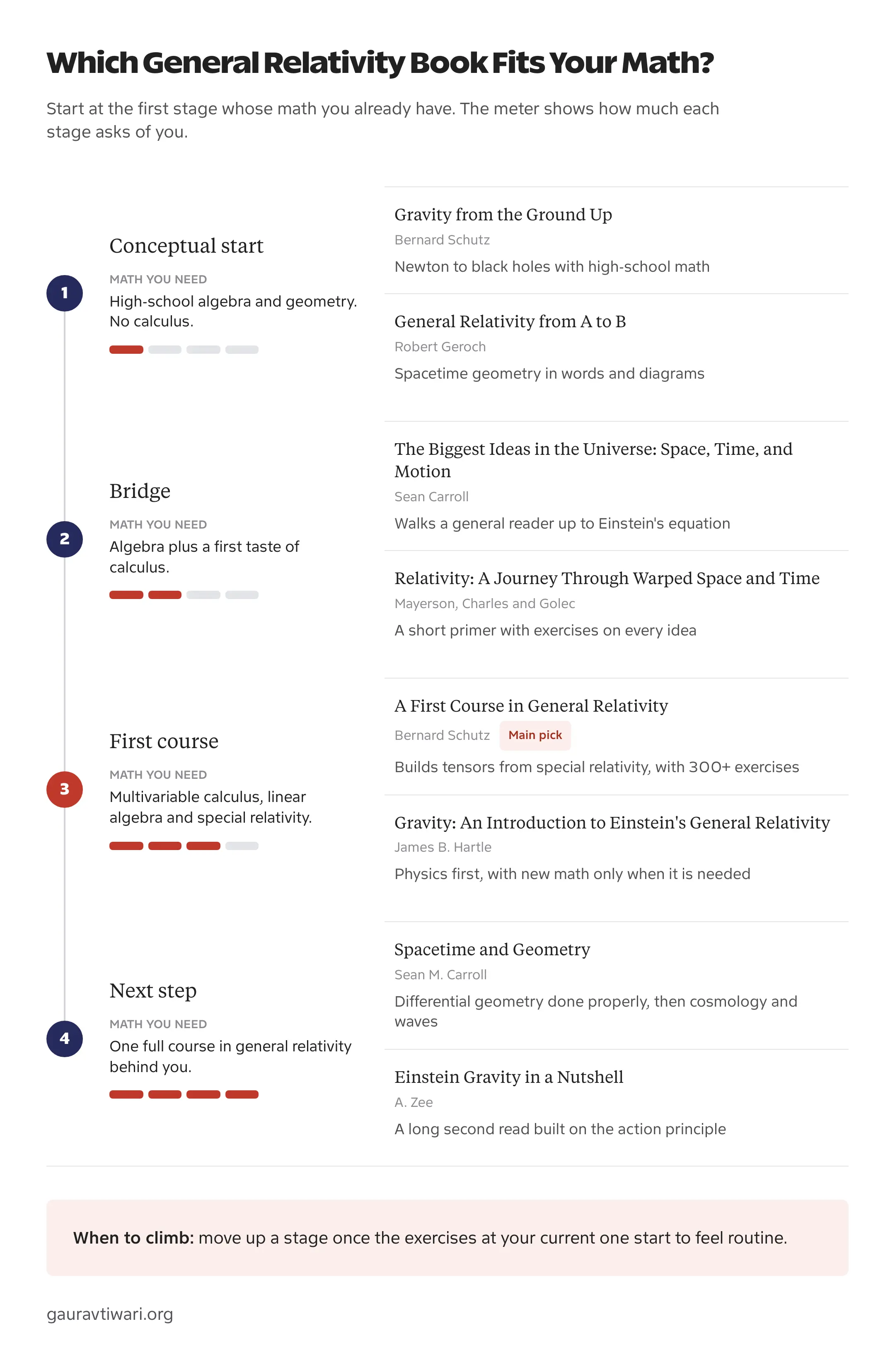
So the book should match your math first. For a conceptual start with only high-school math, I’d pick Gravity from the Ground Up by Bernard Schutz. If you already have calculus, linear algebra and special relativity, his A First Course in General Relativity is the textbook I’d start with, and Sean Carroll’s Spacetime and Geometry is the next step once that course is done.
I’ve gone through dozens of general relativity textbooks over the years. The 8 below are the ones I’d still hand to a beginner, grouped by the job each one does:
- Conceptual introductions: Gravity from the Ground Up and General Relativity from A to B, for the ideas before the machinery.
- Bridge books: The Biggest Ideas in the Universe and Relativity: A Journey Through Warped Space and Time, for a first look at the equations.
- First mathematical courses: A First Course in General Relativity and Hartle’s Gravity, for actually solving problems.
- The next step: Spacetime and Geometry and Einstein Gravity in a Nutshell, once one full course is behind you.
Which General Relativity Book Should You Buy?
Your background decides the starting point, and there are broadly three of them.
No calculus yet, or calculus that has gone rusty. Start with Gravity from the Ground Up. It builds gravity from Newton and Galileo up to black holes and gravitational waves using high-school mathematics, and it still asks you to reason through numbers. General Relativity from A to B is the shorter, almost equation-free companion if you want the geometry of spacetime in words first.
A physics or mathematics undergraduate with calculus, linear algebra and special relativity. A First Course in General Relativity is my pick. Schutz teaches tensors in the flat spacetime of special relativity before he curves anything, which is the gentlest route that still teaches the full mathematics of the field equations. Hartle’s Gravity suits you better if your course is taught physics first, with black holes and orbits before the full tensor calculus.
One general relativity course already done. Move to Spacetime and Geometry for proper differential geometry, cosmology and gravitational waves. Einstein Gravity in a Nutshell is the long second opinion, built around the action principle and symmetry.
One thing I’d recommend: don’t try to start with the most advanced book you can find. General relativity rewards patience. A conceptual book read before a textbook costs you a few weeks, while a graduate text opened too early usually ends with the book back on the shelf.
General Relativity Books Compared
These 8 sit on one ladder, from no calculus at all to graduate-level geometry. The last column matters more than it looks, because several of these titles sell in more than one edition or format and the cheapest listing is not always the book you want.
| Book | Level | Math You Need | Exercises | What to Check Before Buying |
|---|---|---|---|---|
| Gravity from the Ground Up (Schutz) | Conceptual | High-school algebra | Yes | Print is costly in India; the Kindle edition is far cheaper |
| General Relativity from A to B (Geroch) | Conceptual | Almost none | No | Buy the Chicago paperback; old hardcover listings are collector prices |
| The Biggest Ideas in the Universe (Carroll) | Bridge | Some calculus helps | No | Volume 1 (Space, Time, and Motion) is the relativity volume |
| Relativity: A Journey Through Warped Space and Time | Bridge | High-school math | Yes | Only 170 pages; the Kindle edition costs much less than print |
| A First Course in General Relativity (Schutz) | First course | Calculus, linear algebra, special relativity | 300+ | 3rd edition (2022); match any solutions manual to it |
| Gravity: An Introduction to Einstein’s General Relativity (Hartle) | First course | Calculus, introductory mechanics | Yes | Cambridge reissue (2021) of the 2003 text |
| Spacetime and Geometry (Carroll) | Next step | A first GR course, comfort with abstraction | Yes | Cambridge edition; often out of stock on Amazon India |
| Einstein Gravity in a Nutshell (Zee) | Next step | Classical mechanics, electromagnetism | Yes, some solved | 888 pages; better as a second book |
Conceptual General Relativity Books
These two books answer the question most beginners actually arrive with: what does it mean for gravity to be the shape of spacetime? Neither will teach you to solve the field equations. Both will make a textbook far less mysterious when you open one later.
Gravity from the Ground Up
Gravity from the Ground Up is the book I’d give someone who wants real general relativity without calculus. Bernard Schutz, who also wrote the first-course textbook further down, traces gravity from Newton and Galileo to Einstein and then on to black holes, gravitational waves and cosmology, using only high-school mathematics.
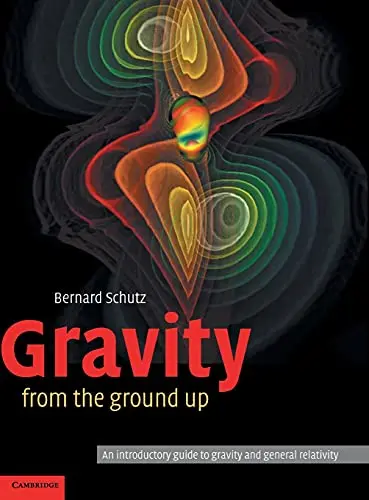
Gravity from the Ground Up: An Introductory Guide to Gravity and General Relativity
- Uses high-school mathematics only
- Newton and Galileo through to black holes and gravitational waves
- Optional computer programs for hands-on exploration
- Written by the author of A First Course in General Relativity
Schutz explains the physics instead of only describing it, and he doesn’t hand-wave through the hard parts. You come away able to reason about why things happen, which is the habit a first textbook expects later.
Why it fits:
- Real explanations with no calculus barrier.
- Covers far more astronomy than most introductions.
- Schutz’s own textbook is the natural next book.
Watch out for:
- It won’t prepare you for tensor calculations, so a first course still comes next.
- The print edition is expensive in India; the Kindle edition costs far less.
General Relativity from A to B
General Relativity from A to B is Robert Geroch’s short book on what space, time and geometry mean in Einstein’s theory, and it uses almost no equations. The University of Chicago Press describes it as suitable for anyone who has had an introductory physics course, and even for some who haven’t.
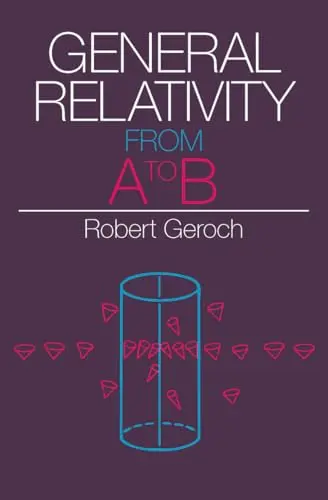
General Relativity from A to B
- 233 pages with 98 line drawings
- Part A builds the spacetime viewpoint from Aristotle and Galileo
- Part B covers the interval, Einstein's equation and black holes
- Inexpensive Chicago paperback
The first half works through the Aristotelian and Galilean pictures of space and time, so the second half can show what Einstein changed: elapsed time becomes a geometric length, measured along a path through spacetime. If that sentence sounds odd today, it is exactly the idea Geroch makes feel ordinary.
Why it fits:
- The clearest account of spacetime as geometry before any tensors.
- Cheap and short enough to finish in a few sittings.
Watch out for:
- No exercises, so it builds understanding without problem-solving skill.
- Written in 1978, before gravitational waves were detected.
Bridge Books
A bridge book shows you the equations without making you derive them. It suits a reader who has finished a conceptual book, or a student who wants to see what the notation looks like before a course starts.
The Biggest Ideas in the Universe: Space, Time, and Motion
The Biggest Ideas in the Universe: Space, Time, and Motion is Sean Carroll’s book for general readers who are willing to look at the equations. It moves from conservation laws and dynamics through spacetime and geometry to gravity and black holes, and it walks you up to the equation Einstein used to describe general relativity.
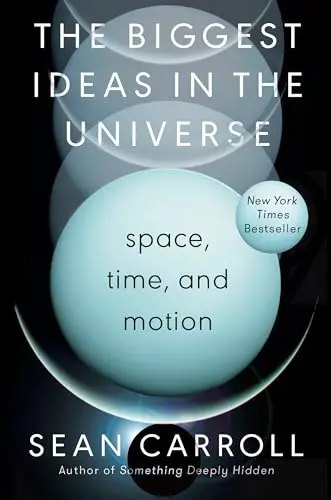
The Biggest Ideas in the Universe: Space, Time, and Motion
- Written for general readers willing to work with equations
- Builds from classical mechanics to spacetime, gravity and black holes
- Builds up to the meaning of Einstein's equation
- By the author of Spacetime and Geometry
It is the first volume of a series, and the one that covers relativity. Publishers Weekly counted more than 120 equations in it, and some readers find the calculus passages dense. I see that as the point of a bridge book: you meet the notation with a guide before a textbook makes you use it.
Why it fits:
- Walks you through what Einstein’s equation actually says.
- Inexpensive in both the US and India.
Watch out for:
- No exercises, so you watch the math more than you practice it.
- Readers with no calculus at all may find the middle chapters heavy.
Relativity: A Journey Through Warped Space and Time
Relativity: A Journey Through Warped Space and Time is a 170-page primer by Daniel Mayerson, Anthony Charles and Joseph Golec. Springer pitches it at the absolute beginner, either as a high-school introduction or as a compass for undergraduates taking their first steps toward Einstein’s theories.
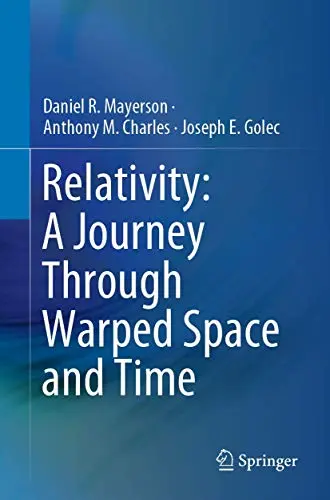
Relativity: A Journey Through Warped Space and Time
- 4 chapters: math and mechanics basics, special relativity, general relativity
- Exercises throughout, with color illustrations
- Covers Minkowski spacetime, geodesics, parallel transport and Einstein's equations
- Ends with black holes, wormholes, cosmology and gravitational waves
Its value is the vocabulary. By the end you have met the metric (the rule for measuring distances and times in spacetime), geodesics (the straightest possible paths through it), curvature and parallel transport, each with small exercises attached. The same words in Schutz or Hartle are no longer strangers after that.
Why it fits:
- Short enough to finish before a semester starts.
- Exercises throughout the book.
Watch out for:
- Expensive in print for its length.
- A primer, so it touches each topic once and moves on.
First Mathematical Courses
This is where you start computing. Both books expect calculus and comfort with special relativity, and both are used as course textbooks. The difference is the order in which they teach.
A First Course in General Relativity
A First Course in General Relativity is the textbook I’d start a mathematical course with. Cambridge describes the third edition (2022) as the first step into general relativity for advanced undergraduates and graduate students, and it carries more than 300 exercises, many of them new to this edition.
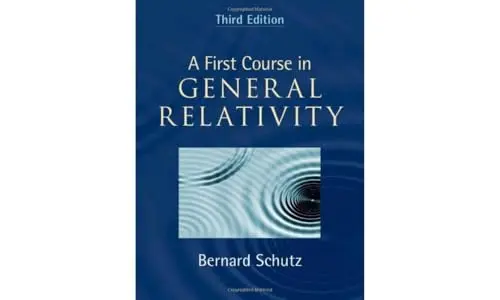
A First Course in General Relativity (3rd Edition)
- Third edition, Cambridge University Press, 2022
- More than 300 exercises, many new to this edition
- Teaches vectors, one-forms and tensors in special relativity first
- Adds the 2015 gravitational-wave detection, pulsars and the accelerating universe
Schutz’s order is the reason I like it for beginners. A tensor is a quantity that changes in a fixed, predictable way when you change coordinates, which is what lets a law of physics look the same to every observer. He teaches vectors, one-forms and tensors in the flat spacetime of special relativity, where you can still check your answers against things you already know, and only then introduces curvature. By the time the Einstein equation arrives, the notation is no longer the obstacle.
Why it fits:
- A gentle mathematical route with a very large problem set.
- Updated for gravitational-wave astronomy.
- A matching solutions manual exists for this edition.
Watch out for:
- Expensive in India in the third edition; the edition section below covers the cheaper second edition.
- Moves slowly if you already know tensors from a mathematics course.
Gravity: An Introduction to Einstein’s General Relativity
Gravity: An Introduction to Einstein’s General Relativity is James Hartle’s physics-first textbook, now reissued by Cambridge. It presents simple solutions of the Einstein equation first, such as the geometry outside a star or a black hole, and introduces new mathematics only when a physical application needs it.
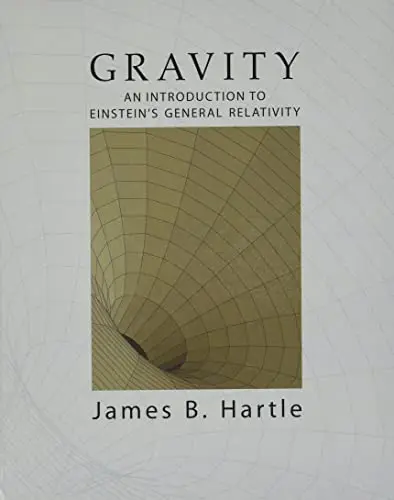
Gravity: An Introduction to Einstein's General Relativity
- Physics-first: orbits, black holes and light bending before the field equations
- Pitched from junior undergraduate to introductory graduate level
- Problems and illustrative boxes throughout
- Cambridge reissue (2021) of the 2003 text
If Schutz is the patient math teacher, Hartle is the one who says “let me show you what this does first.” That order suits a reader who loses patience with pages of index manipulation, because the chapters pay off with results you can measure, such as light bending or the precession of Mercury’s orbit.
Why it fits:
- Applications arrive early, which keeps motivation up.
- Needs only typical calculus to begin.
Watch out for:
- The full tensor machinery arrives late, so it may not match a math-first course.
- A large hardcover with no cheap edition currently listed in India.
Books for the Next Step
These two belong after one full course. Carroll’s preface places Spacetime and Geometry at the advanced-undergraduate or graduate level, and Zee’s book runs to 888 pages, so both reward a reader who already knows what a metric and a geodesic are.
Spacetime and Geometry
Spacetime and Geometry is Sean Carroll’s graduate-level introduction, and it is the book I’d move to after Schutz or Hartle. It treats manifolds and curvature properly, then uses them for black holes, perturbation theory and gravitational waves, cosmology and a first look at quantum fields in curved spacetime.
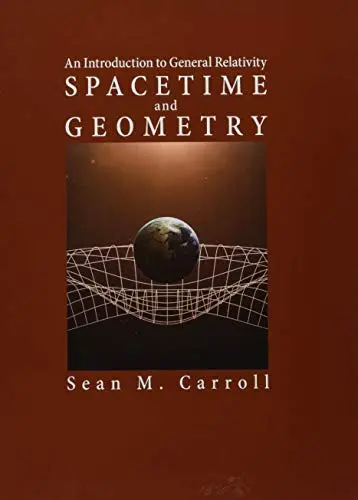
Spacetime and Geometry: An Introduction to General Relativity
- Advanced undergraduate and graduate level
- Full treatment of manifolds, curvature and the Einstein equation
- Chapters on gravitational waves, cosmology and quantum fields in curved spacetime
- Cambridge reissue of the 2004 text
Carroll writes the geometry the way a working physicist uses it, which is why so many graduate courses adopt it. With only elementary calculus behind you, though, the early chapters on manifolds and curvature are a steep first climb.
Why it fits:
- The standard bridge from a first course to research-level reading.
- Clear prose for a demanding subject.
Watch out for:
- Too fast as a first book.
- The Cambridge edition is often unavailable on Amazon India, so check other sellers before relying on it for a course.
Einstein Gravity in a Nutshell
Einstein Gravity in a Nutshell is A. Zee’s 888-page tour of gravity, written for undergraduates and graduate students who already know classical mechanics and electromagnetism. It builds the theory from the action principle and symmetry, and it goes much further than a first course: de Sitter and anti-de Sitter spacetimes, Kaluza-Klein theory, brane worlds and Hawking radiation.
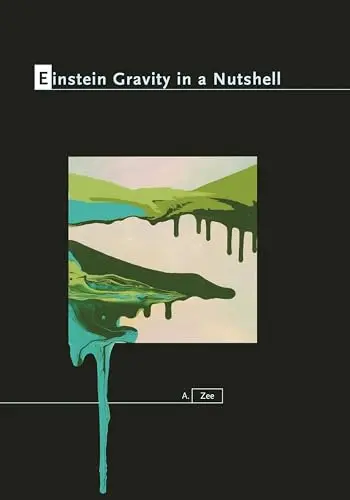
Einstein Gravity in a Nutshell
- 888 pages, Princeton University Press
- Built around the action principle and group theory
- Revisits topics in a spiral, a little deeper each time
- Solutions to selected exercises included
Zee teaches in a spiral, returning to each topic a little deeper every time. That is friendly on a second reading and tiring on a first, which is why I’d keep it as the second opinion next to Carroll.
Why it fits:
- Shows why the theory has the form it has.
- Enjoyable historical asides and a huge range of topics.
Watch out for:
- Its length makes it a poor first book.
- The spiral style can feel repetitive if you want a straight line through the material.
If black holes and cosmology pull you more than the mathematics does, my list of astrophysics books for beginners is the better shelf to browse next.
Textbook and Solutions Manual Editions
Robert B. Scott’s student manual is the companion to Schutz’s textbook. It solves the textbook’s exercises and adds supplementary problems of its own, so it is a study partner for the course book and cannot replace it. The catch is that there are two manuals for two editions:
- Schutz 2nd edition (2009) pairs with the original Scott manual from 2016, which solves more than 200 exercises and adds 125 supplementary problems.
- Schutz 3rd edition (2022) pairs with the new Scott manual, updated for the third edition, which solves more than 200 selected exercises and adds 168 supplementary problems.
The third edition added many new exercises, so the two manuals cover different problem sets and a mismatched manual can send you to the wrong problems. Amazon US still lists the new manual as a pre-order, while Amazon India already shows it in stock.
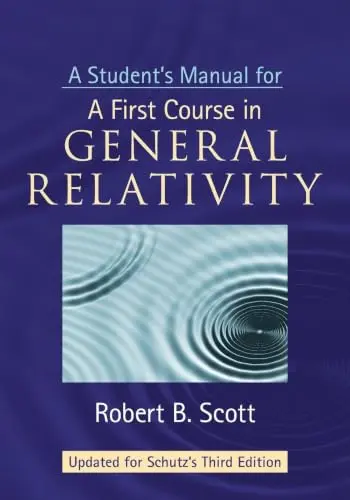
A Student's Manual for A First Course in General Relativity, Third Edition
- Updated for Schutz's third edition
- Detailed solutions to more than 200 selected exercises
- 168 supplementary problems on conceptual sticking points
- Solutions cross-referenced to the textbook's equations and sections
Budget matters here too. In India, the third-edition hardcover is sold print-on-demand and costs several times as much as the second-edition paperback when that is in stock. If your course doesn’t prescribe the third edition, the second edition with the original Scott manual teaches the same core course for much less. You lose the newer gravitational-wave and astronomy material, which a conceptual book or Carroll can fill in later.
Math You Need
The conceptual and bridge books need nothing beyond school mathematics. A first course is different, and most of the trouble beginners have with Schutz or Hartle comes from a gap in one of these:
- Single and multivariable calculus: partial derivatives, the chain rule and line integrals. My list of calculus books covers this ground.
- Linear algebra: matrices, changes of basis and eigenvalues. Index notation is just linear algebra written out component by component, and my linear algebra books list has the right refreshers.
- Special relativity: Lorentz transformations, four-vectors and spacetime diagrams. My special relativity study notes are a quick check of where you stand.
- Newtonian gravity and some classical mechanics: the gravitational potential, orbits and a first look at the Lagrangian.
You don’t need a separate tensor course before Schutz, because he teaches tensors from scratch. If you’d still like a bridge, A Primer in Tensor Analysis and Relativity by Ilya Shapiro covers tensor algebra, tensor analysis, special relativity and general relativity in one undergraduate volume, with plenty of exercises.
A Reading and Exercise Plan
Here is the sequence I’d follow as a self-learner with calculus. It is a plan to adapt, with no deadline attached, because how fast it goes depends on how many exercises you actually do:
- Read Gravity from the Ground Up or General Relativity from A to B for the picture.
- Work through Schutz’s chapters on special relativity and tensors with every exercise you can manage.
- Move to curvature and the Einstein equation, using the matching Scott manual only after an honest attempt.
- Do one worked problem that connects the math to a measurement, like the GPS example below.
- Then open Carroll for the geometry done properly.
The GPS problem is my favorite first calculation, because it shows the theory changing something you use every day. A GPS satellite orbits at a radius of about 26,560 km, where gravity is weaker than on the ground, and it moves at about 3.87 km/s. Both effects change how fast its clock runs compared with a clock on Earth:
- Gravity: the fractional rate difference is about (GM/c²)(1/R − 1/r). With GM/c² ≈ 4.4 mm for Earth, R = 6,371 km and r = 26,560 km, that is about 5.3 × 10⁻¹⁰, or about 45.7 microseconds a day fast.
- Speed: special relativity slows a moving clock by about v²/2c², which is about 8.3 × 10⁻¹¹, or about 7.2 microseconds a day slow.
- Net: the satellite clock gains about 38 microseconds a day. Light travels more than 11 km in that time, so uncorrected positions would drift by kilometers within a day.
A conceptual book tells you that clocks run faster higher up. A first course has you derive that rate from the weak-field metric, which is the same arithmetic as above with one more line of justification. When the field equations themselves start to feel like symbols on a page, my notes on the Einstein field equations unpack each term.
FAQs on General Relativity Books
What is the best general relativity book for beginners?
It depends on your math. With no calculus, Gravity from the Ground Up by Bernard Schutz is the best start because it uses high-school mathematics. With calculus, linear algebra and special relativity, A First Course in General Relativity by the same author is the best first textbook, with Hartle’s Gravity as the physics-first alternative.
Can you learn general relativity without advanced math?
You can understand the core ideas without advanced math. Gravity from the Ground Up and General Relativity from A to B explain curved spacetime with school mathematics. To calculate anything, such as orbits, light bending or clock rates, you need multivariable calculus, linear algebra, special relativity and eventually tensors.
What is the difference between special and general relativity?
Special relativity describes physics in flat spacetime, including accelerated motion, when gravity can be ignored. General relativity describes gravity itself as the curvature of spacetime caused by mass and energy. Special relativity is the local, small-region limit of general relativity.
Is a solutions manual enough to learn general relativity?
No. A solutions manual is built around another book’s exercises and equation numbers. Use it with the matching textbook and only after you have attempted a problem yourself.
Should I buy the newest edition of Schutz?
Buy the edition your course uses. If you study alone, the third edition adds gravitational-wave astronomy and new exercises, while the cheaper second edition still teaches the same core course. Match any Scott solutions manual to the textbook edition you own.
Can I start with Carroll if I only know elementary calculus?
It isn’t a good idea. Carroll’s preface places Spacetime and Geometry at the advanced-undergraduate or graduate level. Start with Schutz or Hartle and come to Carroll after one full course.
Is print or ebook better for a general relativity textbook?
Print is easier for a textbook you will work through with paper beside it, flipping between equations and exercises. An ebook makes sense for conceptual and bridge books or when print is expensive in your country. Check that equations render clearly on your device before buying.
Final Remarks
Buy one main book for your current level and give it a real try before adding a second. For most students with calculus, that book is A First Course in General Relativity with the matching Scott manual. If the first chapter of tensors feels like a wall, spend a few weeks with Gravity from the Ground Up and then try again. The math is far easier to carry once the picture is already in your head.
Tell Google you want more of this.
Add Gaurav Tiwari as a preferred sourceOne tap, and this site shows up more often in your own Top Stories, AI Overviews and AI Mode. Remove it any time.
Disclaimer: This site is reader-supported. If you buy through some links, I may earn a small commission at no extra cost to you. I only recommend tools I trust and would use myself. Your support helps keep gauravtiwari.org free and focused on real-world advice. Thanks. - Gaurav Tiwari