
 by
by
If you’ve been looking for free Halloween reading comprehension worksheets, the challenge isn’t a lack of options. The problem is that many worksheets stop at a short story and offer only a few questions. Even when they include an answer key, the answers are often too brief, describing how a character felt without explaining why.
That is fine for a recall question, but on an inference question 25 students write 25 different answers and you have to decide which ones count.
My Halloween Reading Comprehension Worksheets pack is built for the marking. It has 6 original Halloween and fall reading passages for grades 1 to 6, 46 questions labeled by skill and an answer key that gives the paragraph number, the exact words that prove each answer and what else to accept.
Every PDF comes in US Letter and A4, the student pages come as a separate low-ink file and nothing asks for an email address.
Each grade band is also a Canva template, so you can put your students’ names into the stories or change a question before you print.
Choose a Reading Level
Pick the level your students can read on their own without stopping at every second word, even when that level sits below their grade. Once decoding takes all their attention, the questions measure reading speed instead of understanding, and the inference questions turn into guessing. The Halloween reading comprehension worksheets come in three bands with two passages each.
| Passage | Level | Words | Skills beyond recall and sequence |
|---|---|---|---|
| The Pumpkin on the Step | Grades 1-2 | 140 | Cause and effect, Inference, Vocabulary |
| The Missing Pumpkin Cookies | Grades 1-2 | 140 | Cause and effect, Inference, Vocabulary |
| The Scarecrow Who Kept Moving | Grades 3-4 | 300 | Cause and effect, Character, Inference, Vocabulary |
| The Corn Maze Map | Grades 3-4 | 270 | Cause and effect, Character, Inference, Vocabulary |
| Bring a Sheet | Grades 5-6 | 390 | Cause and effect, Figurative language, Inference, Theme, Vocabulary |
| How a Pumpkin Grows (article) | Grades 5-6 | 420 | Cause and effect, Compare, Inference, Main idea, Text features, Vocabulary |
The level labels are editorial guidance, and I set them by passage length, sentence length, vocabulary and how much reading between the lines the questions ask for. The grades 1-2 stories run about 6 words a sentence with everyday words. The grades 5-6 article runs about 15 words a sentence and uses words like pollinate and rind, which the passage explains in place.
For a mixed class, these swaps keep the skill the same and change only the reading load:
- A grades 3-4 reader who struggles can take a grades 1-2 passage. The questions still ask for inference and cause and effect, only with shorter sentences.
- A strong reader can move up a band. The grades 5-6 questions ask for more than one piece of evidence, which stretches a confident fourth grader.
- Kindergarten and early first grade can hear a grades 1-2 story read aloud and answer the questions out loud. The draw-it box on the last sheet works without any writing.
Halloween Reading Passages
These Halloween reading passages with questions were written for this pack, so you won’t find them on another worksheet site. They keep the Halloween mood and leave out the fright. The ghosts are sixth graders in bedsheets, the culprit in the mystery is a dog and two passages skip Halloween altogether for classes that don’t celebrate it.
Grades 1-2
Both stories run about 140 words in short sentences, printed large with a paragraph number beside each paragraph so children can point to where they found an answer.
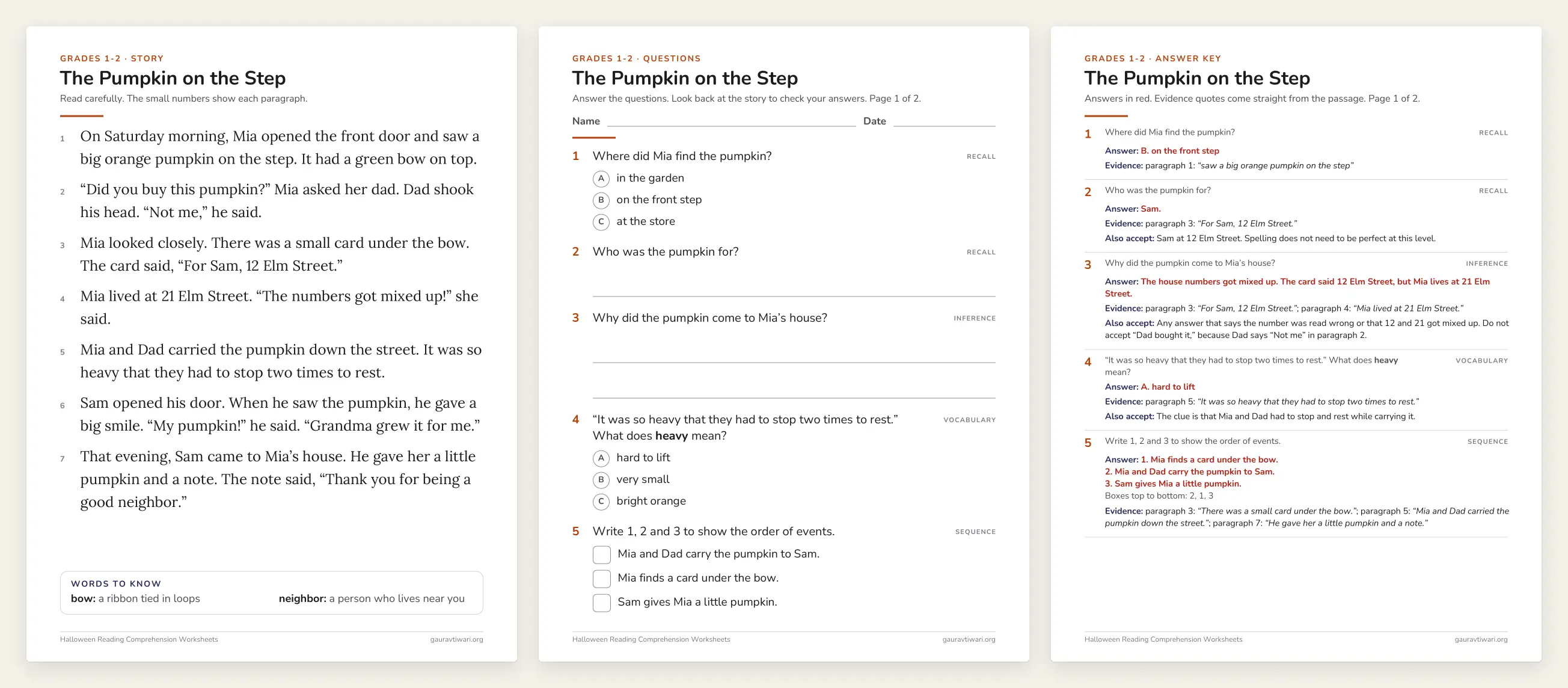
- The Pumpkin on the Step: a pumpkin lands at Mia’s house by mistake. The card says 12 Elm Street, and Mia lives at 21. The inference question asks children to spot the swapped numbers on their own.
- The Missing Pumpkin Cookies: three cookies vanish and Nina finds orange crumbs and muddy paw prints. The clues lead to Pepper the dog, and the story notes that cookies are not good for dogs.
Each story has 7 questions, mostly multiple choice, short answers and number-the-events boxes, plus a draw-it box. The grades 1-2 worksheets come as a Canva template and as PDFs in both paper sizes:
Grades 3-4
The grades 3-4 passages run between about 270 and 310 words, and both turn on a clue the reader has to notice before a character says it out loud.
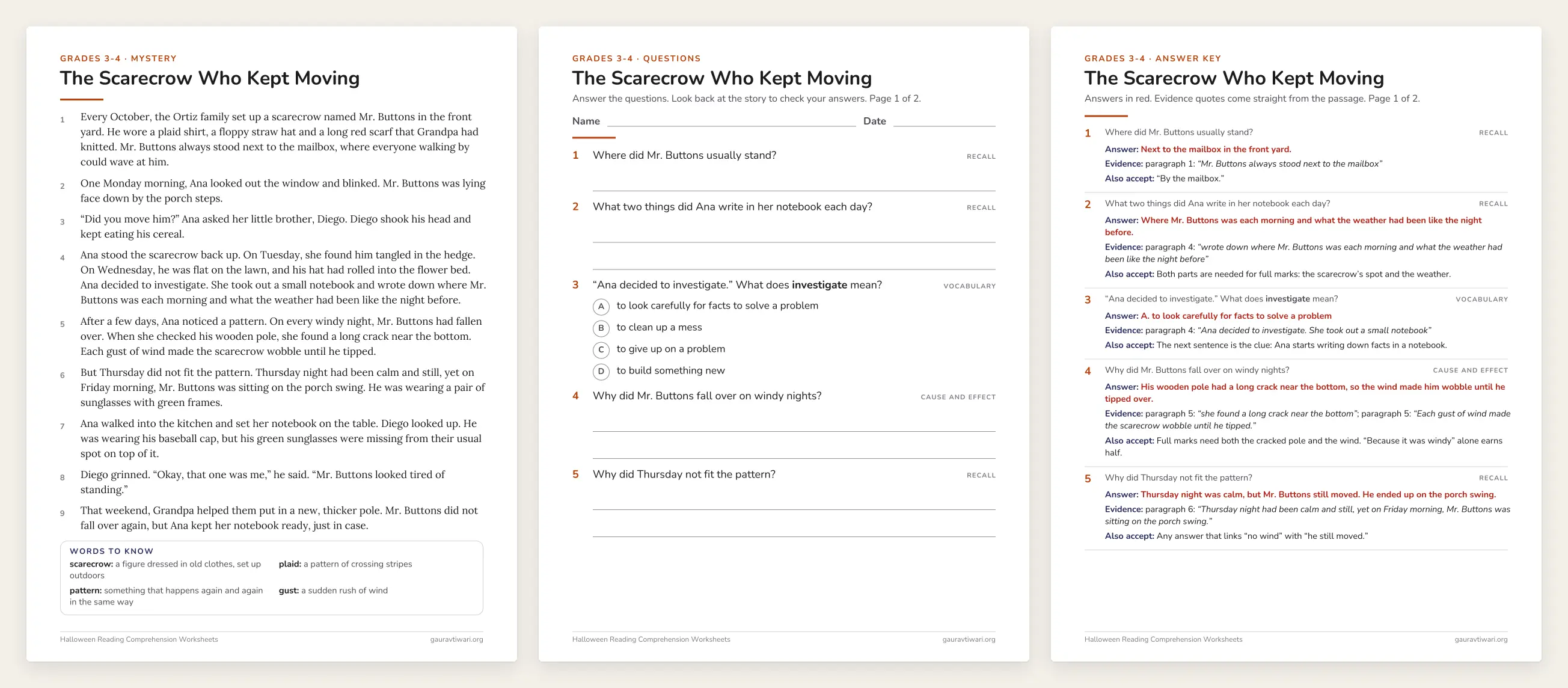
- The Scarecrow Who Kept Moving: Ana keeps notes on where the family scarecrow ends up each morning and finds a pattern with the wind. Then one calm night breaks the pattern, and a pair of green sunglasses gives the answer away.
- The Corn Maze Map: a class trip to a corn maze goes wrong when June has been holding the map upside down. She fixes it by using the sunset behind the barn. This one has no Halloween in it at all.
Each has 8 questions, including a vocabulary-in-context question, a character question and a Your Turn writing box. The grades 3-4 worksheets come as a Canva template and as PDFs in both paper sizes:
Grades 5-6
The grades 5-6 pair puts a story next to an informational article, so students practice both kinds of reading in one week.
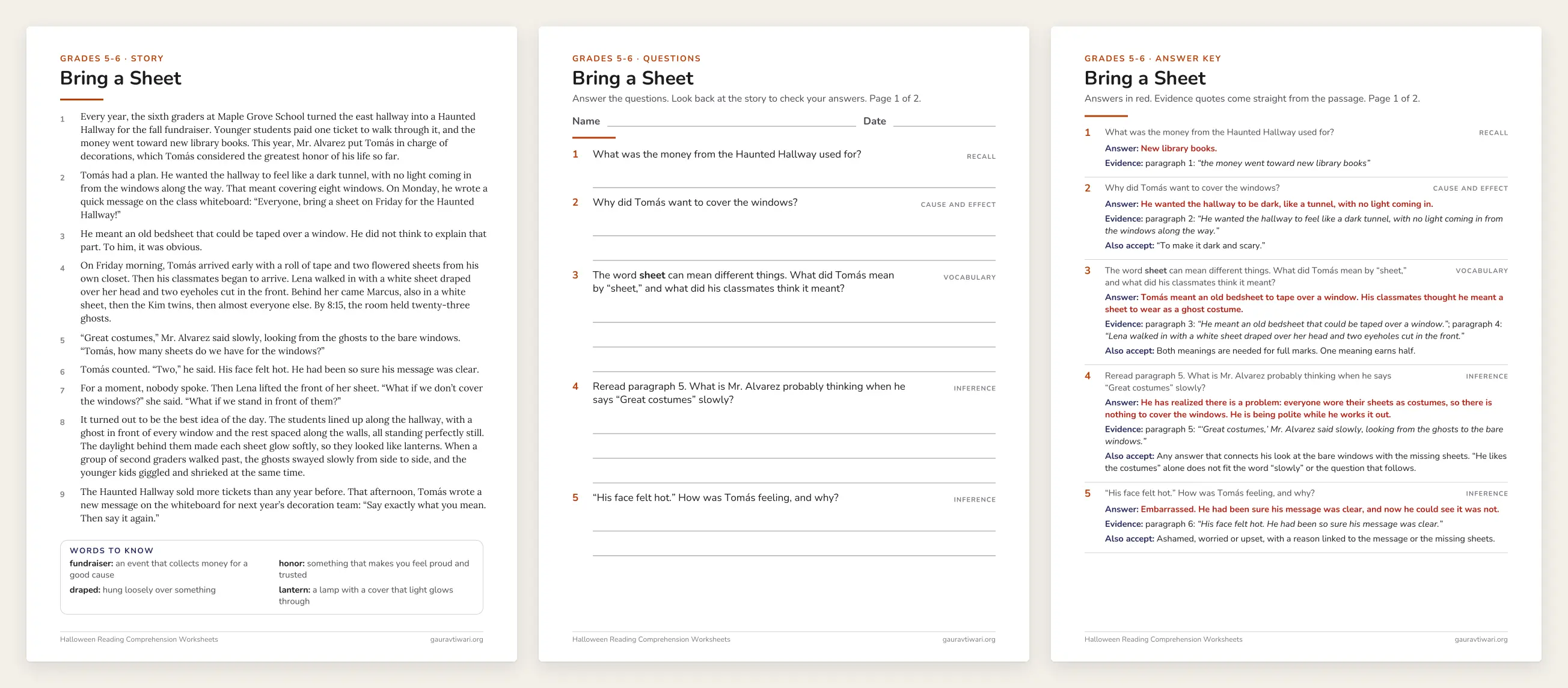
- Bring a Sheet: Tomás asks his class to “bring a sheet” to cover the windows of the Haunted Hallway, and 23 classmates arrive dressed as ghosts. The questions cover a word with two meanings, what a teacher means when he says “Great costumes” slowly, a simile and the lesson Tomás writes on the whiteboard.
- How a Pumpkin Grows: an article in 4 headed sections, from seed to harvest, covering seed leaves, male and female flowers, pollination by bees and why you shouldn’t carry a pumpkin by its stem. It suits science-minded readers and classes that skip Halloween.
Each passage has 8 questions. For How a Pumpkin Grows, the Words to Know box sits at the top of the first question sheet, so the whole first page is left for the reading. The grades 5-6 worksheets come as a Canva template and as PDFs in both paper sizes:
Comprehension Questions
Every question carries a small label, so you can see at a glance which skill it practices and pick the ones that match your lesson:
- Recall: the answer is stated in the passage.
- Inference: the answer comes from putting two or more clues together.
- Vocabulary: working out a word from the sentence around it.
- Cause and effect: why something happened, or what happened because of it.
- Sequence: numbering 3 to 5 events in the order they happened.
- Character, theme and figurative language: what a character is like, what the story teaches and what a comparison helps you picture.
- Main idea, text features and compare: the informational passage only.
Recall versus inference is the distinction I’d teach first, and the scarecrow mystery shows it with two questions next to each other. Question 5 asks why Thursday did not fit the pattern. Paragraph 6 says it plainly, the night was calm and the scarecrow still moved, so this one is recall.
Question 6 asks which clue in paragraphs 6 and 7 shows that Diego moved the scarecrow. No sentence says so until Diego admits it in paragraph 8. The reader has to connect the green sunglasses on the scarecrow with the green sunglasses missing from Diego’s cap, and joining two facts the author kept apart is exactly what an inference question asks for.
I’d do that pair together on the board before handing out any sheet. Once children see that one answer is printed in the text and the other has to be built from it, the rest of the inference questions get much easier to explain.
Answer Keys
Each answer key lists 4 things for every question:
- the answer, in red
- the paragraph number where the evidence sits
- the exact words from the passage that prove it
- what else to accept, and sometimes what not to accept and why
Plenty of Halloween worksheets with answers give a single word per question. The “also accept” line is what makes these keys usable on inference questions. In Bring a Sheet, question 4 asks what Mr. Alvarez is thinking when he says “Great costumes” slowly. The key accepts any answer that links his look at the bare windows with the missing sheets, and it explains why “he likes the costumes” alone does not fit the word slowly. In The Pumpkin on the Step, the key rejects “Dad bought it” because Dad says “Not me” in paragraph 2.
The marking rule across the pack is simple, and I’d share it with older students before they start:
- Full marks when the answer fits the passage and points to a clue from it.
- Half marks for a correct idea with no clue, or for one part of a two-part answer.
- For grades 1-2, spelling doesn’t cost marks. The point is whether the child understood the story.
- The draw-it and Your Turn boxes are extensions for early finishers and are not marked. The key gives marking guidance for the Your Turn writing tasks.
Use the Worksheets in Class
Each passage and its questions are sized for a single lesson. There are three ways to run it:
- Independent: students read the passage twice, then answer. The second read is where the inference clues show up.
- Paired reading: partners take turns reading paragraphs aloud, then answer on their own sheets and compare the evidence they found.
- Supported reading: read the passage aloud while students follow along, go over the Words to Know box first and let them answer out loud before writing.
Two passages, The Corn Maze Map and How a Pumpkin Grows, have no ghosts, costumes or Halloween at all. They work for a family or a school that skips the holiday, and the questions practice the same skills as the Halloween stories.
If you want a full Halloween lesson block, the Halloween math worksheets follow the same grade bands with their own answer keys, and the pumpkin passage leads straight into a hands-on session from these Halloween science experiments. For read-aloud time after the worksheets, my list of Halloween books for kids is sorted by age, from board books for toddlers to middle-grade novels like Coraline.
Edit the Worksheets in Canva
Each grade band is also a Canva template with the same pages as its PDF: the cover, both passages, the question sheets and the answer keys. Every passage, question and name is its own text box, so you can change Mia to a student in your class or swap a question for one that fits your lesson.
Canva is a free online design tool that runs in the browser and in its phone apps, and a free account is enough for these templates.
Here is how to make your own copy:
- Click “Edit in Canva” under the grade band you want, then sign in or create a free Canva account.
- Click “Use template”. Canva makes a copy for you, so the original stays the same for the next teacher.
- Click any passage, question or name and type over it.
- Download your copy as “PDF Print” and print it at 100%.
If you change a passage, check its answer key at the back of the same design. The keys quote the exact words from each paragraph, so an edited sentence can leave a key pointing at words that are no longer there. A new name is safe as long as you change it everywhere it appears, including the key.
The type is set for each age group, with the passages in Lora and the questions in Nunito. Both are free Canva fonts, so your copy prints the way the PDF does:
- Grades 1-2: passages at 18 point, answer lines about 0.6 inch apart
- Grades 3-4: passages at about 13 point, answer lines about 0.45 inch apart
- Grades 5-6: passages at just under 12 point, answer lines about 0.4 inch apart
You don’t need a Canva account to print anything here. The PDFs below carry exactly the pages the templates show.
Print and Download
Every Halloween reading comprehension PDF here is print-ready, with selectable text. Pick the file for the paper you print on. The A4 files carry the same pages fitted to A4, so your printer has nothing to crop or shrink.
- Complete pack, 33 pages: US Letter or A4. Cover, teacher guide, all student pages and all answer keys.
- Student pages only, 21 pages: US Letter or A4. A plain white cover and no keys, so it prints light on ink.
- Grades 1-2, 12 pages: US Letter or A4.
- Grades 3-4, 12 pages: US Letter or A4.
- Grades 5-6, 13 pages: US Letter or A4.
A few printing notes:
- Print at 100% or “actual size.” Every page works in black and white.
- In the complete pack, the answer keys start on page 22, so you can print pages 1 to 21 for students and keep 22 to 33 on your desk. The cover lists the exact page range for each passage and its key.
- Each passage sits on its own page with its questions on the next 2 pages, or 3 for How a Pumpkin Grows. Print double-sided only if students won’t need to flip back and forth while answering.
FAQs on Halloween Reading Worksheets
Yes. These free Halloween reading worksheets, including every passage, question sheet and answer key, download and print with no email address or account. The Canva templates are free too, and they need a free Canva account.
Yes. Each grade band has a Canva template where every passage, question and name is editable text. If you change a passage, update its answer key as well, because the keys quote the passage word for word.
Yes. All 6 passages were written for this pack. None of them is adapted from a book or another worksheet.
Yes. Print and copy them for your own class, homeschool group or family, and share them with colleagues. Please link to this page instead of reposting or selling the files.
The questions practice skills that most reading standards cover, such as key details, inference, vocabulary in context, sequence and text features. The pack is not mapped to specific standard codes, so check it against your own curriculum if you need formal alignment.
Yes. Upload the PDF as an assignment and students can write on it in any PDF app that supports annotation. The text in the PDF is selectable, so students can highlight words and copy evidence straight from the passage.
Start with the student pages for your class level, keep the key on your desk and do the recall-versus-inference pair from the scarecrow story together first.
Tell Google you want more of this.
Add Gaurav Tiwari as a preferred sourceOne tap, and this site shows up more often in your own Top Stories, AI Overviews and AI Mode. Remove it any time.
Disclaimer: This site is reader-supported. If you buy through some links, I may earn a small commission at no extra cost to you. I only recommend tools I trust and would use myself. Your support helps keep gauravtiwari.org free and focused on real-world advice. Thanks. - Gaurav Tiwari