
 by
byHalloween slime is the craft kids ask for every October, and it’s also the one where recipes disagree the most. One popular page uses four times the baking soda the glue maker recommends, some measure contact solution in teaspoons when the glue maker uses tablespoons, and one recipe that shows up in Google’s recipe results calls boric-acid slime “toddler safe”.
These 10 Halloween slime recipes use the glue maker’s own ratio for every glue slime, tell you which age each one suits and who should handle the activator, and include three taste-safe slimes made from food for little kids who put everything in their mouths. The free recipe cards print all 10 with the exact amounts.
Which Halloween Slime Is Safe for Which Age
Slime recipes fall into three groups, and the group matters more than the color. The one thing most recipe pages get wrong is that borax-free doesn’t mean boron-free. Contact lens solution works as an activator because it contains boric acid and sodium borate, which is the same boron chemistry as borax in a weaker form.
| Type | What’s in it | Who it suits | Who adds the activator |
|---|---|---|---|
| Taste-safe | Food only: psyllium, chia seeds, cornstarch | Toddlers and anyone who puts things in their mouth | No activator. An adult does any cooking. |
| Contact solution | Glue, baking soda and contact lens solution with boric acid | Ages 3 and up, with an adult | An adult, or an older child with an adult watching |
| Borax | Glue and a borax-and-water activator | Older kids. Not for pregnant women. | An adult only |
The age line for the middle row comes from Elmer’s, which says its slime recipes need adult supervision and aren’t meant for children under 3. The Missouri Poison Center goes further: children who might put slime in their mouths should only play with edible slime made from food. So I’d keep the taste-safe recipes for toddlers, let kids from about 6 mix the contact solution slimes while an adult adds the solution, and save borax for older kids with an adult making the activator.
What You Need for Halloween Slime
Most of the ingredients are already in the kitchen or the school supply drawer. These are the specific products that match the recipes below:
- Elmer’s Liquid School Glue in white comes in a 32 oz bottle, which is enough for about 6 batches of the base recipe. White glue gives the brightest colors.
- Elmer’s Clear School Glue, also 32 oz, is the one to use for the monster eyeball slime.
- Elmer’s Glow in the Dark Glue comes as 10 oz in total, enough for 2 ghost slimes.
- The Elmer’s Glitter Glue 6-pack includes the purple and green you need for the witch’s brew.
- Bausch + Lomb Sensitive Eyes Saline Solution lists boric acid and sodium borate in its ingredients, so it works as the activator.
- Arm & Hammer Baking Soda is the other half of the activator, and a fresh box helps.
- 20 Mule Team Borax is only needed for the borax slime, and the box stays with the adult.
- NOW Psyllium Husk Powder is plain psyllium rather than a flavored fiber drink, which is what the vampire blood recipe needs.
- Anthony’s Organic Chia Seeds make the swamp monster slime.
- Wiggle googly eyes go into the monster eyeball slime. Leave the sticky backing on, so they don’t glue themselves to the slime.
- BISON LIFE kids safety glasses are rated ANSI Z87.1 and come in a 6-pack, enough for a borax slime session with friends.
Cornstarch, food coloring and measuring spoons come from the kitchen. For the fluffy pumpkin slime, pick an unscented foaming shaving cream rather than a shave gel.
Making slime with a class or a party? The free Halloween slime party planner multiplies these amounts for 6, 12 or 24 kids, and adds a setup plan, a station rules sign and a note for parents.
The Base Recipe: Contact Solution Slime
Six of the Halloween slimes below start from this recipe. It’s Elmer’s own slime recipe, and the same ratio appears on its color, glow and glitter glue recipes, with glitter glue taking a little more solution. It’s also the easiest way to make slime without borax.
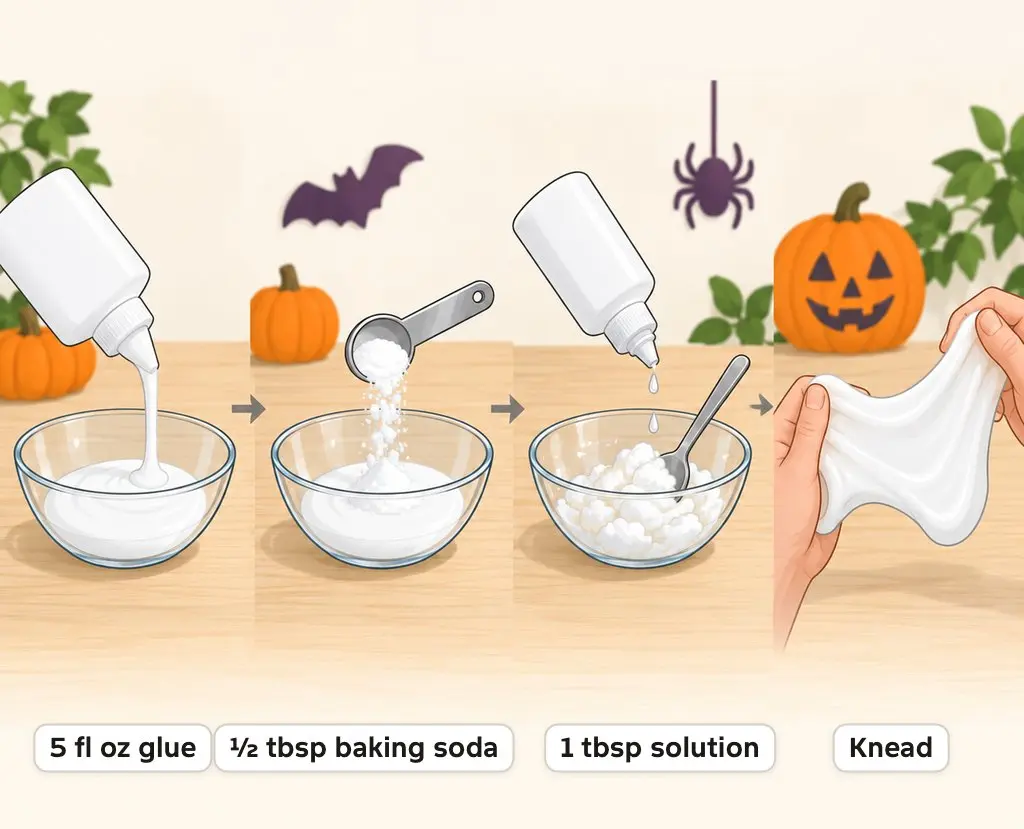
You need:
- 5 fl oz white or clear school glue
- 1/2 tablespoon baking soda
- 1 tablespoon contact lens solution that lists boric acid and sodium borate
- Pour the glue into a bowl.
- Add 1/2 tablespoon baking soda and mix well.
- Add 1 tablespoon contact lens solution and stir until it gets hard to mix.
- Knead it with both hands.
- Still sticky? Add 1/4 tablespoon more solution and knead again. Repeat until it stops sticking.
Three details decide whether it works:
- The label: the contact solution must list boric acid or sodium borate. Elmer’s says only solutions with borate or boric acid make slime, so a saline spray without them just makes runny glue.
- Tablespoons, not teaspoons: the recipe uses 1 tablespoon of solution for 5 fl oz of glue. A tablespoon is 3 teaspoons, so a recipe that uses 1 1/2 teaspoons is using half as much.
- Fresh baking soda: old baking soda is one of the first things Elmer’s tells you to check when slime won’t come together.
Liquid starch is the other common activator. The San Diego Public Library’s recipe uses 1/2 cup glue, 1/2 cup water and a few drops of food coloring, then 1/4 cup liquid starch, adding up to 1/2 cup if it stays watery. Check the starch label before you treat it as the gentle option, because some liquid starches list borax (sodium tetraborate) in their ingredients.
Halloween Slime Recipes
These six all use contact solution as the activator, so they’re borax-free but still contain boron. Make the base recipe once before you try the variations, and the rest is mostly color and add-ins.
Pumpkin Guts Slime
Borax-free, contains boron. 3+ with an adult. About 15 min.
Real pumpkin pulp and seeds folded into orange slime, ideally mixed right inside the carved pumpkin.
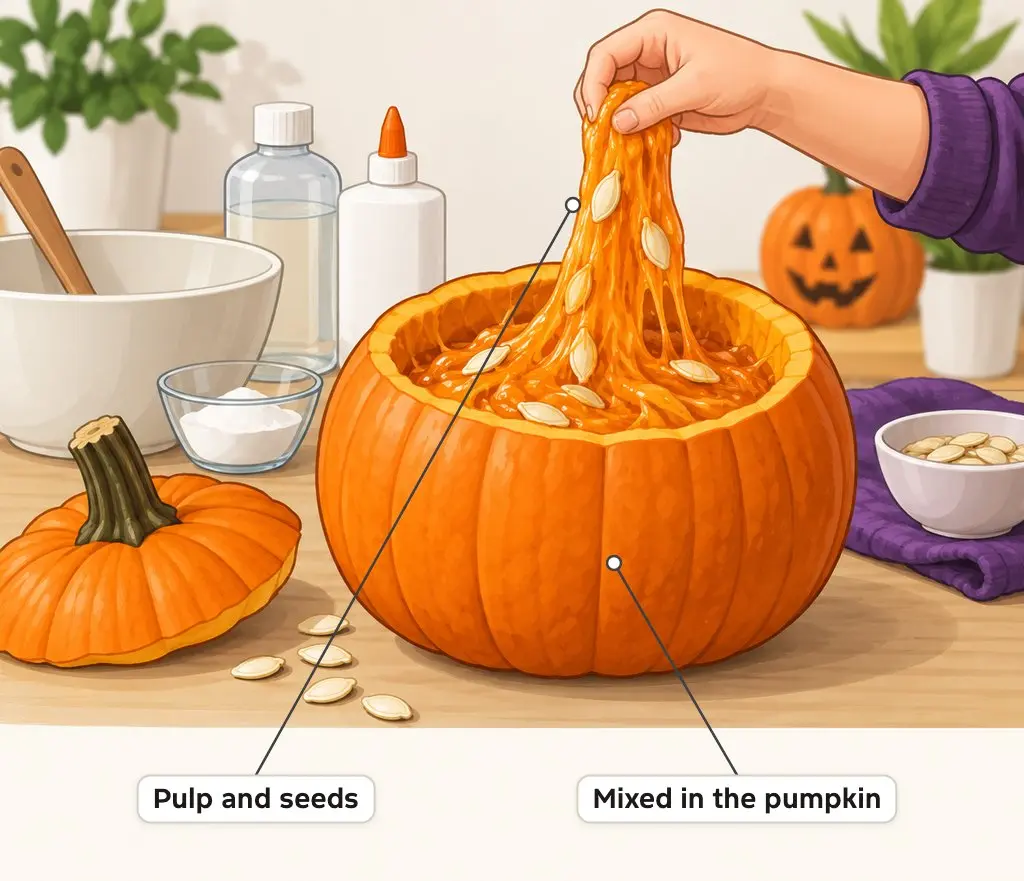
You need:
- 5 fl oz white school glue
- Orange food coloring
- 1/2 tablespoon baking soda
- 1 tablespoon contact lens solution
- A handful of stringy pumpkin pulp and seeds
- Stir a few drops of orange coloring into the glue.
- Mix in the baking soda, then the contact solution, and knead.
- Once it stops sticking, fold in the pumpkin pulp and seeds.
Note: Real pumpkin spoils. Keep this one sealed in the fridge and throw it out within a few days, or sooner if it smells.
Glow-in-the-Dark Ghost Slime
Borax-free, contains boron. 3+ with an adult. About 10 min.
A pale ghost by day that glows once the lights go off.
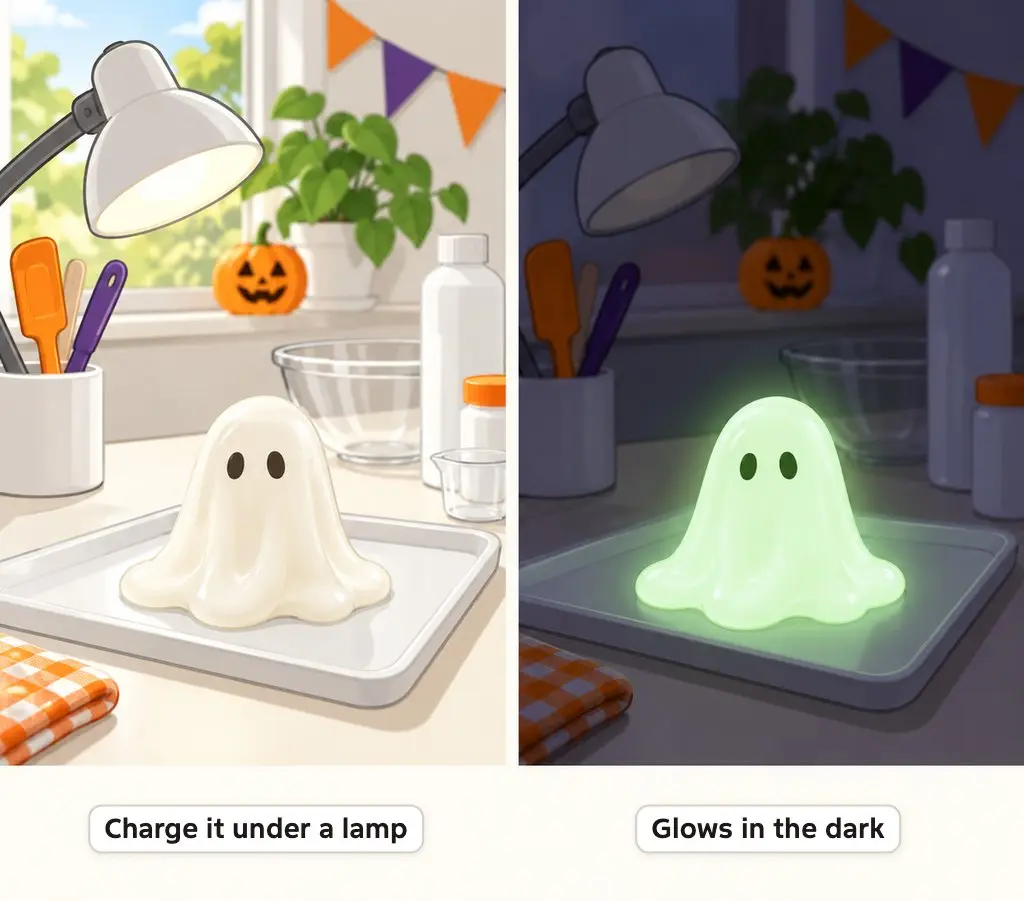
You need:
- 5 fl oz glow-in-the-dark glue
- 1/2 tablespoon baking soda
- 1 tablespoon contact lens solution
- Mix the baking soda into the glow glue.
- Add the contact solution, stir and knead.
- Hold it under a bright lamp or in sunlight, then switch off the lights.
Note: Use glow glue or glow paint made for kids rather than loose glow powder.
Witch’s Brew Slime
Borax-free, contains boron. 3+ with an adult. About 10 min.
Sparkly purple potion slime with green swirls, served in a jar with toy spiders.
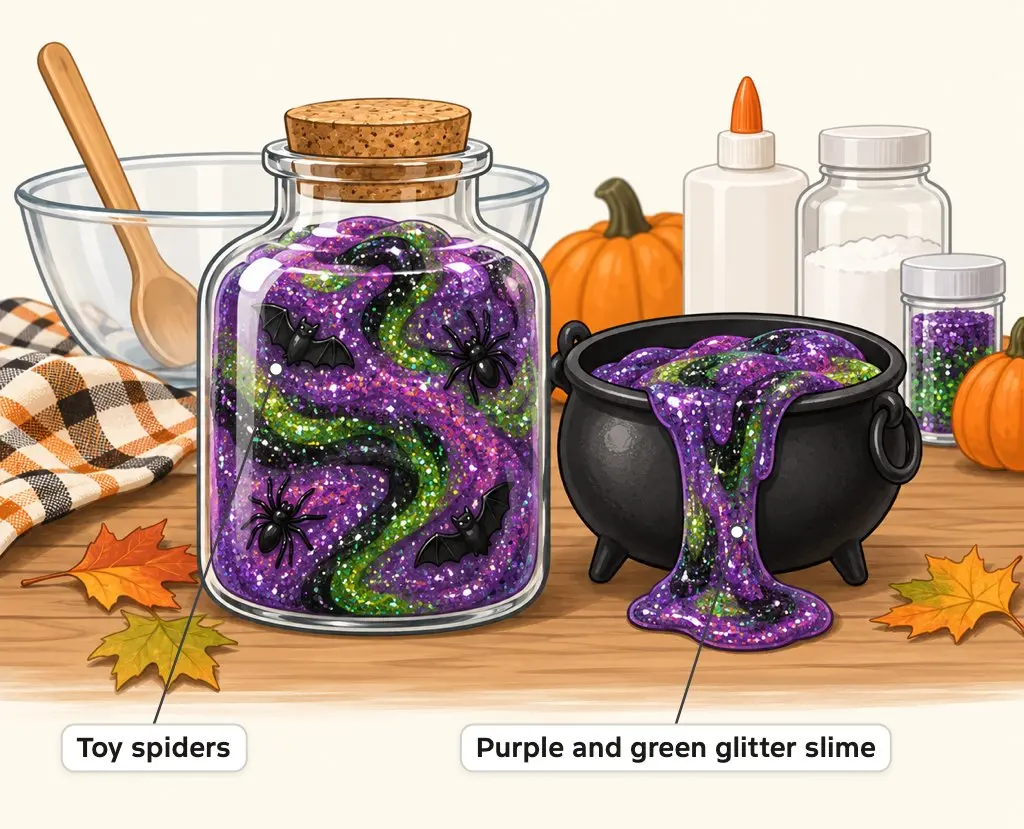
You need:
- 6 fl oz purple glitter glue
- A squeeze of green or black glitter glue
- 1/2 tablespoon baking soda
- 1 1/4 tablespoons contact lens solution
- Small plastic spiders or bats
- Swirl a little green or black glitter glue into the purple glue.
- Mix in the baking soda, then the contact solution, and knead.
- Tuck the toy creatures in and display it in a jar.
Note: Glitter glue needs a little more contact solution than plain glue. Wash hands before touching eyes, because glitter can scratch them.
Candy Corn Swirl Slime
Borax-free, contains boron. 3+ with an adult. About 20 min.
Yellow, orange and white slime twisted into a candy corn rope.
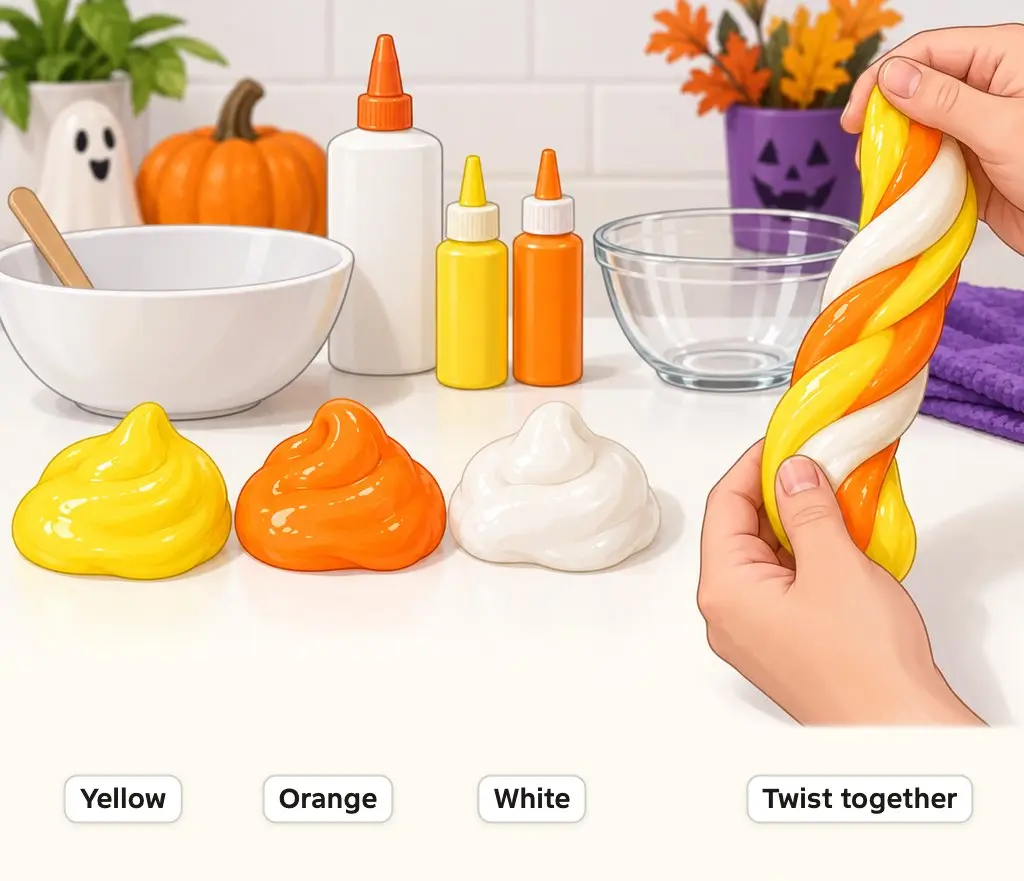
You need:
- 5 fl oz white school glue split into 3 bowls
- Yellow and orange food coloring
- 1/2 teaspoon baking soda per bowl
- 1 teaspoon contact lens solution per bowl
- Color one bowl yellow and one orange. Leave the third white.
- Add the baking soda and contact solution to each bowl and knead each slime.
- Lay the three colors side by side and twist them together.
Note: The per-bowl amounts are the base recipe divided by 3: 1/2 tablespoon is 1 1/2 teaspoons, and 1 tablespoon is 3 teaspoons.
Monster Eyeball Slime
Borax-free, contains boron. 3+ with an adult. About 10 min.
Clear green slime full of googly eyes staring back at you.
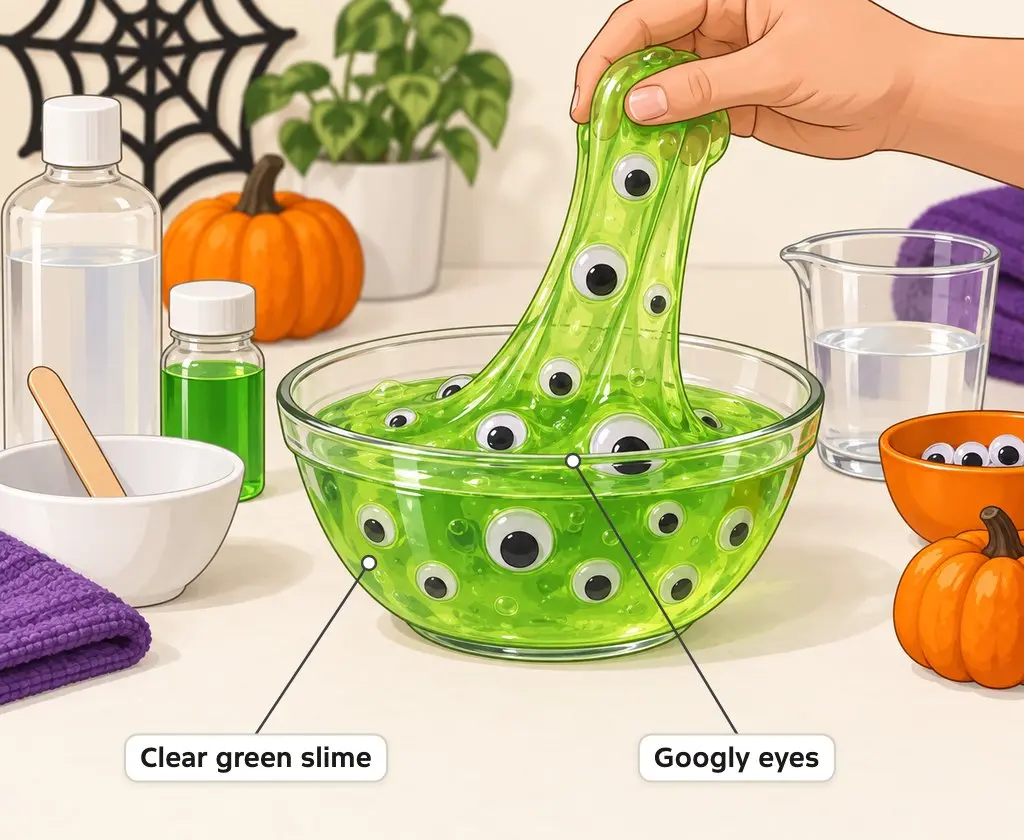
You need:
- 5 fl oz clear school glue
- Green food coloring
- 1/2 tablespoon baking soda
- 1 tablespoon contact lens solution
- A handful of googly eyes
- Stir a drop or two of green coloring into the clear glue.
- Mix in the baking soda, then the contact solution, and knead.
- Fold in the googly eyes.
Note: Googly eyes are a choking hazard. Keep this one away from toddlers and count the eyes back out when play ends.
Fluffy Pumpkin Slime
Borax-free, contains boron. 3+ with an adult. About 15 min.
Soft, puffy orange slime that feels like a pumpkin-colored cloud.
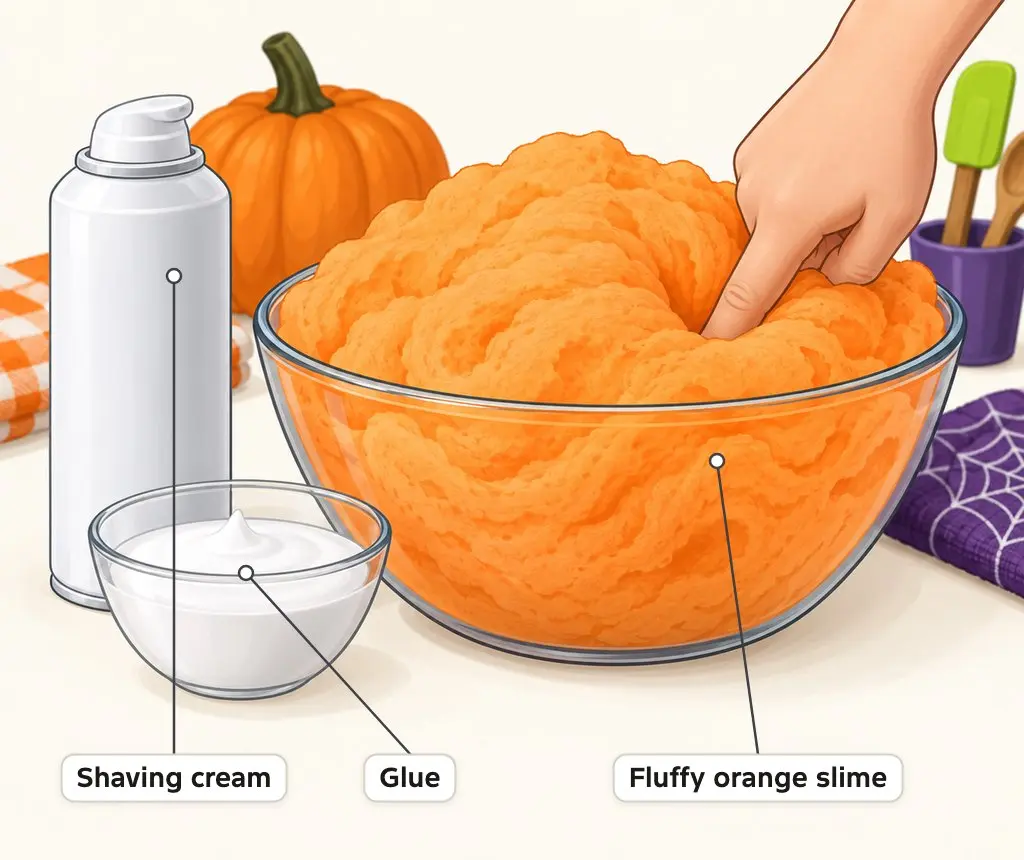
You need:
- 1/2 cup white school glue
- About 3 cups shaving cream
- Orange food coloring
- 1/2 teaspoon baking soda
- 1 1/2 tablespoons contact lens solution
- Mix the glue and a few drops of orange coloring.
- Fold in the shaving cream, then the baking soda.
- Add the contact solution, stir and knead.
Note: Shaving cream adds fragrance and preservatives, which can bother sensitive skin. Choose an unscented one.
The fluffy pumpkin amounts come from The Children’s Museum of Indianapolis, and the fridge rule for the pumpkin guts slime comes from University of Illinois Extension. The rest follow the Elmer’s ratio.
Giving slime as party favors? The free Halloween slime labels and gift tags have a jar label for each of the 10 slimes and gift tags with a short safety line on every one.
Borax Slime for Older Kids
Borax slime is the classic stretchy slime, and it’s fine when an adult handles the borax. The amounts below come from University of Illinois Extension and match the strength of the American Chemical Society’s own slime activity, which also asks for goggles.
Zombie Slime (Borax)
Borax recipe. Older kids, adult makes the activator. About 15 min.
The classic stretchy green slime, made the old-fashioned way with borax.
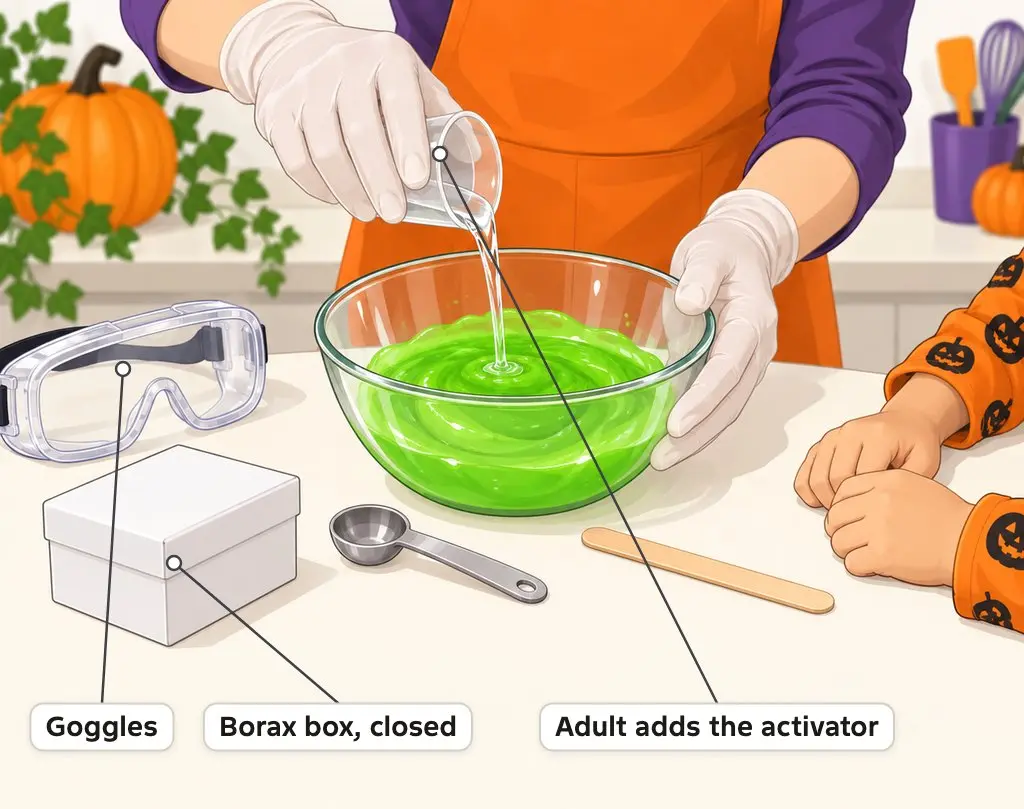
You need:
- Activator: 1/2 teaspoon borax dissolved in 2 tablespoons warm water
- 1/4 cup white school glue
- 4 tablespoons water
- Green food coloring
- An adult dissolves the borax in the warm water.
- Mix the glue, water and a few drops of green coloring.
- The adult slowly pours in the activator while the child stirs, then knead it until it stops sticking.
Note: Goggles on, borax box closed and out of reach, and pour any leftover activator down the sink right away. Not for pregnant women.
Taste-Safe Halloween Slime for Toddlers
These three are made from food, so a lick or a taste isn’t a poison worry. They don’t stretch like glue slime and they spoil like food, so make them on the day and throw them out when play ends.
Vampire Blood Slime
Taste-safe. All ages, adult does the cooking. About 10 min + cooling.
Dark red, gooey and stretchy, made from a fiber supplement and water.
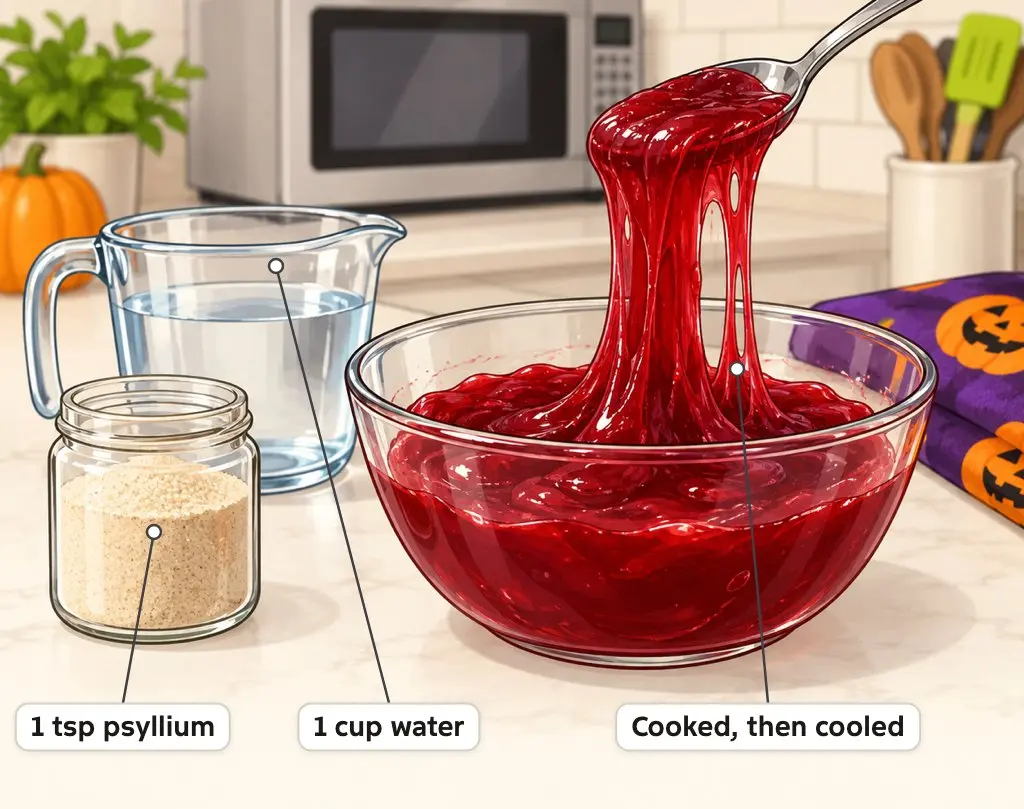
You need:
- 1 cup water
- 1 teaspoon psyllium husk powder
- A couple of drops of red food coloring
- Stir the psyllium and coloring into the water in a microwave-safe bowl.
- An adult microwaves it for 3 to 5 minutes, watching the whole time, and stops when it starts to boil.
- Let it cool completely before anyone touches it. Heat it longer for a thicker slime.
Note: It comes out of the microwave very hot. Make it the day you use it.
Swamp Monster Chia Slime
Taste-safe. All ages with an adult. About 30 min.
Gloopy green swamp slime, speckled with seeds.
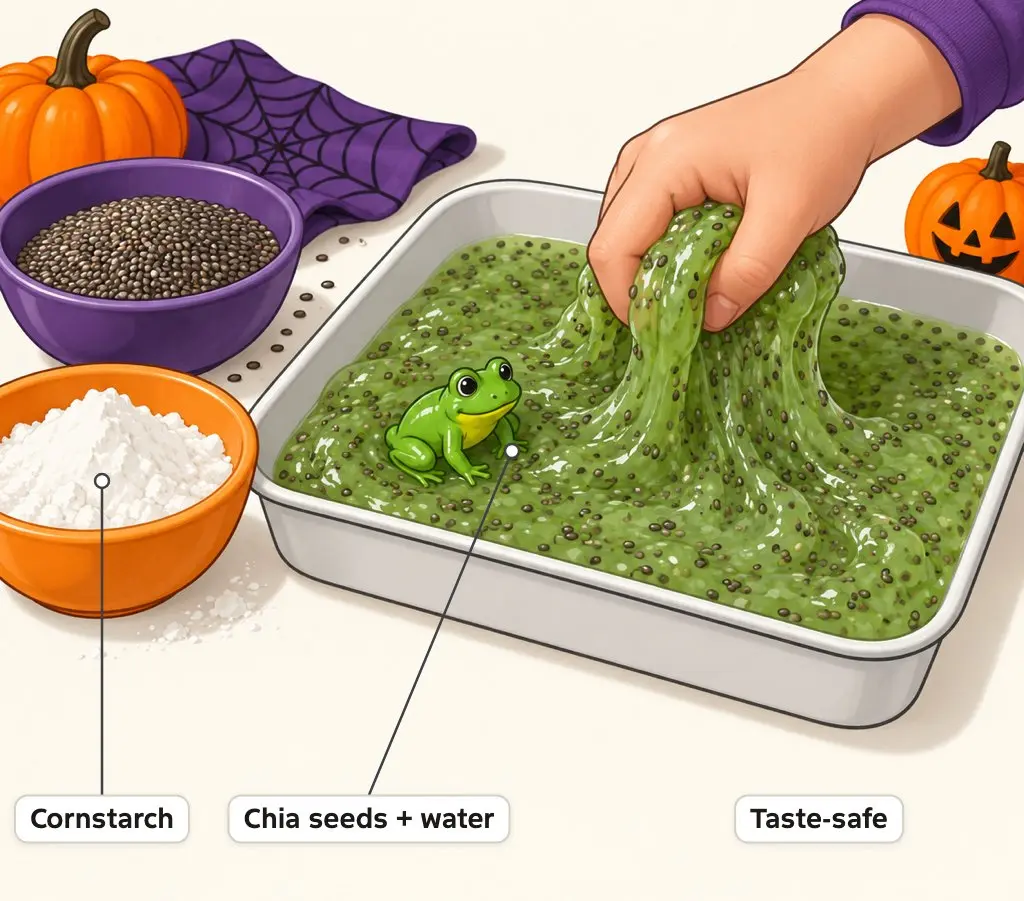
You need:
- 2 tablespoons chia seeds
- 1 to 1 1/2 cups water
- Green food coloring
- Cornstarch, starting with 1 cup
- Stir the chia seeds and coloring into the water and leave it for at least 20 minutes.
- Stir in the cornstarch a little at a time, starting with 1 cup, until it stops sticking.
Note: Safe to taste, but it does not taste good. Keep it in the fridge and throw it out if it smells or grows mold.
Ghost Goo (Oobleck)
Taste-safe. All ages with an adult. About 10 min.
White goo that turns solid when you poke it and drips when you let go.
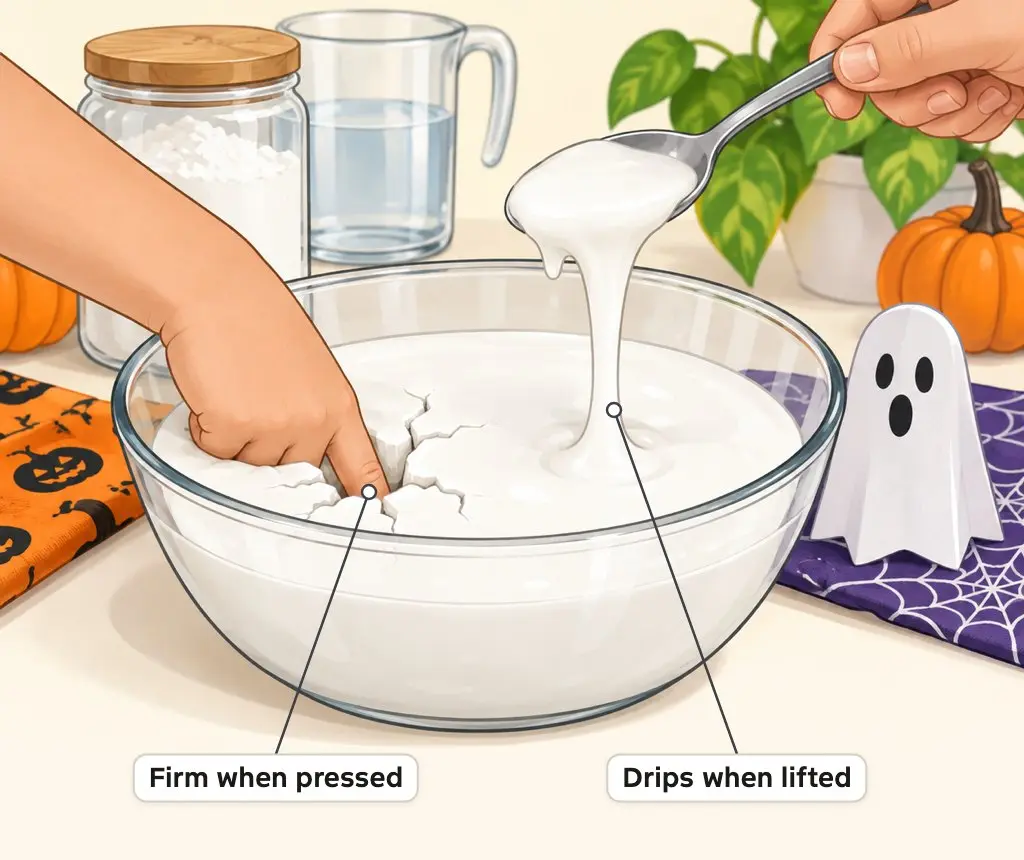
You need:
- 1 cup water
- 1 1/2 to 2 cups cornstarch
- Food coloring, if you want it
- Pour the water into a bowl.
- Add the cornstarch slowly, mixing with your hands, and slow down as you pass 1 1/2 cups.
- Stop when it feels firm to a quick poke but drips when you lift it.
Note: It dries out and separates, so make it fresh. Scrape leftovers into the trash rather than the sink.
The psyllium recipe comes from Museums Victoria’s Scienceworks, the chia slime from the Children’s Museum of Richmond and the cornstarch goo from the Geneva Park District.
Why Slime Works
Slime is a good chemistry lesson hiding in a craft, and the explanation helps when a batch goes wrong.
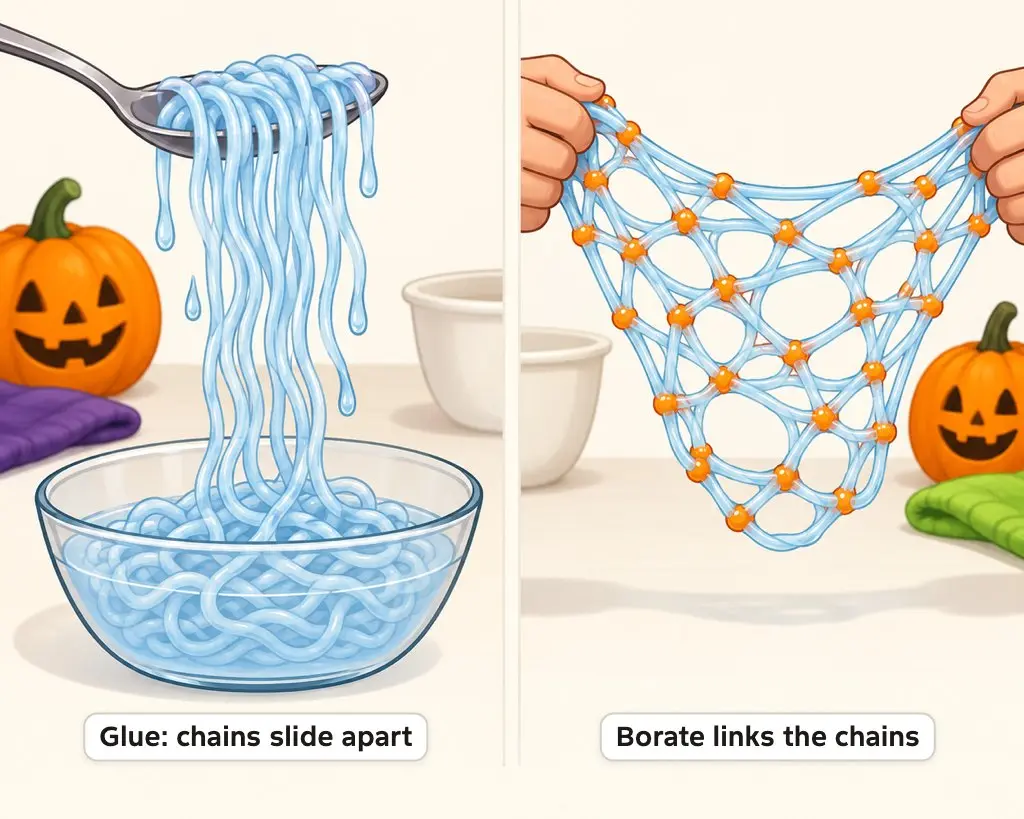
- Glue is a polymer: school glue is mostly water with long, flexible polymer chains in it. On their own, the chains slide past each other, so glue pours like a liquid.
- Borate links the chains: borax, contact solution and some liquid starches all supply borate ions. Each borate ion makes weak bonds to two chains at once, tying them into a loose net. Chemists call this cross-linking.
- The links break and re-form: pull slowly and the bonds have time to let go and grab again, so slime stretches. Pull fast and it snaps. Leave it alone and it slowly flows. That mix of liquid and solid behavior is called viscoelastic.
- Baking soda makes contact solution work: the boron in contact solution sits mostly as boric acid, which only turns into borate as the mixture gets more alkaline. Boric acid’s pKa is 9.24, and baking soda nudges the pH up so more borate forms.
- Acid undoes it: vinegar is an acid, and acid breaks the cross-links. That’s why vinegar is the best way to get slime out of clothes and carpet.
To see cross-linking for yourself, try the slime stretch test. Kids make three small batches with different amounts of contact solution, measure how far each one stretches before it snaps and graph the results.
Fixes for Sticky, Stiff or Runny Slime
Most failed slime is a measuring problem, and each one has a simple fix:
- Too sticky: knead in 1/4 tablespoon more contact solution at a time. Slime also gets less sticky the longer you play with it.
- Won’t come together at all: check that the contact solution lists boric acid or sodium borate, and that the baking soda isn’t old.
- Stiff, rubbery and snapping: too much activator, or it went in too fast. More borate means more cross-links. Start the next batch slower.
- Watery liquid starch slime: add a little more starch, keep mixing and give it 30 seconds.
- Gone hard: the water evaporated. Store slime in a sealed bag or tub.
Halloween Slime Safety
Slime is a safe activity when an adult handles the activator, and the real problems come from repeated contact more than one accident. This is what poison centers and doctors actually report:
- One small swallow: the Missouri Poison Center says a small amount of slime eaten once does “not much”. A harmful amount of borax for a 2-year-old is about a teaspoon of the powder, which is why the box stays with the adult.
- Repeated contact: doctors have published several case reports of children with red, peeling, itchy palms after playing with homemade slime for weeks or months, often worse on the dominant hand. It cleared up once they stopped, sometimes with a short course of skin cream.
- Preservative allergy: some children react to the preservatives in glue, liquid detergent and shaving foam rather than to borax.
- The overall picture: French poison centers logged 208 slime exposures between 2014 and 2018, mostly swallowing, and every child recovered. Their advice was that making slime at home should be supervised by adults.
- Detergent slime: skip recipes that use laundry detergent as the activator. A 2022 review of slime skin reactions named detergent and soap as the worst irritants, and the ASPCA calls detergent the most dangerous slime ingredient for pets.
- Pregnancy: the Missouri Poison Center advises pregnant women to avoid borax slime recipes.
The habits that prevent almost all of it are simple. An adult measures and adds every activator, everyone washes their hands before and after, play stops at the first sign of red or itchy skin, and kids with eczema or broken skin wear gloves or stick to the taste-safe recipes. Pour leftover borax activator down the sink straight away, so nobody mistakes it for a drink. If a child swallows activator or borax powder, call Poison Control at 1-800-222-1222 in the US.
Buying Halloween Slime Instead
Shop-bought slime isn’t automatically gentler. The EU and UK limit boron in toy slime to 300 mg/kg, and tests keep finding products over it:
- Which? tested 13 slimes and putties in 2018, and more than 40% failed. The worst slime had 1,400 mg/kg of boron, more than four times the limit.
- A 2019 Dutch survey found 35% of toy slimes over the limit.
- UK regulators were still recalling slimes for excess boron in 2025.
The US has no specific boron limit for toys. If you buy a Halloween slime kit, I’d pick a toy brand that also sells in the EU or UK, where slime has to meet that limit, and treat a no-name slime the way you’d treat a homemade borax one.
How to Get Slime Out of Clothes and Carpet
Vinegar works because acid breaks the cross-links that hold slime together:
- Scrape off as much slime as you can with a spoon or a blunt knife.
- Dab white vinegar on what’s left and let it sit for a few minutes. Test it on a hidden spot first.
- Scrub or blot until the slime loosens, then wash the clothes as usual or rinse the carpet with water.
Put old slime in the trash, never down the drain, because it can clog the pipes. Food coloring can stain, so dark slime is best kept away from light carpets in the first place.
Free Halloween Slime Printables
Every printable here is a free PDF on US Letter that also prints on A4, with no signup. Start with the recipe cards, then add the planner for a group, the labels for party favors or the stretch test for a science lesson.
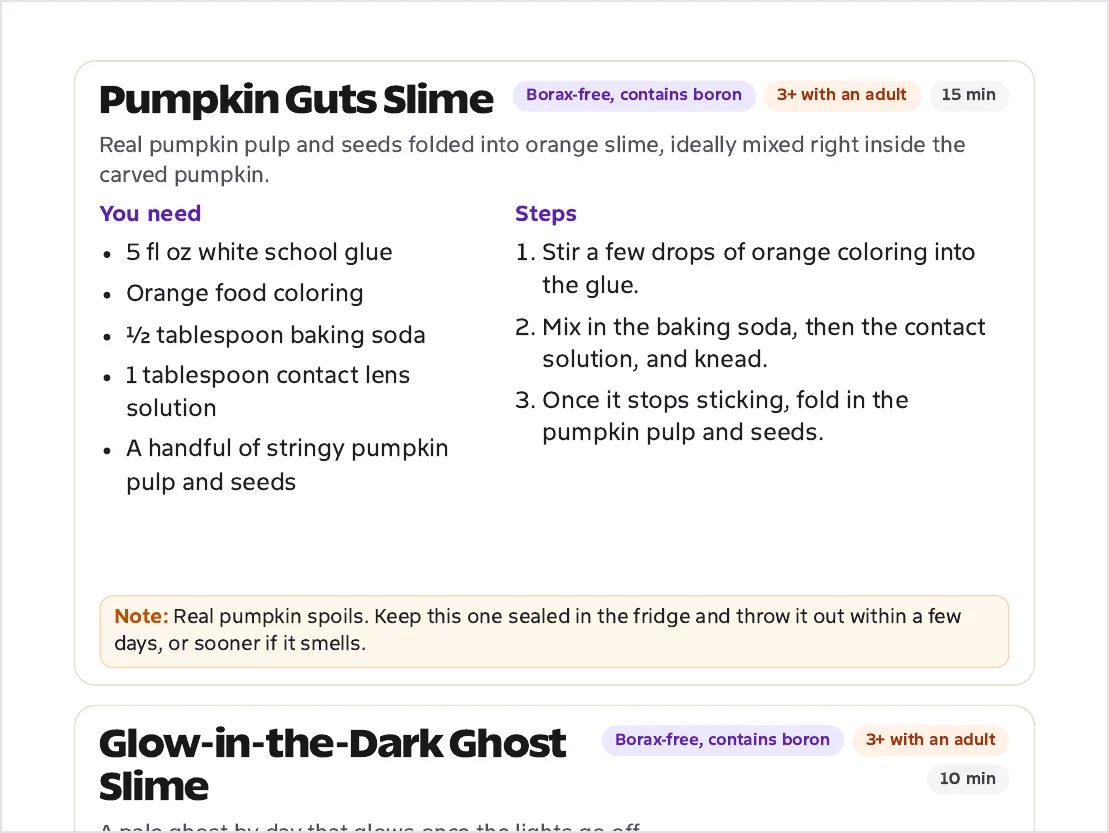
Halloween Slime Recipe Cards
All 10 recipes with exact amounts, plus an age guide, a fixes and cleanup page and a slime science lab sheet. 8 pages.
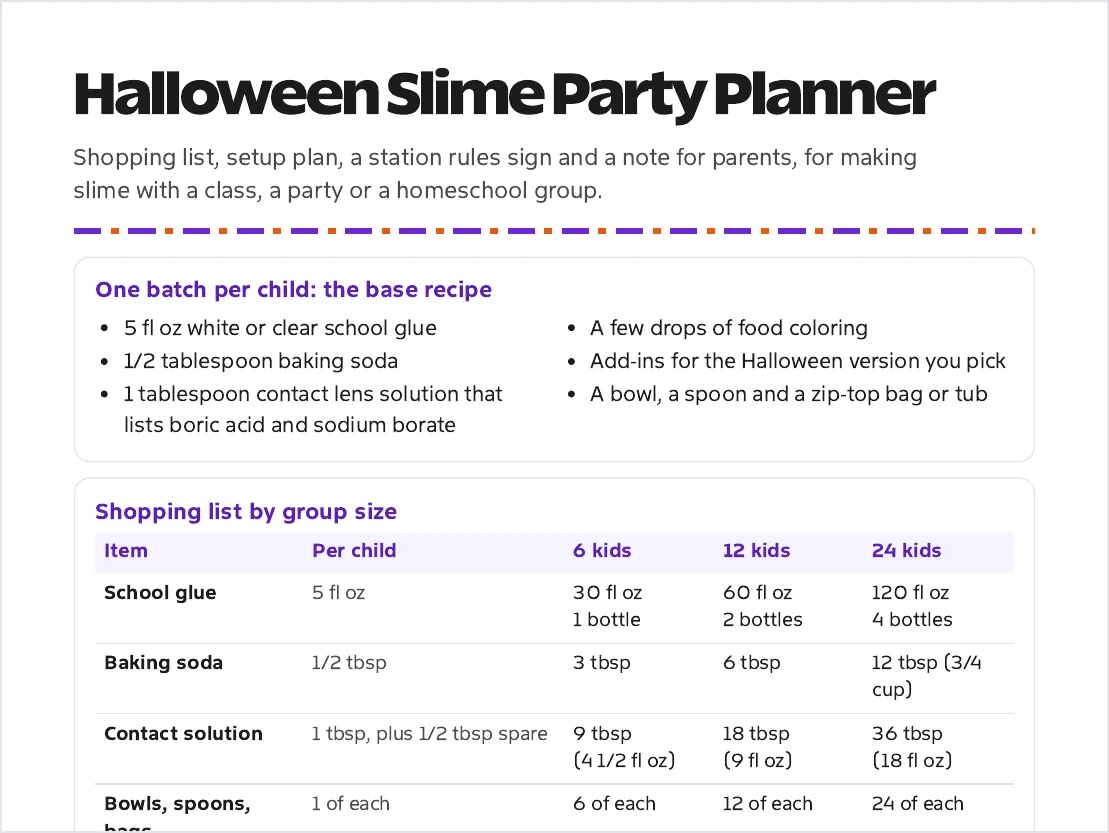
Halloween Slime Party Planner
A shopping list for 6, 12 or 24 kids, a 45-minute session plan, a station rules sign and a note for parents with an allergy check. 4 pages.
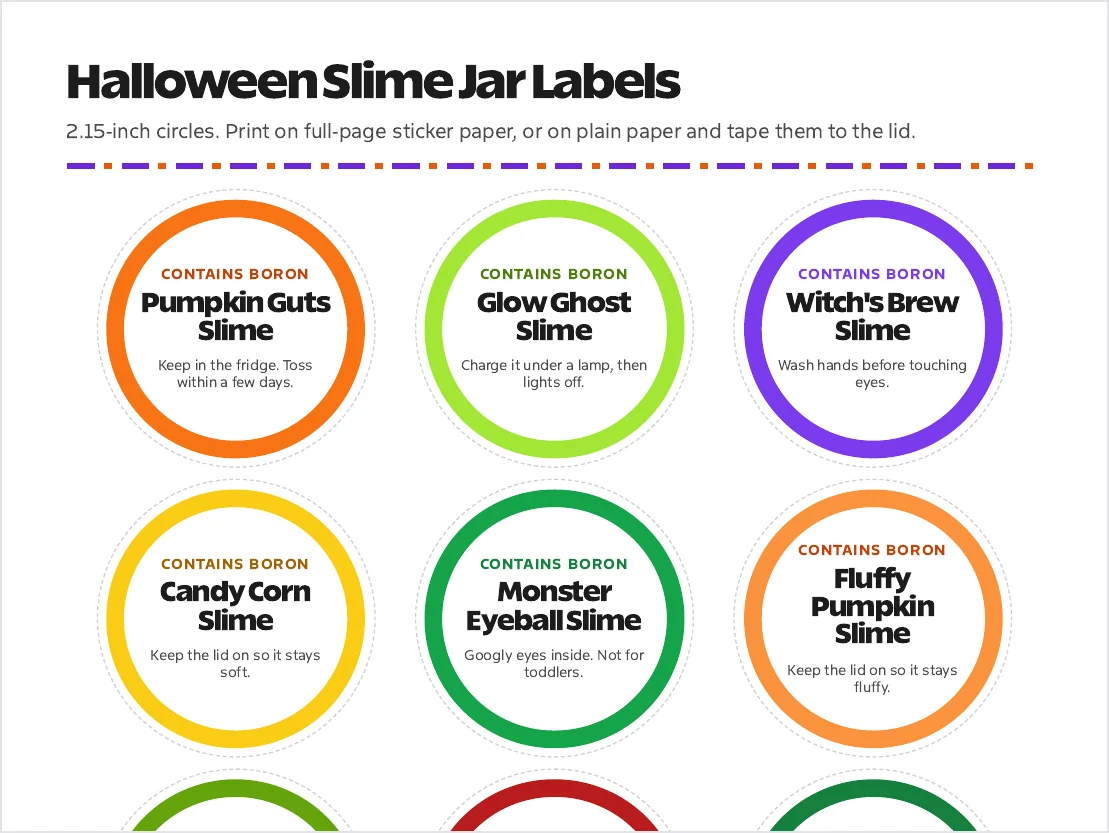
Halloween Slime Labels and Gift Tags
Round jar labels for all 10 slimes, two blank ones for your own creations and 10 gift tags for party favors. 2 pages.
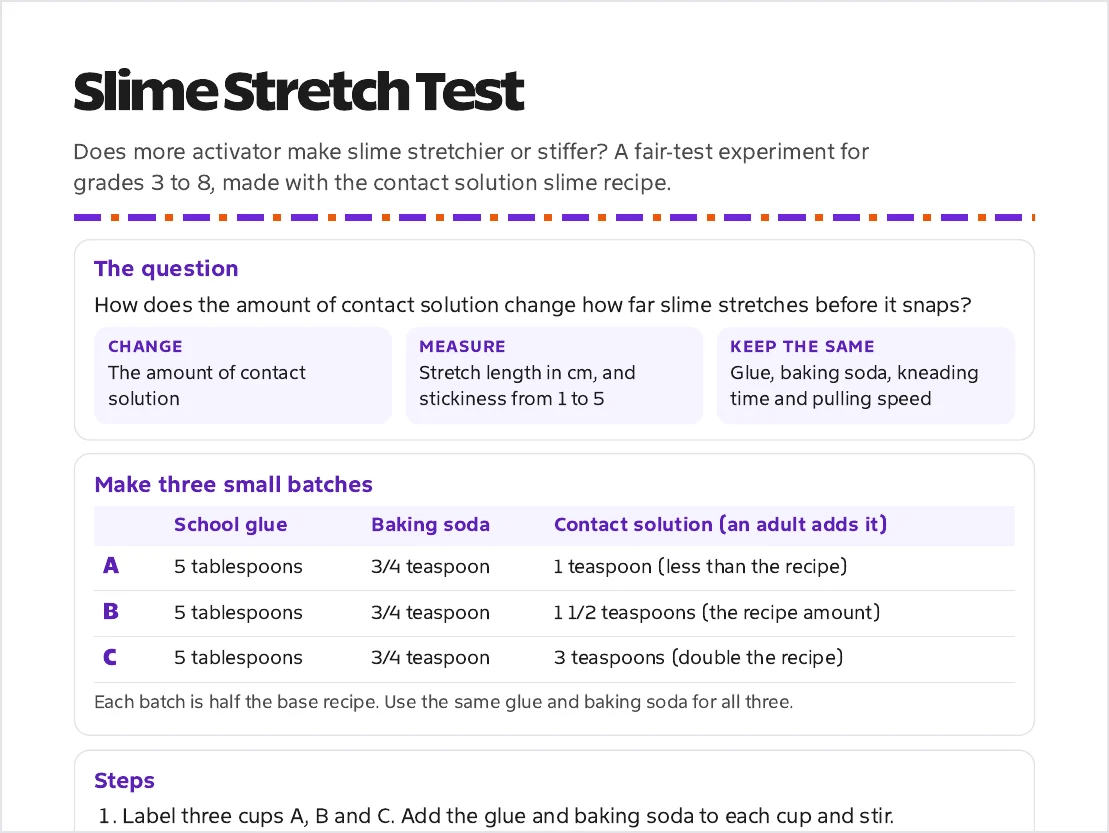
Slime Stretch Test
A fair-test experiment for grades 3 to 8, with three batches, a data table, a bar graph, questions and a note for the adult. 2 pages.
More Halloween Activities
If slime goes down well, these keep the Halloween week going:
- My Halloween science experiments include the puking pumpkin, glow sticks and oobleck, with a free lab journal.
- The free Halloween math worksheets cover kindergarten to high school, with answer keys.
- For year-round ideas, my list of STEM websites for students has plenty more hands-on science.
FAQs on Halloween Slime
Is Halloween slime safe for toddlers?
Only the taste-safe kind made from food, such as psyllium, chia or cornstarch slime. Elmer’s says its glue slime isn’t meant for children under 3, and the Missouri Poison Center says children who put things in their mouths should only play with edible slime.
How do you make Halloween slime without borax?
Use contact lens solution with boric acid and baking soda: 5 fl oz glue, 1/2 tablespoon baking soda and 1 tablespoon contact solution. It’s borax-free, but it still contains boron, so it needs the same supervision.
What contact solution works for slime?
Any contact lens solution that lists boric acid or sodium borate in its ingredients. Solutions without them won’t turn glue into slime.
Why is my slime still sticky?
It needs a little more activator. Knead in 1/4 tablespoon more contact solution at a time, and keep kneading, because slime gets less sticky as you play.
How long does homemade slime last?
Glue slime keeps for a while in a sealed bag or tub. Throw it out if it changes color, smells or grows mold. Taste-safe slimes are food, so make them on the day.
Can you make slime without glue?
Yes. Psyllium husk slime, chia seed slime and cornstarch oobleck all work without glue, and they’re safe for little kids to touch and taste.
Final Remarks
Pick the slime by age before you pick it by color. Make the base recipe once, measure the contact solution in tablespoons, and keep the activator in an adult’s hands. Happy Halloween.
Tell Google you want more of this.
Add Gaurav Tiwari as a preferred sourceOne tap, and this site shows up more often in your own Top Stories, AI Overviews and AI Mode. Remove it any time.
Disclaimer: This site is reader-supported. If you buy through some links, I may earn a small commission at no extra cost to you. I only recommend tools I trust and would use myself. Your support helps keep gauravtiwari.org free and focused on real-world advice. Thanks. - Gaurav Tiwari