
 by
by
Most Halloween writing prompts for kids stop at the first line. “A ghost is scared of the dark” gets a child to write a sentence or two, and then the pencil stops, because nobody has decided what the ghost wants, what gets in its way or how the story ends. The prompt gave them a character and a spooky place but no story to tell.
This guide fills that gap. It has 48 original Halloween writing prompts sorted by grade band and writing type, each with a sentence starter, and a printable story planner that asks 5 questions before the first sentence: who the character is, what they want, what stands in the way, what they choose and how it ends. Both are free: print the PDFs as they are, or open the Canva versions and change a prompt, a word bank or a sentence starter before you print.
All 48 prompts are also on cut-apart Halloween writing prompt cards (PDF), with larger cards for grades K-2. Printing on A4? Use the A4 story planner and prompt cards instead. Every page prints in black and white, and the Canva versions of both files are in the next section.
What’s in the Writing Pack
The pack is 2 files, a story planner and a set of prompt cards. Each one comes as a Canva template you can edit and as print-ready PDFs in US Letter and A4. I kept the pages plain on purpose, with thin lines and no full-page color, so a school printer doesn’t run out of toner halfway through a class set. The planner pages also work as ordinary Halloween writing worksheets if you only need lined paper and a word bank.
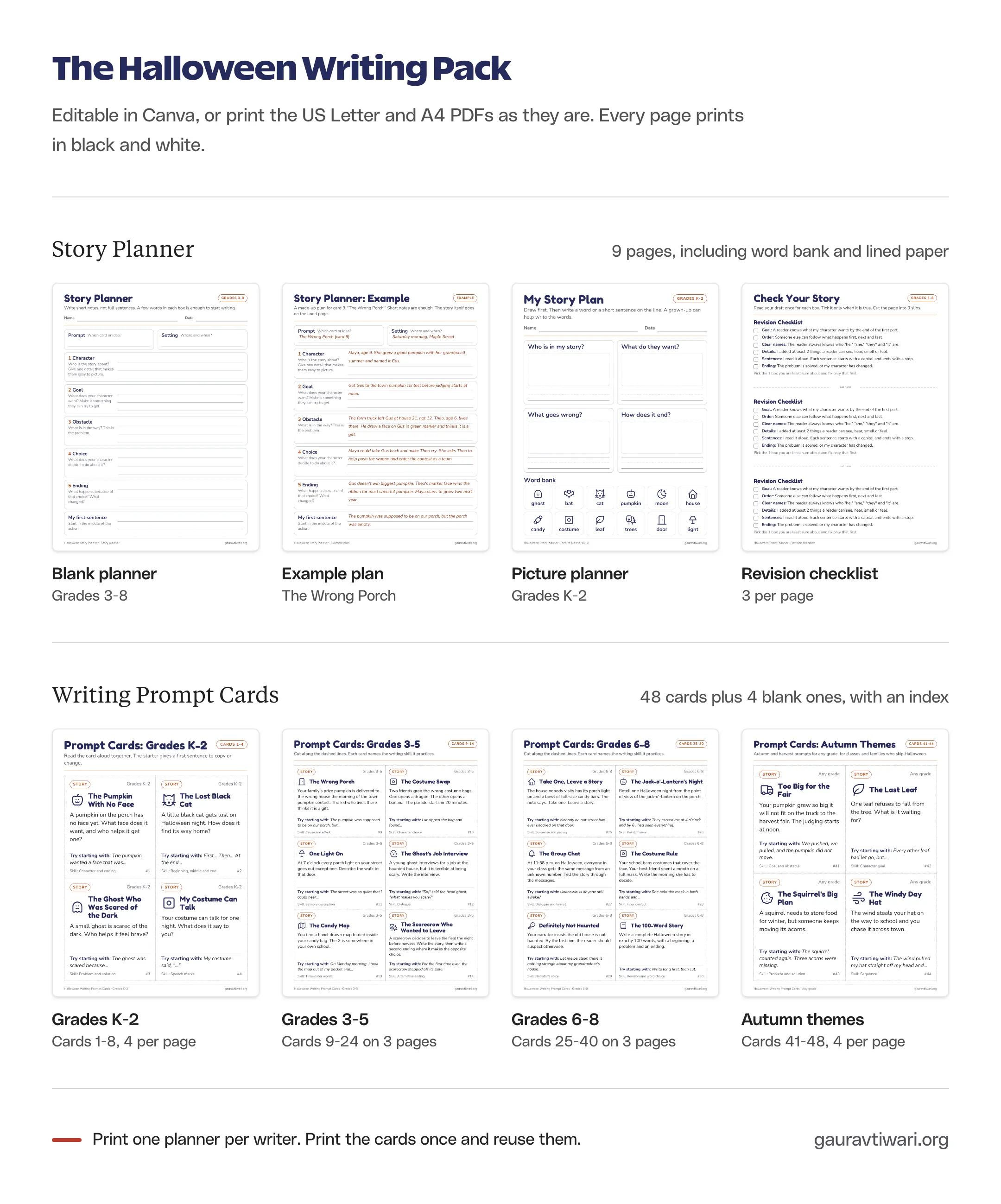
- Story Planner: setting, character, goal, obstacle, choice, ending and a first sentence, for grades 3-8.
- Example plan: the same planner filled in for one prompt, marked as a made-up example.
- My Story Plan: a draw-and-write planner for grades K-2 with a 12-word picture word bank.
- Opinion and Explain Planner: an opinion or topic, 3 reasons or facts, the other side and a closing.
- Word Bank and Sentence Starters: characters, places, sounds, sights, feelings, time words and 10 starters.
- Check Your Story: a 6-point revision checklist, 3 copies per page.
- Writing paper: lined paper for grades 3-8, and a picture box with wide handwriting lines for K-2.
- Prompt cards: 48 cards, each with its type, grade band, a starter line and the skill it practices, plus 4 blank cards for prompts your writers invent.
- Card sizes: the K-2 and autumn cards print 4 to a page in larger type, and the grades 3-8 cards print 6 to a page.
Halloween Story Planner
This is the 9-page planner pack, from the 5-box planner to the K-2 writing paper. In Canva you can rewrite the questions, the word bank and the sentence starters.
For A4 paper, edit the A4 story planner in Canva instead. It has the same 9 pages.
Halloween Writing Prompt Cards
The card set has an index page and 10 card pages with 48 prompts and 4 blank cards. In Canva you can edit every prompt, starter line and skill label.
For A4 paper, edit the A4 prompt cards in Canva instead. It has the same 11 pages.
Edit the Pack in Canva
Canva is a free design tool that runs in the browser and as a phone app. Every word on both templates is live text, and they use free fonts, so a free Canva account is enough. Here is how to make your own copy:
- Click “Edit in Canva” on the file you want, then sign in or create a free Canva account.
- Click “Use template”. Canva makes a copy for you, so the original stays the same for the next teacher.
- Click any prompt, word or starter and type over it. The text boxes are sized for the sample wording, so keep new lines about as long or make the text a little smaller.
- Click Share, then Download, choose PDF Print and print at 100% or “Actual size”.
These are the edits worth making before you print:
- Word bank: swap in this week’s vocabulary or spelling words, so the planner page doubles as practice.
- Prompts: rewrite a card around a class event, a local place or the book you are reading aloud.
- Blank cards: type prompts your writers suggest into the 4 My Own Prompt cards, or leave the lines for them to fill in by hand.
- Starters: change a sentence starter to match the skill you are teaching that week, such as dialogue or a time word.
If you don’t use Canva, the PDFs above print exactly as shown and need no account.
Choose a Halloween Writing Prompt
The prompts are sorted 2 ways. The grade band tells you how much support a card assumes, and the type tells you what kind of writing it asks for:
- Story: a narrative with a character, a problem and an ending.
- Opinion: a point of view backed by reasons. The grades 6-8 cards add the other side, which is where opinion writing turns into argument.
- Explain: an informative piece built on facts, steps or causes.
- Poem: sound words, imagery, syllable counts or a voice that isn’t the writer’s own.
The first 3 types follow the opinion, informative and narrative split in the Common Core writing standards, so a card can slot into a unit you already teach. Each card also names one skill, such as dialogue or cause and effect, which gives you something specific to look for when the writing comes back.
I’d let children choose their own card from a band instead of assigning one. A child who picks the ghost interview over the quiet street has already made the first writing decision, and a story they chose is easier to keep going with than one handed to them.
Grades K-2
These Halloween story starters for kids are short enough to read aloud. The starter line is there to copy, trace or change, and an adult can write down what the child says.
- The Pumpkin With No Face (story): A pumpkin on the porch has no face yet. What face does it want, and who helps it get one? Start with: The pumpkin wanted a face that was…
- The Lost Black Cat (story): A little black cat gets lost on Halloween night. How does it find its way home? Start with: First… Then… At the end…
- The Ghost Who Was Scared of the Dark (story): A small ghost is scared of the dark. Who helps it feel brave? Start with: The ghost was scared because…
- My Costume Can Talk (story): Your costume can talk for one night. What does it say to you? Start with: My costume said, "…"
- The Best Costume (opinion): What is the best costume to wear? Give 2 reasons. Start with: The best costume is ___ because ___.
- Give or Get? (opinion): Would you rather hand out treats at the door or go trick-or-treating? Why? Start with: I would rather ___ because ___.
- Decorate a Pumpkin (explain): Tell a friend how to decorate a pumpkin with stickers or paint. Use 3 steps. Start with: First, … Next, … Last, …
- Halloween Night Senses (poem): Finish each line: Halloween night looks like…, sounds like…, smells like…, feels like… Start with: Halloween night looks like…
Grades 3-5
The grades 3-5 cards put a problem in the prompt itself, so the obstacle box on the planner is half filled before the child starts. Card 14 also asks for a second ending, which shows young writers that one changed choice changes the whole ending.
- The Wrong Porch (story): Your family's prize pumpkin is delivered to the wrong house the morning of the town pumpkin contest. The kid who lives there thinks it is a gift. Start with: The pumpkin was supposed to be on our porch, but…
- The Costume Swap (story): Two friends grab the wrong costume bags. One opens a dragon. The other opens a banana. The parade starts in 20 minutes. Start with: I unzipped the bag and found…
- One Light On (story): At 7 o'clock every porch light on your street goes out except one. Describe the walk to that door. Start with: The street was so quiet that I could hear…
- The Ghost's Job Interview (story): A young ghost interviews for a job at the haunted house, but it is terrible at being scary. Write the interview. Start with: "So," said the head ghost, "what makes you scary?"
- The Candy Map (story): You find a hand-drawn map folded inside your candy bag. The X is somewhere in your own school. Start with: On Monday morning, I took the map out of my pocket and…
- The Scarecrow Who Wanted to Leave (story): A scarecrow decides to leave the field the night before harvest. Write the story, then write a second ending where it makes the opposite choice. Start with: For the first time ever, the scarecrow stepped off its pole.
- Costume Day at School (opinion): Should your school have a costume day? Give 3 reasons and a closing sentence. Start with: I believe our school should… One reason is…
- Candy Corn Court (opinion): Candy corn is on trial. Is it a great treat or the worst one in the bag? Argue your side. Start with: Ladies and gentlemen of the jury, candy corn is…
- Scary or Funny? (opinion): Which makes a better costume: something scary or something funny? Use examples. Start with: A funny costume beats a scary one because…
- Carve or Paint? (opinion): Is it better to carve a pumpkin or paint it? Think about safety, mess and how long it lasts. Start with: If I had to choose, I would…
- Bats Are Not Villains (explain): Bats show up on Halloween decorations. Find 3 true facts about bats and explain why they are helpful. Start with: Many people think bats are scary, but…
- Why Leaves Change Color (explain): Explain to a younger child why leaves turn red, orange and yellow in autumn. Start with: Leaves change color because…
- A Safe Trick-or-Treat Route (explain): Write a how-to guide for planning a safe trick-or-treat route with your family. Start with: Before you leave the house, …
- Haunted House Sound Poem (poem): Write a poem made of the sounds inside an old house: creaks, drips, rattles. Give each sound its own line. Start with: Creak goes the…
- Pumpkin Patch Haiku (poem): Write 3 haiku about a pumpkin patch: morning, afternoon and night. Count 5, 7 and 5 syllables. Start with: Orange in the mist…
- A Potion for Bravery (poem): Write a recipe poem for a potion that cures being scared of the dark. List the ingredients, then the steps. Start with: Take one spoon of moonlight…
Grades 6-8
These Halloween creative writing prompts ask for a craft move on top of the story: point of view, a narrator the reader shouldn’t trust, a strict word count or a counterclaim. The spooky part stays gentle, and the challenge is the writing move itself.
- Take One, Leave a Story (story): The house nobody visits has its porch light on and a bowl of full-size candy bars. The note says: Take one. Leave a story. Start with: Nobody on our street had ever knocked on that door.
- The Jack-o'-Lantern's Night (story): Retell one Halloween night from the point of view of the jack-o'-lantern on the porch. Start with: They carved me at 4 o'clock and by 6 I had seen everything.
- The Group Chat (story): At 11:58 p.m. on Halloween, everyone in your class gets the same message from an unknown number. Tell the story through the messages. Start with: Unknown: Is anyone still awake?
- The Costume Rule (story): Your school bans costumes that cover the face. Your best friend spent a month on a full mask. Write the morning she has to decide. Start with: She held the mask in both hands and…
- Definitely Not Haunted (story): Your narrator insists the old house is not haunted. By the last line, the reader should suspect otherwise. Start with: Let me be clear: there is nothing strange about my grandmother's house.
- The 100-Word Story (story): Write a complete Halloween story in exactly 100 words, with a beginning, a problem and an ending. Start with: Write long first, then cut.
- An Age Limit for Trick-or-Treating? (opinion): Some towns have debated an age limit for trick-or-treating. Should there be one? Address the other side. Start with: Some people argue that…, but…
- Move Halloween to Saturday? (opinion): Should Halloween always be celebrated on the last Saturday of October? Use at least 2 kinds of evidence. Start with: Moving Halloween to a Saturday would…
- Homemade or Store-Bought? (opinion): Which is better: a homemade costume or a store-bought one? Consider cost, creativity and time. Start with: The real cost of a costume is not only the price tag.
- Costume Day or Career Day? (opinion): Your school wants to replace costume day with dress-as-your-future-job day. Write a letter to the principal. Start with: Dear Principal…
- From Turnips to Pumpkins (explain): Research where the jack-o'-lantern tradition came from and explain how it changed over time. Start with: Long before pumpkins, people carved…
- How a Pumpkin Rots (explain): Explain what happens to a carved pumpkin over 2 weeks and why it happens faster than to an uncarved one. Start with: Once the skin is cut open, …
- Why We Like Being Scared (explain): Why do people enjoy haunted houses when they know they are safe? Explain with evidence from your research. Start with: Your heart speeds up even though…
- The Moon's View (poem): Write a poem in the voice of the moon watching your town on Halloween night. Start with: From up here, the costumes look like…
- Found Wrapper Poem (poem): Collect words from candy wrappers and decoration packages. Arrange them into a poem without adding new words. Start with: Choose 20 words first, then arrange.
- Bat and Moth (poem): Write a poem for two voices: a bat hunting and a moth trying to escape. Alternate their lines. Start with: Bat: I hear you… Moth: I hear you hearing me…
Autumn Prompts Without Halloween
Cards 41-48 use harvest and autumn themes for schools and families who skip Halloween. They practice the same skills, and nothing in the planner mentions the holiday, so the rest of the pack works unchanged.
- Too Big for the Fair (story): Your pumpkin grew so big it will not fit on the truck to the harvest fair. The judging starts at noon. Start with: We pushed, we pulled, and the pumpkin did not move.
- The Last Leaf (story): One leaf refuses to fall from the tree. What is it waiting for? Start with: Every other leaf had let go, but…
- The Squirrel's Big Plan (story): A squirrel needs to store food for winter, but someone keeps moving its acorns. Start with: The squirrel counted again. Three acorns were missing.
- The Windy Day Hat (story): The wind steals your hat on the way to school and you chase it across town. Start with: The wind pulled my hat straight off my head and…
- The Best Season (opinion): Which season is the best one of the year? Give reasons and examples. Start with: Autumn is the best season because…
- A Class Garden (opinion): Should your class plant a garden this spring? Convince your teacher. Start with: Our class should plant a garden because…
- How a Pumpkin Grows (explain): Explain how a pumpkin grows from a seed to a fruit you can pick. Start with: It all starts with one flat seed.
- Autumn Sounds (poem): Write a poem about the sounds of autumn: crunching leaves, geese, rain on a window. Start with: Crunch under my boots…
Build the Story Plan
A prompt hands the child a situation. The planner asks for the 5 things a situation doesn’t include, and the goal box matters most. A character who wants something has a reason to act. A character with no goal has nothing to do once the setting is described, and that is usually where the writing stops.
| Planner box | The question it asks | Example note from The Wrong Porch |
|---|---|---|
| Character | Who is the story about? Add one detail. | Maya, 9, grew a giant pumpkin named Gus |
| Goal | What do they want? | Get Gus to the pumpkin contest by noon |
| Obstacle | What is in the way? | Gus went to house 21, and Theo, 6, thinks he is a gift |
| Choice | What do they decide to do? | Team up with Theo instead of taking Gus back |
| Ending | What changed because of that choice? | No biggest-pumpkin prize, but a ribbon for most cheerful pumpkin |
Each box should hold a few words. When a child writes a full paragraph into the planner, the story gets written twice and the second version usually comes out flatter. The notes are a promise to write it properly on the lined page, and it is wise to fill the goal box together on the board the first time you use the planner.
Ask what the character wants. Most stories that stop after 2 sentences have an empty goal box, and a goal gives the next sentence something to do.
The setting and first-sentence boxes are extras. Setting feeds the sensory cards, and the first-sentence box nudges writers to open in the middle of something happening instead of with “One day.”
Develop One Story Starter
Here is one prompt worked from card to plan, so you can see how the boxes depend on each other. Maya, Theo and Gus are made up for this guide. Every line of the example was written for this guide to show how the boxes connect.
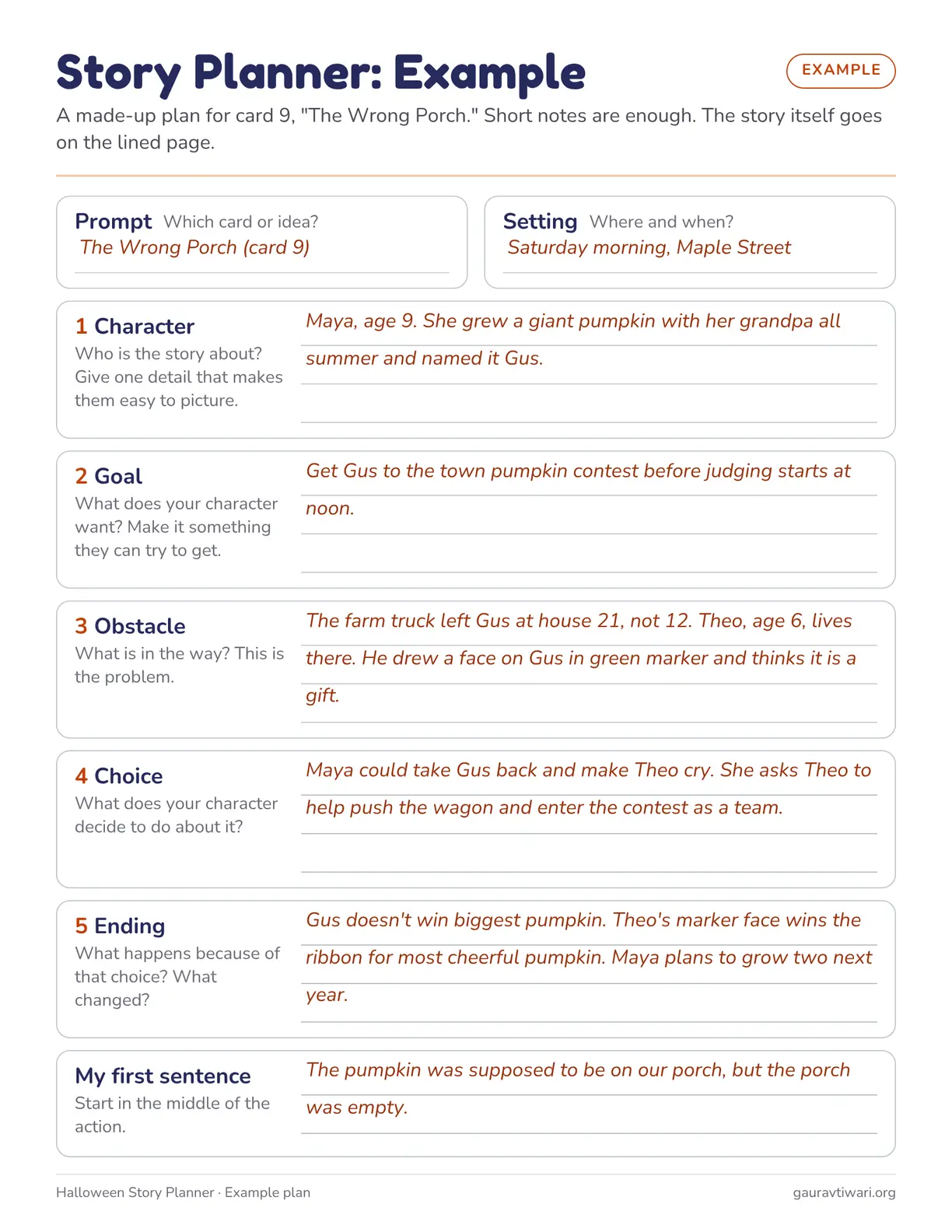
The prompt is card 9, The Wrong Porch: your family’s prize pumpkin is delivered to the wrong house the morning of the town pumpkin contest, and the kid who lives there thinks it is a gift. The obstacle comes with the card, so the planning starts with the goal. Maya wants Gus on the contest table by noon, and that one line gives the story a clock.
The choice box is where the story gets decided. Maya has 2 real options, and each one leads to a different ending:
- She takes Gus back. She makes the contest in time, Theo cries on his porch and the story ends on a win that feels a little hollow.
- She lets Theo help. They push the wagon to the square together, Gus loses biggest pumpkin and Theo’s green marker face wins the ribbon for most cheerful pumpkin.
Both are good stories. The planner leaves that decision to the child but makes them take it before writing, which matters because an unmade choice is where most drafts stall. Here is how the first paragraph might read from the plan, again written for this guide:
The pumpkin was supposed to be on our porch, but the porch was empty. Grandpa checked the delivery slip twice. Gus, the biggest pumpkin we had ever grown, had gone to number 21 instead of number 12, and the contest started at noon.
That opening covers the character, the goal and the obstacle in 3 sentences, and the reader already wants to know what is waiting at number 21.
Prompts for Different Writers
The same card works at 3 levels. Changing the support around a prompt is easier than finding a new prompt for every child in the room:
- More support: the picture planner, the word bank and the starter line. The child draws each box and tells the story aloud while an adult writes a few key words. A picture story with 4 sentences counts as a finished story in kindergarten.
- Independent: a prompt card, the Story Planner and lined paper. One paragraph per planner box is a good shape for a first draft.
- Extension: the same card with one added constraint: write the scene as dialogue only, retell it from another character’s point of view, add a second ending or cut the finished story to exactly 100 words.
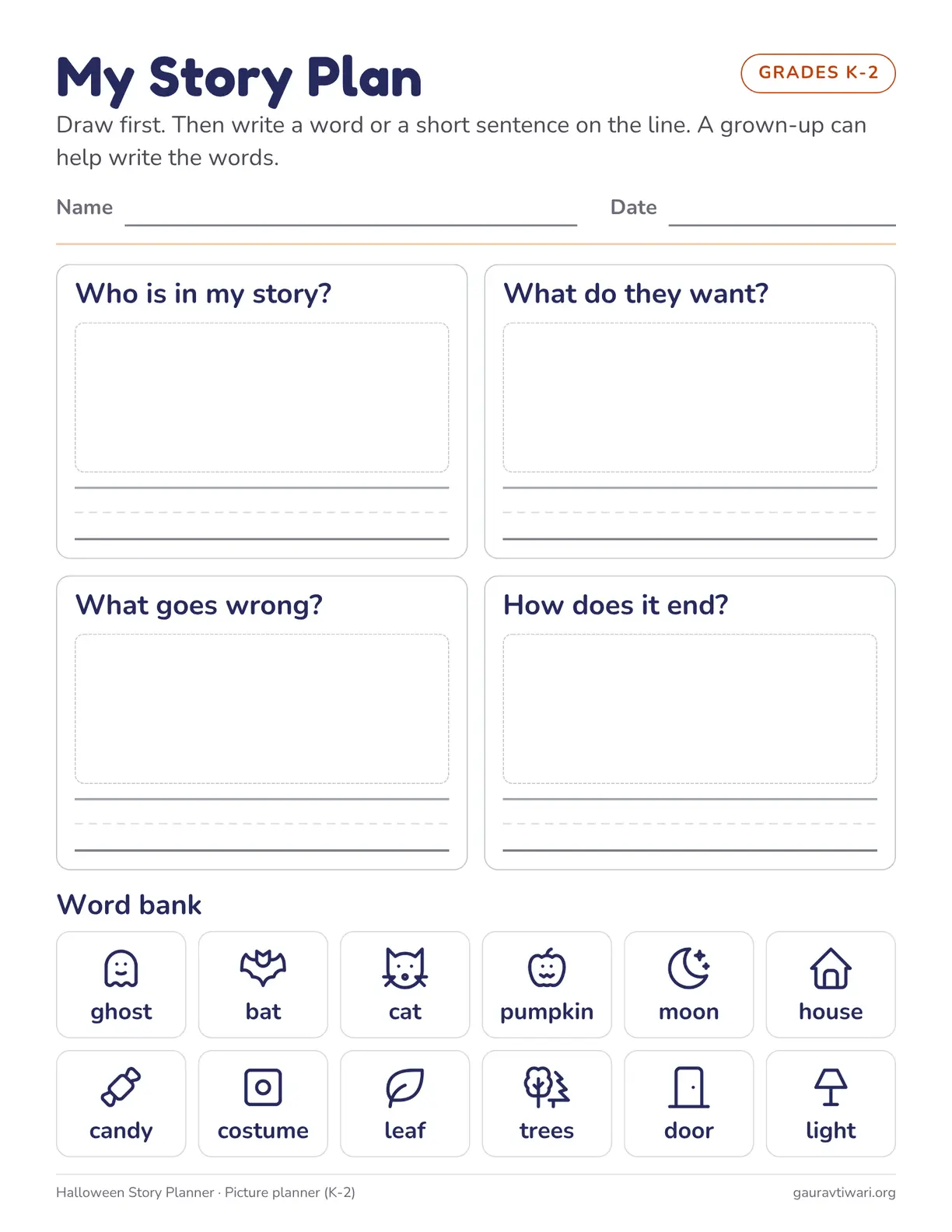
For The Wrong Porch, that might mean a K-2 writer draws Gus on the wrong porch and writes “The pumpkin is lost,” a fourth grader writes the whole story from the plan, and a seventh grader retells the morning from Theo’s side, where the pumpkin really did look like a present.
Revise the Story
Revision is where most young writers run out of patience, so the checklist is short and asks for one fix at a time. It is printed 3 to a page in the planner pack:
- Goal: a reader knows what my character wants by the end of the first part.
- Order: someone else can follow what happens first, next and last.
- Clear names: the reader always knows who “he,” “she,” “they” and “it” are.
- Details: I added at least 2 things a reader can see, hear, smell or feel.
- Sentences: I read it aloud, and each sentence starts with a capital letter and ends with a stop.
- Ending: the problem is solved, or my character has changed.
Here is one meaningful revision, using a sample draft written for this guide. The first version is a very common shape: every sentence is true, but the reader sees nothing.
Before
We went to the house. The kid had our pumpkin. I was mad. I asked for it back.
After
Number 21 had a pumpkin on the steps, and it was Gus. Someone had drawn a giant smile on him in green marker. A little boy in dinosaur pajamas sat next to him with both arms around his stem. I opened my mouth to say “That’s ours,” and then I closed it again.
The revision fixes 2 checklist boxes. The details box gets a house number, a green marker and dinosaur pajamas, and “I was mad” turns into a mouth that opens and closes, which shows the feeling and sets up Maya’s choice. That is a better use of 10 minutes than hunting for spelling mistakes across the whole page.
Use the Pack in Class
Each format below uses the same files. The times are rough planning estimates for one lesson, so stretch them for slower writers:
- Individual writing: about 10 minutes to choose a card and fill the planner, 20 to 30 minutes to write and 10 minutes with the checklist.
- Paired planning: 2 children plan from one card together, then write separately. Comparing 2 stories written from one shared plan shows how differently the same 5 boxes can be told.
- Read-aloud first: read a Halloween picture book, then hand out a card with the same kind of character. My list of Halloween books for kids has options for younger readers.
- Writing center: laminate the cards and keep the word bank page next to them, so early finishers can start a new plan on their own.
The pack also fits around other Halloween-week work. After a lab from these Halloween science experiments, card 36 or the Opinion and Explain Planner turns what the class observed into an explain piece. A batch of Halloween slime gives K-2 writers something to describe with all 5 senses before card 8. And if you want a math block the same week, the Halloween math worksheets use the same grade bands.
If your school doesn’t celebrate Halloween, cards 41-48 and the planner are enough on their own. A pumpkin that grew too big for the fair truck practices the same goal-and-obstacle thinking as a haunted house, and nobody has to dress up for it.
FAQs on Halloween Writing Prompts
Go back to the goal box. Ask what the character wants and what could stop them from getting it. If the child still has nothing, offer 2 options out loud, such as “Does Maya take the pumpkin back or let Theo help?” Picking between 2 choices is much easier than inventing one from nothing.
Yes. Cards 41-48 use autumn and harvest themes, and the planner, word bank and checklist never mention the holiday. You can also swap single words on the other cards, such as a scarecrow for a ghost.
The goal, obstacle and choice boxes should be filled, because those decide the story. Setting and the first sentence are optional. Some writers find the ending while drafting, so let them leave it blank and come back once the choice is written.
The cards cover kindergarten to grade 8 in 3 bands, plus 8 autumn cards for any grade. The grade labels describe how much support a card assumes, so a confident grade 2 writer can use a grade 3-5 card.
Yes. Open the Canva version of the planner or the cards, click Use template and type over any prompt, word bank entry or sentence starter. Then download your copy as PDF Print and print it at 100%.
Yes. The PDFs and the Canva templates are free to edit, print and copy for your own class, homeschool group or family. The Canva versions need a free Canva account, and the PDFs need no account at all. Please share a link to this page instead of reposting the files.
If you want one place to start, print the story planner and give your writers The Wrong Porch. Fill the goal, obstacle and choice boxes first, then write the first scene.
Tell Google you want more of this.
Add Gaurav Tiwari as a preferred sourceOne tap, and this site shows up more often in your own Top Stories, AI Overviews and AI Mode. Remove it any time.
Disclaimer: This site is reader-supported. If you buy through some links, I may earn a small commission at no extra cost to you. I only recommend tools I trust and would use myself. Your support helps keep gauravtiwari.org free and focused on real-world advice. Thanks. - Gaurav Tiwari