by
by
The best linear algebra books are not interchangeable. The best text for computation is rarely the best first proof book. Separate matrix skill, geometric intuition, proofs, and data applications. This guide gives self-learners, mathematics students, engineers, and machine learning readers choosing the right level of linear algebra a clear first choice, 9 useful alternatives, and the limitation that should move you away from each pick.
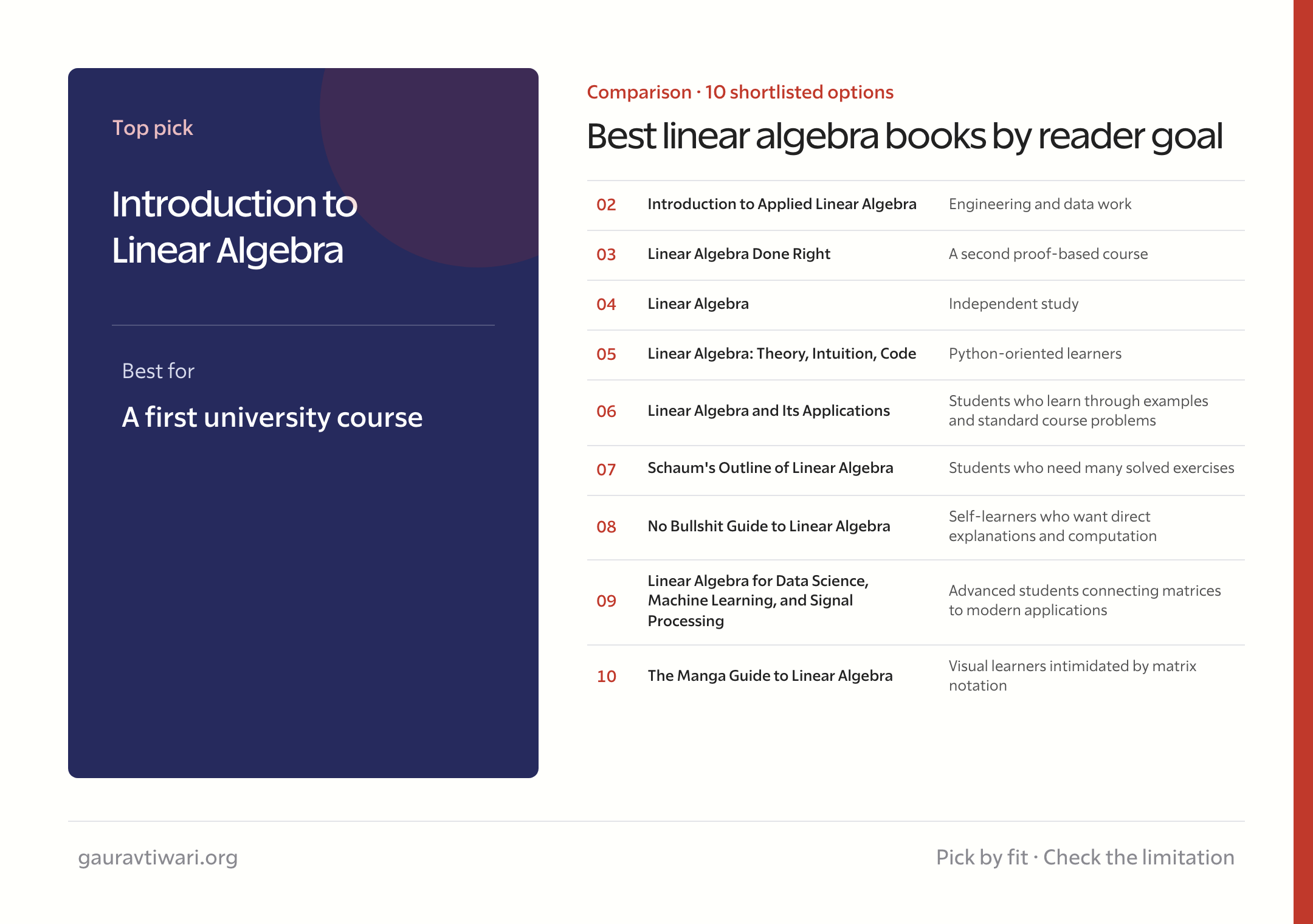
My top pick is Introduction to Linear Algebra for a first university course. Choose Introduction to Applied Linear Algebra for engineering and data work, or Linear Algebra Done Right for a second proof-based course. The rest of the guide explains why those jobs should not be collapsed into one bestseller ranking.
Important: Do not start with an elegant proof-heavy text if you still struggle with vectors, systems, and matrix multiplication.
Quick verdict
If you want one answer, start with Introduction to Linear Algebra. Strang teaches the subject the way it is actually used, with computation, geometry, and applications feeding one another instead of running as three separate stories. The comparison table links every recommendation directly, including Introduction to Applied Linear Algebra and Linear Algebra Done Right.
| Recommendation | Verdict | Best for | Starting level |
|---|---|---|---|
| Introduction to Linear Algebra | Top Pick | a first university course | Calculus helpful |
| Introduction to Applied Linear Algebra | Best for Applications | engineering and data work | Basic programming helpful |
| Linear Algebra Done Right | Best for Proofs | a second proof-based course | Proof experience required |
| Linear Algebra | Best for Free-First Study | independent study | College algebra and persistence |
| Linear Algebra: Theory, Intuition, Code | Best for Coding | Python-oriented learners | Basic Python helpful |
| Linear Algebra and Its Applications | Best for Worked Applications | students who learn through examples and standard course problems | College algebra and precalculus |
| Schaum's Outline of Linear Algebra | Best for Extra Problems | students who need many solved exercises | First linear algebra course |
| No Bullshit Guide to Linear Algebra | Best for Independent Review | self-learners who want direct explanations and computation | Algebra and basic geometry |
| Linear Algebra for Data Science, Machine Learning, and Signal Processing | Best for Data and Signals | advanced students connecting matrices to modern applications | Calculus and a first linear algebra course |
| The Manga Guide to Linear Algebra | Best for Visual Support | visual learners intimidated by matrix notation | High-school algebra |
If you are still building the surrounding skills or setup, use the best calculus books and the discrete math book guide. Those published guides cover adjacent decisions without forcing another overlapping purchase.
How I built this shortlist
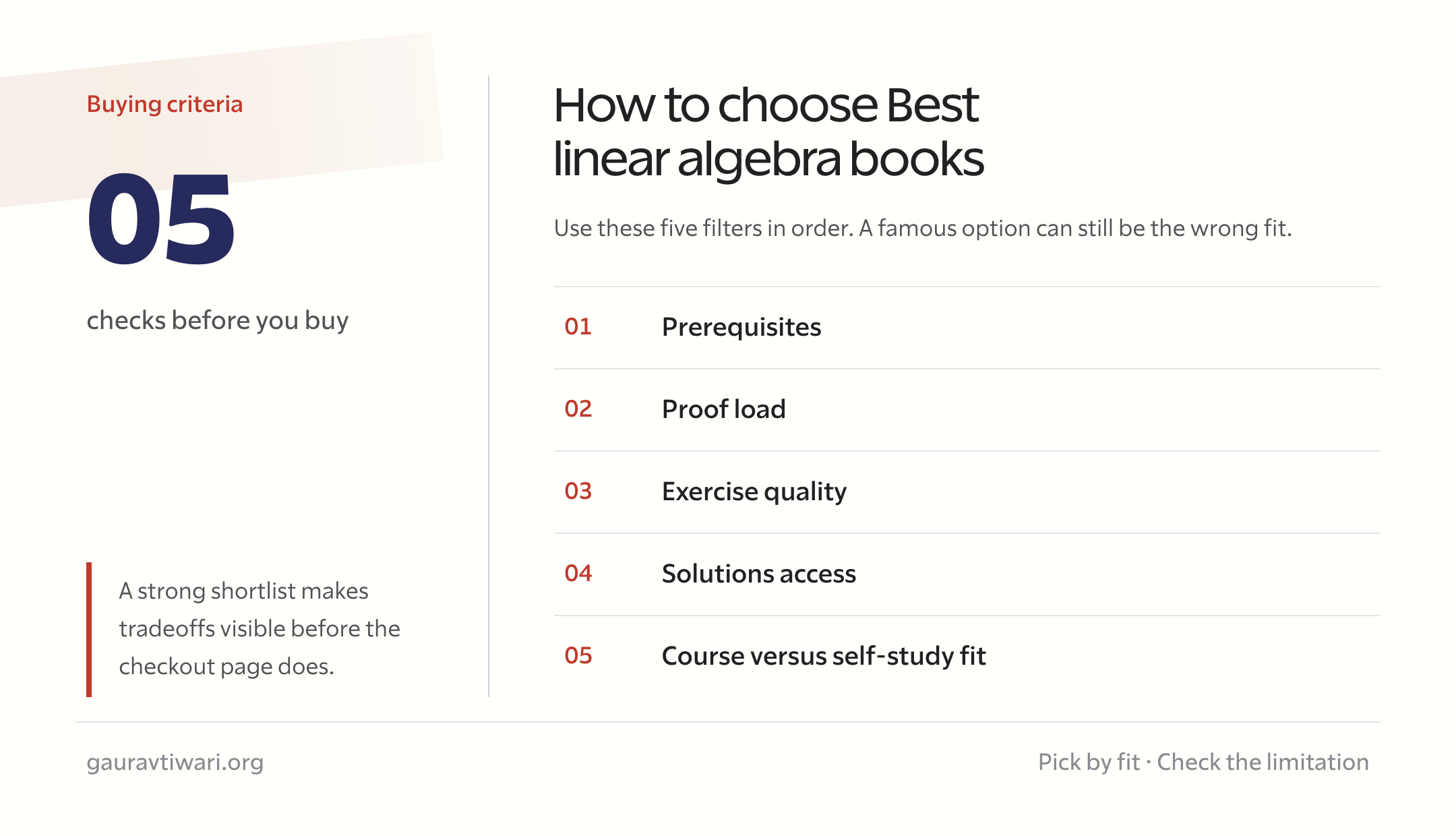
Linear algebra is home ground for me. I am a mathematics postgraduate, and this is the subject I have spent the most time explaining to stuck students, which is why this list is organized around where readers actually get stuck. I shortlisted by prerequisites, proof load, exercise quality, solutions access, and course versus self-study fit, and I separated the job each book does from the reputation attached to its title. A famous advanced text is not automatically the right first teacher.
The list is honest about its evidence. It uses current edition and catalog information, each book’s stated scope, and the learning path it supports. I know several of these texts closely and the rest by structure and reputation; I have not claimed to have completed every one cover to cover, and no entry pretends otherwise.
Prices, formats, and bundled access change. The links point to exact Amazon.com ASINs, but you should still match the author, edition, binding, seller, and included digital material before ordering.
Some links are affiliate links. If you buy through them, I may earn a commission at no extra cost to you. That does not change the recommendation or the limitations listed for each product.
The best linear algebra books by need
Every recommendation below names the job it handles well and the reason another reader should skip it. That distinction matters more than forcing 10 different products into one score.
1. Introduction to Linear Algebra
Gilbert Strang’s Introduction to Linear Algebra is the book I hand to anyone starting a serious first course. Strang’s gift is refusing to separate computation from meaning: you row-reduce, but you watch what the column space and null space are doing while you do it. His picture of the four fundamental subspaces is the single most useful mental image the subject has, and once it lands, half of the standard exam questions become obvious.
Calculus helps but is not load-bearing; fluency with algebra matters more. The honest condition is that this book performs best when paired with Strang’s free MIT lectures and a steady problem schedule. Read passively, it turns into a coffee-table book about matrices.
Buy it if you are starting a first university course and will actually do the problems. Skip it if you want a proofs-first treatment; that is Axler’s job further down. Compare editions on Amazon.com or Amazon.in.
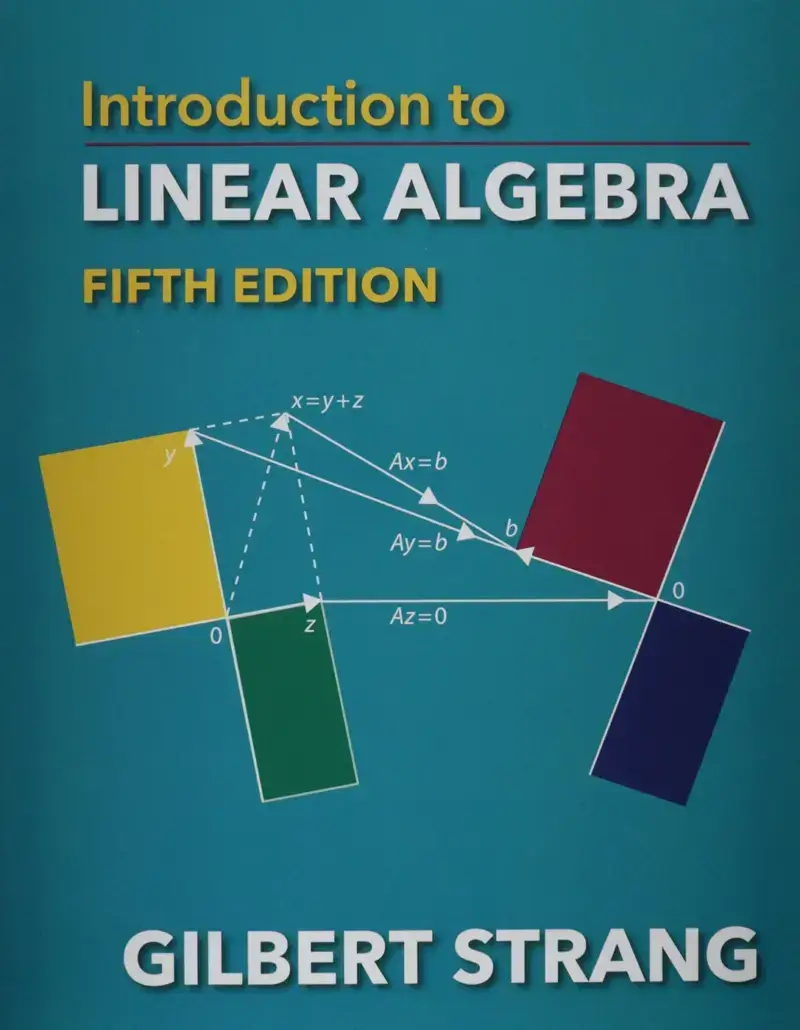
Introduction to Linear Algebra
- By Gilbert Strang
- Best for: a first university course
- Level: Calculus helpful
- Main strength: Balances computation, geometry, applications, and serious conceptual development.
- Watch-out: The book is strongest with Strang's lectures and a steady problem schedule.
- Verify the exact edition, format, and seller
2. Introduction to Applied Linear Algebra
Introduction to Applied Linear Algebra by Stephen Boyd and Lieven Vandenberghe is the applications pick, and it is refreshingly clear about what it is. The book builds vectors, matrices, and least squares around problems engineers and data people actually solve: regression, classification, control, portfolio weighting. Theory arrives when a problem needs it, never before.
Basic programming experience helps. Know one thing going in: the book famously all but skips eigenvalues, which tells you exactly what it is and is not for. A theorem-first pure mathematics course needs a different text entirely.
Buy it if your linear algebra exists to serve engineering or data work. Skip it if you are in a theorem-first pure mathematics course. The complete PDF is legally free on Boyd’s Stanford page, so read before you decide between it and print on Amazon.com or Amazon.in.
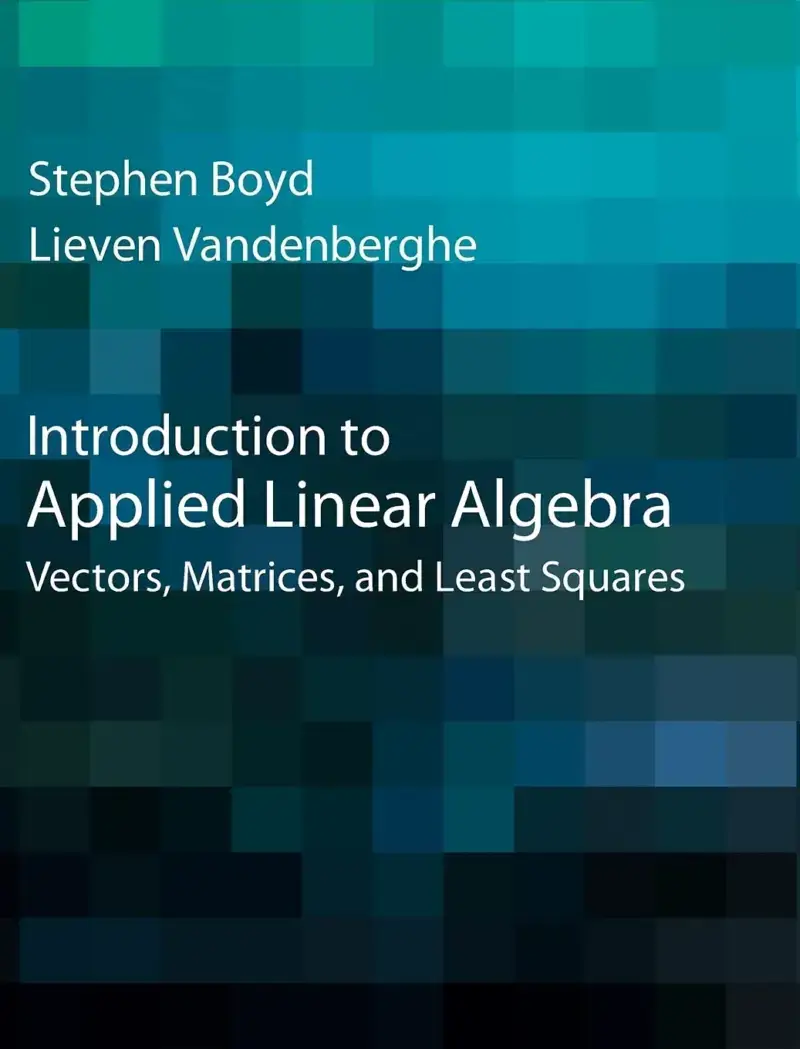
Introduction to Applied Linear Algebra
- By Stephen Boyd and Lieven Vandenberghe
- Best for: engineering and data work
- Level: Basic programming helpful
- Main strength: Builds vectors, matrices, and least squares around modern applications.
- Watch-out: It is less suited to a traditional theorem-first pure mathematics course.
- Verify the exact edition, format, and seller
3. Linear Algebra Done Right
Linear Algebra Done Right by Sheldon Axler is the proofs pick, and its famous design choice is the whole argument: it starts from vector spaces and refuses to touch determinants until the end. For a second pass at the subject, when you already compute confidently and want to understand linear operators as objects, it is the cleanest treatment ever written.
Proof experience is required, not recommended. Handing this to a first-time student is how you convince someone the subject is inaccessible; the delayed determinants that make it elegant as a second book make it cruel as a first one.
Buy it if a proof-based course or self-study is the actual requirement. Skip it if you have never written proofs. The fourth edition is Open Access: Springer hosts the full PDF legally free via Axler’s site, so paper from Amazon.com or Amazon.in is a preference, not a requirement.
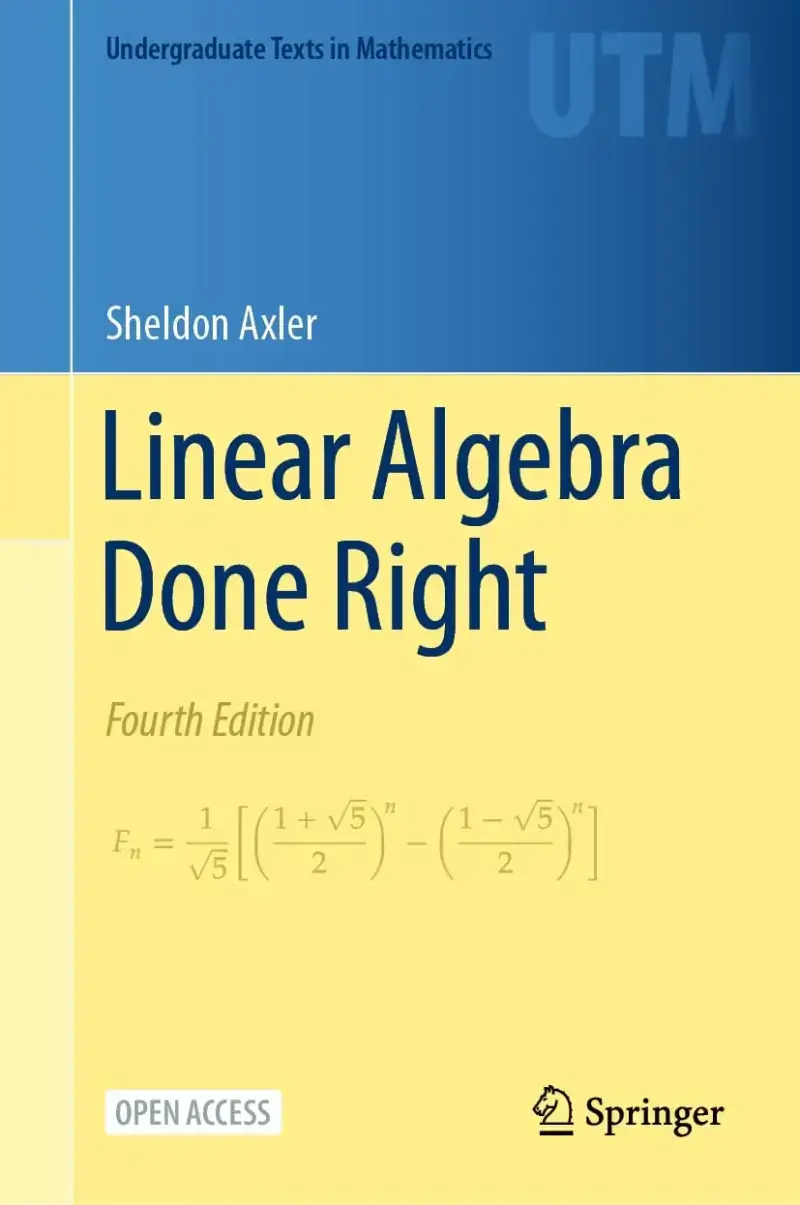
- By Sheldon Axler
- Best for: a second proof-based course
- Level: Proof experience required
- Main strength: Develops vector spaces and linear operators with unusually clean structure.
- Watch-out: It delays determinants and expects mathematical maturity.
- Verify the exact edition, format, and seller
4. Linear Algebra by Jim Hefferon
Jim Hefferon’s Linear Algebra is the free-first pick and one of the quiet triumphs of open textbooks: a complete, rigorous first course, with worked answers available for every exercise, given away legally by the author. For a self-learner without a lecturer to ask, those full answers are worth more than any production polish a commercial text can offer.
College algebra and persistence are the real prerequisites. The print listing exists purely for people who study better on paper; the text is identical to the free download.
Buy it if you want the paper copy of a text you already know is free. Skip it if the PDF serves you fine; the author would not mind. Print sits on Amazon.com or Amazon.in.
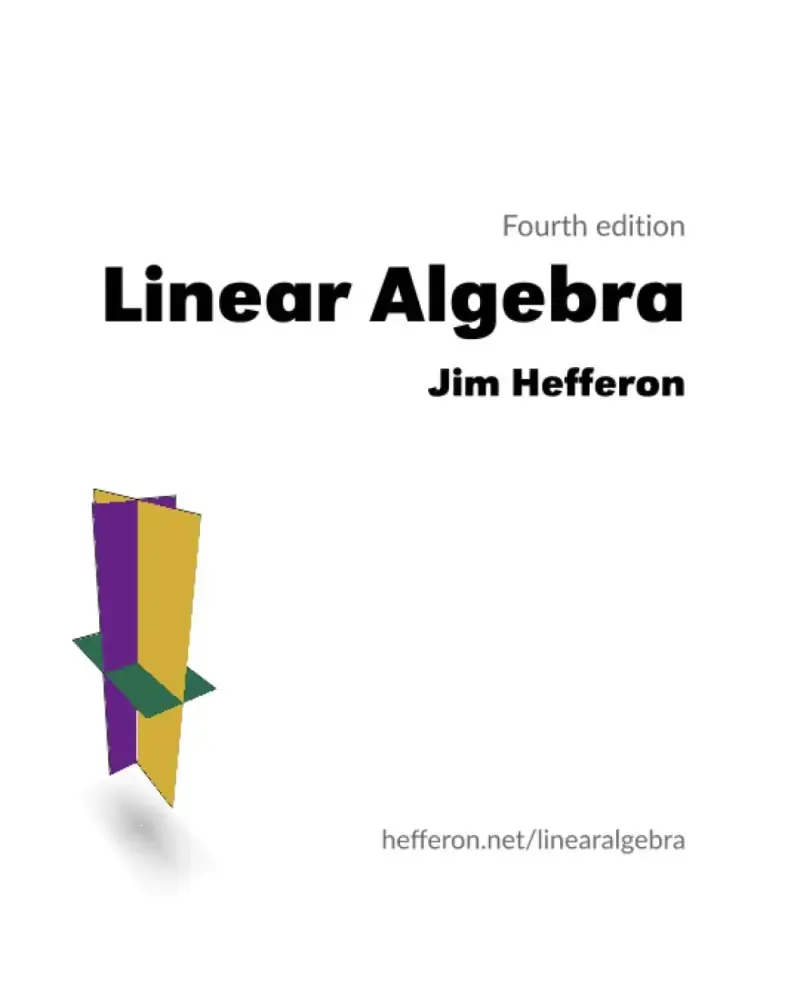
- By Jim Hefferon
- Best for: independent study
- Level: College algebra and persistence
- Main strength: Provides a rigorous full course with exercises and legal free access from the author.
- Watch-out: The print listing is optional because the same text is freely available.
- Verify the exact edition, format, and seller
5. Linear Algebra: Theory, Intuition, Code
Linear Algebra: Theory, Intuition, Code by Mike X Cohen is the pick for people whose home language is Python. Concepts land through NumPy experiments you can run and modify, which suits learners who trust a result more after they have computed it themselves.
Basic Python is enough to start. Treat it as a companion for applied learning rather than a substitute for a full course; it verifies intuition, it does not build theory.
Buy it if you think in code and want the math to compile. Skip it if you need a proof-based course credit. Listings are on Amazon.com or Amazon.in.
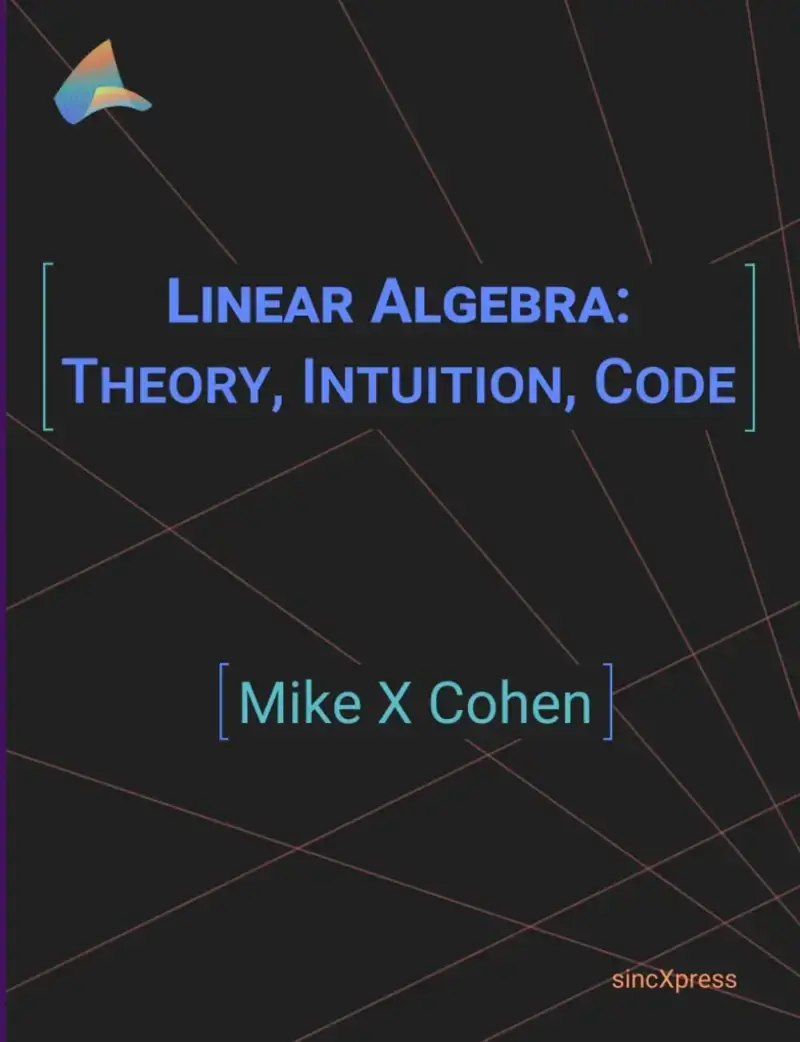
Linear Algebra: Theory, Intuition, Code
- By Mike X Cohen
- Best for: Python-oriented learners
- Level: Basic Python helpful
- Main strength: Connects theory with geometric intuition and executable examples.
- Watch-out: It is a companion for applied learning, not a substitute for a full proof course.
- Verify the exact edition, format, and seller
6. Linear Algebra and Its Applications
Linear Algebra and Its Applications by David Lay, Steven Lay, and Judi McDonald is the standard classroom textbook, and that is a compliment: a conventional progression through matrix methods, vector spaces, and eigenvalues, backed by enormous problem sets keyed to how courses actually test. When a syllabus lists “Lay”, this is why.
College algebra and precalculus are enough to enter. The trade is clear: less conceptual daring than Strang, less rigor than Axler, more predictable scaffolding than either. The book is currently in its sixth edition; earlier editions cover the same core for far less, so match the ISBN your course requires before paying new-edition prices.
Buy it if you learn through worked examples and standard course problems. Skip it if you want Strang’s intuition or Axler’s rigor instead of classroom convention. Compare editions on Amazon.com or Amazon.in.
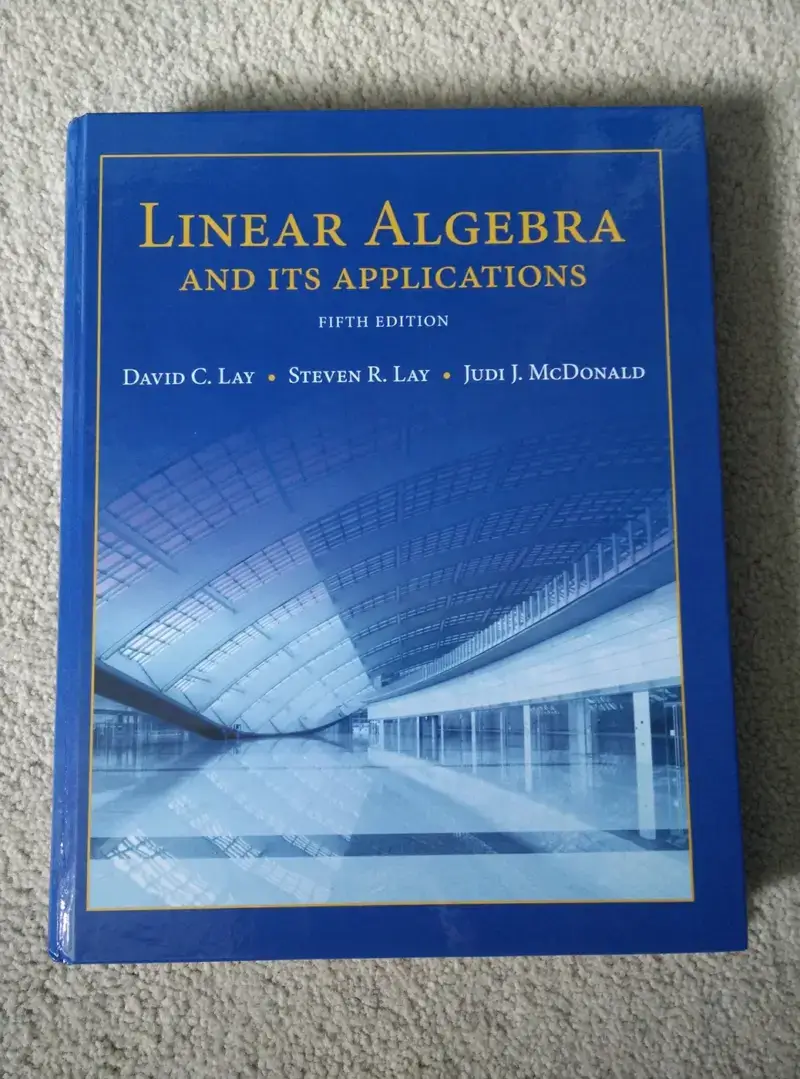
Linear Algebra and Its Applications
- By David Lay, Steven Lay, and Judi McDonald
- Best for: students who learn through examples and standard course problems
- Level: College algebra and precalculus
- Main strength: Builds matrix methods, vector spaces, eigenvalues, and applications through a conventional classroom progression.
- Watch-out: The presentation is less conceptual than Strang and less proof-focused than Axler.
- Verify the exact edition, format, and seller
7. Schaum's Outline of Linear Algebra
Schaum’s Outline of Linear Algebra by Seymour Lipschutz and Marc Lipson is the problem gym. Concise review, then hundreds of fully solved exercises, at a fraction of textbook prices. Nobody ever understood linear algebra by reading about it, and this is the cheapest cure for that.
It assumes you are taking or have taken a first course. A gym is not a teacher: use it beside a main text, not instead of one.
Buy it if your course needs more solved problems than the textbook provides. Skip it if you have no main text; concepts have to come from somewhere. It is on Amazon.com or Amazon.in.
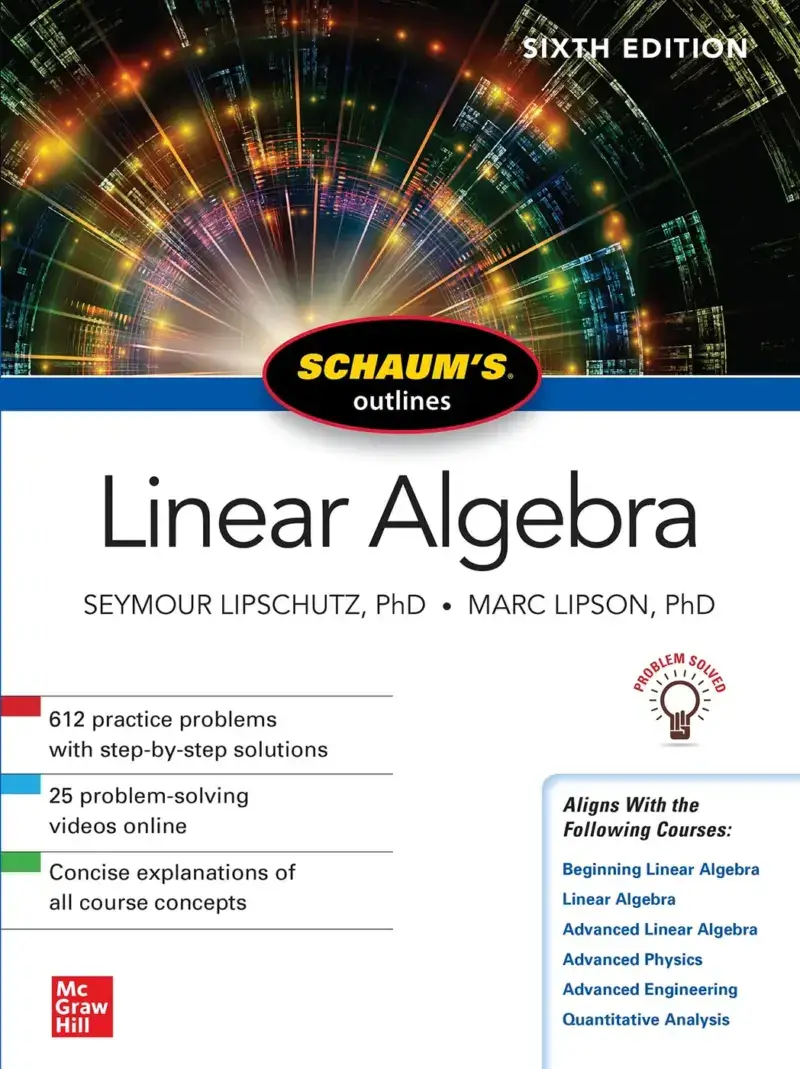
Schaum's Outline of Linear Algebra
- By Seymour Lipschutz and Marc Lipson
- Best for: students who need many solved exercises
- Level: First linear algebra course
- Main strength: Offers concise review followed by a large bank of worked and practice problems.
- Watch-out: It works best as a supplement, not as the only source for concepts and proofs.
- Verify the exact edition, format, and seller
8. No Bullshit Guide to Linear Algebra
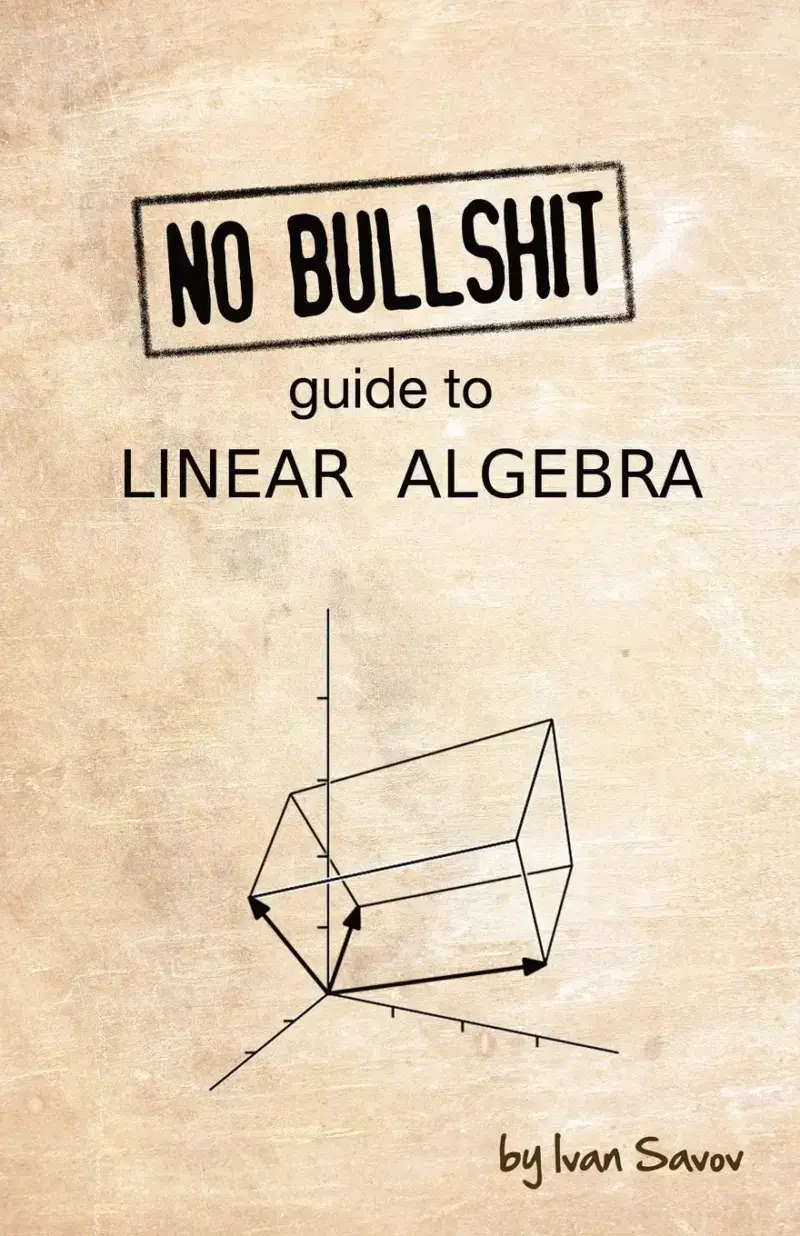
No Bullshit Guide to Linear Algebra by Ivan Savov earns its title: one compact volume that walks from high-school algebra to university linear algebra in a direct, informal voice, connecting procedures to geometry and applications without padding. For adult self-learners restarting math after years away, this tone is the difference between finishing and quitting.
Algebra and basic geometry are enough to start. The compression that makes it readable also means it cannot replace a full proof-based university text; it is a fast, honest bridge, not the destination.
Buy it if you are self-teaching and want straight talk plus computation. Skip it if a proof-based university text is the actual requirement. Find it on Amazon.com or Amazon.in.
No Bullshit Guide to Linear Algebra
- By Ivan Savov
- Best for: self-learners who want direct explanations and computation
- Level: Algebra and basic geometry
- Main strength: Uses an informal voice to connect algebraic procedures with geometry and applications.
- Watch-out: Its compressed style cannot replace a full proof-based university text.
- Verify the exact edition, format, and seller
9. Linear Algebra for Data Science, Machine Learning, and Signal Processing
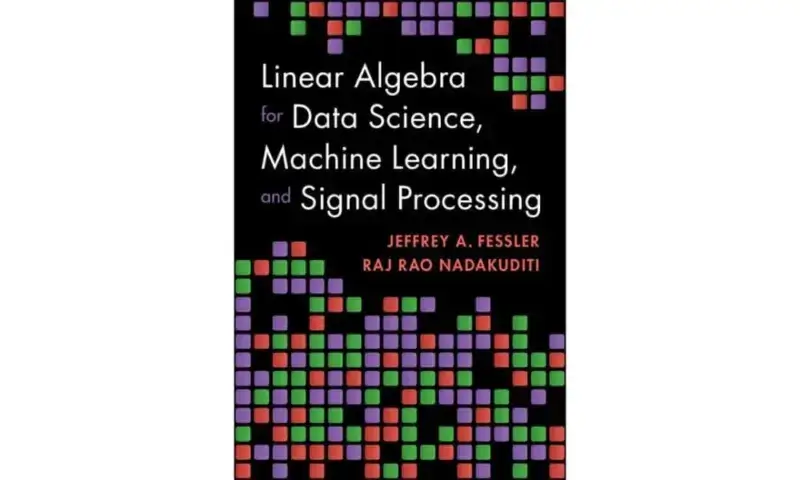
Linear Algebra for Data Science, Machine Learning, and Signal Processing by Jeffrey A. Fessler and Raj Rao Nadakuditi is the advanced bridge: from matrix theory to the SVD, low-rank approximation, optimization, and estimation as they are used in modern data and signal work. This is where the subject stops being coursework and starts being infrastructure.
Calculus and a completed first course in linear algebra are genuine prerequisites. An introductory machine-learning learner who arrives without them will bounce off; that is the book working as designed, not failing.
Buy it if you have a first course behind you and data or signal processing ahead of you. Skip it if you are still building basics; start with Strang or Boyd and return. Listings are on Amazon.com or Amazon.in.
Linear Algebra for Data Science, Machine Learning, and Signal Processing
- By Jeffrey A. Fessler and Raj Rao Nadakuditi
- Best for: advanced students connecting matrices to modern applications
- Level: Calculus and a first linear algebra course
- Main strength: Develops decompositions, optimization, estimation, and signal-processing uses with current technical context.
- Watch-out: It expects stronger mathematics than an introductory machine-learning learner may have.
- Verify the exact edition, format, and seller
10. The Manga Guide to Linear Algebra
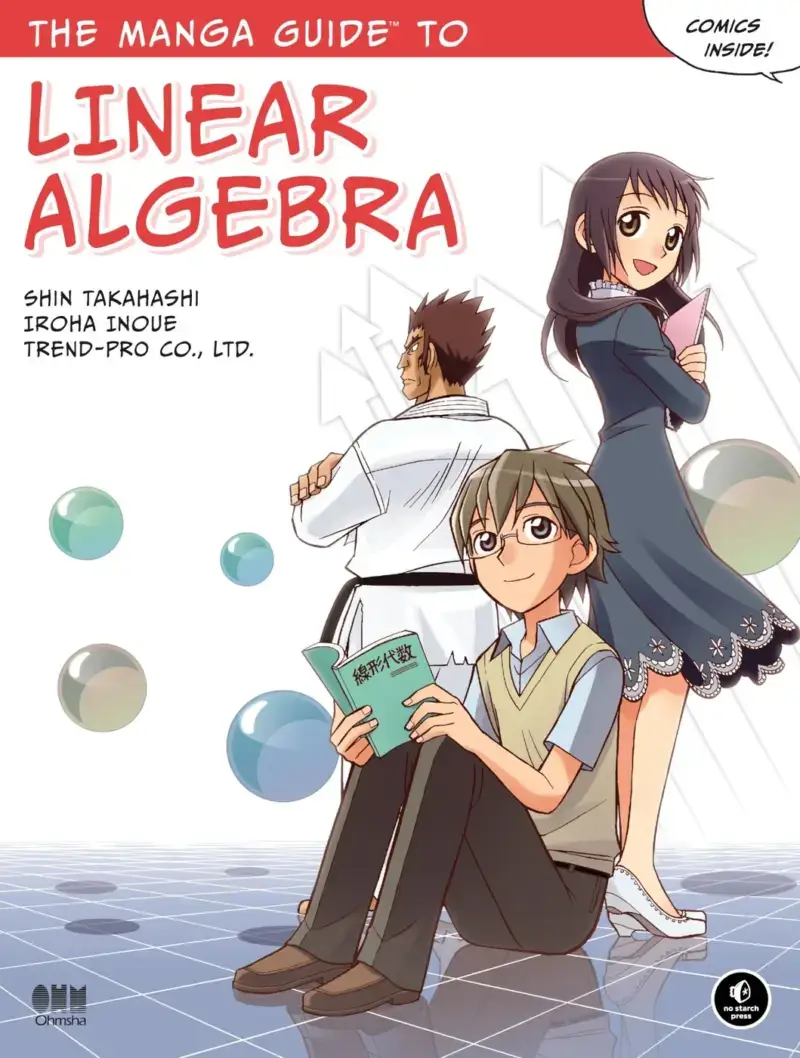
The Manga Guide to Linear Algebra by Shin Takahashi and Iroha Inoue is the gentlest on-ramp on this list. It teaches vectors, transformations, determinants, and eigenvalues through story and pictures, and it works precisely because it takes the reader’s intimidation seriously instead of pretending notation is easy.
High-school algebra is enough. The story format and limited depth make it a companion rather than a course textbook; pair it with any real text on this list once the fear is gone.
Buy it if matrix notation makes your eyes slide off the page and you want the fear gone first. Skip it if you need an actual course textbook. It lives on Amazon.com or Amazon.in.
The Manga Guide to Linear Algebra
- By Shin Takahashi and Iroha Inoue
- Best for: visual learners intimidated by matrix notation
- Level: High-school algebra
- Main strength: Uses a narrative and diagrams to make vectors, transformations, determinants, and eigenvalues approachable.
- Watch-out: The story format and limited depth make it a companion rather than a course textbook.
- Verify the exact edition, format, and seller
Free options before you buy
Use these legal free resources first. They can cover the foundation, reveal the level you need, and prevent an unnecessary purchase.
- Jim Hefferon's Linear Algebra: a complete legal open textbook with exercises, answers, and supporting material.
- Linear Algebra Done Right, fourth edition: Axler's current edition is an Open Access book; Springer hosts the full PDF legally free.
- Introduction to Applied Linear Algebra (VMLS): Boyd and Vandenberghe publish the complete PDF free on the Stanford site.
- MIT OpenCourseWare 18.06 Linear Algebra: Gilbert Strang's free lectures, assignments, and exams.
- 3Blue1Brown's Essence of Linear Algebra: the best visual intuition for transformations, determinants, and eigenvectors ever put on a screen.
Notice that two of my ten paid picks appear in this free list, because their authors publish them openly. That is not a reason to skip this guide’s links; it is a reason to try a book before deciding whether the print copy earns shelf space. A free resource is not automatically inferior to a paid one. What a paid title usually buys is editing, sequence, print usability, or a specialized point of view.
How to choose
Start with the failure condition, not the bestseller rank. For this topic, prerequisites, proof load, and exercise quality change the decision faster than a longer feature list.
Check prerequisites
For this subject, the prerequisite that matters is algebra fluency, not calculus; only Strang assumes calculus exposure, and lightly. The prerequisite people actually miss is proof-writing: if you have never proved anything, every proofs-first text on this list will hurt regardless of its reputation. Match the book to the mathematics you have, not the mathematics you intend to have.
Check proof load
Linear algebra is really two courses wearing one name: a computational course about solving systems and factoring matrices, and a proof course about vector spaces and operators. Engineers and data scientists mostly need the first; mathematics majors eventually need both. Decide which course the next six months require, because a book built for the other one will feel wrong every single chapter.
Check exercise quality
You learn this subject through problems or not at all, so weigh exercises like they are the product. Look at a sample chapter’s problem sets: are they graded from mechanical to conceptual, and do answers exist anywhere? Hefferon publishes full answers, Schaum’s is solved problems by design, and Strang’s course pairs with decades of MIT exams and solutions. That is evidence; a back-cover blurb is not.
Check solutions access
Solutions access matters most when nobody is grading you. A course student has a TA to catch errors; a self-learner with an answerless textbook has no way to know whether three weeks of work built skill or reinforced mistakes. If you are studying alone, treat available answers as a hard requirement, not a nice-to-have.
Check course versus self-study fit
Course students should buy exactly what the syllabus names, including the edition, because problem numbers shift between editions and a mismatched book turns every assignment into a scavenger hunt. Self-learners are free: an older edition or a free PDF covers the same mathematics, and the money saved buys a Schaum’s for practice.
A practical reading plan
One main book plus one free course or open text is enough to start. Reading several introductions in parallel feels productive but delays problem solving, practice, and recall.
- Start with Introduction to Linear Algebra if its level and use case match your goal.
- Use Introduction to Applied Linear Algebra instead when your goal is engineering or data work rather than a mathematics course.
- Schedule practice, notes, exercises, or applied work after every reading block.
- Review errors and unclear terms once a week instead of highlighting more pages.
- Move to Linear Algebra Done Right when its specialization becomes the next bottleneck.
For adjacent material, use the real analysis book shortlist and machine learning courses. Those guides can fill prerequisite or application gaps without turning this list into a pile of overlapping purchases.
Common buying mistakes
Most bad purchases in this category are predictable.
- Buying for reputation: A famous advanced text can be the wrong first teacher.
- Ignoring the edition: Exam formats, software libraries, examples, and bundled access can change.
- Collecting instead of practicing: A smaller book completed with exercises beats a shelf of unread references.
- Skipping free material: Use the open resources below to test the level and your interest first.
- Confusing scope with quality: A concise review book and a full textbook solve different problems.
The five-minute worksheet
Before choosing from the best linear algebra books, answer these questions in writing. The exercise makes hidden assumptions visible and gives you a reason for the final choice. Keep the answers beside the comparison table, because a product that cannot satisfy them should leave the shortlist even when its reviews look impressive.
- Outcome: Write the exact course, project, exam section, or skill you want the book to support.
- Starting point: Name the mathematics, coding, proof, science, or business knowledge you already have.
- Practice: Decide whether you need worked examples, exercises, solutions, projects, or a compact reference.
- Format: Check whether print, ebook, used, rental, or bundled access fits the way you study.
- Stop rule: Do not buy Introduction to Applied Linear Algebra until Introduction to Linear Algebra or a free resource exposes a specific gap.
This worksheet turns a book list into a learning decision. It also gives you a reason to stop shopping and start reading.
Which book should you choose?
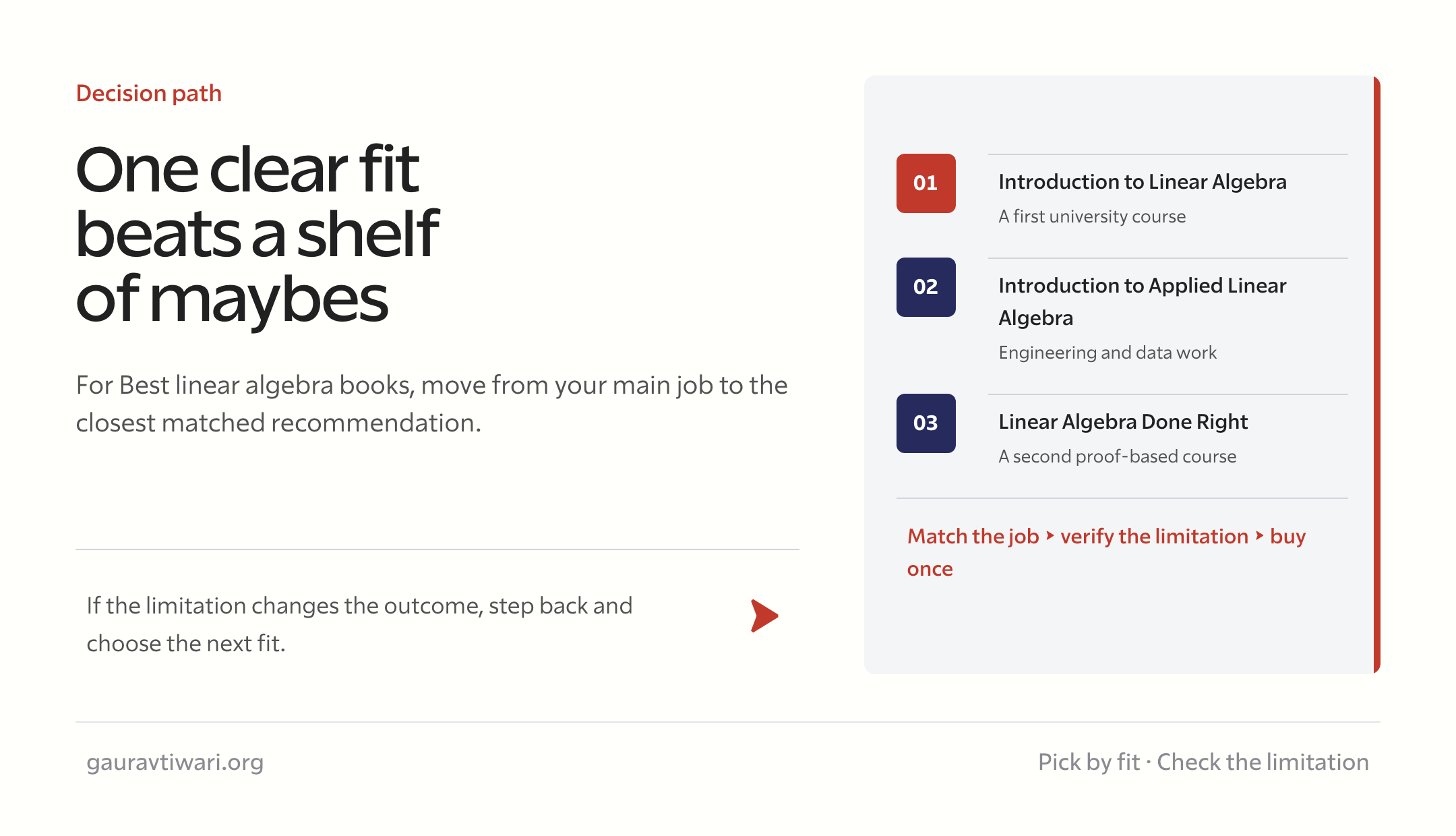
Choose Introduction to Linear Algebra when a first university course is the main job. Move to Introduction to Applied Linear Algebra for engineering and data work. Pick Linear Algebra Done Right only when a second proof-based course is the real requirement.
The shortest useful decision is this: match the best linear algebra books to your next task, confirm the exact edition or model, and keep the limitation visible. A well-matched second choice is better than a famous top pick aimed at someone else.
Frequently asked questions
What are the best linear algebra books?
Introduction to Linear Algebra is the top pick for a first university course. Introduction to Applied Linear Algebra is better for engineering and data work, while Linear Algebra Done Right suits a second proof-based course. Match the prerequisite and teaching style before choosing.
How many of the best linear algebra books should I buy?
Buy one main book first. Add a second only when it fills a specific gap such as extra problems, visual explanation, technical depth, or exam practice. More books do not create more study time.
Is an older edition worth buying?
An older edition can be good value when the core theory is stable and you do not need online access. Avoid old editions for changing exams, software libraries, platform instructions, or assignments tied to a current course.
Should I buy print, ebook, or used?
Choose print for heavy annotation and equation work, ebook for search and portability, and used for stable textbooks without required access codes. Always match the ISBN or ASIN to the edition you intend to study.
Are there good free alternatives?
Yes. Jim Hefferon’s Linear Algebra, the Open Access fourth edition of Linear Algebra Done Right, Boyd and Vandenberghe’s free PDF of Introduction to Applied Linear Algebra, and MIT OpenCourseWare 18.06 are all legal free starting points. Use them to test the level before paying for anything.
How were these books shortlisted?
The shortlist compares prerequisites, proof load, exercise quality, solutions access, and course versus self-study fit. It does not use unverified ratings, fixed prices, or claims that every title was personally completed.
Tell Google you want more of this.
Add Gaurav Tiwari as a preferred sourceOne tap, and this site shows up more often in your own Top Stories, AI Overviews and AI Mode. Remove it any time.
Disclaimer: This site is reader-supported. If you buy through some links, I may earn a small commission at no extra cost to you. I only recommend tools I trust and would use myself. Your support helps keep gauravtiwari.org free and focused on real-world advice. Thanks. - Gaurav Tiwari