A dissertation rarely goes wrong all at once. The question drifts, an archive closes or a partner withdraws in week 9, and the plan you wrote in month one stops matching the project. This book shows you how to keep the question, the evidence and the deadline in one project while everything underneath it changes.
chapters in 5 parts, from the first question to the final upload
3
student projects followed from proposal to defense
24
diagrams for the decisions that are easier to see than read
9
working templates, each with a filled example and a blank copy
328
pages in the 6 × 9 edition, or 271 in A4
Three Projects That Go Wrong and Recover
Advice about dissertations is easy to agree with and hard to use. So the book follows three students through their whole projects, and each of them hits a real setback halfway through.
Amina · History · archival study
The archive closes in week 8.
Amina is reading residents’ letters to a city council about water supply, 1952 to 1964. In week 8 the record office closes the later letters for 8 months.
What she does next: She narrows the letters to 1952 to 1957 and turns the question from change over time to how residents framed their claims.
Follow it in Chapters 3, 11 and 13
Daniel · Management · interview study
The partner company withdraws in week 9.
Daniel has 4 of 14 planned interviews when the company restructures and pulls access. His ethics approval was written around their HR team.
What he does next: He recruits through professional networks after a 9-day ethics amendment, ends with 11 interviews and states the new limits plainly.
Follow it in Chapters 5, 7 and 13
Mei · Engineering · design capstone
Her own data has a 1-hour error in week 17.
Mei is testing a low-cost sensor shield against a weather station. Her loggers wrote local time, the station wrote UTC and the clocks changed.
What she does next: She fixes the join, logs the anomaly, reruns 9 days of field tests and narrows her claim to the conditions she actually tested.
Follow it in Chapters 12, 19 and 21
All three are invented examples. Their documents, from the first project spine to the last decision log, are printed in the book so you can copy the shape.
Look Inside
Most decisions in a dissertation have a shape, so the book draws them. You can open any page below at full size.
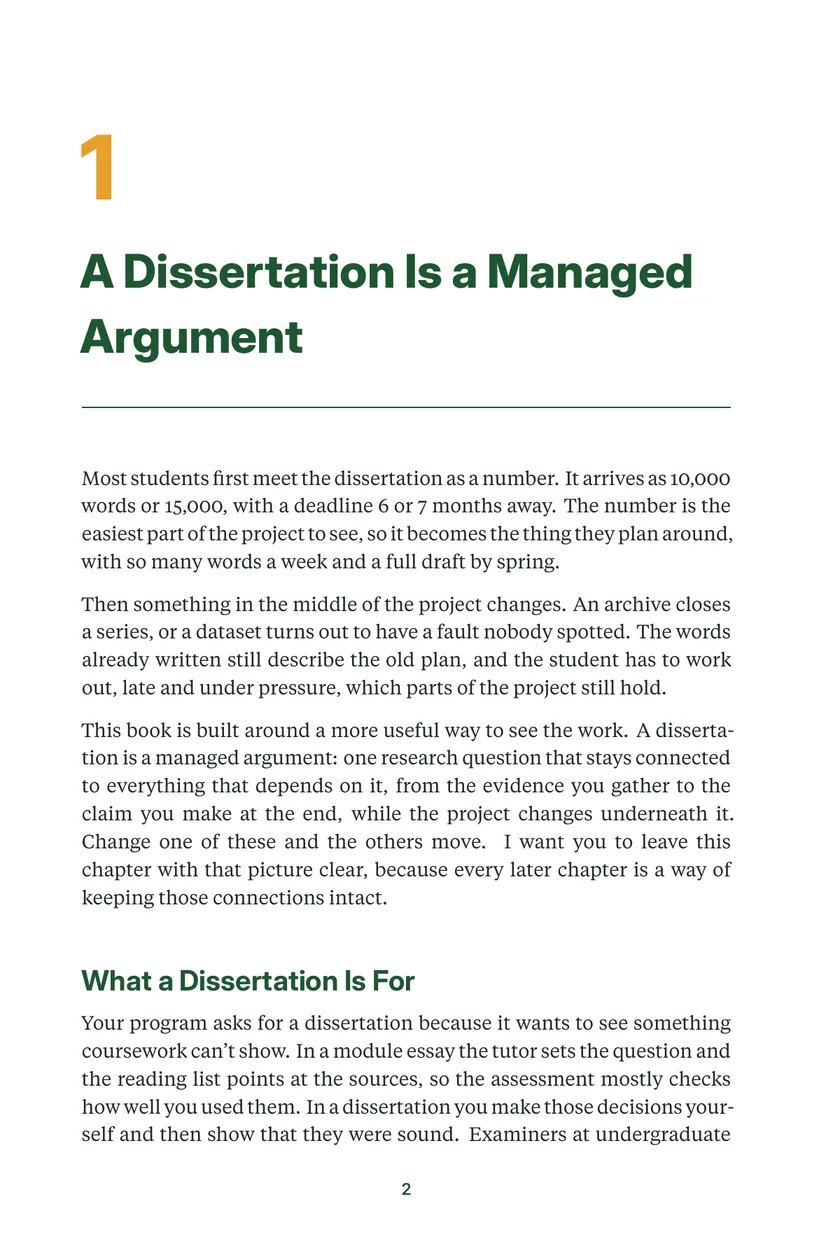
Chapter 1. Why a dissertation is a managed argument, and why the long-essay model breaks at this scale.
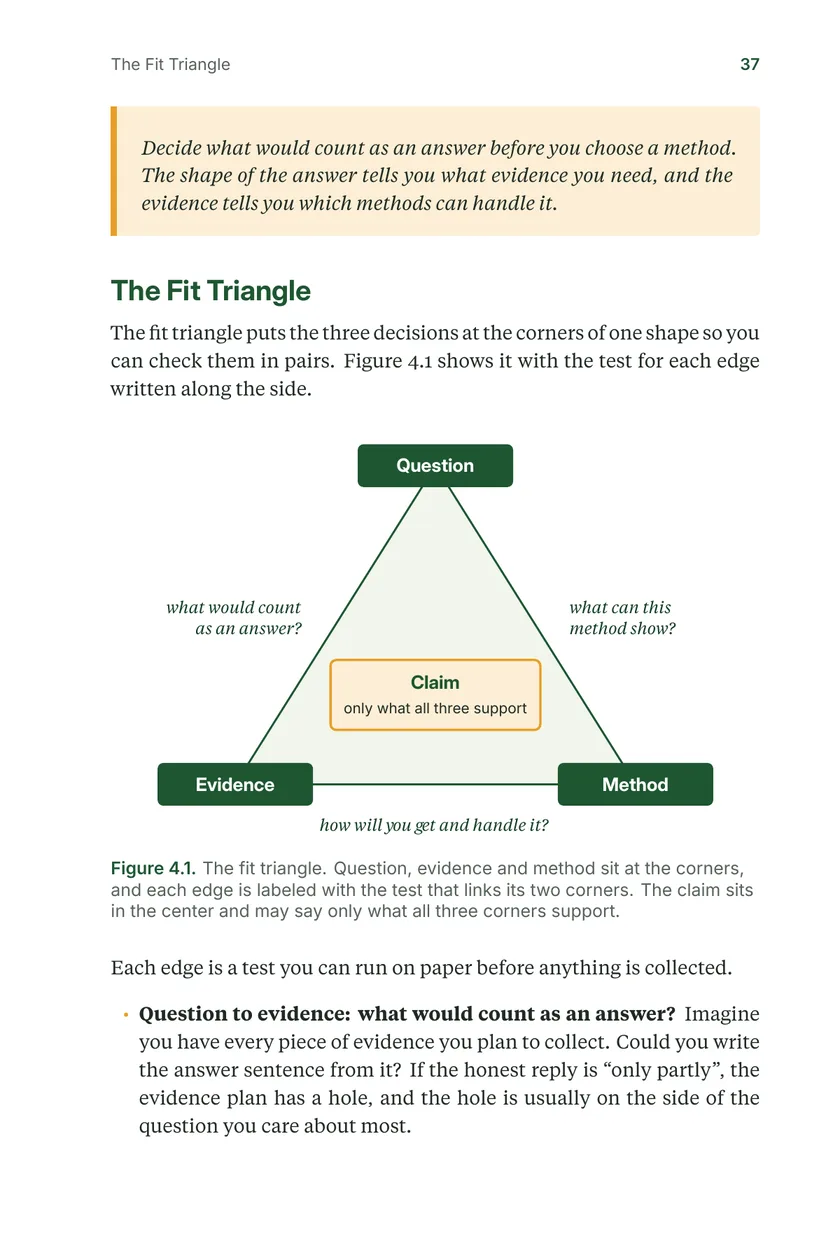
Chapter 4. The fit triangle: what would count as an answer, how you will get it and what your method can show.
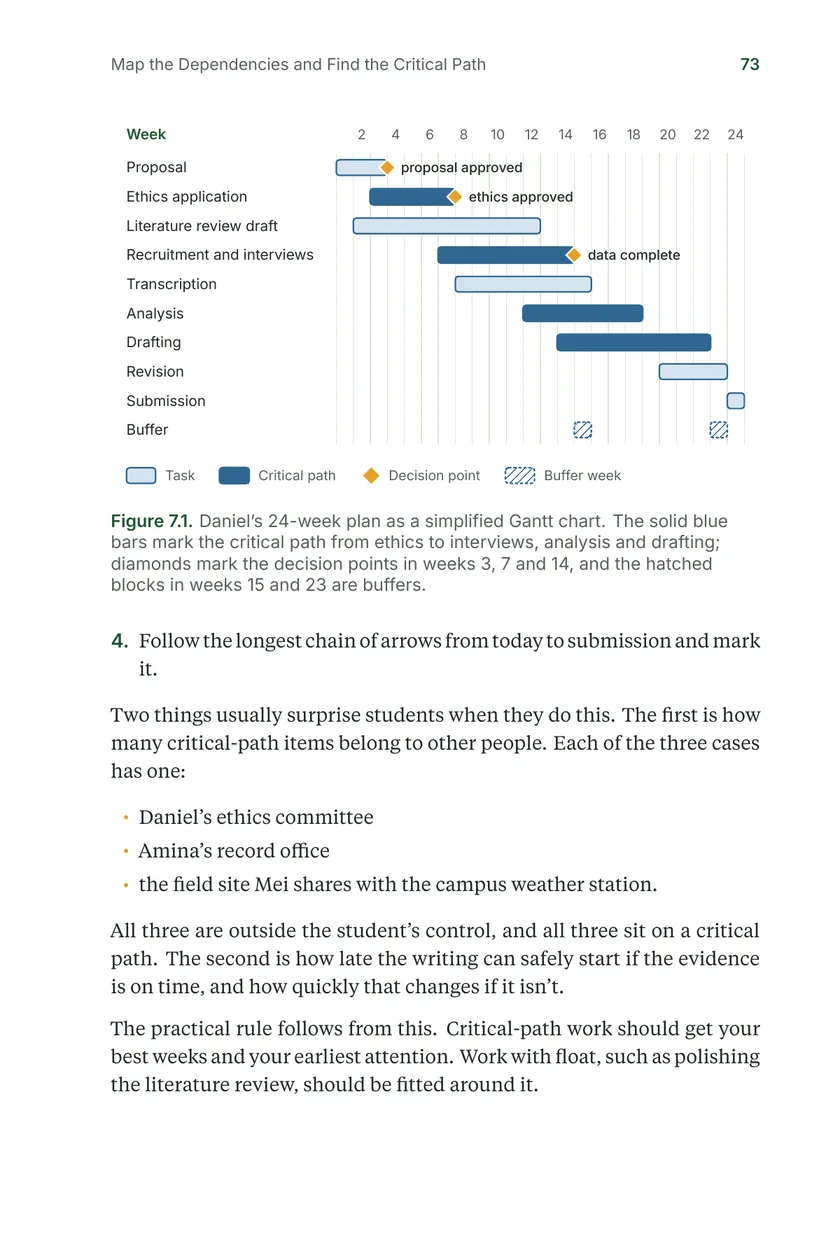
Chapter 7. Daniel's 24-week plan with the critical path, decision points and buffer weeks marked.
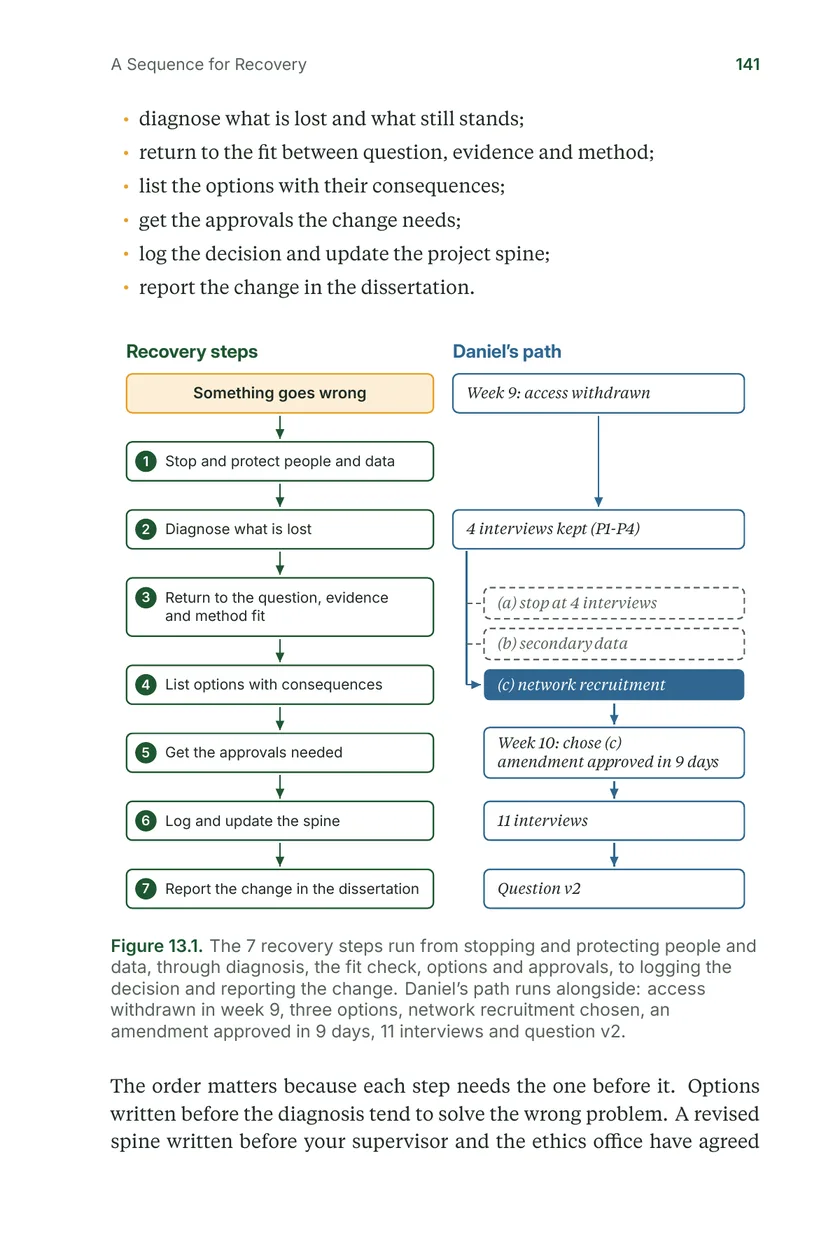
Chapter 13. The 7 recovery steps beside Daniel’s real path after his access was withdrawn.
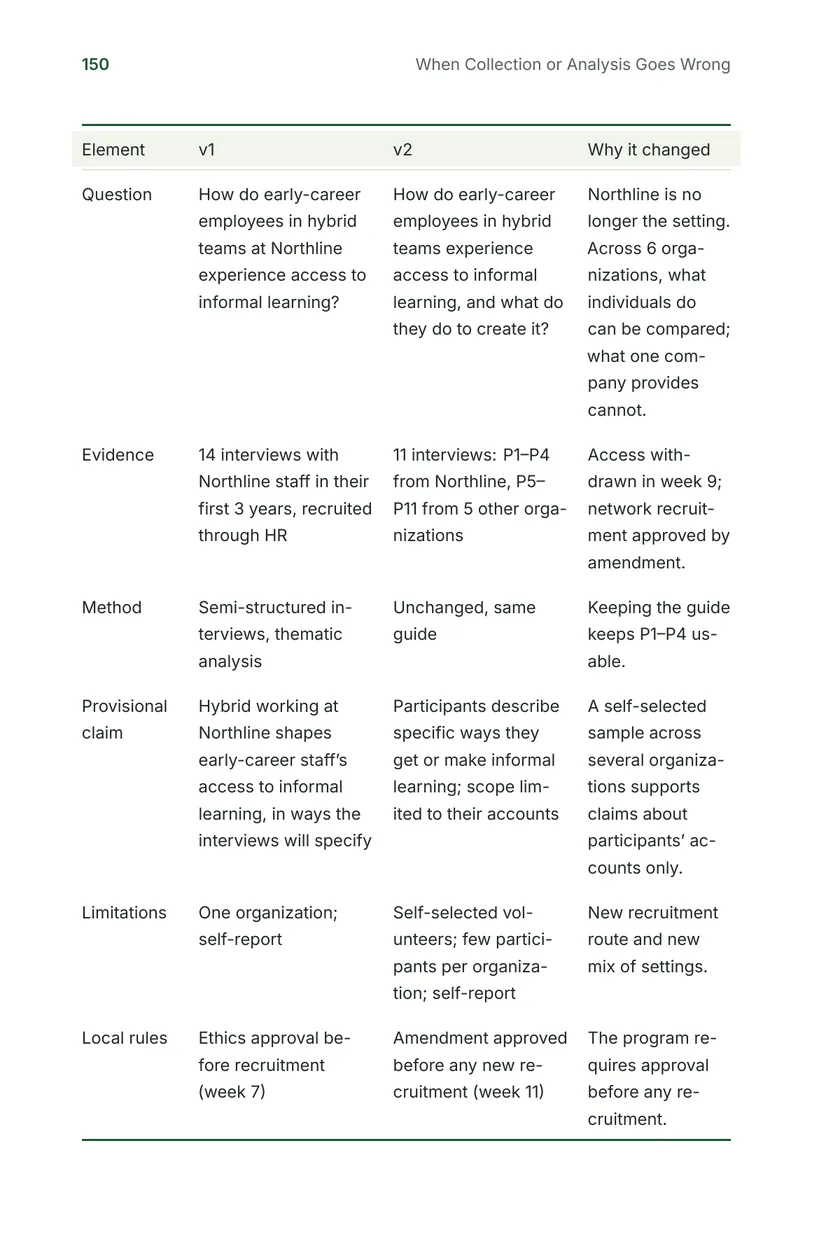
Chapter 13. Daniel's project spine before and after the recovery, with the reason each row changed.
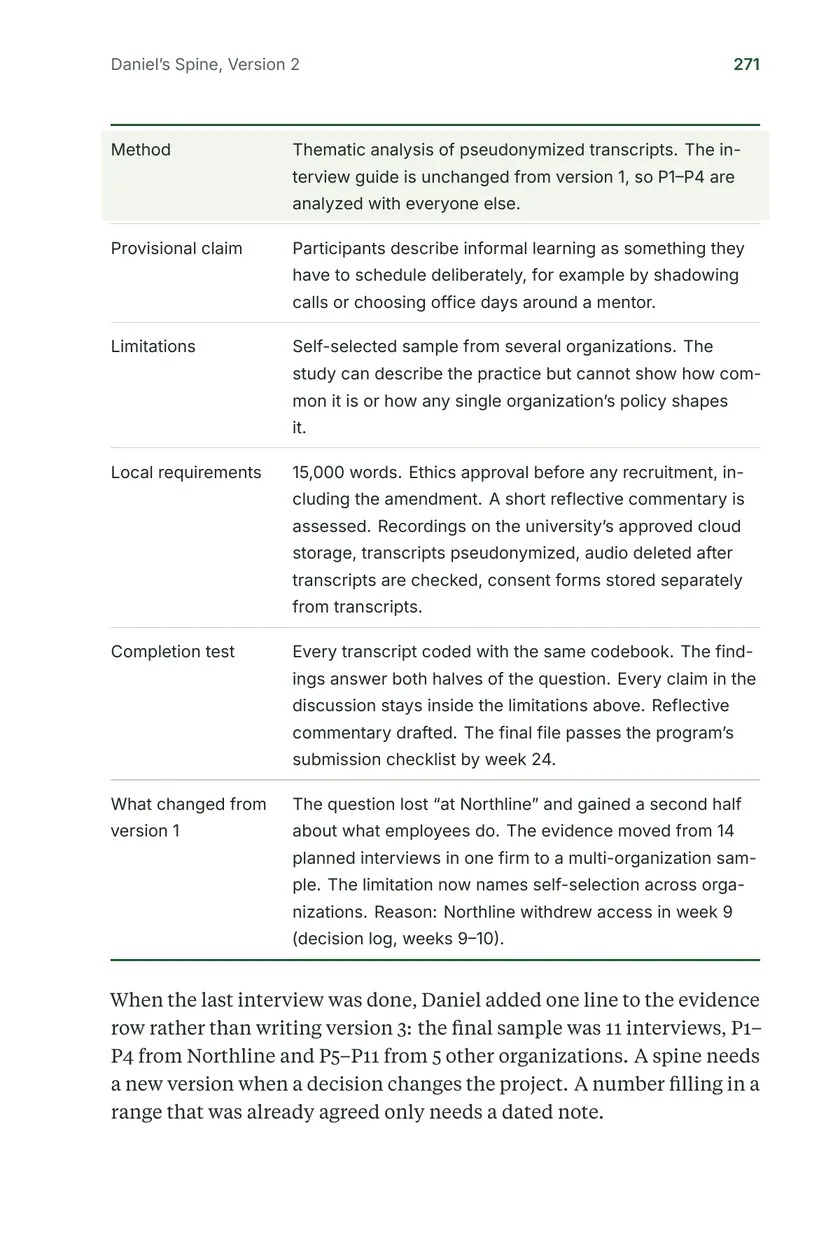
Appendix A. Daniel's filled project spine from the Control Pack. A blank copy follows it.
Swipe for more pages.
What Each Part Leaves You Holding
The book follows the order a project unfolds in. Every part ends with a document you can put in front of your supervisor.
Parts I and II
Define and design the project
Turn an interest into a question you can finish, match it to evidence and a method, and plan the work with your supervisor and the ethics route in view.
You leave with: a one-page project spine, a milestone plan with buffers and a risk register with written fallbacks.
Part III
Produce the evidence
Choose a method at the right depth, keep an audit trail as you go and recover honestly when collection or analysis breaks.
You leave with: a decision log, an audit trail an examiner can follow and a recovery route for the setback you didn’t plan for.
Part IV
Write the dissertation
Draft in a useful order, write the literature review as an argument and keep findings and discussion inside what your evidence can carry.
You leave with: a drafting order, a word budget and a discussion that answers your question.
Part V
Revise, defend and submit
Audit every claim, use AI tools within your institution’s rules, prepare for the oral defense and submit with time to spare.
You leave with: a claim audit, a bank of defense answers and a final submission checklist.
Table of Contents
The parts follow the order a project unfolds in. Each part opens to its chapters, and the filter finds a topic across all of them.
31 chapters and templates
Part IDefine a Finishable Project5 chapters
Before anything is collected, the project has to be small enough to finish and sharp enough to matter.
1A Dissertation Is a Managed ArgumentThe 7 linked elements, why the long-essay model breaks and the three running projects.
2Read the Local Rules FirstHandbooks, rubrics and policies turned into a one-page rules sheet.
3From Interest to Research QuestionThe question funnel, kinds of question and feasibility tests.
4Match Question, Evidence and MethodThe fit triangle and the mismatches that sink projects.
5Write the Project SpineOne page that holds the whole project, versioned as it changes.
Part IIDesign the Work5 chapters
A plan is a set of decisions with dates attached, made early enough that you can still change them.
6The Proposal and Getting It ApprovedA proposal mapped to the spine, and how to answer revision requests.
7Plan Milestones and Risks With SlackCritical paths, decision points, buffers and a risk register.
8Use Supervision WellThe supervision packet, the decision log and slow replies.
9Ethics, Consent, Privacy and RiskWhen review is needed, consent, anonymization and amendments.
10Build the Source, Data and File SystemSearch logs, folders, raw data kept read-only and backups.
Part IIIProduce the Evidence4 chapters
Evidence rarely arrives the way the proposal described it.
11Choose and Apply a Method ResponsiblyMethod families, pilots and what to ask a methods text.
12Keep an Audit TrailVersions, transformations, exclusions and anomalies on record.
13When Collection or Analysis Goes WrongDaniel’s full recovery, with his decision log and revised spine.
14Analyze Toward the QuestionThe claim ladder and no claim beyond the method.
Part IVWrite the Dissertation4 chapters
The order you write in is rarely the order the reader reads in.
15Drafting Order and a Writing RoutineWhat to write first, writing sessions and a word budget.
16Write the Literature Review as an ArgumentSynthesis instead of summary, with a synthesis matrix.
17Write the Method and Findings TransparentlyDeviations, exclusions, quotes, tables and uncertainty.
18Write the Discussion, Introduction and ConclusionThe discussion moves, the hourglass and the abstract.
Part VRevise, Defend and Submit4 chapters
The last stretch decides whether the reader meets the project you actually did.
19Revise the Whole ProjectThe claim audit, consistency checks and cutting to length.
20Use AI Tools HonestlySupport versus authorship, verification, disclosure and a usage record.
21Prepare for the Oral DefenseAnswer reconstruction, hard questions and corrections.
22The Final Mile and SubmissionProofreading, permissions, file checks and submitting early.
AppendicesThe Dissertation Project Control Pack9 templates
Nine working documents, each with a filled example from one of the three projects and a blank copy.
AProject SpineDaniel’s spine, version 2.
BQuestion-Evidence-Method Fit MatrixAmina’s matrix after her recovery.
CDecision LogDaniel’s log, weeks 2 to 10.
DRisk RegisterDaniel’s register from week 2.
ESupervision PacketAmina’s packet for week 9.
FMilestone and Recovery PlanMei’s plan and her week 17 recovery.
GClaim AuditMei’s audit, including the claim she cut.
HDefense Question Bank and Answer Reconstruction30 questions and a reconstruction grid.
IFinal Submission ChecklistThe last 2 weeks, line by line.
Nothing matches that yet. Try a broader word such as question, data or writing.
Who This Book Is For
It is written for a first long project. If yours is something else, one of the other books will serve you better.
A good fit if you are
a final-year undergraduate starting a dissertation or capstone
a taught master's student with a 10,000 to 20,000 word project
doing archival, interview, survey, lab or design work for the first time
halfway through and watching the plan drift away from the project
a supervisor who wants a shared set of documents for meetings
Look elsewhere if you need
a PhD thesis guide; the project management is similar but the scale and the viva are not
a methods textbook; the book orients you and points you to one
a deep guide to searching and reading literature; The Student Research Workflow covers that
help typesetting the final file; LaTeX for Theses and Dissertations covers that
approval for your research; only your institution and ethics committee can give it
Price and What You Get
One payment of $1.99 gets you the whole book, both PDFs and the Control Pack. Download links appear as soon as checkout finishes.
If you downloaded the free first edition, your account already has the second edition under the same product, at no charge.
From Question to Submission
Second edition, 2026
$1.99One-time payment · DRM-free PDFs
A4 PDF, 271 pages, for laptops and home printing
6 × 9 PDF, 328 pages, for phones, tablets and e-readers
22 chapters in 5 parts, with 24 full-color diagrams
The Control Pack: 9 templates with filled examples and blank copies
The first-edition EPUB and CSV templates, kept for anyone who wants them
Download links stay in your account. Checkout may show your local currency, and the refund policy explains what it covers.
I Build Tools That Pay for Themselves And Give Away the Ones That Can’t
Everything here is quick to set up, light on your pages and built to do one real job well. I only charge for the tools that can make you money. The rest are free.
18+years building websites, plugins and stores, since 2008
I obsess over performance
Switch a feature off and it loads nothing. What does load stays small. A tool that replaces a plugin shouldn’t make your pages slower.
I care how it feels
Clear screens, sensible defaults and settings written in plain English. If you need a tutorial for the basics, that’s my design mistake, not yours.
Aa
I build for everyone
Full keyboard support, visible focus, proper labels and text you can actually read. When more people can use your store, more people can buy from it.
I build tools that earn
My paid tools help you sell, renew, license or convert. If one just sits in your stack, I haven’t done my job.
$0
If it can’t earn, it’s free
I won’t charge for anything that can’t make you money. The free tools get the same care as the paid ones, down to the last setting.
FAQs on From Question to Submission
Still unsure? Open a few pages in the gallery above, or ask me through the contact page.
What do I get for $1.99?
You get 2 DRM-free PDFs of the second edition: an A4 edition with 271 pages and a 6 × 9 edition with 328 pages, both with the full Control Pack. The download links appear as soon as checkout finishes and stay in your account.
It used to be free. What changed?
The first edition was a free 78-page outline, and if you downloaded it, the second edition is already in your account at no charge. The second edition is a full rewrite with:
three student projects followed from proposal to defense
a full chapter on recovering when collection or analysis fails
a new chapter on using AI tools honestly
24 diagrams and a rebuilt 9-template Control Pack
Which PDF should I read?
You get both, so you can switch whenever you like:
The A4 edition has a bigger page and suits a laptop, a large tablet or a home printer.
The 6 × 9 edition uses the paperback layout and suits a phone, an e-reader or a small tablet.
Does it replace my handbook or my supervisor?
No. Your program handbook, your supervisor and your ethics committee control your project. The book shows you how to find those rules early, bring better questions to supervision and keep a record of what was decided.
Is it enough for a PhD thesis?
It is written for a first dissertation, thesis or capstone at undergraduate or taught master’s level. The project management carries over, but a doctoral thesis has a different scale, contribution and examination, so treat the book as a starting point there.
Can I print it or share it?
You can print it for your own use as often as you like, and the Control Pack templates may be photocopied for personal and classroom use. If a friend needs it, send them this page so they get the latest edition.
Write Your Project Spine Before the Next Meeting
Chapter 5 takes an evening and gives you one page your supervisor can react to. The whole book, with the Control Pack, is $1.99.