by
by
Writing a product description that sells means doing 7 jobs: a benefit-first headline, scannable benefit bullets, technical specs, social proof, a short FAQ, imagery cues, and a call to action built on shipping facts. For most physical goods, 150-400 words covers all 7. Software and info products need 600-1,200, because the buyer researches longer before trusting you.
Most descriptions fail because they describe the product instead of selling it. “Made with premium materials” is wallpaper; the buyer walks past it. “The waxed-canvas shell stays dry through 6 hours of steady rain” tells them exactly what they’re paying for. The framework below turns the first sentence into the second, and the 3 templates make it repeatable across a whole catalog.
The 7-Part Product Description Framework
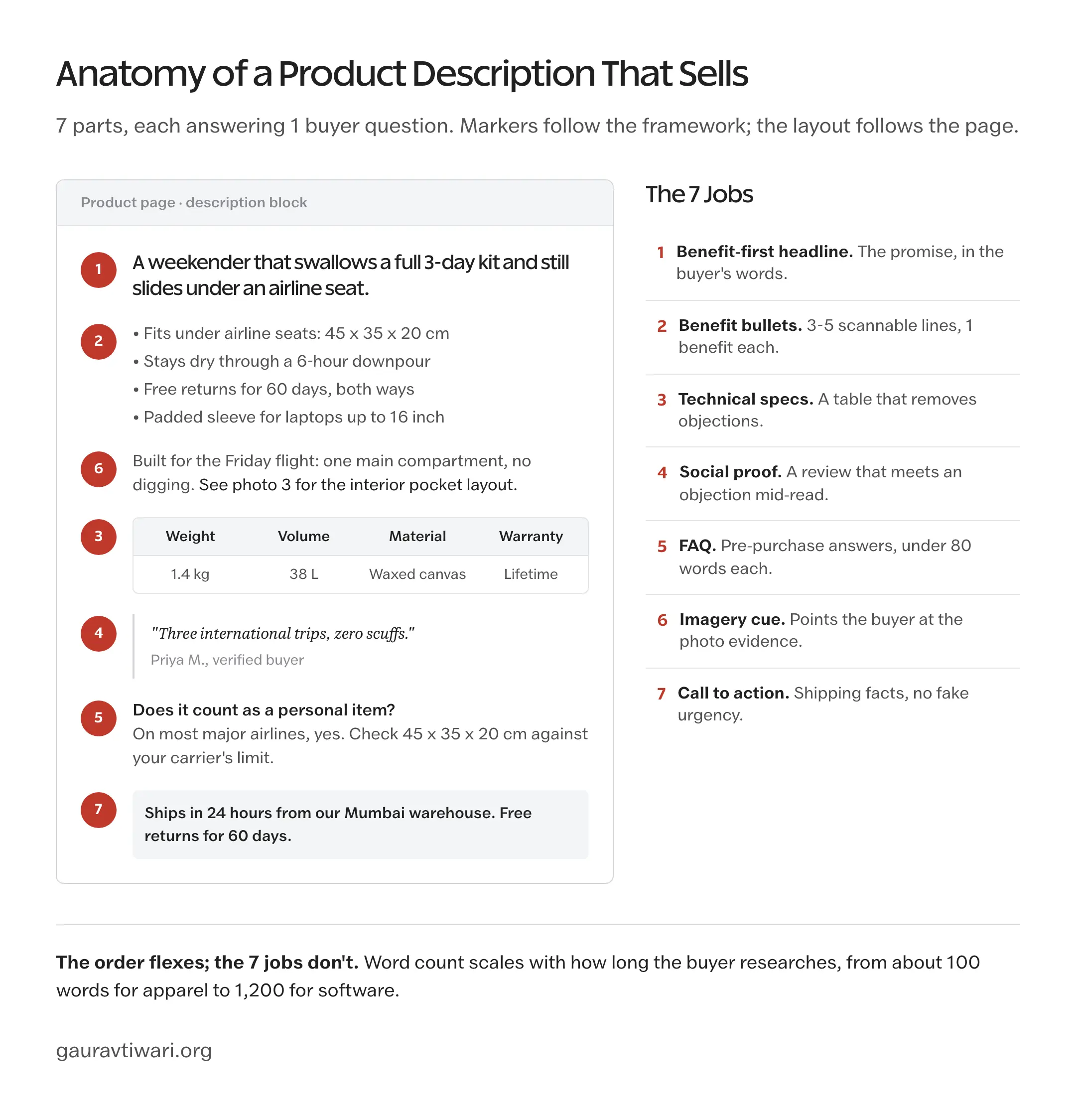
Every description that sells uses some version of these 7 parts. Not in this exact order, and not with equal weight. But all 7 present, each answering one buyer question: “What does this do for me, and why should I trust it?”
1. Benefit-First Headline
The headline isn’t your product name. The product name lives in the H1 elsewhere on the page. The description headline is the first sentence of the description block, and it states the primary benefit in the buyer’s words.
What most product pages write:
Premium Leather Weekender Bag
What works better:
A weekender that swallows a full 3-day kit and still slides under an airline seat.
Same bag. The second version answers the question the buyer arrived with: will this fit my trip and the overhead bin.
Apple runs its product pages on this exact move. The iPhone 17 Pro page leads its design story with “Heat-forged aluminum unibody design for exceptional pro capability”: a materials claim tied directly to the outcome a pro buyer cares about, not a list of alloys. Your headline should do the same job at your price point.
2. Scannable Benefit Bullets
After the headline, 3-5 bullets carry the top benefits. Buyers scan these before they read anything else, and many never read anything else. Each bullet should:
- Lead with the benefit, not the feature
- Include a specific number when one exists
- Fit on one line on mobile (under 75 characters)
- Start with a strong verb or a benefit noun
What most product pages write:
Includes waterproof zipper and YKK hardware
What works better:
Stays dry through a 6-hour downpour, zippers included
Same zipper. The second bullet sells the afternoon it survives, not the part number. Only claim the number you can back with a spec sheet, a test, or a review.
Write 7-10 draft bullets, then cut to the 4 that would most move a skeptical buyer. The discipline is subtraction.
3. Technical Specifications
Specs go in a dedicated block, usually an HTML table or a clean list: dimensions, materials, weight, compatibility, warranty, country of manufacture.
A buyer deciding between 2 identical-looking bags will settle it on a single line: carry-on dimensions, or weight under 3 pounds. If that line is missing, the buyer assumes the worst and buys the competitor that printed it.
Format specs as a table, never as paragraph prose. Nobody should read 80 words to find the weight.
4. Social Proof Snippets
Embed 1 or 2 review quotes directly in the description, not just in the reviews section further down. A quote inside the description meets the objection at the exact moment it forms, while the buyer is still reading your claims.
Good: “‘Three international trips, zero scuffs.’ (Priya M., Bengaluru, verified buyer)”
Better is the quote that handles a known objection: “‘I was worried about the price. It’s paid for itself in 4 trips where I didn’t buy a second bag.’ (Marcus K.)”
5. FAQ Section
2-5 short FAQs inside the description handle pre-purchase objections without sending the buyer to a support page. They’re also the passages AI shopping assistants lift when someone asks “does this fit” or “can I return it”, so each answer has to make sense out of context.
Common FAQ topics: sizing, shipping, return specifics, care instructions, compatibility, what’s in the box.
Keep answers under 80 words. Link to longer guides for anything deeper.
6. Imagery Cues
The copy should point at what the photos and video show. A cue like the ones below turns the gallery from a slideshow into a guided tour, because the buyer now looks at each image with a question already answered:
- “See the photo above for the interior pocket layout”
- “The video demonstrates the one-handed open mechanism”
- “Swipe to see color variants in natural light”
Left alone, buyers interpret photos through their own worries. Cued, they see the evidence you arranged for them.
7. Call to Action
The CTA at the end of the description is secondary to the Add to Cart button. It still matters, because it’s where you set expectations and create urgency without fake scarcity:
- “Ships in 24 hours from our Mumbai warehouse. Free returns for 60 days.”
- “In stock for Prime delivery by Tuesday.”
- “Order by 3pm EST for same-day shipping.”
Specific and factual beats “Order now!” every time.
3 Copy-Paste Product Description Templates
3 templates for the 3 most common product categories: physical goods, software, and info products. Each section starts with a .docx download you can edit in Word, Pages, or Google Docs; the code block underneath is the same template for direct copy-paste. Adapt the voice, keep the structure.
Template 1: Physical Goods (Apparel, Gear, Home)
Download: Physical Goods Template (.docx), ready to edit in Word, Pages, or Google Docs.
[PRODUCT NAME]

[BENEFIT-FIRST HEADLINE - one sentence, what does this solve]

What you get:
• [Benefit 1 with specific number]
• [Benefit 2 with specific outcome]
• [Benefit 3 addressing common objection]
• [Benefit 4 highlighting differentiator]

[2-3 sentence paragraph with sensory detail and specific use case. Name a real scenario: a 6-hour flight, a Pacific Northwest winter, a New York subway commute.]

[REVIEW SNIPPET - one customer quote with name/location]

Specs:
• [Dimension]
• [Weight]
• [Material]
• [Warranty]
• [Country of manufacture]

FAQ:
Q: [Most common pre-purchase question]
A: [Answer in under 80 words]

Q: [Second most common question]
A: [Answer in under 80 words]

[CTA: Shipping specifics, return policy, in-stock confirmation]
Template 2: Software and SaaS Products
Download: SaaS Template (.docx), ready to edit in Word, Pages, or Google Docs.
[PRODUCT NAME]

[BENEFIT-FIRST HEADLINE - what outcome does the user get]

Who this is for:
• [Specific role or use case 1]
• [Specific role or use case 2]
• [Specific role or use case 3]

What it does:
• [Core feature tied to outcome]
• [Second feature tied to outcome]
• [Third feature tied to outcome]
• [Integration or ecosystem detail]

[2-3 sentence paragraph explaining the "before and after" of using the product. Specific: time saved per week, revenue per user, hours reclaimed.]

[TESTIMONIAL - quote from a user with role/company]

Pricing:
• [Tier 1: price, features, limits]
• [Tier 2: price, features, limits]
• [Tier 3 or enterprise: price or contact]

Works with: [List integrations: Zapier, Slack, API, specific platforms]

FAQ:
Q: [Common objection: security, data portability, onboarding time]
A: [Direct answer]

Q: [Common objection: pricing, cancellation, refund]
A: [Direct answer]

[CTA: Free trial length, demo booking, or direct signup]
Template 3: Info Products (Courses, Ebooks, Templates)
Download: Info Product Template (.docx), ready to edit in Word, Pages, or Google Docs.
[PRODUCT NAME]

[BENEFIT-FIRST HEADLINE - what transformation does the buyer get]

This is for you if:
• [Specific situation 1]
• [Specific situation 2]
• [Specific situation 3]

What's inside:
• [Module 1 with outcome]
• [Module 2 with outcome]
• [Module 3 with outcome]
• [Bonuses or assets]

[2-3 sentence paragraph about the creator's relevant expertise. Not credentials. Specific wins: "I generated $47,000 from this exact framework in Q1 2026."]

[TESTIMONIAL - quote from a past student with a specific outcome]

What you get:
• [Format: PDF, video hours, templates]
• [Delivery: immediate, drip, live]
• [Support: community, 1:1, email]
• [Guarantee: 14-day, 30-day, conditional]

FAQ:
Q: [Common objection: time commitment, prerequisites]
A: [Direct answer]

Q: [Common objection: outcome guarantee, refund policy]
A: [Direct answer]

[CTA: Current enrollment status, bonus expiry, or next cohort date]
Ecommerce SEO for Product Descriptions
A well-written product description still needs SEO scaffolding to get indexed and ranked. The technical pieces below work together: keyword placement, schema, entities, UGC, and internal linking. For a deeper dive into the schema side, see Rank Math Review; for the AI-citation angle, formatting for AI search applies the same rules to product pages.
Primary Keyword Placement
The product’s primary keyword goes in the H1 (product title), the first 100 words of the description, the image alt text, and the URL slug. Skip the stuffing: once in the H1, once in the first sentence, once in a bullet, once in an FAQ answer. 4 placements for a 400-word description is right.
Schema Markup
Product schema is mandatory. Rank Math, Yoast, and most WooCommerce setups add it automatically. Check that it includes:
- Product name
- Brand
- Price and currency
- Availability
- Aggregate rating
- Review count
FAQ schema is a different story now. Google restricted FAQ rich results to government and health sites back in August 2023, so don’t add the markup expecting dropdown snippets in the SERP. It still earns its place: the structured question-answer pairs are exactly what AI assistants and shopping surfaces parse when they summarize your product.
Semantic Entities
AI search engines cite product descriptions with high entity density. That means naming specific materials, specific component brands, specific certifying bodies, specific compatibility standards.
Low entity density: “Made with high-quality materials.” High entity density: “Waxed Martexin canvas (made in New Jersey), YKK zippers (Japan), solid brass hardware, lifetime warranty.”
Every proper noun is an entity, and every named standard is a claim a machine can verify against the rest of the web. Both raise the odds your page is the one cited.
User-Generated Content (UGC)
Review text on the product page counts toward the total indexable content. A page with 200 words of primary copy and 40 customer reviews carries thousands of indexable words the description alone never could, which is part of why high-review products outrank identical low-review ones.
Prompt buyers with specific questions: “What problem did this solve for you?” Open-ended prompts generate “great product, fast shipping.” Specific prompts generate the objection-handling sentences you’ll quote in the description later.
Internal Linking
Every product description should link to:
- Related products in the same category
- A relevant buyer’s guide or how-to article
- The brand or collection page
- Related FAQ or shipping/returns pages
3-5 internal links per description is the working range. Past 7 it reads spammy and dilutes each link’s value.
Real Product Description Examples
3 brands in 3 different categories, each worth studying for a different move:
Apple iPhone Product Page
Apple’s iPhone 17 Pro page is a chain of benefit chapters: Design, Cameras, Performance, each a swipeable visual section carrying one claim. Technical specs live on a separate Tech Specs page entirely, so the description surface stays a benefit story. Buyers scroll through outcomes, not features, and the ones who need numbers know exactly where to click.
Warby Parker Glasses
Warby Parker descriptions stay short, usually a single tight paragraph plus fit details. Every frame gets the same skeleton: material, lens type, sizing in plain terms, and the backstory of the frame’s name. The backstory isn’t filler. It manufactures an emotional connection to an otherwise interchangeable object, which is the hardest job in eyewear copy.
Away Travel Suitcases
Away’s Bigger Carry-On page opens with the trust claim (“our best-selling suitcase, designed by travelers for travelers”) and then does the single most useful thing in the category: it sizes the product in trips, not liters. The page tells you it fits 4-7 days and 6-9 outfits, puts an airline-compatibility callout near the top, and moves the feature bullets up before the long-form copy. Dimensions are still there, but the buyer decides in outfits.
3 categories, same moves: a benefit-first opening, scannable bullets, specs where they don’t interrupt, and the units the buyer actually thinks in. Copy the structure, never the words.
Product Description Word Counts by Category
Optimal length tracks research intensity. The longer a buyer deliberates before purchase, the more objections the description has to absorb, and the more words that takes:
| Product Category | Working Word Count | Why |
|---|---|---|
| Fashion (apparel, accessories) | 100-200 words | Visual purchase, short attention |
| Home goods (furniture, decor) | 200-400 words | Moderate research, dimensions matter |
| Electronics | 400-700 words | High research, specs-driven |
| SaaS/Software | 600-1200 words | Long research cycle, feature differentiation |
| Info products (courses, books) | 800-1500 words | Trust-heavy, transformation-driven |
| Supplements and health | 500-900 words | Claims require support, compliance concerns |
| B2B services | 600-1000 words | High-stakes purchase, needs objection handling |
Treat these as starting ranges, not rules. A $900 jacket earns electronics-length copy; a $12 phone case doesn’t earn 400 words no matter what the category average says. Price and research intensity outrank category.
Common Product Description Mistakes
5 habits kill conversion on otherwise decent descriptions, and none of them looks like a mistake while you’re making it.
Leading with features instead of benefits. “Made with 100% organic cotton” feels informative to the seller, who knows why cotton matters. The buyer doesn’t. “Keeps you cool through a 95-degree New Delhi summer without plastic feel against skin” does the translation the buyer won’t do themselves.
Generic adjectives. “Premium,” “high-quality,” “durable,” “innovative.” Each one feels like selling and reads like static, because every competitor uses the identical words. Replace each with a specific claim you can back.
Hiding shipping and return information. It feels tidy to leave logistics to the checkout flow. But buyers abandon at the moment of surprise, and the description is where you remove the surprise for free.
One generic description for 40 variants. It saves writing time and costs sales on every variant except the default, because the buyer of the green large can’t find a sentence proving anyone thought about the green large.
Skipping the FAQ. It looks like trimming fluff. It actually routes every unanswered objection to your support inbox or, more often, to the back button. Either outcome costs more than the 100 words the FAQ would have taken.
The Limits
A description can’t fix the offer. If the product loses on price or fit, better verbs move nothing; the fix is the product page’s inputs, not its copy. Watch for the tell: strong traffic, weak add-to-cart, across every rewrite.
It can’t outrun the page around it either. In Baymard’s benchmark of 344 top-grossing ecommerce sites, 52% of desktop product pages score a mediocre or worse UX. Copy can’t rescue a page that fights the reader with slow galleries, buried variants, or a specs tab that never loads. Fix the page, then the words.
And it can’t substitute for reviews you don’t have. The social-proof slot needs real quotes; a new product with 0 reviews should spend that space on the guarantee and return policy instead, because a manufactured testimonial costs more trust than an empty slot ever will.
FAQs on Product Descriptions
How long should a product description be?
The optimal length varies by category: 100-200 words for fashion, 200-400 for home goods, 400-700 for electronics, 600-1200 for SaaS, and 800-1500 for info products. Writing longer than category norms doesn’t help SEO if the content is filler. Writing shorter risks missing objection-handling content.
What is the ideal format for a product description?
7 parts: benefit headline, 3-5 scannable bullet points, a 2-3 sentence descriptive paragraph, a customer review snippet, technical specs in a table, 2-5 FAQs, and a call-to-action with shipping details. This format works across physical goods, software, and info products with minor adaptations.
Should I copy the manufacturer’s product description?
No. Duplicate content from manufacturer descriptions causes Google to consolidate rankings to the original source (usually the brand’s own site), leaving your product page with zero SEO value. Rewrite every description in your voice with your own benefit framing and unique customer reviews. Even 60% paraphrasing outperforms 100% duplication.
How do I write a product description for SEO?
Place the primary keyword in the product title (H1), first sentence of the description, one bullet point, and one FAQ answer. Add Product schema markup with brand, price, availability, and rating. Keep FAQ answers self-contained so AI search can lift them. Name specific materials, standards, and certifications to raise entity density, and link to 3-5 related products and guides internally.
What’s the difference between a feature and a benefit?
A feature is what the product has (‘waxed-canvas outer shell’). A benefit is what the buyer gets from that feature (‘stays dry through 6-hour downpours’). Features alone don’t sell. Benefits connect the feature to a specific buyer outcome or problem solved. The FAB framework (Feature-Advantage-Benefit) chains these together: feature leads to advantage leads to benefit.
Should product descriptions include customer reviews?
Yes, embedded directly in the description block, not just in the separate reviews section. 1 or 2 curated snippets with verifiable attribution (‘Priya M., verified buyer’) work hardest when they answer a specific objection, because they meet the doubt at the moment it forms. Rotate the embedded quotes quarterly to keep the description current.
Can I use the same product description across platforms?
Mostly yes, with adaptations. The description on your own Shopify or WooCommerce store can be 400-700 words. The version on Amazon needs to fit Amazon’s bullet format and 2000-character limit. The version on Etsy favors story-driven copy. Maintain core benefit framing across all but adapt format and length to each platform’s conventions.
How do I write product descriptions at scale for a large catalog?
Create 3-5 template variants by product category, then fill in product-specific details from a spreadsheet with columns for product name, primary benefit, 3 bullets, specs, and FAQ. AI-assisted drafting speeds up the first pass, but never publish unedited AI output. Generic AI copy reads identical across a catalog and converts like it.
Final Remarks
Pick 1 product from your store. Open the template that matches your category, rewrite the description in 45 minutes using the 7-part framework, and compare conversion against the old version over 14 days. On WooCommerce or SureCart, use the built-in A/B tools rather than eyeballing it; the CRO tool stack covers the options if you need proper testing infrastructure.
If it lifts, roll the same template across 10 more products. If it doesn’t, you’ve learned something specific about your buyer, and the next rewrite starts from that.
Tell Google you want more of this.
Add Gaurav Tiwari as a preferred sourceOne tap, and this site shows up more often in your own Top Stories, AI Overviews and AI Mode. Remove it any time.