
The Landlord’s Website Stack in 2026: DIY Brochure Site vs. Integrated Rental Platform
 by
by
Most landlords think of the website as marketing. In 2026, the website is the operations layer, and the marketing is a thin skin stretched over it. A rental site that shows photos and a phone number is doing a small fraction of what the software is now expected to do, and the gap between a brochure site and an integrated rental platform decides whether a small portfolio scales or stalls.
The useful question isn’t whether you need a nicer site. It’s which parts of the stack you should still hand-build and which parts you should stop pretending to run yourself.
The Front Door Does Two Different Jobs
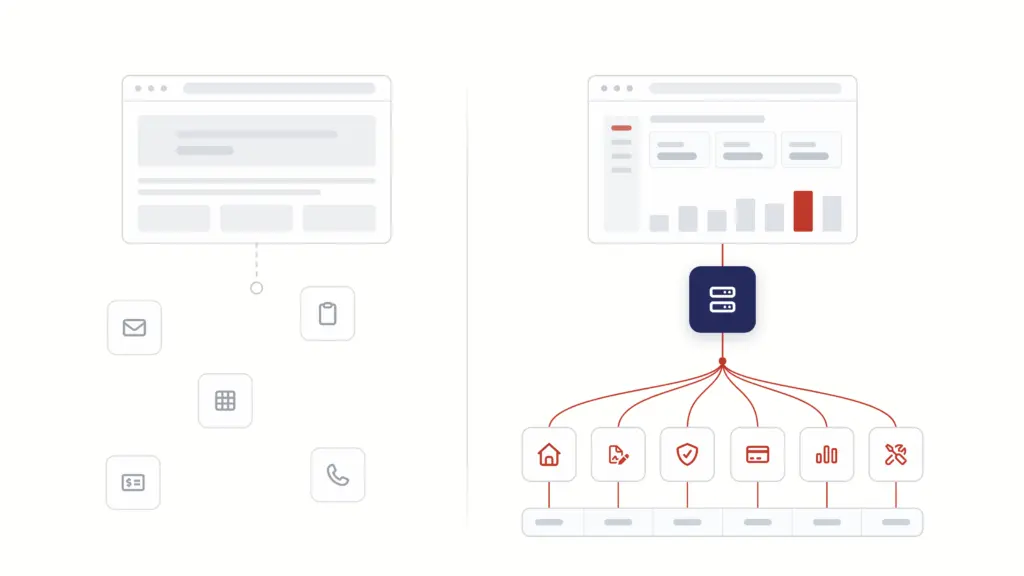
A brochure site treats the homepage as a business card. An integrated platform treats it as a router. The distinction matters because prospective tenants and current tenants land on the same URL wanting completely different things, and one of them is paying you rent this month.
A DIY WordPress build can handle both jobs. A theme, a listings plugin, and a tenant portal plugin will get you surprisingly far. The trade-off is that you’re now the integrator: when the payment plugin updates and breaks the maintenance form, that’s your Saturday. An integrated platform hides that work behind one vendor’s roadmap, which is either a relief or a cage, depending on how much control you want.
The DIY approach wins when your portfolio is small enough that you know every tenant by name. The platform approach wins the moment you stop remembering which unit had the water heater replaced.
Listings Are Where the Two Philosophies Diverge Fastest
Every landlord site has to answer the same question: do listings live on your domain, on a third-party marketplace, or both? The brochure approach usually picks one and pretends the other doesn’t exist. The integrated approach syndicates.
Syndication does not equal “problem solved.” Photo counts differ between channels, amenity fields don’t map cleanly, and Fair Housing rules apply to every version of the copy, no matter where it renders. The National Fair Housing Alliance has a useful primer on how the Fair Housing Act reaches rental advertising across sites, social platforms, and ad targeting settings, and it’s worth reading before anyone on your team writes listing copy or picks an audience filter.
- Own the source of truth. Whichever platform holds the canonical listing (photos, floor plans, pricing) is the one your team edits. Everything else pulls from it.
- Match the fields. If your site lists 14 amenities and the marketplace supports 9, decide which 9 in advance instead of letting each channel improvise.
- Version the copy. Ad copy that runs on social has different length and targeting constraints than a listing page. Write both. Don’t crop one into the other.
Payments and Portals Are No Longer Optional
This is the section where the DIY case gets weakest. Renters have been trained by every other bill in their life to expect a login, a saved payment method, and a receipt in their inbox. A site that still routes rent through a mailed check isn’t neutral. It’s pushing qualified applicants toward the listing next door.
A tenant portal doesn’t need to be fancy. It needs to reliably do four things: accept payment, log maintenance requests with photos, store the lease, and send notices. The brochure site outsources all four to email and a phone line, which works fine until it doesn’t, usually at 11 p.m. on a Sunday when the disposal is jammed.
Performance and Accessibility Decide Who Even Sees the Site
A rental site lives or dies on mobile. Prospective tenants are searching from a phone between meetings, and the site that loads first usually gets the tour. Core Web Vitals feed directly into Google’s page experience signals, and Vercel’s engineering team has a clear breakdown of how Core Web Vitals affect ranking and how to measure them without guessing.
Accessibility is the other half of the problem. The Department of Justice’s web accessibility guidance makes clear that ADA obligations extend to the websites of businesses open to the public, and courts have applied that reasoning to rental operators. WCAG 2.1 AA is the working benchmark. A brochure site with unlabeled form fields and low-contrast text is a site a screen-reader user gives up on before ever calling.
When Each Approach Wins
The DIY brochure site still wins in one specific case: a small owner with under a dozen doors, stable tenants, and the time to answer the phone. An integrated platform isn’t free, and neither is the week you spend learning it.
Past that, the math flips fast. Once you’re posting listings on more than one channel, collecting rent from more than a handful of tenants, and handling maintenance across more than one building, the integrated stack pays for itself in evenings you don’t lose to plugin conflicts.
Owners who don’t want to run any of it in-house often hand the whole surface (site, portal, screening, listings) to a property management partner and buy the time back. The wrong answer is the middle: a brochure site with a phone number, in a market where every competing listing has a tour video, a portal, and a mobile-first page that loads in under two seconds.
Tell Google you want more of this.
Add Gaurav Tiwari as a preferred sourceOne tap, and this site shows up more often in your own Top Stories, AI Overviews and AI Mode. Remove it any time.