
 by
by
The cell cycle is the ordered sequence of events that a eukaryotic cell goes through from its birth to its division into two daughter cells. It is divided into two major periods: interphase (G1, S, G2), where the cell grows, replicates its DNA, and prepares to divide, and the M phase (mitosis plus cytokinesis), where the cell actually divides. A typical actively-dividing human cell completes one full cycle in about 24 hours. Cell-cycle control is one of the most important regulatory systems in biology, and its breakdown is the central problem in cancer.
The cell cycle coordinates growth, genome replication and division. A chromosome count is different from a count of chromatids or DNA molecules.
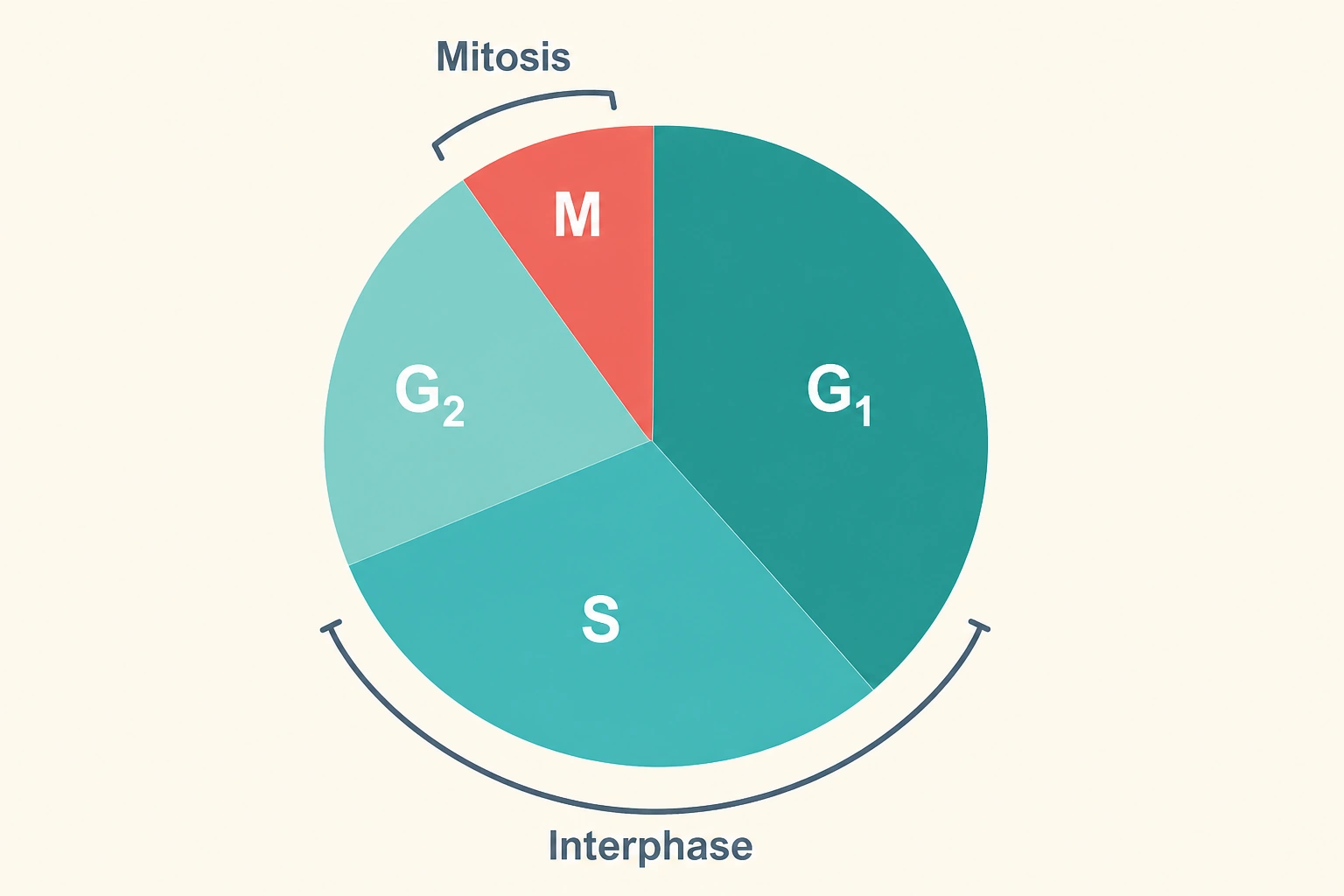
The Phases of the Cell Cycle
The cell cycle has four main phases. Three of them belong to interphase; the fourth is M phase.
G1 phase (Gap 1)
The cell grows in size. Organelles duplicate (more mitochondria, more ribosomes, more endoplasmic reticulum). Protein synthesis ramps up. The cell prepares for DNA replication. G1 is the longest phase in most cells, typically 11 hours in a 24-hour cycle. G1 is also the most variable phase. Cells that decide not to divide (most neurons, for example) exit G1 into a resting state called G0 and can stay there for decades.
S phase (Synthesis)
DNA replication. Each chromosome’s single chromatid is duplicated into two identical sister chromatids joined at the centromere. The cell’s DNA content doubles from 2C to 4C, while the chromosome number stays the same (each chromosome now consists of two chromatids instead of one). S phase typically lasts 6-8 hours in a human cell.
G2 phase (Gap 2)
Final preparation for mitosis. The cell continues growing, manufactures the proteins needed for chromosome segregation (tubulin for the spindle, condensin for chromosome compaction), and checks the replicated DNA for damage. G2 typically lasts 3-4 hours.
M phase (Mitosis + Cytokinesis)
The cell physically divides. Mitosis (nuclear division) goes through prophase, metaphase, anaphase, and telophase, after which cytokinesis pinches the cytoplasm into two daughter cells. M phase is the shortest, typically just 1 hour, only about 5% of the total cycle.
Interphase vs M Phase Proportions
A typical 24-hour human cell cycle breaks down approximately as:
| Phase | Duration | % of cycle | Main activity |
|---|---|---|---|
| G1 | ~11 hours | ~46% | Growth, organelle duplication |
| S | ~8 hours | ~33% | DNA replication |
| G2 | ~4 hours | ~17% | Final prep, damage checks |
| M | ~1 hour | ~4% | Mitosis + cytokinesis |
The picture you typically see in textbooks shows mitosis as a dramatic main event, but in reality cells spend about 95% of their time in interphase quietly growing and replicating. M phase is the brief spectacular finale.
Checkpoints, the Cell Cycle’s Quality Control
Three major checkpoints monitor the cell cycle, halting progression if conditions are wrong. The checkpoints are the cell’s quality-control system. Their failure is the central problem in cancer.
G1/S Checkpoint (Restriction Point)
Located at the end of G1, just before entering S phase. The cell checks: is it large enough? Are nutrients available? Is the DNA undamaged? Is there a growth-factor signal telling the cell to proliferate? If any answer is no, the cell pauses in G1 (or exits to G0). The G1/S checkpoint is the main commit point, once a cell passes it, it is committed to completing the cycle.
The tumor suppressor p53 is the central player at this checkpoint. p53 senses DNA damage, halts the cycle, and either gives the cell time to repair or triggers apoptosis if the damage is irreparable. Mutations in p53 are found in over 50% of human cancers, the most commonly mutated gene in all of oncology.
G2/M Checkpoint
Located at the end of G2, just before mitosis begins. The cell checks: was DNA replication complete and correct? Is the cell ready for the physical demands of mitosis? Errors here stop the cycle until repair is complete.
Spindle Assembly Checkpoint (M Checkpoint)
Located during metaphase. The cell will not begin anaphase until every chromosome’s kinetochore is properly attached to spindle microtubules from both poles. This prevents chromosome mis-segregation. When the checkpoint fails, daughter cells end up with the wrong chromosome number (aneuploidy), which is both a cause and a consequence of cancer.
Cyclins and CDKs, the Cell-Cycle Engine
The cell cycle is driven by a family of proteins called cyclin-dependent kinases (CDKs) bound to regulatory proteins called cyclins. CDKs are kinases, they add phosphate groups to other proteins, modifying their activity. Cyclins are not themselves enzymes, but they bind to CDKs to activate them.
Different cyclin-CDK combinations drive different phases:
- Cyclin D + CDK4/6: drives early G1 progression
- Cyclin E + CDK2: drives the G1/S transition
- Cyclin A + CDK2: drives S phase progression
- Cyclin B + CDK1: drives entry into mitosis
Cyclin levels rise and fall through the cycle (the periodic synthesis and destruction is what gave them the name). CDK levels stay relatively constant, but their activity follows the cyclin levels. Leland Hartwell, Tim Hunt, and Paul Nurse won the 2001 Nobel Prize in Physiology or Medicine for working out this regulatory system.
Cell Cycle and Cancer
Every cancer is, at heart, a cell-cycle disorder. Cancer cells acquire mutations that override the normal stop signals and let them divide whenever they want. The two main mutation categories:
- Oncogenes are activated forms of normal cell-cycle drivers. Mutations in Ras (a growth-signal transducer) lock the protein in ‘on’ state, telling the cell to divide constantly. Ras mutations are found in ~30% of human cancers.
- Tumor suppressors are normal cell-cycle brakes. Mutations that knock them out remove the safety system. p53 mutations (most common) prevent the G1/S checkpoint from halting damaged cells. Retinoblastoma (Rb) mutations prevent control of the G1/S transition. BRCA1/BRCA2 mutations impair DNA-damage response.
Modern cancer therapy increasingly targets cell-cycle proteins directly. Palbociclib, ribociclib, and abemaciclib are CDK4/6 inhibitors approved for breast cancer treatment since 2015, they halt cancer cells at the G1/S transition. PARP inhibitors exploit DNA damage repair deficiencies. The whole field of targeted oncology builds on cell-cycle biology.
Related study notes: Mitosis, Meiosis, Nucleic Acid, Enzyme.
The OpenStax biology textbooks develop the biological processes discussed here with additional diagrams and explanations.
Tracking a Diploid Cell
An illustrative diploid cell has 4 chromosomes before S phase. After replication it still has 4 chromosomes, each with 2 sister chromatids, for 8 chromatids in total. Its DNA content has doubled without its chromosome sets doubling.
After successful mitosis and cytokinesis, each daughter cell has 4 chromosomes with unreplicated chromatids at that stage. Checkpoints regulate progression using signals such as DNA integrity and spindle attachment; a fixed duration like 24 hours is a model example rather than a universal schedule for every cell type.
The points to check in this example are:
- G1 precedes DNA replication.
- S phase copies DNA.
- M phase includes mitotic nuclear division and the associated cytoplasmic division.
Check Your Understanding
Try the questions before reading the answers.
Question 1. How many chromatids are present just after S phase in the example?
Answer. 8.
Question 2. Must a mature nondividing cell continue through the cycle repeatedly?
Answer. No. Many cells remain outside the active proliferative cycle.
Practice Questions
Work each question before reading its solution. The set runs from direct recall and substitution to the applied questions that exams actually use to separate grades. The downloadable PDF includes these questions and their solutions.
Question 1. Name the phases of the cell cycle and the job of each.
Solution. Interphase comprises G1 (growth and normal function), S (DNA replication), and G2 (further growth and pre-division checks); M phase then divides the nucleus (mitosis) and cytoplasm (cytokinesis). A cultured human cell completes the loop in roughly 24 hours, spending about 90% of it in interphase, not division.
Question 2. What happens in S phase, and what is the chromosome bookkeeping before and after?
Solution. Every chromosome is replicated, converting each from 1 DNA molecule to 2 identical sister chromatids joined at the centromere. The chromosome COUNT stays 46 in humans; the DNA content doubles from 2C to 4C. Counting chromosomes by centromeres while tracking DNA mass separately untangles most exam confusion here.
Question 3. What is G0, and which human cells live there?
Solution. A withdrawal from the cycle into a non-dividing working state. Mature neurons and cardiac muscle cells reside there essentially permanently, which is why their losses are so hard to repair; liver cells sit in G0 but re-enter the cycle on demand, powering the liver’s famous regeneration. G0 is retirement, sometimes with a recall clause.
Question 4. Describe the G1/S checkpoint and the question it asks.
Solution. The restriction point asks: is the cell big enough, nourished, undamaged, and instructed by growth signals to commit? Passing it commits the cell to replicating its genome. Damaged DNA halts progress here, chiefly through p53 stabilizing p21 to block the cyclin-CDK engines. It is the most consequential no-return decision in the cycle.
Question 5. What do the G2/M and spindle checkpoints verify?
Solution. G2/M: was the genome copied completely and without damage, before mitosis is allowed to start. The spindle (metaphase) checkpoint: is every chromosome’s kinetochore attached to spindle fibers from both poles, before the sisters are pulled apart. Skipping the second one missegregates chromosomes, producing aneuploid daughters.
Question 6. How do cyclins and CDKs drive the cycle forward?
Solution. Cyclin-dependent kinases are engines present throughout the cycle but inert alone; cyclins are their activating keys, synthesized and destroyed in waves. Each cyclin-CDK pair phosphorylates the substrates of its phase, then the cyclin’s degradation makes the step irreversible. The cycle is a ratchet of build-activate-destroy, discovered in sea urchins and yeast, honored with the 2001 Nobel.
Question 7. Explain p53’s title “guardian of the genome” and the consequence of losing it.
Solution. On DNA damage, p53 accumulates and halts the cycle for repair; if damage is irreparable it triggers apoptosis, deleting the dangerous cell. Lose p53 and damaged cells keep dividing, stacking mutations. TP53 is mutated in roughly half of all human cancers, and inheriting one faulty copy (Li-Fraumeni syndrome) brings early, multiple tumors.
Question 8. Frame cancer as a cell-cycle disease using proto-oncogenes and tumor suppressors.
Solution. Proto-oncogenes are accelerators (growth-signal relays like RAS); a gain-of-function mutation jams them on. Tumor suppressors are brakes (p53, RB); loss-of-function cuts them. Cancer typically needs both: a stuck accelerator plus failed brakes, accumulated over years, which is why risk climbs with age and why oncology drugs target cycle machinery such as CDK4/6.
Question 9. Contrast cytokinesis in animal and plant cells.
Solution. Animal cells pinch: an actin-myosin contractile ring tightens a cleavage furrow until 2 cells separate. Plant cells cannot pinch inside rigid walls; vesicles assemble a cell plate across the middle that grows outward into a new wall. Same goal, opposite geometry: constriction from outside in, versus construction from inside out.
Question 10. A tissue biopsy shows an unusually high mitotic index. What does that measure, and what might it mean?
Solution. The fraction of cells visibly in mitosis, a direct readout of proliferation rate. High values are normal in renewing tissues, bone marrow, gut lining, and in healing wounds, but in a fixed tissue they flag uncontrolled division and factor into tumor grading. Context decides whether fast cycling is health or disease.
Frequently Asked Questions
What is the cell cycle?
The cell cycle is the ordered sequence of events a eukaryotic cell goes through from its birth to its division into two daughter cells. It has four main phases: G1 (growth), S (DNA replication), G2 (final prep), and M (mitosis plus cytokinesis). A typical human cell completes one full cycle in about 24 hours.
What is the difference between interphase and mitosis?
Interphase is the long preparatory period (G1, S, G2) when the cell grows, replicates its DNA, and prepares to divide. It takes up about 95% of the cell cycle. Mitosis is the short, dramatic division event when the cell physically splits into two, it takes only about 1 hour, roughly 5% of the cycle.
What are the cell cycle checkpoints?
Three major checkpoints monitor cell cycle progression: the G1/S checkpoint (also called the restriction point), the G2/M checkpoint, and the spindle assembly checkpoint during metaphase. Each checkpoint halts the cycle if conditions are wrong, DNA damage, incomplete replication, missing nutrients, mis-attached chromosomes. Checkpoint failure is a central cause of cancer.
What are cyclins and CDKs?
Cyclin-dependent kinases (CDKs) are the enzymes that actually drive the cell cycle by adding phosphate groups to other proteins. Cyclins are regulatory partners that bind to CDKs and activate them. Different cyclin-CDK pairs drive different phases, cyclin D-CDK4/6 drives early G1, cyclin B-CDK1 drives entry into mitosis. Hartwell, Hunt, and Nurse won the 2001 Nobel Prize for discovering this system.
Why does cancer involve the cell cycle?
Because cancer is fundamentally uncontrolled cell division. Healthy cells stop dividing in response to signals like contact inhibition, DNA damage, or lack of growth factors. Cancer cells acquire mutations that override these stop signals, either by activating cell-cycle drivers (oncogenes like mutant Ras) or by knocking out cell-cycle brakes (tumor suppressors like p53). The result is cells that divide whenever they want, ignore damage, and form tumors.
What is the G0 phase?
G0 is the resting state, cells that have exited the active cell cycle and are not actively preparing to divide. Most differentiated cells (neurons, mature muscle cells, mature red blood cells) are permanently in G0. Some cells (like liver hepatocytes) sit in G0 normally but can re-enter G1 when needed for repair. G0 is sometimes called a separate phase, sometimes a special state of G1, both conventions exist.
Browse more in Biology.