
 by
by
Meiosis is the specialized nuclear division that produces haploid cells from a diploid starting cell. In animals, meiosis contributes to sperm and egg formation. In plants, it produces spores; the haploid gametophyte subsequently produces gametes by mitosis. Mitosis preserves the chromosome-set number. Meiosis halves it through 2 nuclear divisions after 1 round of DNA replication. The chromosome number is halved, and homologous chromosomes shuffle their genetic material through crossing over. Together with random fertilization, meiosis is the source of the genetic variability that drives sexual reproduction and ultimately evolution by natural selection. Master meiosis and you have the foundation for genetics, evolution, and the entire reproductive biology curriculum.
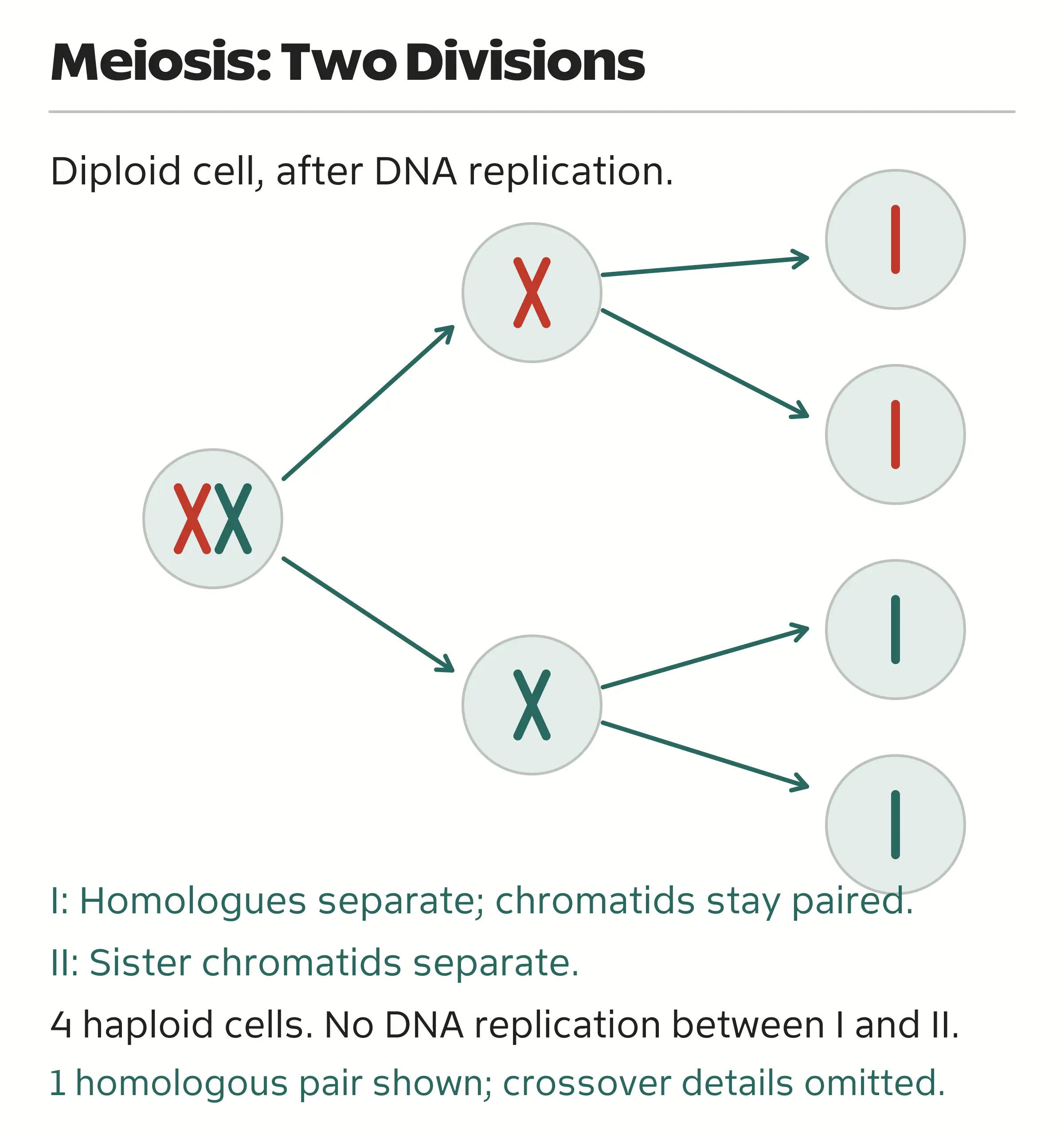
Meiosis separates homologous chromosomes first and sister chromatids second. Ploidy and DNA content change at different steps.
Why Meiosis Exists
Sexual reproduction requires that two parents each contribute half of the offspring’s genetic material. If both parents contributed a full diploid genome, the offspring would have double the chromosomes (4n), and the next generation would have 8n, and within a few generations cells would collapse under their own genome mass. Meiosis solves this by halving the chromosome number when producing gametes. Fertilization then restores the diploid state in the zygote.
Meiosis also generates genetic variation in three distinct ways: independent assortment of homologous chromosomes (the random which-came-from-mom or which-came-from-dad assignment), crossing over during meiosis I (physical exchange of DNA segments between homologs), and random fertilization (any sperm can fertilize any egg). Together these produce roughly 2^23 × 2^23 × infinite ≈ trillions of possible offspring genotypes from any one human couple.
Meiosis I, the Reductional Division
Meiosis I is where the chromosome number actually halves and most of the genetic shuffling happens. It is the more interesting of the two divisions.
Prophase I
The longest and most complex phase of meiosis. Chromatin condenses into visible chromosomes. Homologous chromosomes (one from each parent) pair up along their length, a process called synapsis. The paired structure is called a tetrad or bivalent (four chromatids per pair). While paired, homologs exchange segments of DNA in a process called crossing over (chiasmata are the physical points of exchange visible under a microscope). The nuclear envelope dissolves, the spindle apparatus forms.
Metaphase I
Tetrads line up at the metaphase plate. Critically, each tetrad orients independently, for each chromosome pair, it is random which homolog ends up facing which pole. This is the independent assortment that generates so much genetic variation. For humans with 23 chromosome pairs, that gives 2^23 ≈ 8.4 million possible combinations per gamete from independent assortment alone.
Anaphase I
Homologous chromosomes are pulled apart to opposite poles. Note the difference from mitosis: in mitosis, sister chromatids separate. In meiosis I, sister chromatids stay together, it is the homologous pairs that separate. Each pole receives one chromosome of each homologous pair, with sister chromatids still attached.
Telophase I + Cytokinesis
The cell divides into two daughter cells. Each daughter cell now has half the original chromosome number (haploid in terms of chromosome count) but each chromosome still consists of two sister chromatids. The reductional division is complete.
Meiosis II, the Equational Division
Meiosis II looks essentially identical to mitosis, but it starts from a haploid cell. No DNA replication happens between meiosis I and meiosis II.
Prophase II
The cells from meiosis I prepare for division. Chromosomes (still consisting of paired sister chromatids) condense again. New spindle apparatus forms in each cell.
Metaphase II
Chromosomes (not tetrads anymore, there are no homologs to pair with) line up at the metaphase plate of each of the two cells.
Anaphase II
Sister chromatids finally separate and move to opposite poles. This is the same mechanism as anaphase in mitosis.
Telophase II + Cytokinesis
Each of the two cells divides into two daughter cells. Total: 4 haploid gametes from the original 1 diploid germ cell. Each gamete has half the original chromosome number, and each chromosome is now a single chromatid (no longer paired).
Sources of Genetic Variation
Three mechanisms generate the genetic variation that makes sexual reproduction worth the metabolic cost compared to asexual cloning.
- Crossing over (meiosis I prophase). Homologous chromosomes exchange segments of DNA at chiasmata. Each chromosome typically experiences 1-3 crossover events per meiosis, producing recombinant chromatids that mix maternal and paternal DNA. This is why siblings share only about 50% of their DNA on average, even though they have the same parents, each gamete is a unique combination of grandparental DNA.
- Independent assortment (meiosis I metaphase). The orientation of each homologous pair at the metaphase plate is independent of every other pair. For 23 human chromosome pairs, that gives 2^23 ≈ 8.4 million possible combinations per gamete, before crossing over even adds its variation.
- Random fertilization. Any sperm can fertilize any egg. Each fertilization combines two of those millions of possible gametes. The number of possible zygotic genotypes from any one couple is effectively infinite.
Meiosis vs Mitosis
| Feature | Meiosis | Mitosis |
|---|---|---|
| Number of divisions | 2 (Meiosis I + Meiosis II) | 1 |
| Daughter cells | 4 haploid | 2 diploid |
| Chromosome number | Halved (2n → n) | Same as parent (2n → 2n) |
| Genetic identity | Genetically unique (crossing over + independent assortment) | Identical to parent |
| Where it happens | Germ cells in gonads only | All body (somatic) cells |
| Purpose | Producing gametes for sexual reproduction | Growth, repair, asexual reproduction |
| Homolog pairing | Yes (synapsis in prophase I) | No |
| DNA replication | Once, before meiosis I only | Once, before each division |
When Meiosis Goes Wrong
Failures during meiosis are called nondisjunction, when homologous chromosomes (meiosis I) or sister chromatids (meiosis II) fail to separate properly. The result is gametes with an extra chromosome or a missing one. When such gametes participate in fertilization, the resulting zygote has aneuploidy.
- Down syndrome (trisomy 21): three copies of chromosome 21 instead of two. Affects approximately 1 in 700 live births worldwide. Risk rises sharply with maternal age.
- Klinefelter syndrome (XXY): extra X chromosome in males.
- Turner syndrome (XO): single X chromosome in females.
- Edwards syndrome (trisomy 18) and Patau syndrome (trisomy 13): usually fatal in infancy.
Most aneuploidies are lethal before birth (perhaps 20-50% of conceptions). The few that survive are usually the ones with the smallest chromosomes (chromosome 21 is one of the smallest), because the gene-dosage imbalance is less severe.
Related study notes: Mitosis, Cell Cycle, Punnett Square, Natural Selection.
The OpenStax biology textbooks develop the biological processes discussed here with additional diagrams and explanations.
Counting Through Two Divisions
Begin with an illustrative diploid cell having 4 chromosomes. After S phase it has 4 replicated chromosomes and 8 chromatids. After meiosis I, each of the 2 cells has 2 replicated chromosomes and 4 chromatids. After meiosis II, each product has 2 unreplicated chromosomes.
The products are haploid, but their eventual roles depend on the organism and reproductive pathway. Animal egg formation involves unequal cytoplasmic division and polar bodies. In plants, meiosis produces spores; gametophytes subsequently produce gametes by mitosis. Pollen and an ovule should not simply be labeled sperm and egg.
The points to check in this example are:
- Homologues separate in meiosis I.
- Sister chromatids separate in meiosis II.
- DNA replicates once before the 2 divisions.
Check Your Understanding
Try the questions before reading the answers.
Question 1. What is the chromosome count per final product in the example?
Answer. 2.
Question 2. Does meiosis produce 4 equally sized functional eggs in animals?
Answer. No. Egg formation includes unequal products and polar bodies.
Frequently Asked Questions
What is the main purpose of meiosis?
Meiosis produces gametes (sperm in males, eggs in females) for sexual reproduction. It halves the chromosome number from diploid (2n) to haploid (n) so that fertilization restores the original diploid chromosome number in the zygote. Meiosis also generates genetic variation through crossing over and independent assortment.
How many cells are produced from one meiosis?
Four haploid daughter cells from one diploid parent cell. Meiosis runs two consecutive divisions: meiosis I splits the parent into two cells, then meiosis II splits each of those into two more, for a total of four. In females, only one of the four becomes a functional egg, the other three become polar bodies that degenerate.
What is crossing over?
Crossing over happens during prophase I of meiosis. Homologous chromosomes pair up and physically exchange segments of DNA at points called chiasmata. The resulting chromosomes carry a mix of maternal and paternal DNA, which is why siblings share only about 50% of their DNA on average even though they have the same parents.
What is the difference between meiosis I and meiosis II?
Meiosis I is the reductional division, it halves the chromosome number by separating homologous pairs. It involves synapsis, crossing over, and independent assortment. Meiosis II is the equational division, it separates sister chromatids and looks almost identical to mitosis, except that it starts from a haploid cell with no chromosome-number reduction.
How is meiosis different from mitosis?
Mitosis produces 2 genetically identical diploid daughter cells from 1 parent cell, used for growth and repair in all somatic cells. Meiosis produces 4 genetically unique haploid daughter cells through 2 divisions, used only for gamete production in germ cells. Meiosis includes synapsis, crossing over, and independent assortment that mitosis does not.
What happens when meiosis goes wrong?
Errors in meiosis (called nondisjunction) produce gametes with extra or missing chromosomes. If such a gamete is fertilized, the resulting zygote has aneuploidy. Down syndrome (trisomy 21) is the most familiar example, an extra copy of chromosome 21. Most aneuploidies are lethal before birth; the survivors are typically those involving the smallest chromosomes.
Browse more in Biology.