
 by
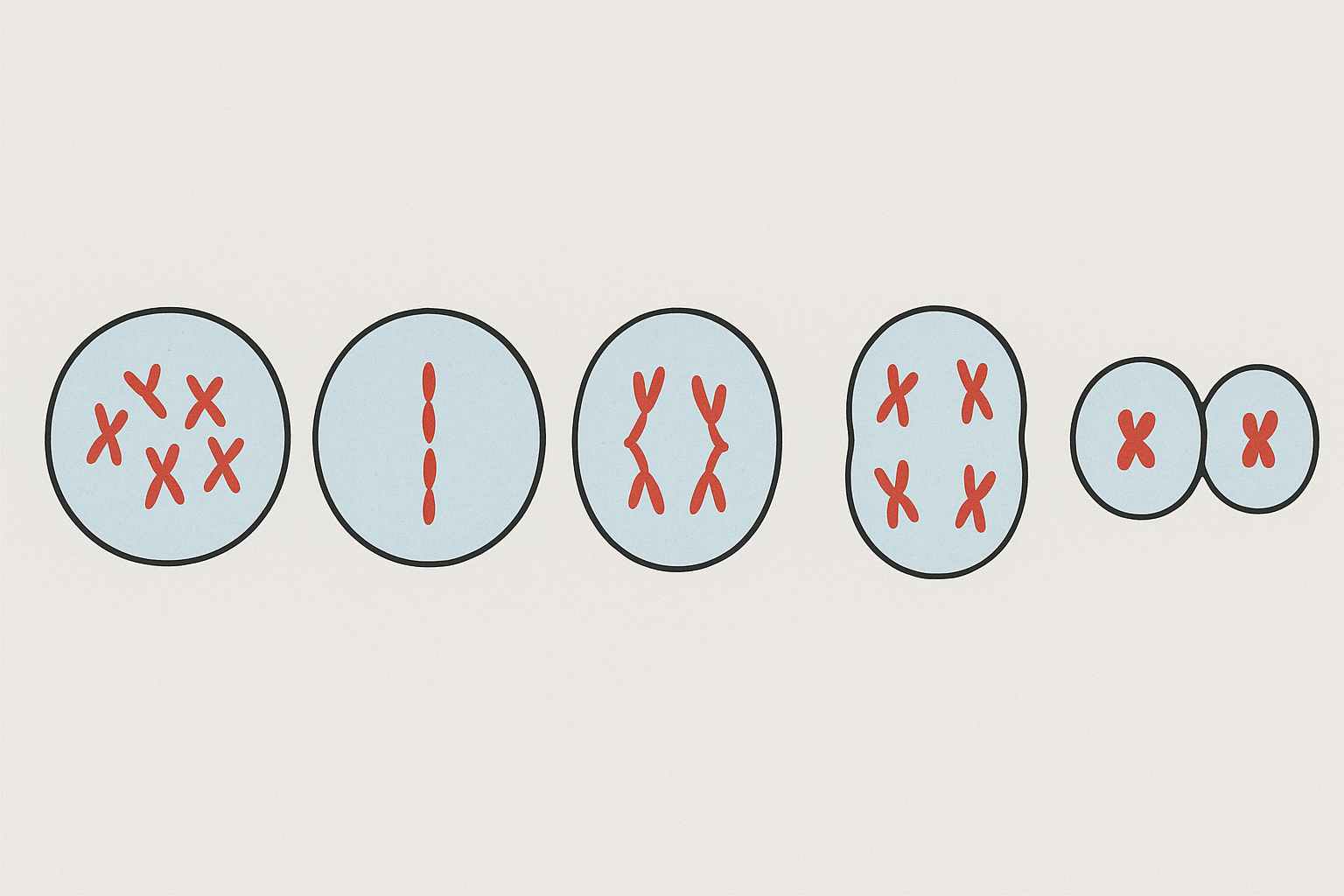
byMitosis is the process by which one eukaryotic cell divides into two genetically identical daughter cells. It is how a fertilized egg becomes an embryo, how skin replaces lost cells, how a cut heals, and (when regulation breaks down) how a tumor grows. The actual mechanics happen in a tightly choreographed sequence of five visible phases, and every cell biology course in the world asks students to memorize that sequence. This study note walks through each phase with a diagram, explains the role of the mitotic spindle, contrasts mitosis with meiosis, and connects the whole process to the larger cell cycle.
What Mitosis Is and Why It Matters
Mitosis is nuclear division in a eukaryotic cell, producing two genetically identical daughter nuclei. It is usually paired with cytokinesis (cytoplasmic division) to complete cell division. The starting cell is diploid (2n); each daughter cell is also diploid (2n) with the same chromosome number and the same DNA content as the parent. That is the key contrast with meiosis, which halves the chromosome number to produce gametes.
Three jobs depend on mitosis: growth (a zygote becomes a person through trillions of mitotic divisions), repair (a cut on your skin heals via mitosis of the surrounding cells), and asexual reproduction (in single-celled eukaryotes, mitosis is the entire reproductive strategy).
The Five Phases of Mitosis
The textbook sequence is prophase, metaphase, anaphase, telophase, and cytokinesis. Some textbooks add prometaphase between prophase and metaphase. The phases describe what is happening to the chromosomes and the spindle apparatus inside the cell.
1. Prophase
The chromatin condenses into visible chromosomes. Each chromosome at this point consists of two identical sister chromatids joined at the centromere, they were replicated earlier, during the S phase of the cell cycle, before mitosis began. The nucleolus disappears. The nuclear envelope begins to break down. Outside the nucleus, the centrosomes move toward opposite poles of the cell and start nucleating microtubules that will become the mitotic spindle.
2. Metaphase
All the chromosomes line up at the cell’s equator, called the metaphase plate. Each chromosome’s centromere is attached to spindle microtubules from both poles via kinetochores. The cell will not proceed to anaphase until every kinetochore is properly attached, this is the spindle assembly checkpoint, the molecular safeguard against chromosome mis-segregation. Metaphase is often the most photogenic phase under a microscope because the chromosomes are condensed, aligned, and easy to see.
3. Anaphase
The sister chromatids separate. The protein complex called cohesin, which had been holding sister chromatids together at the centromere, is cleaved by separase. Once cohesin is gone, the spindle microtubules pull the now-independent chromatids toward opposite poles. The cell elongates as the polar microtubules slide past each other. Anaphase is the fastest phase, often complete in just a few minutes.
4. Telophase
Each set of chromatids (now called chromosomes again) reaches its pole. Nuclear envelopes re-form around each set. The chromosomes decondense back into chromatin. The nucleoli reappear. The cell now has two complete, identical nuclei but is still a single cell. Telophase is essentially prophase in reverse.
5. Cytokinesis
Cytokinesis is the physical division of the cytoplasm and the cell membrane. In animal cells, a contractile ring of actin and myosin pinches the cell in two, forming a cleavage furrow. In plant cells (which have rigid cell walls), a cell plate forms in the middle from Golgi-derived vesicles and matures into a new cell wall. Cytokinesis is sometimes considered a separate process from mitosis proper; some textbooks split it out, others fold it in.
The Mitotic Spindle
The mitotic spindle is the machinery that physically moves chromosomes during mitosis. It is built from three categories of microtubules:
- Kinetochore microtubules attach to the kinetochore at each chromosome’s centromere and pull the sister chromatids apart during anaphase.
- Polar (interpolar) microtubules extend from opposite poles, overlap in the middle, and slide past each other to elongate the cell.
- Astral microtubules radiate outward from each centrosome toward the cell membrane, anchoring the spindle in place and helping orient the cleavage furrow.
Many anticancer drugs target the mitotic spindle. Taxol (paclitaxel) stabilizes microtubules so they cannot dynamically rearrange during anaphase. Vinca alkaloids prevent microtubule polymerization. Both block mitosis specifically in rapidly dividing cells, which is why they are used against tumors, though they also affect every other dividing tissue, which is why chemotherapy side effects hit hair follicles, gut lining, and bone marrow first.
Mitosis Within the Cell Cycle
Mitosis (the M phase) is only one part of the larger cell cycle. The full cycle in a typical actively-dividing somatic cell takes around 24 hours and runs:
- G1 phase: cell growth, protein synthesis, organelle duplication. Lasts about 11 hours in a typical human cell.
- S phase: DNA replication. Each chromosome’s single chromatid is duplicated into two sister chromatids. Lasts about 8 hours.
- G2 phase: continued growth, preparation for mitosis, DNA damage checks. Lasts about 4 hours.
- M phase: mitosis and cytokinesis as described above. Lasts about 1 hour total.
G1 + S + G2 together are called interphase. The cell spends roughly 95% of the cell cycle in interphase and only about 5% in M phase. Non-dividing cells (like most neurons) exit the cycle into G0 and may stay there for years or for a lifetime.
Mitosis vs Meiosis
| Feature | Mitosis | Meiosis |
|---|---|---|
| Purpose | Growth, repair, asexual reproduction | Production of gametes (sperm, egg) |
| Number of divisions | 1 | 2 (Meiosis I + Meiosis II) |
| Daughter cells | 2 | 4 |
| Chromosome number | Same as parent (2n → 2n) | Halved (2n → n) |
| Genetic identity | Identical to parent | Genetically unique (crossing over + independent assortment) |
| Where it happens | All somatic (body) cells | Germ cells in gonads only |
When Mitosis Goes Wrong
Errors in mitosis have severe consequences. Aneuploidy (wrong chromosome number) results when sister chromatids fail to separate during anaphase. The most well-known example is Down syndrome (trisomy 21), a result of meiotic non-disjunction in the parent, not mitotic, but the same mechanism can occur in mitosis and seeds many cancers.
Uncontrolled mitosis is the defining feature of cancer. Healthy cells stop dividing in response to contact inhibition, DNA damage, or lack of growth signals. Cancer cells acquire mutations (often in tumor suppressors like p53 or in oncogenes like Ras) that override these stop signals. The result is a population of cells that divide whenever they want, ignore damage, and eventually outgrow their tissue of origin.
Related study notes: Nucleic Acid, Protein, Enzyme.
Frequently Asked Questions
What are the 5 stages of mitosis in order?
Prophase, metaphase, anaphase, telophase, and cytokinesis. Some textbooks add prometaphase between prophase and metaphase. Prophase: chromatin condenses, nuclear envelope dissolves. Metaphase: chromosomes align at the cell’s equator. Anaphase: sister chromatids pull apart to opposite poles. Telophase: nuclear envelopes re-form around each set. Cytokinesis: the cytoplasm physically divides into two cells.
What is the difference between mitosis and meiosis?
Mitosis produces 2 genetically identical diploid daughter cells from one parent and is used for growth, repair, and asexual reproduction. Meiosis produces 4 genetically unique haploid cells (gametes) through two consecutive divisions and is the basis of sexual reproduction. Mitosis happens in all body (somatic) cells; meiosis happens only in germ cells.
How long does mitosis take?
In a typical human cell, the entire M phase (mitosis plus cytokinesis) lasts about 1 hour, of which prophase is the longest (around 30 minutes) and anaphase is the shortest (a few minutes). The complete cell cycle, including the interphase that precedes mitosis, typically lasts around 24 hours.
Why is metaphase important?
Metaphase is where the spindle assembly checkpoint operates. The cell will not start anaphase until every chromosome’s kinetochore is properly attached to spindle microtubules from both poles. This checkpoint prevents chromosome mis-segregation that would produce aneuploid daughter cells. When the checkpoint fails, cancer often follows.
What is the role of the mitotic spindle?
The mitotic spindle is the molecular machinery that physically moves chromosomes during mitosis. It is built from microtubules nucleated by the centrosomes at opposite poles. Kinetochore microtubules attach to chromosomes and pull them apart; polar microtubules slide past each other to elongate the cell; astral microtubules anchor the spindle to the cell membrane. Many cancer drugs (taxol, vincristine) target this spindle apparatus.
Is cytokinesis part of mitosis?
It depends on the definition. Strictly speaking, mitosis refers only to nuclear division (prophase through telophase). Cytokinesis is cytoplasmic division and is sometimes counted as a separate process. Most introductory biology textbooks include cytokinesis as the final step of mitosis because it almost always follows immediately and is required to complete cell division.
Browse more in Biology.