by
by
Natural selection is the process by which heritable traits that affect survival and reproduction become more or less common in a population over generations. Darwin and Wallace proposed it independently in 1858, and it remains the central mechanism of evolution. Natural selection isn’t a force that acts on individual organisms, it’s the statistical outcome of differential survival and reproduction across a population, accumulating over many generations into the observable phenomenon we call evolution.
Natural selection changes the frequency of heritable variants through differences in reproductive success. Individuals can be affected by selection, while evolutionary change is tracked across populations.
The Four Conditions for Natural Selection
Natural selection occurs whenever four conditions are met simultaneously. Wherever all four exist, evolution by natural selection is essentially inevitable.
- Variation. Individuals in a population differ from each other in observable traits, coat color, beak shape, body size, behavior, anything.
- Heritability. At least some of that variation is genetic, meaning offspring tend to resemble their parents on the trait in question.
- Differential survival or reproduction. Different variants survive or reproduce at different rates. Some traits give their carriers an advantage in finding food, avoiding predators, attracting mates, or surviving harsh conditions.
- Time. Many generations have to pass for small differences in survival or reproduction to compound into observable population-level change.
Strip any one of those four out and natural selection stops. If there’s no variation, there’s nothing to select on. If variation isn’t heritable, the next generation starts from scratch. If all variants survive and reproduce equally, the population doesn’t shift. If only one generation passes, no cumulative change occurs.
The Classic Example: Peppered Moths
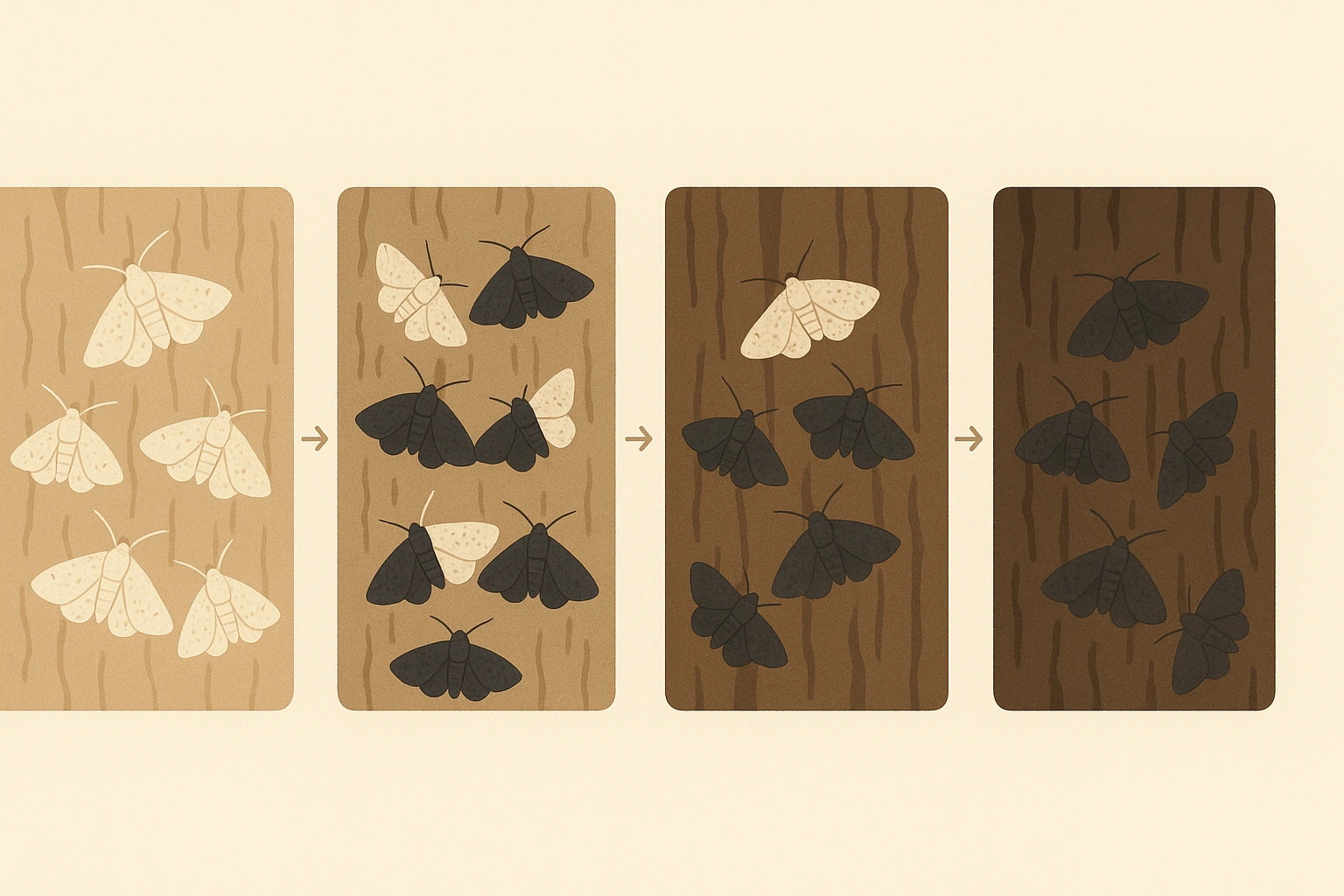
The British peppered moth (Biston betularia) is the textbook case of natural selection observed in human historical time. Two color morphs exist: light (the ‘peppered’ form) and dark (the melanic form).
Before the Industrial Revolution, tree trunks in England were covered in pale lichens. Light-colored moths blended in; dark moths were highly visible to bird predators. Light moths dominated.
During the Industrial Revolution (roughly 1830-1900), coal soot blackened tree bark in industrial regions and killed the pale lichens. Suddenly the camouflage situation was reversed: dark moths blended in, light moths stood out. Within about 50 years (roughly 100 moth generations), dark moths went from less than 2% to over 95% of the population in industrial areas.
After clean-air legislation in the mid-20th century cleaned up the bark and lichens recovered, the population swung back toward light moths. This is natural selection running in observable real time, on a measurable population, with a clear environmental driver. It is one of the cleanest evolutionary case studies in biology.
Types of Natural Selection
Selection can push a trait’s distribution in different directions depending on which variants are favored.
Directional Selection
One extreme is favored over the other. The population mean shifts toward that extreme over generations. Peppered moths under industrial pollution are a directional-selection example: the population mean color shifted darker. Antibiotic resistance in bacteria is another, strains with even slightly higher resistance survive, and population resistance levels climb.
Stabilizing Selection
Both extremes are disadvantaged; intermediate values are favored. Human birth weight is the textbook example. Babies that are too small (under 2.5 kg) or too large (over 4 kg) have higher mortality than babies near the population mean of 3-3.5 kg. The trait stays clustered around the optimum, with variability reduced over generations.
Disruptive Selection
Both extremes are favored; intermediate values are disadvantaged. Less common than the other two but produces the most dramatic outcomes, under sustained disruptive selection, a single population can split into two distinct groups and eventually become separate species. African seed-eating finches show this with beak sizes: small beaks specialize in small seeds, large beaks in large seeds, intermediate beaks handle neither efficiently.
Sexual Selection, A Special Subset
Sexual selection is natural selection acting on traits that affect mating success rather than survival. Darwin treated it as a separate force; modern biology considers it a special case. The classic examples involve traits that are costly to survival but advantageous to reproduction: peacock tails, deer antlers, bird songs.
Why peacock tails? The male’s tail is enormous, costly to grow, and makes him more visible to predators. But females consistently choose males with the largest, most symmetric tails. A male who survives despite the handicap must have good genes, the tail is a handicap signal that demonstrates underlying fitness. Genes for showy male traits and for the female preference co-evolve, sometimes producing runaway selection where the trait becomes more and more extreme until natural-selection costs catch up with sexual-selection benefits.
What Natural Selection Is Not
- Natural selection isn’t ‘survival of the fittest’ in the everyday sense. Fitness in biology means relative reproductive success, not physical strength. A small, weak organism that produces 100 surviving offspring is fitter than a powerful one that produces 10.
- Natural selection doesn’t have goals or foresight. Evolution is not progressing toward any particular endpoint. There’s no ‘higher’ or ‘lower’ organism in evolutionary terms, only organisms adapted to their current environment.
- Natural selection doesn’t create new variation. It only selects from existing variation, which comes from mutation, recombination, and gene flow. Selection is the editor, mutation is the writer.
- Natural selection doesn’t act on individuals over a lifetime. An individual’s genes don’t change in response to selection pressure. Selection acts on populations across generations.
- Natural selection doesn’t always produce the optimum design. It works with the variation available, has to maintain backwards compatibility with existing development, and can get stuck on local optima. The vertebrate eye’s blind spot is famous evidence.
Natural Selection and Modern Evolution
Natural selection is one of five forces that drive evolution. The others are mutation (the source of new variation), genetic drift (random changes in allele frequency, especially in small populations), gene flow (movement of alleles between populations), and non-random mating. For most large populations under stable conditions, natural selection is the dominant force. In small populations or over short timescales, genetic drift can rival or exceed selection. The modern synthesis of evolutionary biology (1930s-1940s) integrated all five mechanisms into a single mathematical framework.
Related study notes: Nucleic Acid, Protein, Punnett Square, Mitosis.
The OpenStax biology textbooks develop the biological processes discussed here with additional diagrams and explanations.
Variation and Reproductive Success
A population contains a heritable trait that improves survival in a particular environment. If carriers also leave more surviving offspring, the associated variants can become more frequent. Improved survival without any contribution to reproduction does not by itself establish that evolutionary outcome.
An environmental change can alter which variant is favored. A variant beneficial under one condition can carry a cost under another. Selection does not create the needed mutation because an organism tries harder; variation arises through processes such as mutation and recombination, and selection changes its representation.
The points to check in this example are:
- Relevant variation must be heritable for the response described.
- Fitness concerns contribution to subsequent generations in a particular context.
- Selection, genetic drift, mutation and gene flow are different processes.
Check Your Understanding
Try the questions before reading the answers.
Question 1. Does an individual evolve by deciding to adapt during its lifetime?
Answer. No. Population frequencies change across generations.
Question 2. Must the largest or strongest organism have the highest fitness?
Answer. No. Reproductive success in the relevant environment is the criterion.
Frequently Asked Questions
What is natural selection in simple terms?
Natural selection is the process by which heritable traits that improve survival or reproduction become more common in a population over generations. It happens whenever there is variation among individuals, that variation is heritable, different variants survive or reproduce at different rates, and enough time passes for the differences to add up.
Who first proposed natural selection?
Charles Darwin and Alfred Russel Wallace proposed natural selection independently in 1858, with Darwin publishing the full theory in On the Origin of Species in 1859. Wallace developed the idea while sick with malaria in the Malay Archipelago and sent his manuscript to Darwin, prompting Darwin to finally publish his own much-longer-developed ideas.
What is ‘survival of the fittest’ really about?
Herbert Spencer coined the phrase in 1864, and Darwin later included it. In biology, ‘fittest’ doesn’t mean strongest or fastest, it means relative reproductive success. A small, fragile organism that produces 100 surviving offspring is fitter than a strong, fast one that produces 10. The phrase is widely misunderstood, which is why most modern biologists avoid it.
What is the difference between directional, stabilizing, and disruptive selection?
Directional selection favors one extreme and shifts the population mean toward it (peppered moths going darker). Stabilizing selection favors intermediate values and reduces variability (human birth weight clustering around 3-3.5 kg). Disruptive selection favors both extremes and disadvantages intermediates, it can eventually split a population into two distinct groups and is a major driver of speciation.
What is sexual selection?
Sexual selection is natural selection acting on traits that affect mating success rather than survival. Peacock tails, deer antlers, and bird songs are classic examples. These traits are often costly to survival but advantageous to reproduction. They can lead to runaway selection where the trait becomes more and more extreme until natural-selection costs catch up with sexual-selection benefits.
Is natural selection still happening in humans?
Yes. Lactose tolerance in adults is a recent (within the last 10,000 years) genetic adaptation in populations with a long dairy-farming history. Resistance to malaria (sickle-cell trait, G6PD deficiency variants) is another. Several genes for skin pigmentation evolved in the last 5,000-15,000 years as humans spread across latitudes. Modern medicine and culture have changed which traits matter, but natural selection has not stopped.
Browse more in Biology.