by
by
Cellular respiration is how cells extract energy from glucose. The process unfolds in three linked stages, glycolysis in the cytoplasm, the Krebs cycle in the mitochondrial matrix, and oxidative phosphorylation on the inner mitochondrial membrane, and yields roughly 30 to 32 ATP per glucose molecule. This note walks through each stage with stoichiometry, the electron transport chain, the difference between aerobic and anaerobic respiration, and how the whole sequence mirrors photosynthesis in reverse.
Respiration accounting should separate glycolysis, pyruvate oxidation, the citric acid cycle and oxidative phosphorylation. ATP yield depends on the organism and coupling assumptions.
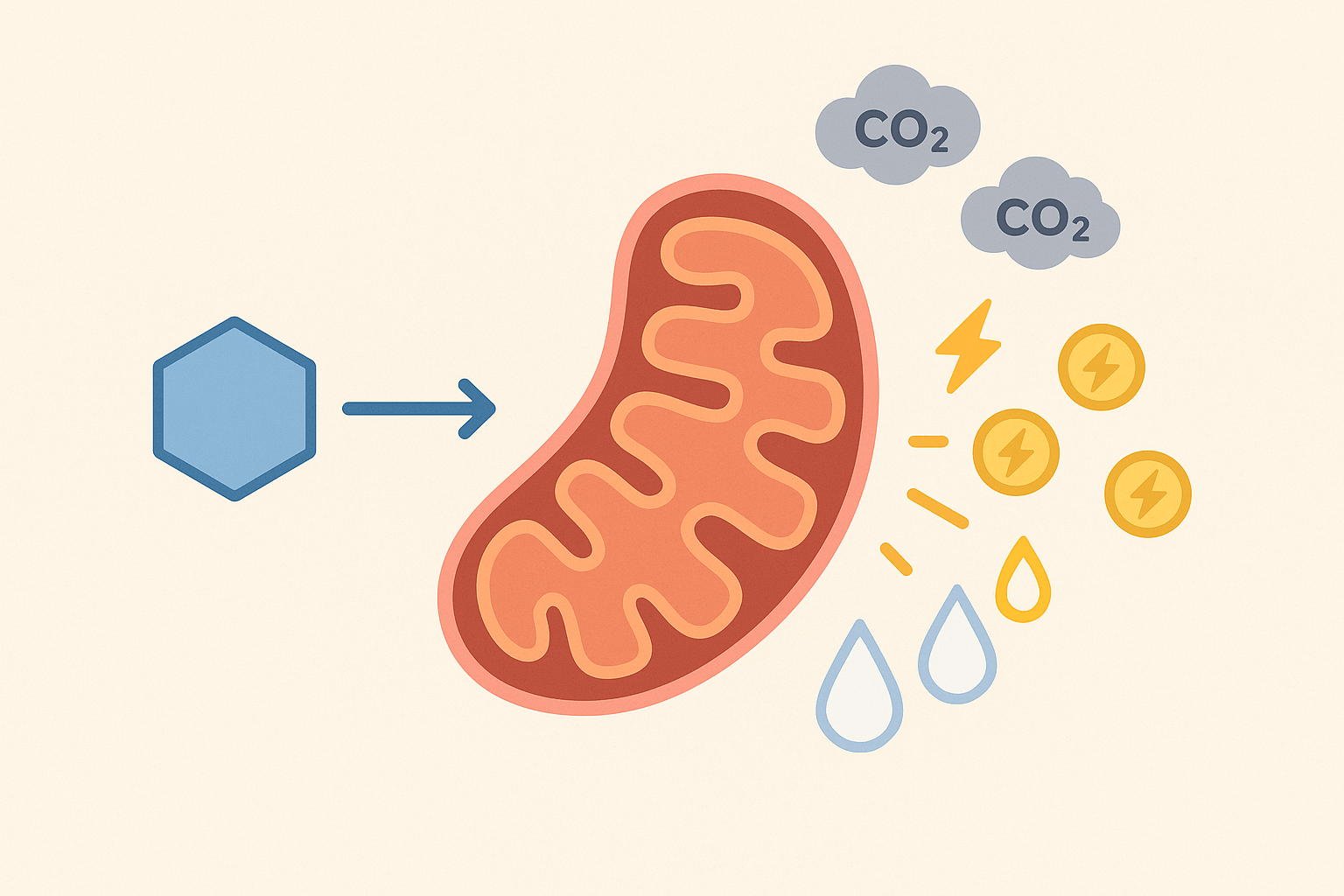
The Net Equation of Cellular Respiration
The summary fits in one line and is the exact reverse of photosynthesis:
$$ C_6H_{12}O_6 + 6\,O_2 \;\longrightarrow\; 6\,CO_2 + 6\,H_2O + \text{ATP} $$
Glucose plus oxygen yields carbon dioxide, water, and energy in the form of ATP. The energy is not released as heat in a single explosion; it is harvested step by step through controlled enzyme reactions so the cell can capture as much of it as possible in usable form.
Stage 1: Glycolysis
Glycolysis happens in the cytoplasm, not the mitochondrion. One glucose molecule (6 carbons) is broken into two molecules of pyruvate (3 carbons each). The cell invests 2 ATP to get the reaction started and then produces 4 ATP plus 2 NADH along the way. Net yield: 2 ATP and 2 NADH per glucose.
Glycolysis is anaerobic, it does not require oxygen. This matters because cells that lack mitochondria (red blood cells) or are temporarily oxygen-starved (muscle during a sprint) can still produce ATP this way, just less efficiently.
Stage 2: the Krebs Cycle
Each pyruvate enters the mitochondrial matrix and is converted to acetyl-CoA, releasing one CO₂ and producing one NADH. Acetyl-CoA then enters the Krebs cycle (also called the citric acid cycle or TCA cycle), where it joins oxaloacetate and runs through eight enzymatic steps that ultimately regenerate oxaloacetate while releasing more CO₂.
Per glucose (two pyruvates), the Krebs cycle produces 6 NADH, 2 FADH₂, 2 GTP/ATP, and releases 6 CO₂. Every breath of carbon dioxide you exhale came from the Krebs cycle running in your mitochondria right now.
Stage 3: Oxidative Phosphorylation
This is where the bulk of the ATP comes from. NADH and FADH₂ from stages 1 and 2 deliver electrons to the electron transport chain on the inner mitochondrial membrane. Electrons hop through four complexes (I, II, III, IV). At each hop, complexes I, III, and IV pump protons from the matrix into the intermembrane space, building a proton gradient.
The proton gradient drives ATP synthase (Complex V), which spins like a rotary motor and produces ATP. Oxygen is the final electron acceptor at Complex IV, without oxygen, the chain backs up, NADH and FADH₂ cannot deliver their electrons, and the whole stage stalls. That is why aerobic respiration requires oxygen.
Per glucose, oxidative phosphorylation produces roughly 26-28 ATP, depending on how efficiently the proton gradient is converted.
Total ATP Yield
| Stage | Location | ATP | NADH | FADH₂ | CO₂ |
|---|---|---|---|---|---|
| Glycolysis | Cytoplasm | 2 net | 2 | 0 | 0 |
| Pyruvate oxidation | Mitochondrial matrix | 0 | 2 | 0 | 2 |
| Krebs cycle | Mitochondrial matrix | 2 (as GTP) | 6 | 2 | 4 |
| Oxidative phosphorylation | Inner membrane | ~26-28 | (uses NADH) | (uses FADH₂) | 0 |
| TOTAL per glucose | ~30-32 | 10 | 2 | 6 |
Aerobic vs Anaerobic Respiration
When oxygen is unavailable, glycolysis continues but the Krebs cycle and oxidative phosphorylation cannot. The cell must regenerate NAD⁺ somehow so glycolysis can keep running.
- Lactic acid fermentation (animal muscle cells, some bacteria). Pyruvate is reduced to lactate, regenerating NAD⁺. This is why your muscles burn during intense sprinting, lactate accumulates faster than oxygen can clear it.
- Alcoholic fermentation (yeast, some bacteria). Pyruvate is converted to ethanol and CO₂. This is the entire basis of bread, beer, and wine.
Both anaerobic pathways yield only 2 ATP per glucose (the glycolysis net), versus 30-32 with oxygen. The 15x efficiency gap is why large active animals depend on aerobic respiration.
Cellular Respiration vs Photosynthesis
The two processes are mirror images. Photosynthesis builds glucose from CO₂ and water using light energy; cellular respiration breaks glucose back down using oxygen and stores the energy as ATP. Plants run both, photosynthesis in chloroplasts to make food, respiration in mitochondria to use it.
Related study notes: Photosynthesis, Mitochondria, Enzyme, Protein.
The OpenStax biology textbooks develop the biological processes discussed here with additional diagrams and explanations.
Carbon Dioxide and ATP
For complete oxidation of 1 glucose in a common eukaryotic model, glycolysis releases no CO2, pyruvate oxidation releases 2 and the citric acid cycle releases 4. Oxygen is reduced at the electron transport chain rather than being converted into the carbon dioxide carbon skeleton.
The often-quoted 30-32 ATP yield includes assumptions about electron-transfer shuttles and oxidative-phosphorylation coupling. It is not an exact fixed yield for every cell or organism. Fermentation can support glycolysis with a 2-ATP net yield while anaerobic respiration uses a different terminal electron acceptor in a respiratory chain.
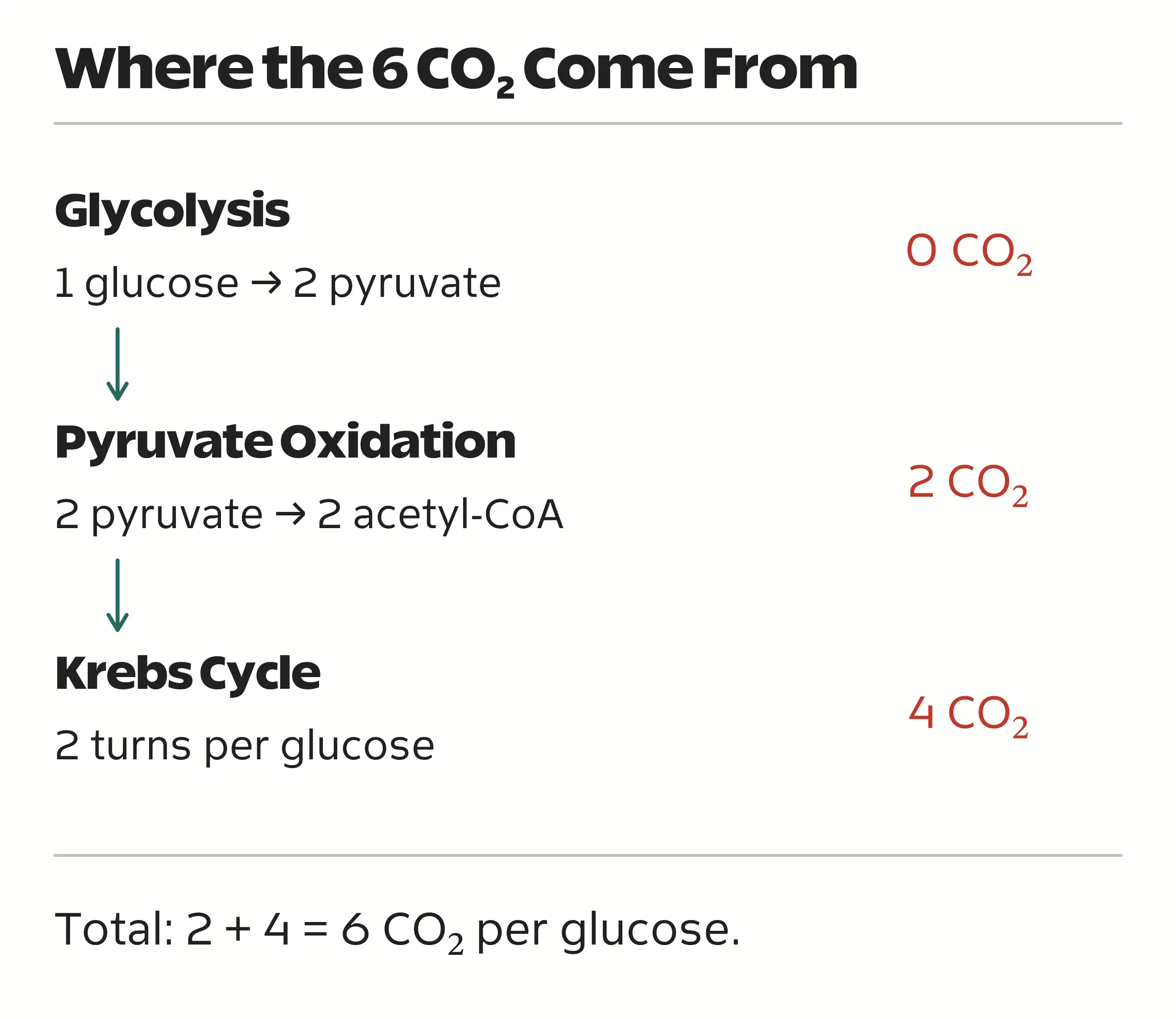
The points to check in this example are:
- Carbon removal and oxygen reduction occur in different reaction steps.
- Adenosine triphosphate yield varies with coupling and transport requirements.
- Plants respire as well as photosynthesize.
Check Your Understanding
Try the questions before reading the answers.
Question 1. Which of the 4 stages produces most ATP in the aerobic model?
Answer. Oxidative phosphorylation.
Question 2. Does fermentation require the full mitochondrial chain?
Answer. No. It regenerates the carrier needed for glycolysis by a different route.
Practice Questions
Work each question before reading its solution. The set runs from direct recall and substitution to the applied questions that exams actually use to separate grades. The downloadable PDF includes these questions and their solutions.
Question 1. Write the overall equation of aerobic respiration and compare it with photosynthesis.
Solution. \(C_6H_{12}O_6 + 6O_2 \rightarrow 6CO_2 + 6H_2O\) + energy (ATP + heat). It is photosynthesis run in reverse direction, energy released instead of stored; plants run both, animals only this one. The symmetry is the carbon cycle at the cellular scale.
Question 2. Summarize glycolysis: location, inputs, outputs, and its evolutionary significance.
Solution. In the cytoplasm, glucose (6C) splits into 2 pyruvate (3C), netting 2 ATP and 2 NADH, no oxygen required. Every domain of life runs it, testifying to its origin before Earth’s atmosphere held oxygen. It is the universal opening move of metabolism.
Question 3. What happens to pyruvate when oxygen is present, before the Krebs cycle proper?
Solution. It enters the mitochondrion and is oxidized by pyruvate dehydrogenase to acetyl-CoA, releasing 1 CO\(_2\) and loading 1 NADH per pyruvate. This link step commits the carbon to full oxidation: 2 pyruvate yield 2 acetyl-CoA, 2 CO\(_2\), 2 NADH.
Question 4. Where does most of respiration’s CO\(_2\) actually come from, and where does the O\(_2\) go?
Solution. CO\(_2\) exits during the link step and the Krebs cycle, not during the electron transport chain. O\(_2\) serves only at the chain’s very end, as the final electron acceptor, combining with electrons and protons into water. The gas you exhale and the gas you inhale are consumed and produced in different rooms of the factory.
Question 5. Explain chemiosmosis: how does the electron transport chain make ATP without touching ATP directly?
Solution. The chain’s complexes use electron energy from NADH and FADH\(_2\) to pump protons from the matrix into the intermembrane space, building an electrochemical gradient. Protons flow back through ATP synthase, spinning its rotor, and the rotation mechanically stitches ADP and phosphate into ATP. Electron energy becomes a proton dam; the dam turns a turbine. Mitchell’s once-heretical idea earned the 1978 Nobel.
Question 6. Tally the ATP: how much does 1 glucose yield, and why do textbooks now say “about 30” instead of 38?
Solution. Substrate-level: 2 (glycolysis) + 2 (Krebs). The 10 NADH and 2 FADH\(_2\) feed the chain for roughly 25 more. Modern measured yields are \(\sim\)2.5 ATP per NADH and 1.5 per FADH\(_2\), minus the cost of shuttling cytoplasmic NADH into the mitochondrion, giving 30 to 32 overall. The gradient leaks and the exchange rates are not integers; the old 38 assumed perfect accounting.
Question 7. Without oxygen, why does the whole system stall at glycolysis, and how does fermentation rescue it?
Solution. No O\(_2\) means the chain backs up, NADH cannot unload, and NAD\(^+\), glycolysis’s essential oxidizer, runs out. Fermentation regenerates NAD\(^+\) by dumping electrons onto pyruvate: to lactate in muscle, or to ethanol and CO\(_2\) in yeast. It buys continued glycolysis at 2 ATP per glucose, a 15-fold pay cut taken to keep the lights on.
Question 8. Compare the energy yield of aerobic respiration and fermentation, and connect it to sprinting versus marathon pace.
Solution. Aerobic: \(\sim\)30 ATP per glucose, limited by oxygen delivery, sustainable. Fermentation: 2 ATP, fast, oxygen-free, but burns glucose 15 times faster for the same power and accumulates lactate. Sprints run on fast glycolysis and stored phosphates; distance running must stay near the oxygen-supplied aerobic ceiling. The burn of a 400 m race is the chemistry of the shortfall.
Question 9. Cyanide blocks cytochrome c oxidase, the chain’s final complex. Trace why this is lethal within minutes.
Solution. With the terminal electron acceptor step blocked, the whole chain halts, the proton gradient dissipates, and ATP synthase stops; NADH piles up and the Krebs cycle strangles for lack of NAD\(^+\). Cells fall back on fermentation’s 2 ATP, hopelessly short for heart and brain. Death by cyanide is death by unplugged mitochondria, with oxygen abundant and unusable.
Question 10. Brown fat is packed with mitochondria that make heat instead of ATP. What is being uncoupled, and why is that useful?
Solution. Uncoupling protein 1 opens a proton leak across the inner membrane, letting the gradient discharge WITHOUT passing through ATP synthase: the dammed energy dissipates directly as heat. Hibernating mammals and human infants use it for non-shivering warmth. The same principle killed dieters who took the uncoupler DNP in the 1930s: unlimited fuel burn, uncontrolled fever.
Frequently Asked Questions
What is cellular respiration in simple terms?
Cellular respiration is the process cells use to break down glucose and capture the released energy as ATP. The simplified equation is C₆H₁₂O₆ + 6 O₂ → 6 CO₂ + 6 H₂O + ATP. It is the reverse of photosynthesis.
Where does cellular respiration take place?
Glycolysis happens in the cytoplasm. Pyruvate oxidation and the Krebs cycle happen in the mitochondrial matrix. Oxidative phosphorylation happens on the inner mitochondrial membrane (the cristae). Most of the ATP comes from the membrane stage.
How much ATP is produced per glucose?
Roughly 30-32 ATP per glucose molecule in aerobic respiration. Older textbooks said 36-38; the modern revised count is lower because pumping NADH from cytoplasm into mitochondria costs some ATP. Without oxygen (anaerobic respiration), only the 2 ATP from glycolysis are produced.
What is the role of oxygen in cellular respiration?
Oxygen is the final electron acceptor at Complex IV of the electron transport chain. Without it, electrons cannot move through the chain, NADH cannot dump its electrons, and the entire chain backs up. That is why aerobic respiration absolutely requires oxygen.
What is the difference between aerobic and anaerobic respiration?
Aerobic respiration uses oxygen and yields 30-32 ATP per glucose by running all three stages. Anaerobic respiration runs only glycolysis followed by fermentation (lactic acid in muscle cells, ethanol in yeast) and yields just 2 ATP per glucose. The 15x efficiency gap is why anaerobic respiration is reserved for short bursts.
Is cellular respiration the same as breathing?
No. Breathing is the macroscopic process of moving air in and out of your lungs. Cellular respiration is the microscopic chemistry happening inside each cell that uses the oxygen your breathing delivered and produces the CO₂ your breathing expels. The two are connected but operate at very different scales.
Browse more in Biology.