by
by
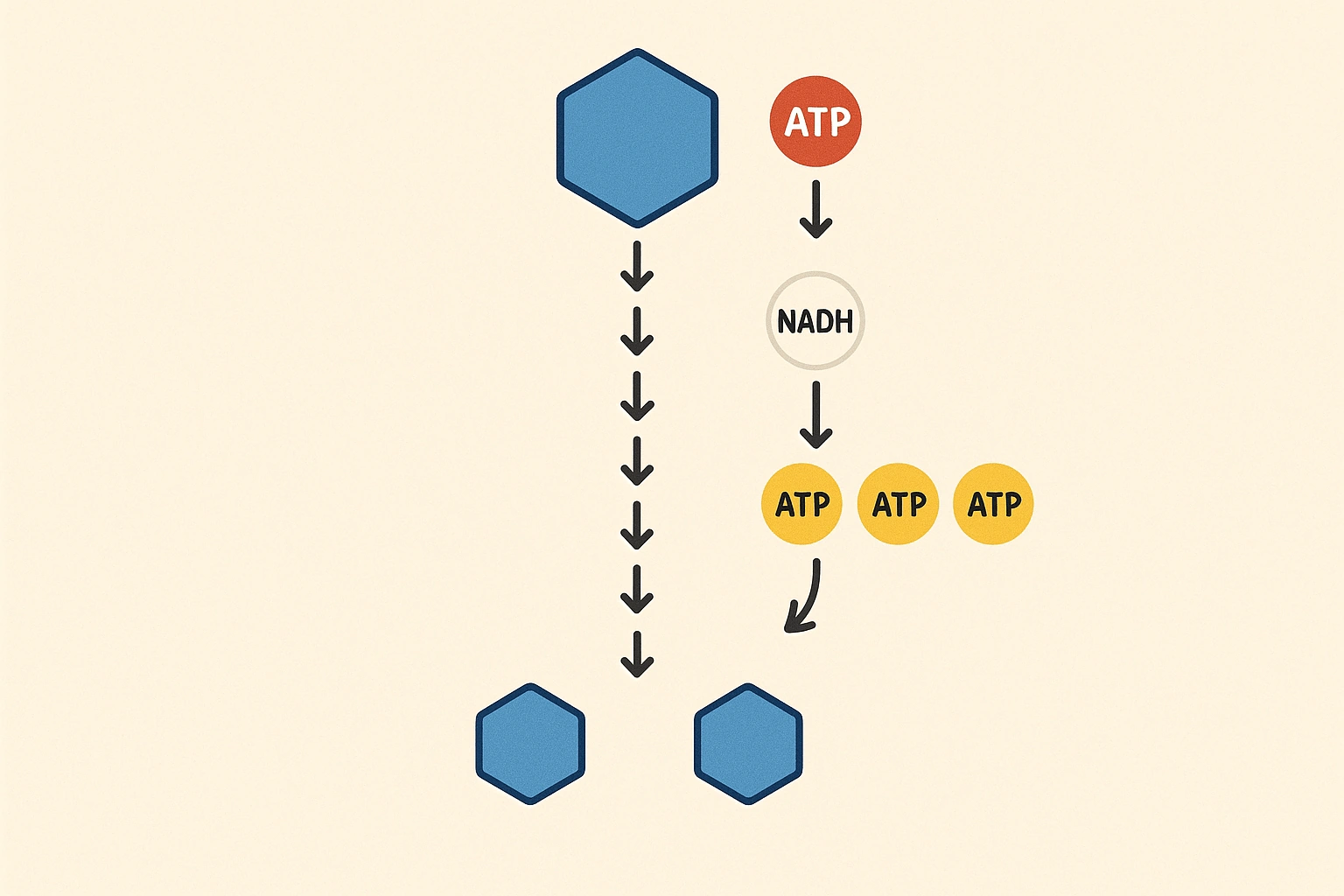
Glycolysis is the first stage of cellular respiration and the most universal energy-extraction pathway in biology. The standard glycolytic pathway is widespread, while some organisms and specialized cells use different metabolic arrangements. The process splits one molecule of glucose (6 carbons) into two molecules of pyruvate (3 carbons each) through 10 enzymatic steps, all of which happen in the cytoplasm without requiring oxygen. The net yield is 2 ATP and 2 NADH per glucose. It’s a small payoff compared to the full aerobic respiration that follows, but glycolysis is what makes anaerobic life possible and what bridges glucose into the larger respiratory pathway.
Glycolysis has an investment stage and a payoff stage. Gross ATP production should be distinguished from its net yield.
The Net Reaction
Summarized in one line:
$$ \text{Glucose} + 2\,NAD^+ + 2\,ADP + 2\,P_i \;\longrightarrow\; 2\,\text{Pyruvate} + 2\,NADH + 2\,ATP + 2\,H^+ + 2\,H_2O $$
Read the equation backwards from the right side: the cell starts with glucose and a bit of metabolic raw material (ADP, inorganic phosphate, NAD+). It ends with two pyruvate molecules ready for the Krebs cycle, plus 2 ATP and 2 NADH worth of harvested energy. All in the cytoplasm. No oxygen needed.
The Two Phases
Phase 1: Energy Investment (Steps 1-5)
The cell spends 2 ATP up front to phosphorylate and prepare glucose for splitting. This may seem counter-productive, but the investment makes the molecule unstable enough to fall apart in phase 2 with a big energy payoff.
- Step 1. Hexokinase phosphorylates glucose using 1 ATP, producing glucose-6-phosphate.
- Step 2. Phosphoglucose isomerase rearranges glucose-6-phosphate into fructose-6-phosphate.
- Step 3. Phosphofructokinase adds a second phosphate using another ATP, producing fructose-1,6-bisphosphate. This is the rate-limiting step of glycolysis and the main regulatory checkpoint.
- Step 4. Aldolase splits fructose-1,6-bisphosphate into two 3-carbon molecules: dihydroxyacetone phosphate (DHAP) and glyceraldehyde-3-phosphate (G3P).
- Step 5. Triose phosphate isomerase rapidly interconverts DHAP and G3P. Only G3P continues; DHAP gets converted to G3P. So we now have 2 G3P molecules per starting glucose.
Phase 2: Energy Payoff (Steps 6-10)
All five steps below happen twice, once per G3P. The numbers below are per glucose (so 2x per G3P).
- Step 6. Glyceraldehyde-3-phosphate dehydrogenase oxidizes G3P to 1,3-bisphosphoglycerate, producing 2 NADH per glucose. This is where the NADH comes from.
- Step 7. Phosphoglycerate kinase transfers a phosphate from 1,3-bisphosphoglycerate to ADP, producing 2 ATP per glucose. The first substrate-level phosphorylation.
- Step 8. Phosphoglycerate mutase rearranges 3-phosphoglycerate into 2-phosphoglycerate.
- Step 9. Enolase dehydrates 2-phosphoglycerate into phosphoenolpyruvate (PEP).
- Step 10. Pyruvate kinase transfers a phosphate from PEP to ADP, producing 2 more ATP per glucose and 2 pyruvate. Second substrate-level phosphorylation.
The Stoichiometry
| Per glucose | Phase 1 (Investment) | Phase 2 (Payoff) | Net |
|---|---|---|---|
| ATP | -2 (consumed) | +4 (produced) | +2 |
| NADH | 0 | +2 (produced) | +2 |
| NAD+ | 0 | -2 (consumed) | -2 |
| Carbon (output) | 2 pyruvate (3C each) | 2 pyruvate |
What Happens to the Pyruvate
Pyruvate has two main fates, depending on whether oxygen is available.
- With oxygen (aerobic): Pyruvate enters the mitochondrion and gets converted to acetyl-CoA, releasing 1 CO2 and producing 1 NADH per pyruvate. Acetyl-CoA then enters the Krebs cycle for the full aerobic-respiration payoff (~30-32 ATP per glucose total).
- Without oxygen (anaerobic): The cell ferments pyruvate to regenerate NAD+ so glycolysis can keep running. In animal muscle, pyruvate becomes lactate (lactic acid fermentation). In yeast, it becomes ethanol and CO2 (alcoholic fermentation). Either way, the cell stays stuck at 2 ATP per glucose, much less efficient than aerobic respiration but enough to keep going.
Why Glycolysis Is Universal
Glycolysis is present in essentially every living cell, bacteria, archaea, plants, animals, fungi. The pathway is highly conserved across all three domains of life. Several reasons it shows up everywhere:
- No oxygen required. Earth’s atmosphere had little free oxygen for the first 2 billion years of life. Glycolysis evolved before oxygen was available, and it still works without it.
- No specialized organelles required. All enzymes are cytoplasmic. Prokaryotes (which lack mitochondria entirely) can still run glycolysis.
- Fast. Substrate-level phosphorylation is much faster than oxidative phosphorylation. Cells that need a quick ATP burst (sprinting muscle, fermenting yeast) rely on glycolysis.
- Backbone for biosynthesis. Glycolytic intermediates feed multiple biosynthetic pathways: glucose-6-phosphate goes to the pentose phosphate pathway; pyruvate goes to fatty acid synthesis; DHAP goes to lipid synthesis.
The Pasteur Effect
Louis Pasteur noticed in the 1860s that yeast cells consume sugar much faster anaerobically than aerobically. This is the Pasteur effect: when oxygen is unavailable, glycolysis speeds up dramatically because the cell needs to compensate for the lower ATP yield per glucose. The biochemical mechanism: AMP and ADP accumulate, activating phosphofructokinase (the rate-limiting enzyme of glycolysis). When oxygen returns, ATP levels recover, phosphofructokinase is inhibited, and glycolysis slows back down.
Related study notes: Cellular Respiration, Krebs Cycle, Mitochondria, Enzyme.
The OpenStax biology textbooks develop the biological processes discussed here with additional diagrams and explanations.
Following One Glucose
One glucose supplies 2 three-carbon pyruvate molecules in the standard glycolytic pathway. The pathway uses 2 ATP and produces 4 ATP, giving 2 net ATP. It also reduces 2 NAD+ to 2 NADH.
Continuing glycolysis requires a route to regenerate NAD+. During lactate fermentation, pyruvate accepts reducing equivalents from NADH and NAD+ is restored. This regeneration permits the ATP-producing glycolytic steps to continue. Fermentation and anaerobic respiration are different processes: the latter uses an electron transport chain with a nonoxygen terminal acceptor.
The points to check in this example are:
- The standard pathway is described in the cytosol.
- No CO2 is released in the net glycolytic conversion of glucose to pyruvate.
- Alternative pathways and organism-specific metabolism should not be hidden by a claim that every living cell uses an identical pathway.
Check Your Understanding
Try the questions before reading the answers.
Question 1. What is the net ATP yield per glucose in standard glycolysis?
Answer. 2.
Question 2. Why is NAD+ regeneration necessary?
Answer. A glycolytic oxidation step needs NAD+ as an electron acceptor.
Practice Questions
Work each question before reading its solution. The set runs from direct recall and substitution to the applied questions that exams actually use to separate grades. The downloadable PDF includes these questions and their solutions.
Question 1. Define glycolysis: location, starting molecule, and net products.
Solution. In the cytoplasm, glucose (6 carbons) is split and processed through 10 enzymatic steps into 2 pyruvate molecules (3 carbons each), netting 2 ATP and 2 NADH per glucose. It requires no oxygen, which is why every domain of life, from ancient anaerobic bacteria to modern human muscle cells, still runs it.
Question 2. Explain the “investment phase” of glycolysis: how much ATP is spent, and why spending ATP to eventually MAKE ATP makes biochemical sense.
Solution. Steps 1 and 3 each consume 1 ATP to phosphorylate the sugar, 2 ATP invested total, before any payoff. Phosphorylating glucose traps it inside the cell (phosphorylated sugars cannot cross the membrane back out) and destabilizes it chemically, priming it to be split apart in step 4. The upfront cost buys both containment and reactivity.
Question 3. What happens at the “splitting” step (step 4), and why does 1 glucose molecule become 2 identical downstream branches?
Solution. Fructose-1,6-bisphosphate (6 carbons) is cleaved into 2 different 3-carbon molecules, which are then rapidly interconverted so both funnel down the SAME remaining pathway. From this point, every subsequent reaction happens TWICE per original glucose, once for each 3-carbon piece, which is exactly why the “payoff phase” yields figures are doubled relative to a single pathway pass.
Question 4. Explain the “payoff phase”: how much ATP and NADH are generated, and what is the NET ATP yield after subtracting the investment?
Solution. Because the pathway runs twice per glucose (from the split), the payoff phase generates 4 ATP and 2 NADH total. Net ATP: \(4 – 2\) invested \(= 2\) ATP per glucose. The gross production number (4) is easy to misremember as the net; always subtract the 2 invested ATP first.
Question 5. What is substrate-level phosphorylation, and how does it differ mechanistically from the oxidative phosphorylation used later in the electron transport chain?
Solution. A high-energy phosphate group is transferred DIRECTLY from a substrate molecule to ADP, forming ATP through a single enzyme-catalyzed reaction, no membrane or electron gradient involved. This is how ALL of glycolysis’s ATP forms. Oxidative phosphorylation, by contrast, builds ATP indirectly via a proton gradient across a membrane, a far larger and slower-assembling apparatus.
Question 6. Why is glycolysis considered evolutionarily ancient, and what does its universal presence across all 3 domains of life suggest?
Solution. It requires no oxygen and no membrane-bound organelles, fitting the anoxic conditions of early Earth’s atmosphere before photosynthetic oxygen accumulation. Its presence in bacteria, archaea, and eukaryotes alike, essentially unchanged in its core chemistry, suggests it evolved before these lineages diverged, making it one of the oldest continuously used biochemical pathways on the planet.
Question 7. Phosphofructokinase (PFK), the step-3 enzyme, is allosterically inhibited by high ATP and citrate, and activated by high AMP. Explain the logic of this regulation.
Solution. High ATP and citrate signal the cell already has abundant energy, so further glucose breakdown is unnecessary and PFK throttles down. High AMP signals energy is being spent faster than it is replenished, so PFK speeds up to replenish supply. This is a feedback thermostat: glycolysis’s rate tracks the cell’s actual energy need rather than running at a fixed pace regardless of demand.
Question 8. Without oxygen, pyruvate cannot proceed to the Krebs cycle. What happens to it instead in human muscle cells, and why is this necessary for glycolysis to CONTINUE at all?
Solution. Pyruvate is reduced to lactate, regenerating NAD\(^+\) from the NADH produced earlier in glycolysis. Without this regeneration, the cell’s NAD\(^+\) supply would be exhausted within seconds, and glycolysis’s own step 6 (which requires NAD\(^+\)) would halt entirely. Fermentation is not really about lactate; it is about keeping the NAD\(^+\)/NADH cycle from stalling glycolysis itself.
Question 9. Cancer cells often perform “aerobic glycolysis” (the Warburg effect): fermenting glucose to lactate even when oxygen IS abundant. Why might a rapidly dividing cell favor this seemingly wasteful, low-ATP-yield pathway?
Solution. Glycolytic intermediates get diverted into biosynthetic pathways (nucleotides, amino acids, lipids) that a rapidly dividing cell desperately needs for building new cells, something the Krebs cycle’s complete combustion to CO\(_2\) cannot provide. Glycolysis also runs much faster than oxidative phosphorylation per unit time even at lower ATP-per-glucose efficiency, favoring rapid biomass production over energy efficiency, a tradeoff cancer cells and rapidly proliferating normal cells (like activated immune cells) both exploit.
Question 10. Compare the ATP yield per glucose from glycolysis alone (2 net ATP) to full aerobic respiration (\(\sim\)30-32 ATP). What does this roughly 15-fold difference reveal about why organisms evolved aerobic respiration at all?
Solution. Glycolysis alone extracts only a small fraction of glucose’s available chemical energy, leaving pyruvate still rich in extractable energy; the Krebs cycle and electron transport chain complete that extraction far more thoroughly. The evolution of oxygen-using respiration, following the rise of atmospheric oxygen from early photosynthesis, let organisms harvest roughly 15 times more energy from the identical glucose molecule, a massive efficiency gain that likely enabled the evolution of larger, more energy-hungry multicellular life.
Frequently Asked Questions
What is glycolysis in simple terms?
Glycolysis is the metabolic pathway that breaks one glucose molecule into two pyruvate molecules in the cell’s cytoplasm. It uses 2 ATP up front (investment phase) and produces 4 ATP and 2 NADH (payoff phase), for a net of 2 ATP and 2 NADH per glucose. It is the first stage of cellular respiration and the only one that does not require oxygen.
Where does glycolysis take place?
In the cytoplasm (cytosol) of the cell, not in any organelle. All ten enzymes are soluble cytoplasmic proteins. This is why even cells without mitochondria, like mature red blood cells, can still run glycolysis and produce ATP.
How much ATP does glycolysis produce?
Net 2 ATP per glucose. The cell invests 2 ATP in the early steps and produces 4 ATP in the later steps. The 2 NADH produced are worth another ~5 ATP if oxygen is present (they feed the electron transport chain), but glycolysis itself produces only 2 net ATP.
Does glycolysis require oxygen?
No. Glycolysis is anaerobic, it works without oxygen. This is why it evolved early in Earth’s history when free oxygen was scarce, and why anaerobic organisms (or aerobic cells under low-oxygen conditions) can still produce some ATP.
What is the rate-limiting step of glycolysis?
Step 3, catalyzed by phosphofructokinase (PFK), which converts fructose-6-phosphate to fructose-1,6-bisphosphate. PFK is highly regulated, it is activated by AMP and ADP (signals of low energy) and inhibited by ATP and citrate (signals of high energy). This is how the cell adjusts glycolysis speed to current energy demand.
What happens to pyruvate after glycolysis?
It depends on oxygen availability. With oxygen, pyruvate enters the mitochondrion, gets converted to acetyl-CoA, and feeds the Krebs cycle for the full aerobic respiration payoff (~30-32 ATP per glucose total). Without oxygen, pyruvate is fermented, to lactate in animal muscle cells, or to ethanol and CO2 in yeast, to regenerate NAD+ so glycolysis can keep running.
Browse more in Biology.