
Krebs Cycle
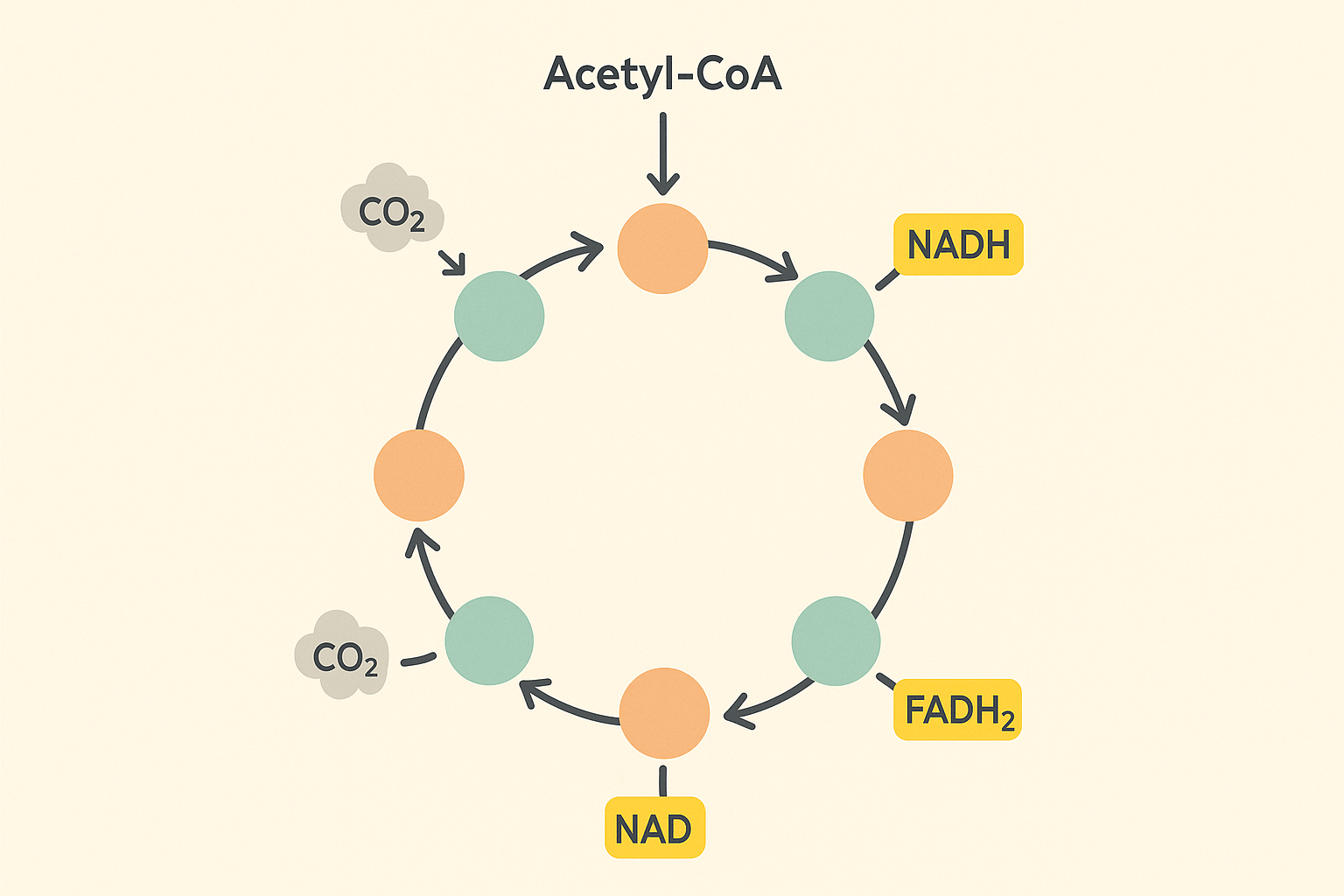
The Krebs cycle — also called the citric acid cycle or the TCA (tricarboxylic acid) cycle — is the second stage of aerobic cellular respiration. It runs inside the mitochondrial matrix, takes in acetyl-CoA produced from pyruvate, runs through eight enzymatic steps in a closed loop, and produces NADH, FADH2, GTP/ATP, and CO2. The cycle’s job is not to make a lot of ATP directly; it’s to strip electrons from carbon and load them onto NADH and FADH2 carriers that then deliver the electrons to the electron transport chain for the big ATP payoff. Hans Krebs worked out the cycle in 1937 and won the 1953 Nobel Prize for the discovery.
Where the Krebs Cycle Sits
The Krebs cycle is stage 2 of aerobic cellular respiration. It’s preceded by glycolysis (cytoplasm) and followed by oxidative phosphorylation (inner mitochondrial membrane).
- Stage 1 — Glycolysis (cytoplasm): glucose splits into 2 pyruvate, producing 2 ATP and 2 NADH per glucose.
- Pyruvate oxidation (mitochondrial matrix): each pyruvate becomes acetyl-CoA, releasing 1 CO2 and producing 1 NADH.
- Stage 2 — Krebs cycle (mitochondrial matrix): acetyl-CoA enters the cycle; covered in detail below.
- Stage 3 — Oxidative phosphorylation (inner membrane): NADH and FADH2 deliver electrons; oxygen is the final acceptor; produces ~26-28 ATP per glucose.
The Krebs cycle is the bridge between glycolysis and the big ATP-generating stage. Strip electrons from carbon, hand them to NADH and FADH2, send them down the road to the electron transport chain.
The Cycle’s Input and Output Per Acetyl-CoA
One turn of the Krebs cycle consumes one acetyl-CoA (2 carbons) and produces:
- 3 NADH (electron carriers)
- 1 FADH2 (electron carrier)
- 1 GTP (which converts to ATP by substrate-level phosphorylation)
- 2 CO2 (released as waste)
Per glucose (which produces 2 pyruvates → 2 acetyl-CoA), the cycle runs twice, doubling all those outputs. Combined with the pyruvate-oxidation step and glycolysis, the running total entering oxidative phosphorylation is 10 NADH, 2 FADH2, 4 ATP, and 6 CO2.
The Eight Steps of the Cycle
The cycle has eight enzymatic steps, each catalyzed by a specific enzyme. The key chemistry is carbon-by-carbon stripping of electrons via oxidation reactions.
- Citrate synthase joins acetyl-CoA (2C) with oxaloacetate (4C) to form citrate (6C). This is the cycle’s entry step.
- Aconitase rearranges citrate into isocitrate (still 6C).
- Isocitrate dehydrogenase oxidizes isocitrate to alpha-ketoglutarate (5C). Releases 1 CO2 and produces 1 NADH. First decarboxylation.
- Alpha-ketoglutarate dehydrogenase oxidizes alpha-ketoglutarate to succinyl-CoA (4C). Releases 1 CO2 and produces 1 NADH. Second decarboxylation.
- Succinyl-CoA synthetase converts succinyl-CoA to succinate, producing 1 GTP (which equals 1 ATP). Substrate-level phosphorylation.
- Succinate dehydrogenase oxidizes succinate to fumarate, producing 1 FADH2. This enzyme is also Complex II of the electron transport chain — it sits in the inner mitochondrial membrane, not the matrix.
- Fumarase adds water to fumarate, producing malate.
- Malate dehydrogenase oxidizes malate back to oxaloacetate, producing the final 1 NADH. Oxaloacetate is now available to accept another acetyl-CoA, restarting the cycle.
Notice the symmetry: the cycle takes in a 2-carbon acetyl group, runs it around, and releases the 2 carbons as 2 CO2 molecules. The carbons that leave are not the same ones that entered (the cycle rearranges atoms), but the carbon balance is exact.
Why the Cycle Matters Beyond ATP
The Krebs cycle is not just an energy-extraction loop. Many of its intermediates are starting materials for biosynthesis.
- Alpha-ketoglutarate is the precursor for the amino acid glutamate, which is in turn the precursor for many other amino acids.
- Oxaloacetate is the precursor for aspartate, which is the precursor for several more amino acids.
- Succinyl-CoA is required for heme synthesis (the iron-binding group in hemoglobin).
- Citrate can leave the mitochondrion to serve as a building block for fatty acid synthesis in the cytoplasm.
Because intermediates are drawn off for biosynthesis, the cycle would eventually run out of oxaloacetate to accept incoming acetyl-CoA. The cell compensates with anaplerotic reactions — replenishment reactions that produce new oxaloacetate from pyruvate via pyruvate carboxylase, for example.
Regulation
The Krebs cycle is regulated at three key enzymes: citrate synthase, isocitrate dehydrogenase, and alpha-ketoglutarate dehydrogenase. The regulation logic is simple — when the cell has plenty of ATP and NADH, slow the cycle down. When ATP is low and ADP/NAD+ are accumulating, speed it up. The cycle is driven by demand, not by supply.
Related study notes: Cellular Respiration, Mitochondria, Enzyme, Protein.
Frequently Asked Questions
What is the Krebs cycle in simple terms?
The Krebs cycle (also called the citric acid cycle or TCA cycle) is the second stage of aerobic cellular respiration. It happens inside the mitochondrial matrix and runs in a circle, accepting acetyl-CoA from pyruvate, stripping electrons onto NADH and FADH2, releasing CO2, and producing a small amount of ATP. The big ATP payoff comes later, in oxidative phosphorylation, using the NADH and FADH2 from this cycle.
Where does the Krebs cycle take place?
In the matrix of the mitochondrion (the innermost compartment). All eight enzymes of the cycle are dissolved in the matrix, except succinate dehydrogenase, which sits in the inner mitochondrial membrane because it also functions as Complex II of the electron transport chain.
How much ATP does the Krebs cycle produce per glucose?
Directly, the cycle produces only 2 ATP per glucose (1 per acetyl-CoA, and one glucose yields 2 acetyl-CoA). The cycle’s real contribution is the 6 NADH and 2 FADH2 per glucose, which feed the electron transport chain and produce roughly 26-28 ATP per glucose downstream. So indirectly, the Krebs cycle drives the bulk of cellular ATP production.
Who discovered the Krebs cycle?
Hans Krebs worked out the cycle in 1937 while at the University of Sheffield. He won the 1953 Nobel Prize in Physiology or Medicine for the discovery (shared with Fritz Lipmann, who discovered coenzyme A). The name ‘citric acid cycle’ refers to citrate, the first intermediate after acetyl-CoA enters; ‘TCA cycle’ stands for tricarboxylic acid cycle, since citrate has three carboxyl groups.
What’s the difference between the Krebs cycle and cellular respiration?
Cellular respiration is the whole process of extracting energy from glucose — glycolysis, the Krebs cycle, and oxidative phosphorylation together. The Krebs cycle is the middle stage. Cellular respiration produces about 30-32 ATP per glucose total; the Krebs cycle is responsible for about 2 of those directly and another 26 indirectly via NADH and FADH2.
Does the Krebs cycle require oxygen?
Not directly — none of the eight enzymes use oxygen. But the cycle depends on the regeneration of NAD+ and FAD from NADH and FADH2, which only happens when the electron transport chain is running. The electron transport chain requires oxygen as the final electron acceptor. So in practice, the Krebs cycle stops when oxygen runs out, because NADH and FADH2 accumulate and there’s no NAD+ or FAD left to accept electrons.