by
by
Photosynthesis is the process by which plants, algae, and cyanobacteria convert sunlight, water, and carbon dioxide into glucose and oxygen. It is the entry point for solar energy into the biosphere. Without photosynthesis there is no food chain, no atmospheric oxygen, no fossil fuels.
The oxygen released by oxygenic photosynthesis comes from water. Carbon fixation and light-driven energy conversion are linked but occur through different reaction systems.
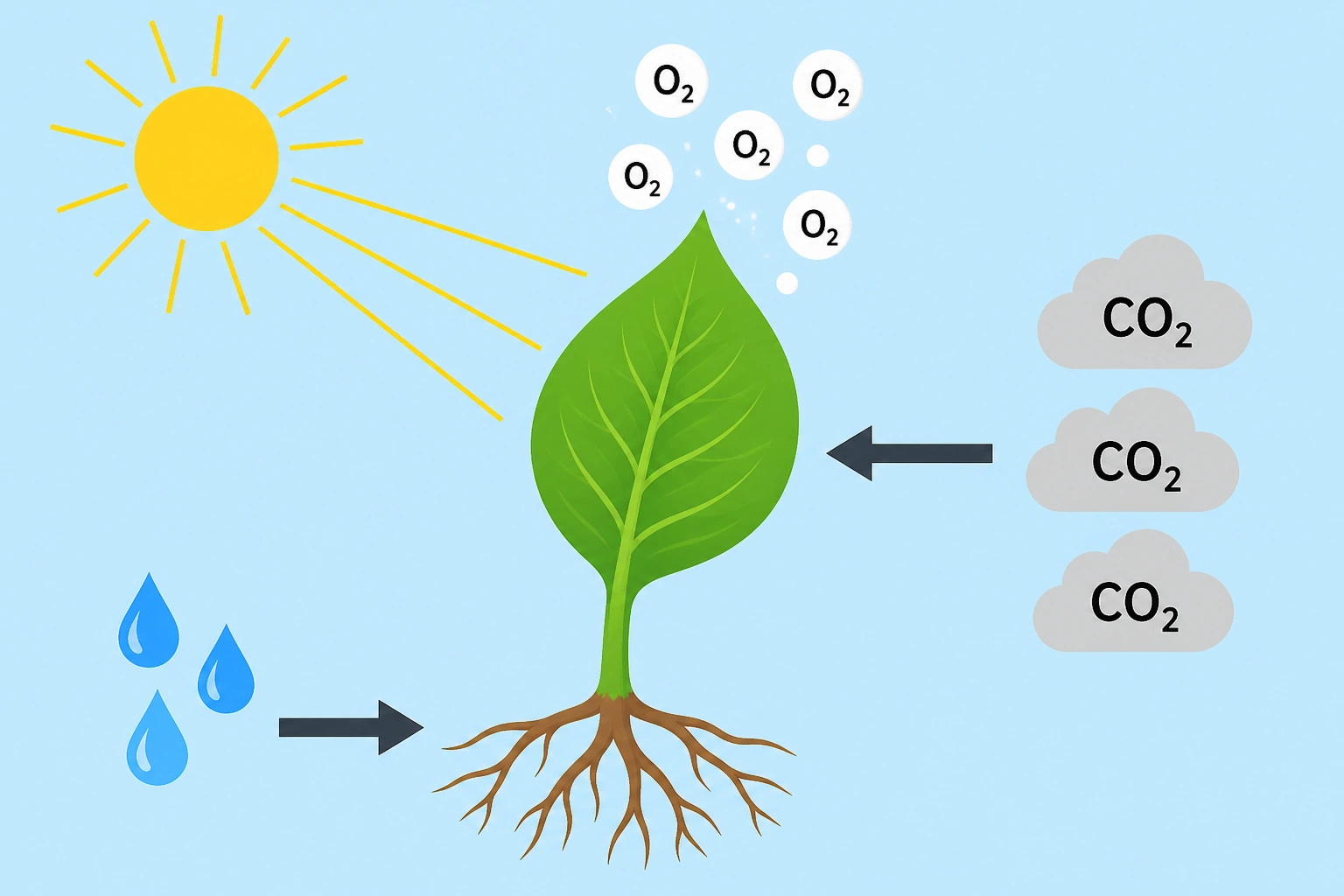
The Net Equation of Photosynthesis
The simplest summary of photosynthesis fits in one line:
$$ 6\,CO_2 + 6\,H_2O + \text{light energy} \;\longrightarrow\; C_6H_{12}O_6 + 6\,O_2 $$
Six molecules of carbon dioxide and six of water, driven by light, produce one molecule of glucose and six of oxygen. Written that way it looks like a single chemical reaction. In reality it is the integrated output of dozens of enzymatic steps in two distinct stages. The two stages can be separated cleanly, even spatially: the light reactions happen in the thylakoid membrane, the Calvin cycle happens in the surrounding stroma.
The oxygen released comes from the water, not from the CO₂. Labeling experiments with the heavy isotope ¹⁸O found the label in the released gas, and exam papers test this almost every year because the equation alone suggests the wrong answer.
Stage 1: the Light Reactions
The light reactions take place in the thylakoid membrane of the chloroplast. Their job is to capture photon energy, split water, release oxygen, and produce two energy-carrying molecules (ATP and NADPH) that the Calvin cycle will use in stage 2.
Photosystem II (PSII)
PSII is named in reverse order of discovery, not function. It is actually the first step. A photon excites a chlorophyll-a molecule at the reaction center called P680. The excited electron is captured by an electron transport chain. To replace the lost electron, PSII splits water: \( 2\,H_2O \longrightarrow 4\,H^+ + O_2 + 4\,e^- \). This is where atmospheric oxygen comes from. Every breath you take traces back to PSII somewhere on Earth, mostly in the oceans.
Electron Transport Chain and ATP Synthase
The excited electron moves down an electron transport chain, releasing energy that pumps protons into the thylakoid lumen. The resulting proton gradient drives ATP synthase, which produces ATP. The mechanism is identical in principle to oxidative phosphorylation in the mitochondria, life uses the same trick everywhere.
Photosystem I (PSI)
A second photon excites a chlorophyll molecule at PSI (reaction center P700). The high-energy electron from PSI reduces NADP+ to NADPH. The light reactions therefore yield three products: O₂ (released as a byproduct), ATP, and NADPH. NADPH and ATP both move into the stroma for use in stage 2.
Stage 2: the Calvin Cycle
The Calvin cycle (also called the light-independent reactions or the C3 pathway) takes place in the stroma. It does not directly require light, but it depends on the ATP and NADPH produced by the light reactions. The cycle fixes CO₂ into sugar in three phases.
- Carbon fixation. The enzyme RuBisCO attaches a CO₂ molecule to a 5-carbon sugar (ribulose-1,5-bisphosphate, or RuBP). The unstable 6-carbon product immediately splits into two 3-carbon molecules of 3-phosphoglycerate (3-PGA). RuBisCO is the most abundant protein on Earth, but it is also notoriously inefficient and slow.
- Reduction. Each 3-PGA is phosphorylated by ATP and then reduced by NADPH to glyceraldehyde-3-phosphate (G3P), a 3-carbon sugar. For every three CO₂ molecules entering the cycle, six G3P are produced. Five of those six G3P regenerate RuBP; one exits to build glucose, sucrose, or starch.
- Regeneration. The remaining five G3P molecules pass through a series of rearrangements that consume more ATP and regenerate three RuBP, ready for the next CO₂.
Stoichiometry: producing one glucose molecule (C₆H₁₂O₆) requires six turns of the Calvin cycle, 18 ATP, and 12 NADPH. All of that comes from the light reactions running in parallel in the thylakoid.
Chlorophyll and the Other Pigments
Chlorophyll a is the primary pigment of photosynthesis in plants and cyanobacteria. It absorbs strongly in the blue (around 430 nm) and red (around 662 nm) regions of the spectrum and weakly in the green, which is why leaves look green: green light is reflected rather than absorbed.
Chlorophyll a is not the only pigment present. Chlorophyll b broadens the absorption range and passes its captured energy to chlorophyll a. Carotenoids (the orange and yellow pigments that show up when chlorophyll degrades in autumn) absorb in the blue-green and also protect the plant from oxidative damage. Different algae use additional accessory pigments such as phycobilins to capture wavelengths that chlorophyll a misses.
Factors That Affect the Rate of Photosynthesis
- Light intensity. Up to a saturation point, photosynthesis rate increases roughly linearly with light intensity. Above saturation, other factors become limiting.
- CO₂ concentration. Doubling atmospheric CO₂ in greenhouse experiments roughly doubles the photosynthesis rate in C3 plants until other factors saturate.
- Temperature. Photosynthesis enzymes (especially RuBisCO) have an optimum around 25-35°C in temperate plants. Above that, the enzyme denatures and the rate falls sharply.
- Water availability. Drought-stressed plants close their stomata to conserve water, which simultaneously shuts off CO₂ intake.
- Chlorophyll content. Nitrogen-deficient or iron-deficient plants produce less chlorophyll and photosynthesize more slowly. Crop yields scale heavily with leaf nitrogen status.
C3, C4, and CAM Plants
Different plants have evolved different strategies for handling the inefficiency of RuBisCO, which can wastefully bind oxygen instead of CO₂ in a process called photorespiration.
| Pathway | Examples | How it works | Where it wins |
|---|---|---|---|
| C3 | Rice, wheat, soybeans | Standard Calvin cycle in mesophyll cells | Cool, moist climates |
| C4 | Maize, sugarcane, sorghum | Spatial separation: CO₂ pre-fixed in mesophyll, then concentrated in bundle-sheath cells around RuBisCO | Hot climates, high light |
| CAM | Cacti, pineapples, succulents | Temporal separation: stomata open only at night to fix CO₂; Calvin cycle runs during the day with stomata closed | Arid environments |
Photosynthesis vs Cellular Respiration
Photosynthesis and cellular respiration are mirror processes. Photosynthesis builds glucose from CO₂ and water using light energy; cellular respiration breaks glucose back down into CO₂ and water, releasing the stored energy as ATP. Plants do both, animals only do the latter.
$$ \text{Photosynthesis:} \quad 6\,CO_2 + 6\,H_2O + \text{light} \longrightarrow C_6H_{12}O_6 + 6\,O_2 $$
$$ \text{Respiration:} \quad C_6H_{12}O_6 + 6\,O_2 \longrightarrow 6\,CO_2 + 6\,H_2O + \text{ATP} $$
A plant in bright light photosynthesizes faster than it respires, and the surplus becomes growth. The light level where the 2 rates exactly balance is the compensation point: net gas exchange is zero, and below it the plant cannot grow.
Related study notes: Protein, Carbohydrate, Enzyme, Nucleic Acid.
The OpenStax biology textbooks develop the biological processes discussed here with additional diagrams and explanations.
Carbon and Energy Accounting
Fixing 3 CO2 into a net triose-phosphate output through the standard Calvin-cycle accounting requires 9 ATP and 6 NADPH. The cycle also regenerates its CO2 acceptor. Producing a 6-carbon sugar equivalent doubles that carbon input and energy requirement.
The ATP and NADPH are supplied by the light reactions in the usual chloroplast description. Saying that the Calvin cycle is "light-independent" means it does not absorb light directly in its carbon-fixation steps; it does not imply that it can continue indefinitely in darkness without energy and reducing power.
The points to check in this example are:
- Water oxidation supplies the released oxygen.
- The thylakoid system supplies ATP and reducing power.
- The Calvin cycle fixes carbon and regenerates its acceptor.
Check Your Understanding
Try the questions before reading the answers.
Question 1. Does the oxygen gas directly come from the carbon dioxide carbon-fixation reaction?
Answer. No. It is released through water splitting.
Question 2. How many CO2 molecules are needed for a 6-carbon sugar equivalent?
Answer. 6, under the standard net carbon accounting.
Practice Questions
Work each question before reading its solution. The set mixes recall, mechanism, calculation, and the graph-and-scenario questions that exams actually use. The downloadable PDF includes these questions and their solutions.
Question 1. Write the balanced net equation of photosynthesis and state where each stage of the process occurs.
Solution. \(6\,CO_2 + 6\,H_2O + \text{light} \longrightarrow C_6H_{12}O_6 + 6\,O_2\). The light reactions run in the thylakoid membrane; the Calvin cycle runs in the stroma of the chloroplast.
Question 2. The oxygen released by a plant comes from which reactant? How was this established?
Solution. From water, not CO₂. PSII splits water: \(2\,H_2O \longrightarrow 4\,H^+ + O_2 + 4\,e^-\). Experiments feeding plants water labeled with the heavy isotope ¹⁸O found the label in the released oxygen gas, settling the question directly.
Question 3. Name the 3 products of the light reactions and state what each is used for.
Solution. O₂, released as a byproduct of water splitting; ATP and NADPH, both consumed by the Calvin cycle in the stroma, ATP as the energy source and NADPH as the reducing power.
Question 4. How many turns of the Calvin cycle, ATP, and NADPH does 1 glucose molecule cost?
Solution. 6 turns, 18 ATP, and 12 NADPH. Each turn fixes 1 CO₂, and glucose carries 6 carbons, so 6 turns; the ATP and NADPH bill scales with those turns at 3 ATP and 2 NADPH each.
Question 5. Why do leaves look green?
Solution. Chlorophyll a absorbs strongly in the blue (about 430 nm) and red (about 662 nm) but weakly in the green. Green light is reflected or transmitted rather than absorbed, so that is the color that reaches your eye. The leaf looks like the light it rejects, not the light it uses.
Question 6. A student measures photosynthesis rate against light intensity and finds the curve rises, then flattens. What limits the rate in each region?
Solution. On the rising section, light intensity is the limiting factor: more photons, more photochemistry. On the plateau, light is saturated and something else limits the rate, typically CO₂ concentration or temperature. The plotted variable can only be limiting where changing it changes the rate.
Question 7. What is photorespiration, and why is it wasteful?
Solution. RuBisCO sometimes binds O₂ instead of CO₂, sending carbon down a salvage pathway that consumes ATP and releases previously fixed CO₂ without making sugar. It undoes photosynthesis at the plant’s expense, and it worsens in hot, dry conditions when closed stomata let O₂ build up inside the leaf.
Question 8. Maize outperforms wheat in hot, bright climates. Explain why using their pathways.
Solution. Maize is C4: it pre-fixes CO₂ in mesophyll cells and concentrates it around RuBisCO in bundle-sheath cells, suppressing photorespiration. Wheat is C3 and loses an increasing share of its fixed carbon to photorespiration as temperature rises. The C4 CO₂ pump costs extra ATP, which bright sunlight repays.
Question 9. A cactus keeps its stomata shut all day. How does it still run the Calvin cycle in daylight?
Solution. CAM plants open stomata at night, fix CO₂ into organic acids, and store them in vacuoles. By day, with stomata closed against water loss, the acids release CO₂ internally to feed the Calvin cycle. The separation is temporal, night versus day, rather than spatial as in C4.
Question 10. Define the compensation point of a plant.
Solution. The light intensity at which photosynthesis exactly balances respiration, so net gas exchange is zero: CO₂ fixed equals CO₂ released. Below it the plant runs a net loss and cannot grow; above it, net photosynthesis accumulates biomass.
Frequently Asked Questions
What is the simple definition of photosynthesis?
Photosynthesis is the process by which plants, algae, and cyanobacteria convert sunlight, water, and carbon dioxide into glucose and oxygen. The simplified equation is 6 CO₂ + 6 H₂O + light → C₆H₁₂O₆ + 6 O₂.
Where in the plant does photosynthesis happen?
Photosynthesis happens inside chloroplasts, organelles found mainly in the mesophyll cells of leaves. Within a chloroplast, the light reactions occur in the thylakoid membranes (organized into stacks called grana) and the Calvin cycle happens in the surrounding stroma.
What are the two main stages of photosynthesis?
Stage 1 is the light reactions, which capture photon energy, split water, release oxygen, and produce ATP and NADPH. Stage 2 is the Calvin cycle (light-independent reactions), which uses that ATP and NADPH to fix CO₂ into glucose. The light reactions happen in the thylakoid; the Calvin cycle happens in the stroma.
Why are leaves green?
Leaves are green because chlorophyll a, the primary photosynthetic pigment, absorbs blue and red light strongly but reflects green light. The reflected green light is what reaches your eyes. In autumn, chlorophyll degrades and the underlying carotenoid pigments (yellows and oranges) become visible.
What is the difference between C3, C4, and CAM photosynthesis?
C3 plants use the standard Calvin cycle directly in mesophyll cells. C4 plants pre-fix CO₂ in mesophyll cells and shuttle it to bundle-sheath cells where it is concentrated around RuBisCO, making them more efficient in hot, sunny climates. CAM plants open their stomata only at night to capture CO₂ and run the Calvin cycle during the day with stomata closed, conserving water in arid environments. Maize is C4; pineapples and cacti are CAM; rice and wheat are C3.
How many ATP and NADPH are needed to make one glucose?
Producing one molecule of glucose requires six turns of the Calvin cycle (one per CO₂ fixed), consuming 18 ATP and 12 NADPH overall. All of that ATP and NADPH comes from the light reactions running in parallel in the thylakoid membrane.
Browse more in Biology.