
Modern India history book · Volume 3 · Free PDF + EPUB
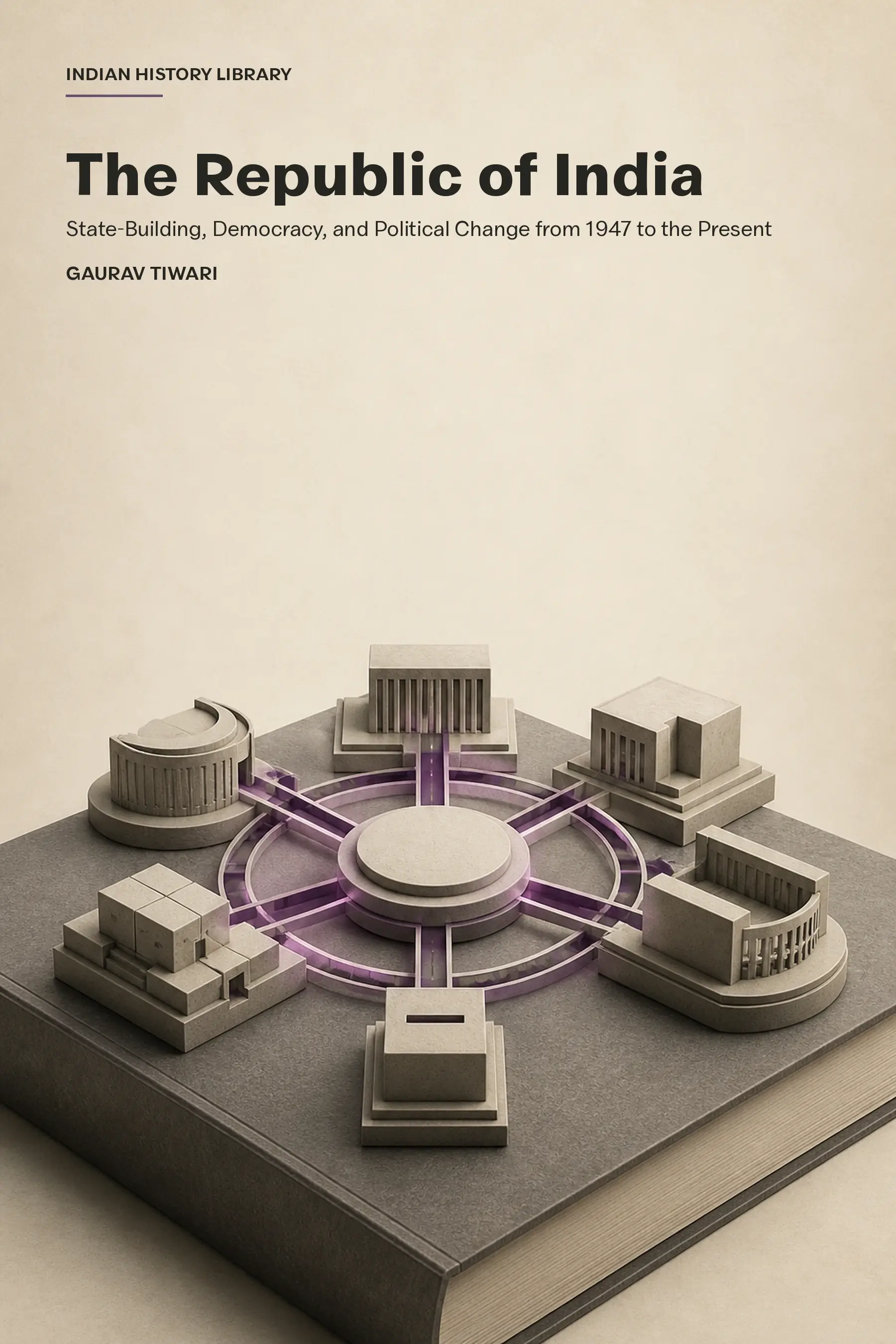
The Republic of India: A Modern India History Book
The republic survived by changing, and every change redistributed power.
This volume begins with refugees, territorial integration, Constitution-making, and the first election, then follows planning, science, foreign policy, linguistic reorganization, the Emergency, coalition politics, economic reform, welfare, digital state capacity, and political change through 10 August 2026.
Download the free history book134 pages · 7 chapters · PDF + EPUB · Price: ₹0
This history book explains the machinery behind the chronology.
Dates and rulers are useful only when you can reconstruct the relationships around them. This book keeps power, institutions, society, economy, and political choices in the same frame.
Institutions carry the chronology
Integration, Constitution-making, elections, planning, federalism, welfare, and state capacity explain how political change became durable.
Change redistributes power
Centralization, linguistic reorganization, social justice, coalition politics, reform, and digital systems are assessed through who gained authority and who carried the cost.
Recent history has a fixed boundary
Law is separated from implementation, event from interpretation, and contemporary claims from evidence through 10 August 2026.
The governing idea
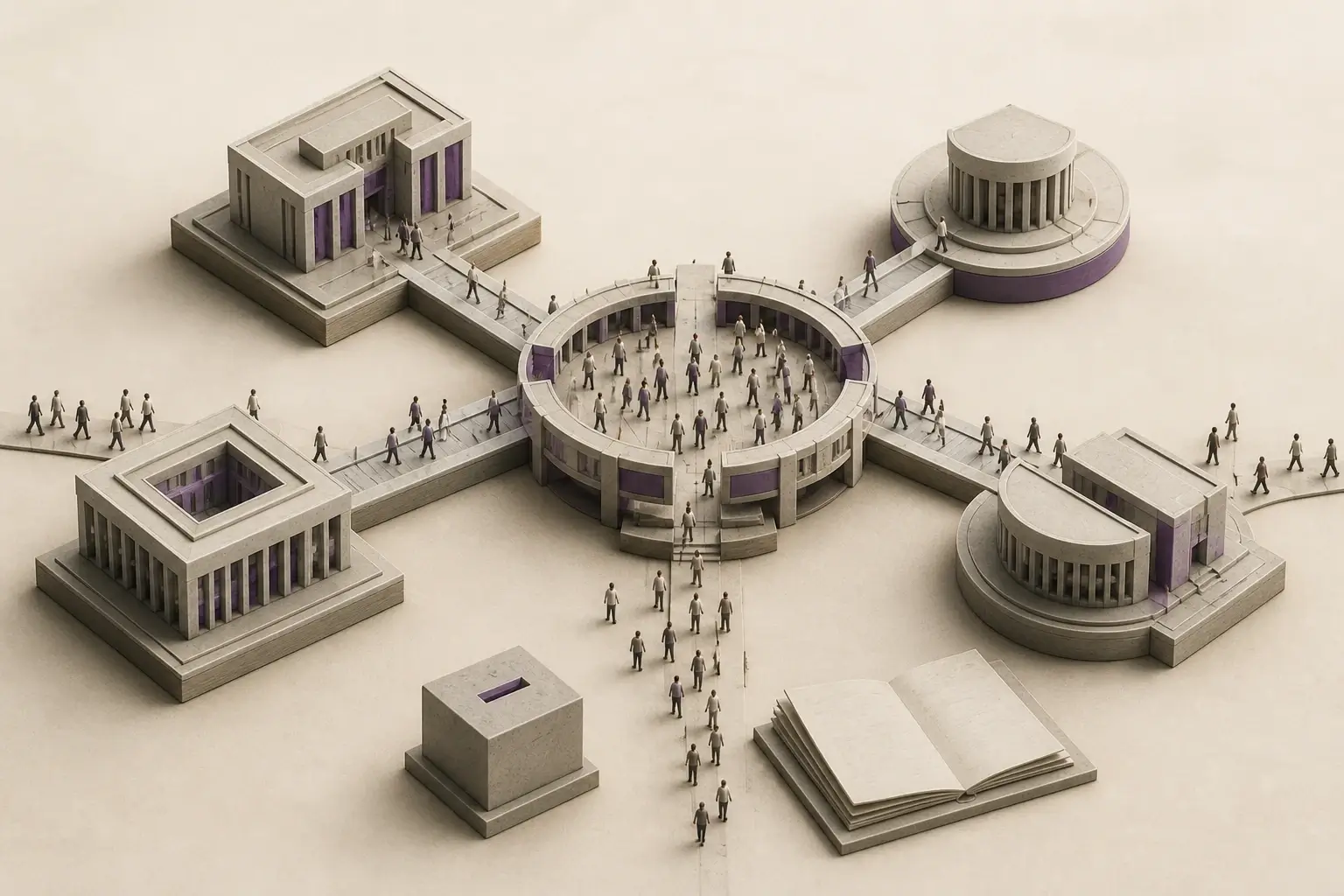
A republic is a network of institutions, not a single building.
The illustration places a civic forum at the center and connects it to elections, courts, administration, federal units, and citizens. The book follows how those relationships changed while the constitutional system endured.
What this history book covers
The 7-chapter structure is organized around historical transitions, not arbitrary note packets.
Part 01
Founding the republic
Chapters 31-33 cover refugees, integration, linguistic reorganization, Constitution-making, electoral democracy, planning, development, science, foreign policy, and the Nehruvian state.
Part 02
Democracy, development, and political change
Chapters 34-37 move through Shastri, Indira Gandhi, the Emergency, Janata, technology, social justice, reform, coalition politics, NDA, UPA, and India since 2019.
Read, reconstruct, retrieve.
The page order is the reading method. Explanation comes first, reconstruction second, and retrieval last.
01
Start with the institution
Identify the constitutional, electoral, federal, economic, or administrative structure at stake.
02
Track the redistribution
Ask how each reform, crisis, movement, or election shifted power, capacity, rights, and political participation.
03
Hold recent claims to a date
Use the 10 August 2026 evidence cutoff to keep current history open to later revision without making it vague now.
Use this book if
Readers who want post-1947 India in one disciplined narrative
Students connecting political events with institutions and state capacity
Anyone who needs a stated evidence cutoff for contemporary history
The Limits
The evidence cutoff is 10 August 2026; later events are outside this edition
The book distinguishes verified record from interpretation but cannot remove live political disagreement
Seven synthetic chapters prioritize mechanisms over exhaustive state-by-state coverage
FREE HISTORY BOOK
Get the complete PDF and EPUB for ₹0.
Choose the fixed-layout PDF for reading or printing, and the reflowable EPUB for phones and e-readers. Both protected files are included in one free checkout.
134 pages · PDF + EPUB · No paid edition required
Download Questions
How current is the book?
The evidence cutoff is 10 August 2026. Events after that date are deliberately outside the first edition.
Does it cover the Constitution and elections?
Yes. Constitution-making, rights, federal design, citizenship, universal adult suffrage, the Election Commission, and the first election form a full chapter.
How does it handle recent politics?
It separates law from implementation, event from interpretation, and political memory from the record, while stating where evidence ends.
Continue through the Indian history books
Each volume stands alone, but the series is designed to carry institutions, political choices, and retrieval practice across periods.