
Modern India history book · Volume 1 · Free PDF + EPUB
Company Rule and the Colonial State: A Modern India History Book
Company conquest changed more than the flag above a fort.
This volume traces the eighteenth-century transition, Company expansion, colonial institutions, land and economy, reform, resistance, the Revolt of 1857, Crown rule, and the growth of nationalism to the First World War.
Download the free history book315 pages · 19 chapters · PDF + EPUB · Price: ₹0
This history book explains the machinery behind the chronology.
Dates and rulers are useful only when you can reconstruct the relationships around them. This book keeps power, institutions, society, economy, and political choices in the same frame.
Conquest becomes administration
European competition, military expansion, revenue settlements, law, education, and the archive are shown as parts of one colonial system.
Economy and society stay in frame
Land, trade, industry, drain, famine, caste, gender, religion, reform, and resistance are connected to political change.
Nationalism has a history
Associations, economic critique, Congress, Swadeshi, revolutionary politics, Home Rule, and war emerge from the institutions and conflicts that precede them.
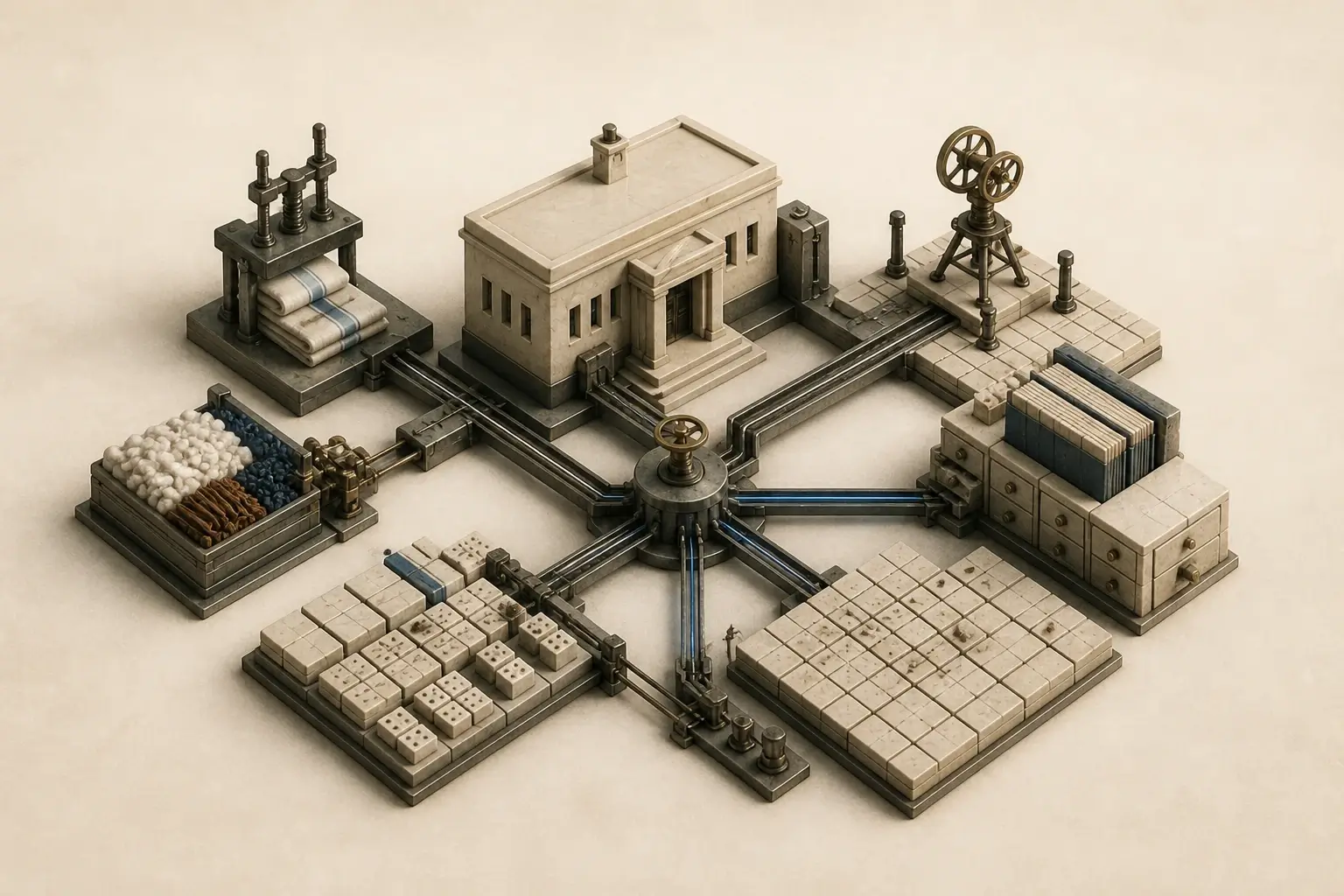
The governing idea
A trading company became a machine for rule.
The illustration joins the counting house, survey, textile trade, revenue ledger, and divided land into one administrative mechanism. Conquest supplied the power; institutions made it durable.
What this history book covers
The 19-chapter structure is organized around historical transitions, not arbitrary note packets.
Part 01
Conquest and the eighteenth-century transition
Chapters 1-6 cover evidence and interpretation, Mughal fragmentation, regional states, rival companies, Plassey, the Diwani, Mysore, Marathas, Sikhs, annexation, and the frontier.
Part 02
Colonial institutions, economy, reform, and resistance
Chapters 7-13 connect administration, revenue, trade, drain, famine, education, print, reform, resistance, and the Revolt of 1857.
Part 03
Crown rule and the rise of nationalism
Chapters 14-19 move through imperial ideology, caste, gender, community, associations, Congress, economic nationalism, Swadeshi, revolutionary politics, Home Rule, and war.
Read, reconstruct, retrieve.
The page order is the reading method. Explanation comes first, reconstruction second, and retrieval last.
01
Name the institution
Identify the law, settlement, office, company, or political organization doing the work.
02
Follow the consequence
Connect administrative change to land, economy, society, resistance, and political language.
03
Compare interpretations
Use the debate and retrieval sections to separate evidence from the historical claim made about it.
Use this book if
Readers who want modern India as more than a nationalist timeline
Students connecting political events with economy, law, and society
Anyone who needs 1757-1919 in one causal frame
The Limits
It ends in 1919; the mass-nationalist phase continues in the next volume
It introduces major historiographical schools but is not a survey of every historian
Its scale is synthetic: specialist regional histories can go much deeper
FREE HISTORY BOOK
Get the complete PDF and EPUB for ₹0.
Choose the fixed-layout PDF for reading or printing, and the reflowable EPUB for phones and e-readers. Both protected files are included in one free checkout.
315 pages · PDF + EPUB · No paid edition required
Download Questions
Where does the book end?
It ends with the First World War and the political transition to 1919. The next volume begins with Gandhi’s early satyagrahas and mass politics.
Does it cover the Revolt of 1857?
Yes. The Revolt is placed after earlier resistance and before Crown rule so its causes, geography, social bases, consequences, and interpretations remain connected.
Is economic history included?
Yes. Revenue settlements, agrarian change, trade, industry, drain, poverty, famine, and economic nationalism are part of the main narrative.
Continue through the Indian history books
Each volume stands alone, but the series is designed to carry institutions, political choices, and retrieval practice across periods.