
Modern India history book · Volume 2 · Free PDF + EPUB
Mass Nationalism, Competing Futures, and Partition: A Modern India History Book
The freedom struggle created a mass politics it could not fully contain.
This volume follows Gandhian satyagraha, Non-Cooperation, constitutional negotiation, Civil Disobedience, social and regional movements, the Second World War, the INA, communal politics, transfer of power, and Partition.
Download the free history book198 pages · 11 chapters · PDF + EPUB · Price: ₹0
This history book explains the machinery behind the chronology.
Dates and rulers are useful only when you can reconstruct the relationships around them. This book keeps power, institutions, society, economy, and political choices in the same frame.
Method, not just movement names
Satyagraha, negotiation, constructive work, council entry, socialist organization, and revolutionary action are treated as competing political strategies.
Coalitions with real limits
Workers, peasants, caste movements, women, regional actors, religious politics, and constitutional claims complicate any single story of national unity.
Partition receives causal depth
War, the Pakistan demand, constitutional deadlock, political choice, violence, and transfer of power remain connected to the mass politics that precede them.
The governing idea
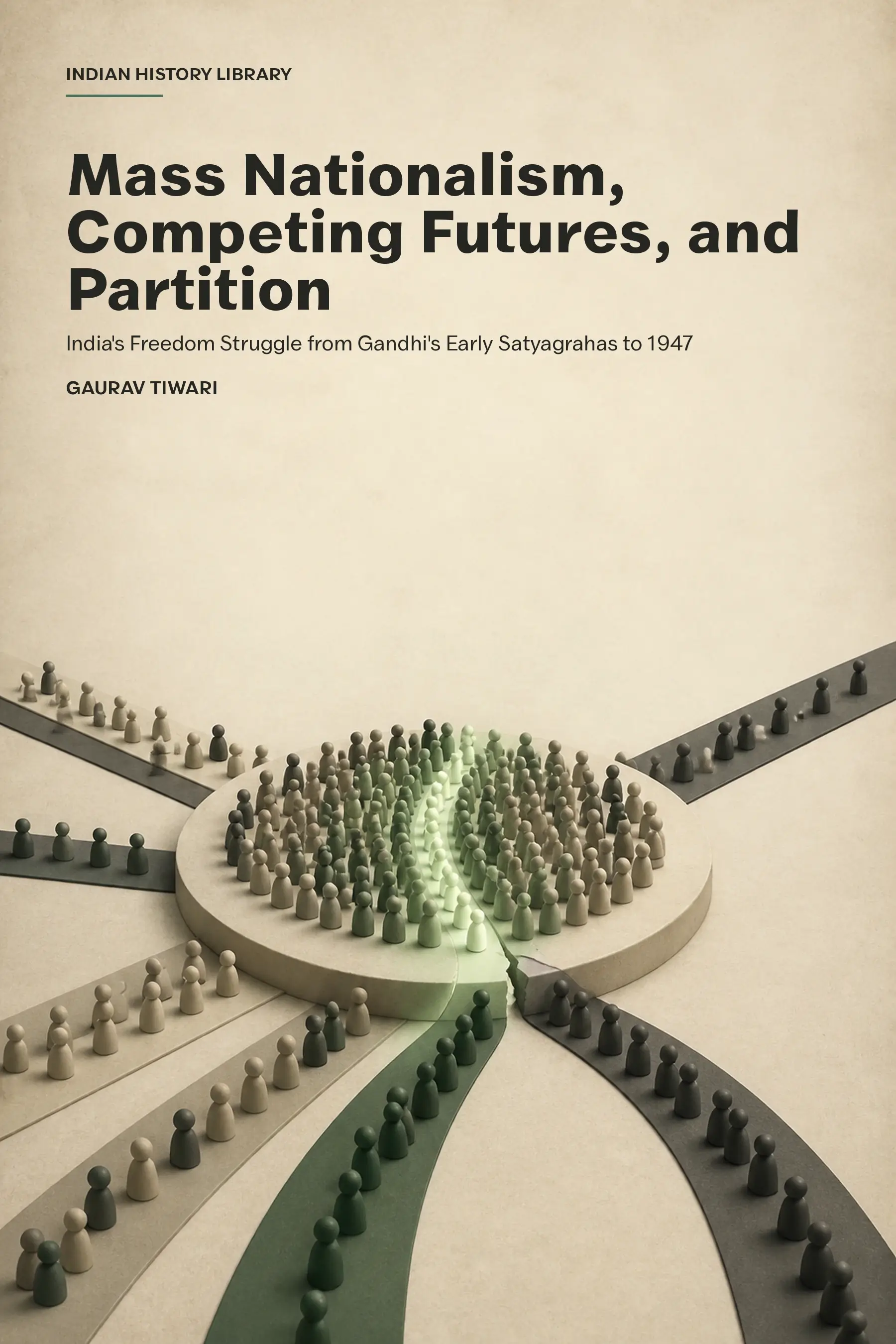
A mass movement can converge and still imagine different futures.
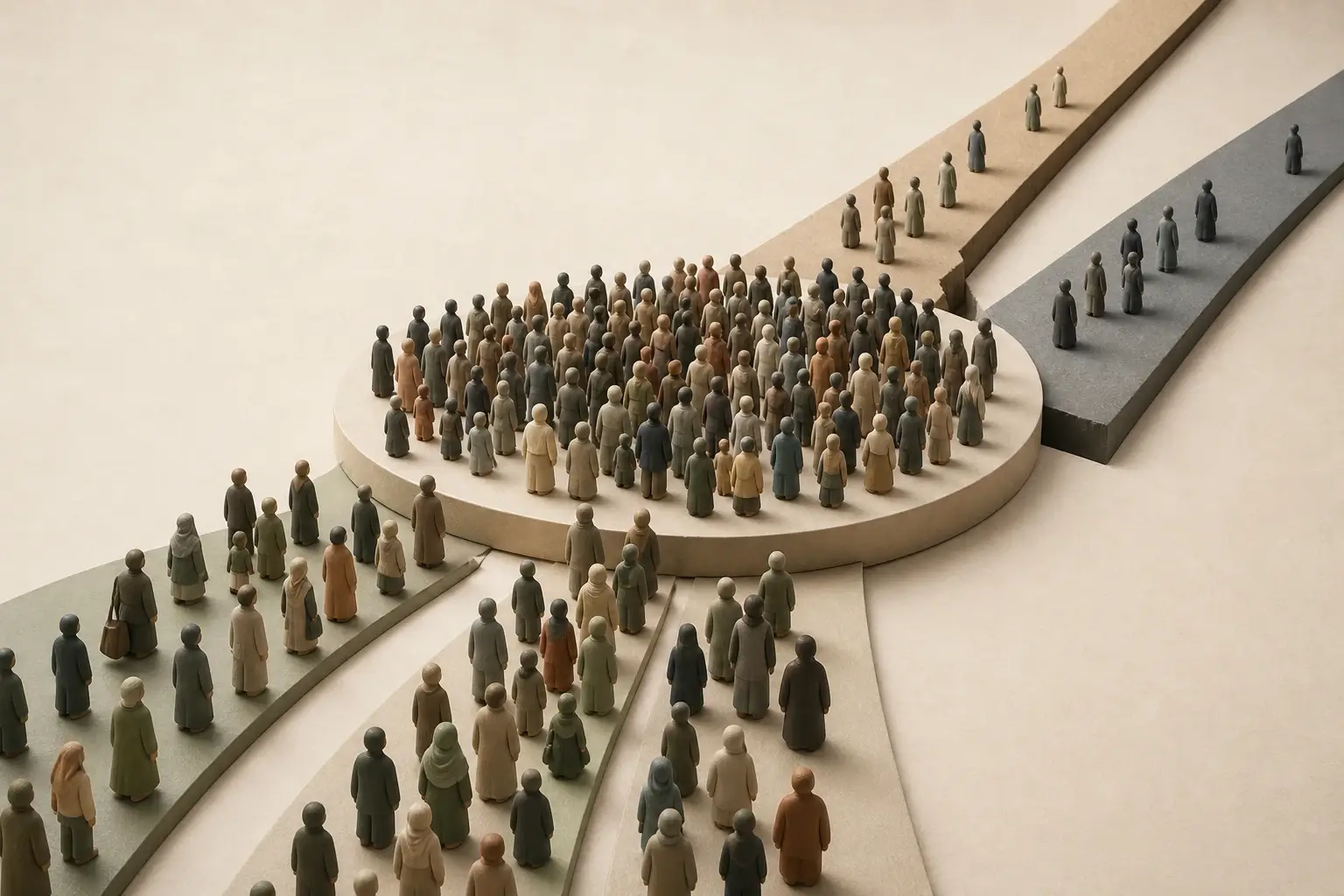
The illustration shows a large civic field moving toward a shared platform before dividing into distinct political paths. Shared anti-colonial purpose did not erase conflict over representation, power, and the shape of independence.
What this history book covers
The 11-chapter structure is organized around historical transitions, not arbitrary note packets.
Part 01
Gandhian mass politics and constitutional struggle
Chapters 20-24 move from early satyagrahas through Rowlatt, Non-Cooperation, Swarajists, constructive work, socialists, revolutionaries, Purna Swaraj, Civil Disobedience, and the Poona Pact.
Part 02
Social coalitions, war, and Partition
Chapters 25-30 cover the 1935 Act, provincial ministries, social movements, competing claims, war, Cripps, Quit India, Subhas Bose, the INA, the Pakistan demand, independence, and Partition.
Read, reconstruct, retrieve.
The page order is the reading method. Explanation comes first, reconstruction second, and retrieval last.
01
Separate method from event
Ask what political technique a movement used and what kind of participation it could sustain.
02
Map the coalition
Track whose demands entered the national movement, whose remained distinct, and where negotiation broke down.
03
Reconstruct the choice
Use chronology and comparisons to explain why transfer of power took the form it did in 1947.
Use this book if
Readers who want the freedom struggle without a smooth heroic script
Students comparing Gandhian, constitutional, socialist, revolutionary, and communal politics
Anyone seeking a causal account of independence and Partition
The Limits
It does not reduce Partition to one leader, party, or event
It cannot substitute for regional studies of violence and displacement
It begins with Gandhi’s early satyagrahas; the colonial background is in the previous volume
FREE HISTORY BOOK
Get the complete PDF and EPUB for ₹0.
Choose the fixed-layout PDF for reading or printing, and the reflowable EPUB for phones and e-readers. Both protected files are included in one free checkout.
198 pages · PDF + EPUB · No paid edition required
Download Questions
Does the book cover movements outside Congress?
Yes. Labour, socialist, revolutionary, caste, regional, religious, and constitutional currents are treated as parts of the political field, not as side notes.
How is Partition handled?
Partition is explained through mass politics, competing claims, war, the Pakistan demand, constitutional deadlock, transfer-of-power decisions, violence, and displacement.
Do I need the previous volume first?
You can read this volume independently, but Company Rule and the Colonial State provides the institutional and nationalist background up to 1919.
Continue through the Indian history books
Each volume stands alone, but the series is designed to carry institutions, political choices, and retrieval practice across periods.