
Medieval India history book · Volume 1 · Free PDF + EPUB
Connected Worlds, Kingdoms, and the Delhi Sultanate: A Medieval India History Book
Medieval India was never an isolated sequence of dynasties.
This volume connects the worlds around India to the regional states, trade routes, institutions, social orders, and religious cultures that shaped the subcontinent between the eighth and early sixteenth centuries.
Download the free history book173 pages · 11 chapters · PDF + EPUB · Price: ₹0
This history book explains the machinery behind the chronology.
Dates and rulers are useful only when you can reconstruct the relationships around them. This book keeps power, institutions, society, economy, and political choices in the same frame.
Connections before chronology
India, the Arab world, Africa, Europe, and East and Southeast Asia appear in one historical field instead of separate background boxes.
Institutions behind the rulers
Regional kingdoms and the Delhi Sultanate are explained through land, revenue, armies, trade, locality, and political ideas.
Retrieval after explanation
Each chapter closes with chronology, comparisons, and self-test material without breaking the narrative into raw notes.
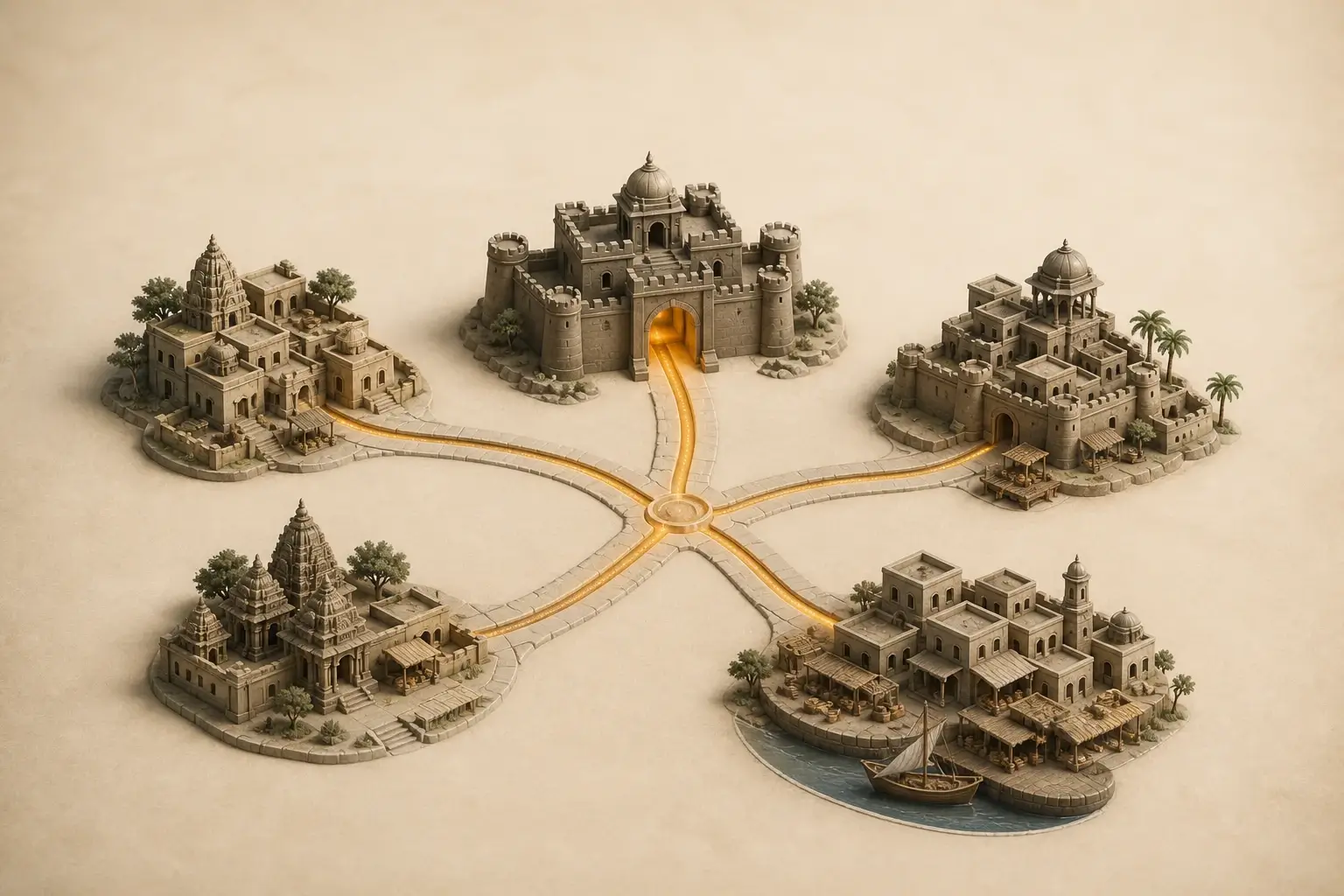
The governing idea
A route, a port, and a court belong in the same explanation.
The illustration shows the book’s governing idea: settlements are linked by routes, institutions, and exchange. The political map matters, but so do the networks that made power possible.
What this history book covers
The 11-chapter structure is organized around historical transitions, not arbitrary note packets.
Part 01
Connected worlds and regional formations
Chapters 1-5 move from the wider medieval world to the Palas, Pratiharas, Rashtrakutas, Cholas, land, society, learning, belief, and the Turkish conquest.
Part 02
The Delhi Sultanate and regional powers
Chapters 6-11 cover the making and government of the Sultanate, Khalji-Tughluq expansion and crisis, Vijayanagara, the Bahmani kingdom, the Portuguese, and cultural life.
Read, reconstruct, retrieve.
The page order is the reading method. Explanation comes first, reconstruction second, and retrieval last.
01
Read the mechanism
Follow the chapter argument before memorizing dates or names.
02
Rebuild the sequence
Use the chronology and comparison tables to reconstruct cause, change, and consequence.
03
Test retrieval
Answer the chapter questions without looking back, then return only to the weak link.
Use this book if
Readers who want medieval India as a connected narrative
Students who need chronology without losing explanation
Anyone revising regional states and the Delhi Sultanate together
The Limits
It is not a primary-source anthology
It does not replace specialist monographs on individual kingdoms
Its retrieval companions support the narrative; they are not a one-night cram sheet
FREE HISTORY BOOK
Get the complete PDF and EPUB for ₹0.
Choose the fixed-layout PDF for reading or printing, and the reflowable EPUB for phones and e-readers. Both protected files are included in one free checkout.
173 pages · PDF + EPUB · No paid edition required
Download Questions
Does the book begin with the Delhi Sultanate?
No. It begins with the connected medieval world and the regional formations that shaped the field in which the Sultanate emerged.
Does it include South India?
Yes. The Cholas, Vijayanagara, the Bahmani kingdom, Indian Ocean connections, and the Portuguese are part of the same narrative.
Is this only for exam preparation?
No. The prose is written as a readable history. The chronology, comparisons, and self-tests make it useful for structured revision too.
Continue through the Indian history books
Each volume stands alone, but the series is designed to carry institutions, political choices, and retrieval practice across periods.