
Medieval India history book · Volume 2 · Free PDF + EPUB
Mughals, Deccan Powers, and an Empire in Crisis: A Medieval India History Book
An empire is more than the ruler sitting at its center.
This volume follows Mughal formation and consolidation, administration and social order, the Deccan, cultural and religious life, Aurangzeb’s long reign, and the shift from imperial dominance to regional power.
Download the free history book142 pages · 9 chapters · PDF + EPUB · Price: ₹0
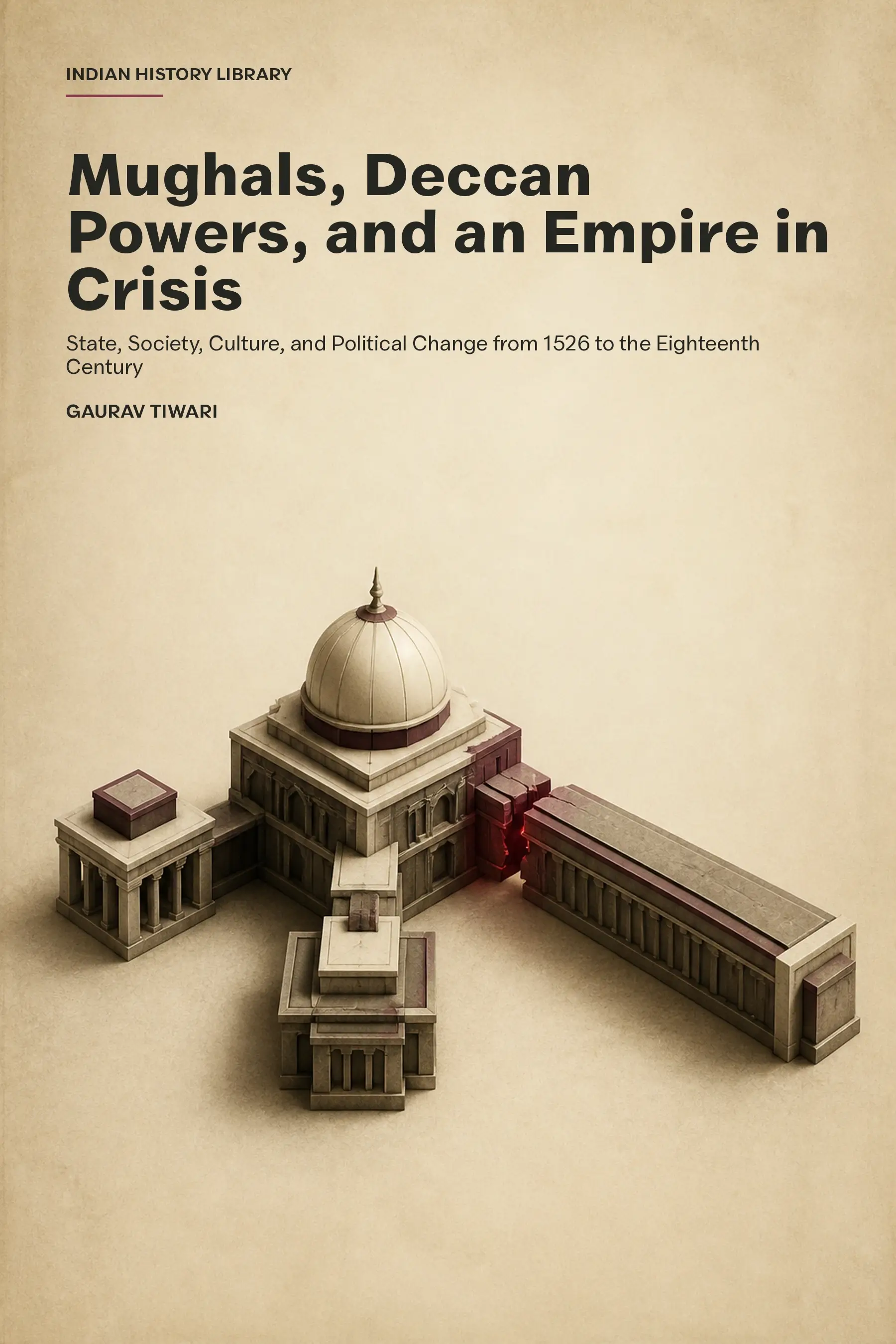
This history book explains the machinery behind the chronology.
Dates and rulers are useful only when you can reconstruct the relationships around them. This book keeps power, institutions, society, economy, and political choices in the same frame.
Empire as a working system
Rank, revenue, locality, military service, court politics, and regional negotiation explain how Mughal power operated beyond the emperor.
The Deccan inside the story
Deccani states, the Marathas, Mughal expansion, and regional cultures are structural forces rather than a late detour.
Crisis without a single-cause myth
Fiscal strain, warfare, succession, regional assertion, and political accommodation are kept in relation instead of reduced to one ruler.
The governing idea
Imperial reach expands faster than imperial control.
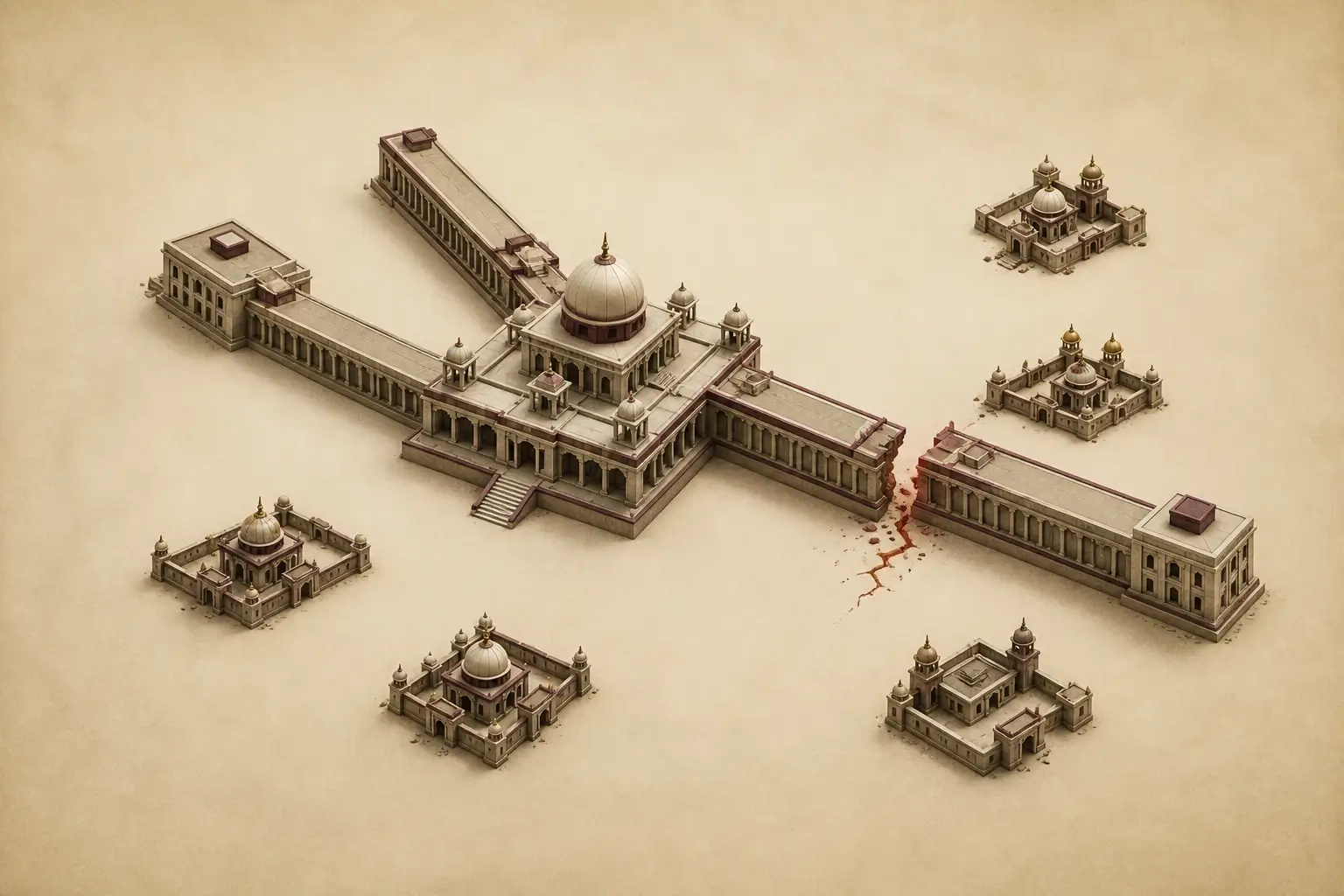
The illustration turns the empire into a structure under load: a central court connected to provinces and regional powers, with one broken connection showing how expansion, negotiation, and strain could coexist.
What this history book covers
The 9-chapter structure is organized around historical transitions, not arbitrary note packets.
Part 01
Mughal formation and imperial consolidation
Chapters 12-13 follow Babur, Humayun, Sher Shah, Akbar, expansion, administration, Rajput relations, and the architecture of integration.
Part 02
Mughal power, regional states, and society
Chapters 14-17 cover the Deccan, early seventeenth-century politics, economy, society, religious thought, culture, and artistic life.
Part 03
Imperial expansion and regional transformation
Chapters 18-20 examine Aurangzeb, the pressures of empire, the rise of regional power, and what the medieval centuries changed.
Read, reconstruct, retrieve.
The page order is the reading method. Explanation comes first, reconstruction second, and retrieval last.
01
Trace the institution
Follow how revenue, rank, military service, and locality connect court decisions to the ground.
02
Compare center and region
Use the chapter companions to separate Mughal authority, negotiated power, and regional autonomy.
03
Explain the crisis
Reconstruct the interacting pressures instead of memorizing one verdict about decline.
Use this book if
Readers who want Mughal history beyond rulers and battles
Students comparing administration, society, and regional power
Anyone trying to understand why imperial strength became political strain
The Limits
It is not a biography of every Mughal emperor
It does not treat regional states as footnotes to Delhi or Agra
It keeps interpretive disagreement visible rather than offering one neat decline formula
FREE HISTORY BOOK
Get the complete PDF and EPUB for ₹0.
Choose the fixed-layout PDF for reading or printing, and the reflowable EPUB for phones and e-readers. Both protected files are included in one free checkout.
142 pages · PDF + EPUB · No paid edition required
Download Questions
Is the book mainly about Aurangzeb?
No. Aurangzeb is placed inside a longer account of formation, consolidation, administration, society, culture, the Deccan, and regional transformation.
Does it cover Mughal administration?
Yes. Mansabdari, revenue, government, the army, nobility, zamindars, trade, and locality are central to the explanation.
Does it explain Mughal decline?
It explains imperial crisis and the shift to regional power through interacting political, fiscal, military, and regional pressures rather than one slogan.
Continue through the Indian history books
Each volume stands alone, but the series is designed to carry institutions, political choices, and retrieval practice across periods.