
 by
by
The co.in meaning is simple: .co.in is a commercial namespace inside India’s .in country-code domain. For example, brand.co.in is registered under co.in, while brand.in is registered directly under .in.
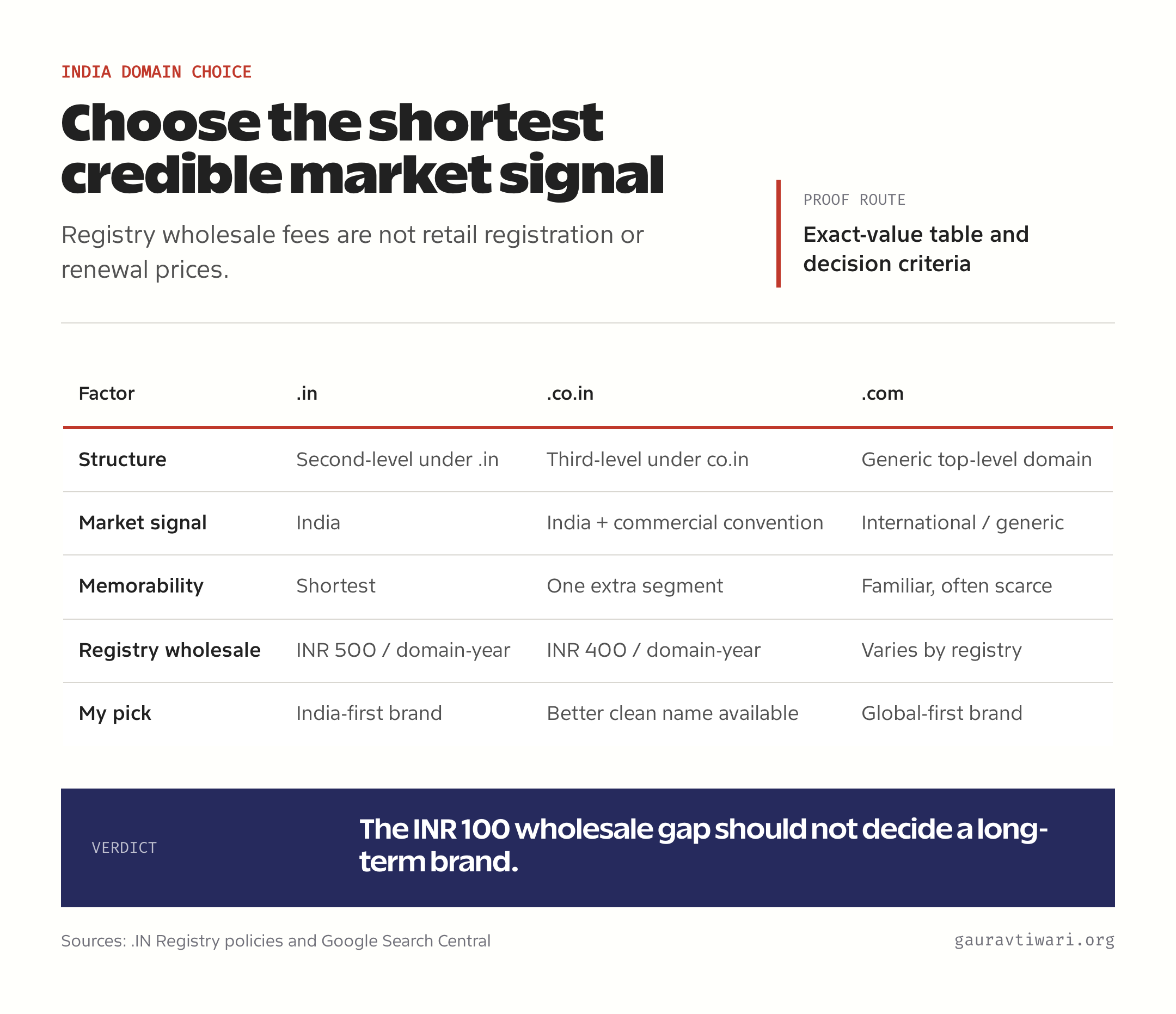
For most new India-first brands, I would choose .in because it is shorter and easier to say. I would choose .co.in when the clean .in name is unavailable, customers already know the longer address, or the complete name simply reads better. If international expansion is central from day one, I would look for a strong .com.
What does .co.in mean?
The practical co.in meaning is “commercial use under India’s .in namespace.” .co.in describes the domain’s place in the DNS hierarchy. It does not give a business legal company status.
.inis the two-letter ccTLD assigned to India.cois the second-level label commonly associated with companies and commercial use.- Your chosen name becomes the third-level label in an address such as
brand.co.in.
Registering brand.co.in does not incorporate the business, create trademark rights, or prove that the registrant is located in India. It is a domain registration, not a company registration.
.co.in vs .in: Which should you choose?
.in is usually the stronger choice for a new India-first brand because it is shorter. .co.in is a sound alternative when it gives you a clearer available name. .com is usually better when one domain must serve a broad international audience.
| Factor | .co.in |
.in |
.com |
|---|---|---|---|
| Domain structure | Third-level name under co.in |
Second-level name under .in |
Second-level name under a generic TLD |
| Geographic signal | India | India | Generic or international |
| Memorability | Longer, with an extra dot | Shortest India-specific option | Globally familiar |
| Name availability | Often better | More competitive | Usually most competitive |
| Best fit | India-focused commercial site with a clean available name | India-first brand, product, publication, or personal site | International or global-first brand |
| Main trade-off | More characters to type and remember | Strong India association | Good names may be unavailable or expensive |
Can anyone register a .co.in domain?
Yes. The .IN Registry lists .in, .co.in, .net.in, .org.in, and several other public namespaces as unrestricted. People and organizations worldwide can register them without an Indian local-presence requirement.
Unrestricted does not mean anonymous. The current rules include these registration requirements:
- KYC is mandatory for
.inregistrations. - Registrant contact information must be accurate and kept current.
- The current registrant terms prohibit proxy or privacy services for hiding registrant details.
- Names can contain letters, digits, and hyphens, but cannot begin or end with a hyphen.
- A name can be 3 to 63 characters long and registered for 1 to 10 years.
- A new registration cannot normally be transferred to another registrar during its first 60 days.
Restricted zones are different. Names such as .gov.in, .edu.in, .ac.in, and .mil.in require the registrant to meet specific eligibility rules. Check the live .IN Registry policies before buying a long-term brand asset.
Is .in or .co.in better for SEO?
Neither extension has an inherent ranking advantage over the other. Both are part of India’s .in namespace and both clearly signal an India-focused site. The claim that .co.in is “not SEO friendly” has no credible basis.
Google Search Central says country-code domains are a strong signal to users and search engines that a site is intended for a particular country. Its international site guidance also explains the trade-off: strong country targeting can help clarify the intended market but may make international expansion less flexible.
A .in domain does not automatically outrank a .com in India, and a .co.in domain is not penalized for having an extra label. Search performance still depends on:
- How well the page answers the search intent
- Content quality and first-hand usefulness
- Internal and external links
- Technical crawlability and indexation
- Site reputation and topical authority
- Language, currency, address, and other local-market signals
- Page experience and mobile usability
Choose the extension for market fit and memorability. Do not expect it to compensate for weak content, poor links, or a technically broken website.
Is .in easier to trust and remember?
.in is normally easier to remember because it is shorter. Compare brand.in with brand.co.in: the first version has two fewer characters and one fewer dot. That small difference repeats across business cards, podcast mentions, phone calls, search results, and email addresses.
.co.in can still look credible to Indian users. The real test is whether your complete domain is easy to hear, type, and distinguish from another brand. Avoid unnecessary hyphens, unexplained numbers, misspellings, and names that are too close to a trademark.
My guide to finding a strong domain name covers the naming decision beyond the extension.
How much do .in and .co.in domains cost?
The .IN Registry publishes wholesale prices. Your registrar sets the retail registration, renewal, transfer, and restore prices you actually pay.
| Registry charge | Current wholesale price |
|---|---|
.in registration or renewal |
₹500 per domain-year |
Third-level names such as .co.in |
₹400 per domain-year |
| Restore during the redemption grace period | ₹1,000, in addition to the renewal charge |
That ₹100 wholesale difference should not decide your brand. Compare the standard renewal, transfer, restore fee, DNS controls, account security, support, and current data-handling policy. A cheap first year can hide an expensive renewal.
My domain registrar comparison explains what to check before placing a business-critical name with a registrar.
Do .in and .co.in work differently with email or DNS?
No. Both extensions work with normal DNS, hosting, CDN, DNSSEC, subdomain, and business-email setups. The extension itself does not determine website speed or email deliverability.
- Website speed depends on the host, application, caching, CDN, and network path.
- Email deliverability depends on the provider, sender reputation, authentication, and message quality.
- DNS reliability depends on the DNS provider and how carefully records are managed.
- Transfers depend on registry and registrar rules, including the initial 60-day lock.
you@brand.in is shorter than you@brand.co.in, but both are valid. Choose a provider based on deliverability, security, recovery, administration, and support. My email hosting guide compares those trade-offs.
If you move the domain later, follow a controlled domain-transfer process and keep a copy of every DNS record before changing nameservers.
When should you choose .in?
Choose .in when India is the primary market and the clean version of your name is available. It is the simplest India-specific option for most new businesses, products, publications, portfolios, and communities.
- You want the shortest credible Indian web address.
- Most customers will be in India for the next few years.
- The exact brand is available without hyphens or filler words.
- The strong India association matches the brand’s plan.
- You can protect the matching
.comor high-risk variants when necessary.
When should you choose .co.in?
Choose .co.in when it gives you a clean, memorable name that is better than the available .in alternatives. It also makes sense when an established business already has recognition, links, email accounts, and printed material tied to that address.
- The exact
.inname is unavailable. - The commercial convention makes the full name read naturally.
- Customers already recognize the
.co.inaddress. - You can protect the closest variants that could confuse customers.
Do not choose .co.in only because its registry wholesale price is slightly lower. A better brand name is worth far more than ₹100 per year.
When is .com the better choice?
Choose .com when international reach is part of the business model from the start, the audience is spread across countries, and you can obtain a clean name without awkward additions.
A .com can still target India through useful local content, Indian pricing, addresses, Business Profile signals, and properly structured regional pages. If both .com and .in are available for a serious brand, I would usually register both, choose one canonical domain, and redirect the other. I would not publish duplicate copies of the site.
Which five questions decide the domain?
Once the co.in meaning is clear, the right choice becomes easier. Test the name against the next three years of the business, not just today’s registration price.
- Where will most customers be for the next three years?
- Which version is easiest to say, spell, and type?
- Is the name safe to use after a trademark search?
- Can you protect the variants most likely to confuse customers?
- Will the domain still fit if the business expands?
My default recommendation is simple: buy the clean .in for an India-first brand, use .co.in when it gives you the better defensible name, and prioritize .com for a global-first business. Then stop debating extensions and build the brand.
FAQs
These short answers cover the registration and SEO questions people usually ask before choosing an Indian domain.
What does .co.in stand for?
.co.in conventionally means a commercial or company-oriented name inside India’s .in country-code domain. It describes where the name sits in the domain hierarchy. Registering one does not incorporate a company or create trademark rights.
Is .in better than .co.in?
For most new India-first brands, .in is better because it is shorter and easier to remember. .co.in is still a valid choice when it provides the cleaner available name or an established business already uses it.
Can anyone register a .co.in domain?
Yes. The current .IN Registry policy makes .co.in available worldwide without an Indian local-presence requirement. Registrants must still complete KYC, provide accurate contact information, and follow the registry’s terms.
Does .in rank better in India?
An .in domain provides a strong India-targeting signal, but it does not guarantee higher rankings. A .co.in domain uses the same country namespace. Relevance, authority, links, technical quality, and local-market signals still decide search performance.
Does .IN allow WHOIS privacy?
The current .IN registrant terms prohibit using proxy or privacy services to hide registrant details. KYC and accurate contact data are mandatory, so review the live registry rules and your registrar’s data-handling process before registering.
Should I buy .com, .in, and .co.in?
For a valuable brand, registering the variants most likely to cause confusion can be sensible. Use one canonical domain and redirect the others. Do not publish duplicate versions of the same website across all three domains.
Tell Google you want more of this.
Add Gaurav Tiwari as a preferred sourceOne tap, and this site shows up more often in your own Top Stories, AI Overviews and AI Mode. Remove it any time.